Inspiration
Every hackathon starts the same way: 100+ people who will spend a weekend three feet apart and leave knowing four of them. Icebreakers don't fix it. A Slack channel of introductions is a wall of text nobody scrolls, and a name tag tells you a name.
Trading cards solved this decades ago. You make one, you put it in the pool, and the only way to see anyone else's is to open a pack. The scarcity is the mechanic. You don't browse a directory of 150 strangers and message nobody. You get one, at random, and that one person becomes someone you actually go find in the room.
What it does
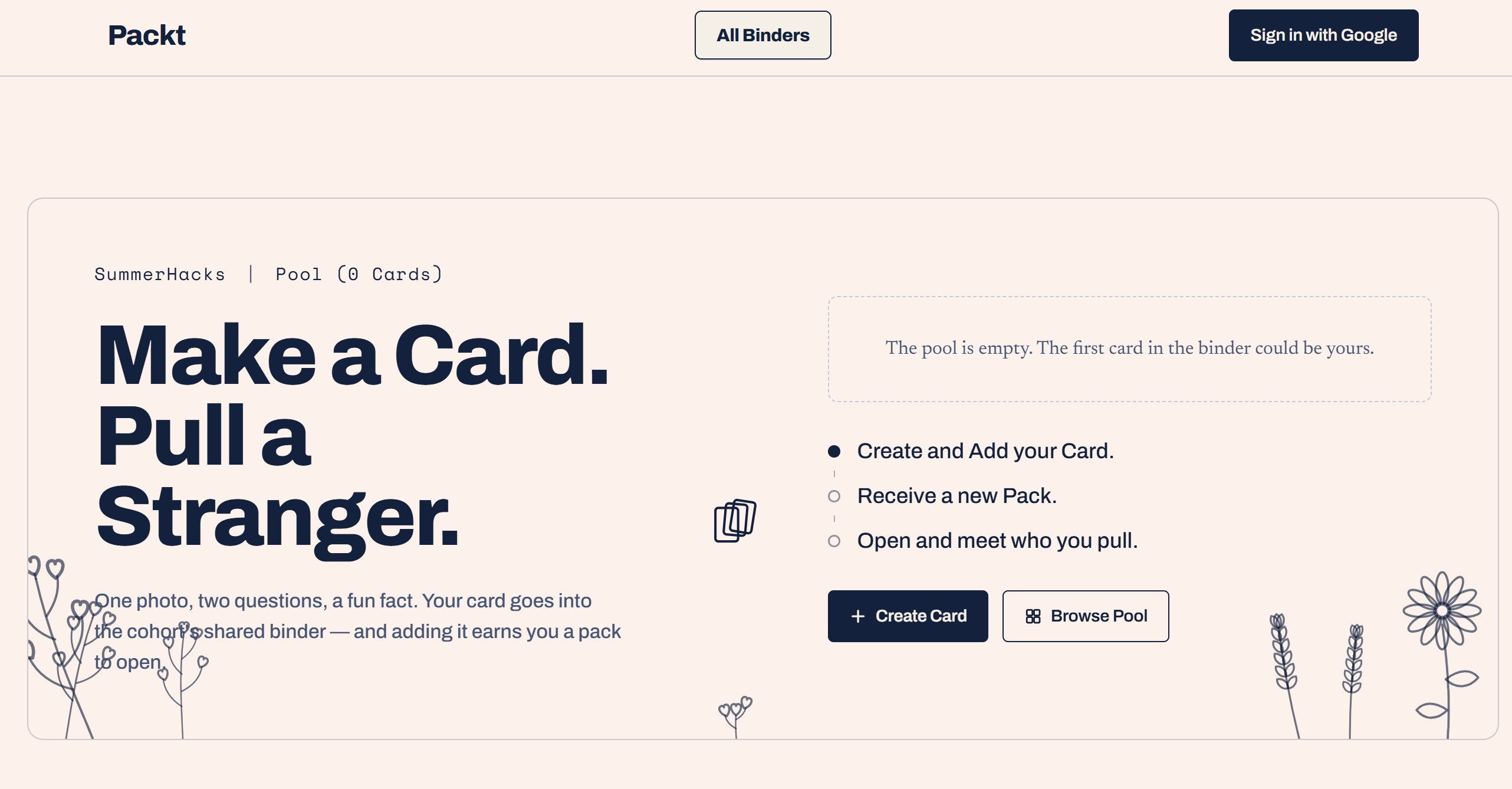
Packt turns a community into a trading card set.
- Make your card. One screen: a photo, two prompts from a catalogue of eight, a fun fact, a link. The card assembles live beside the form as you type.
- Contributing earns you exactly one pack. Not a feed, not a directory. One sealed pack.
- Open it. A foil pack tears open on a dark stage and reveals one random card from the pool. Never your own, never one you already hold.
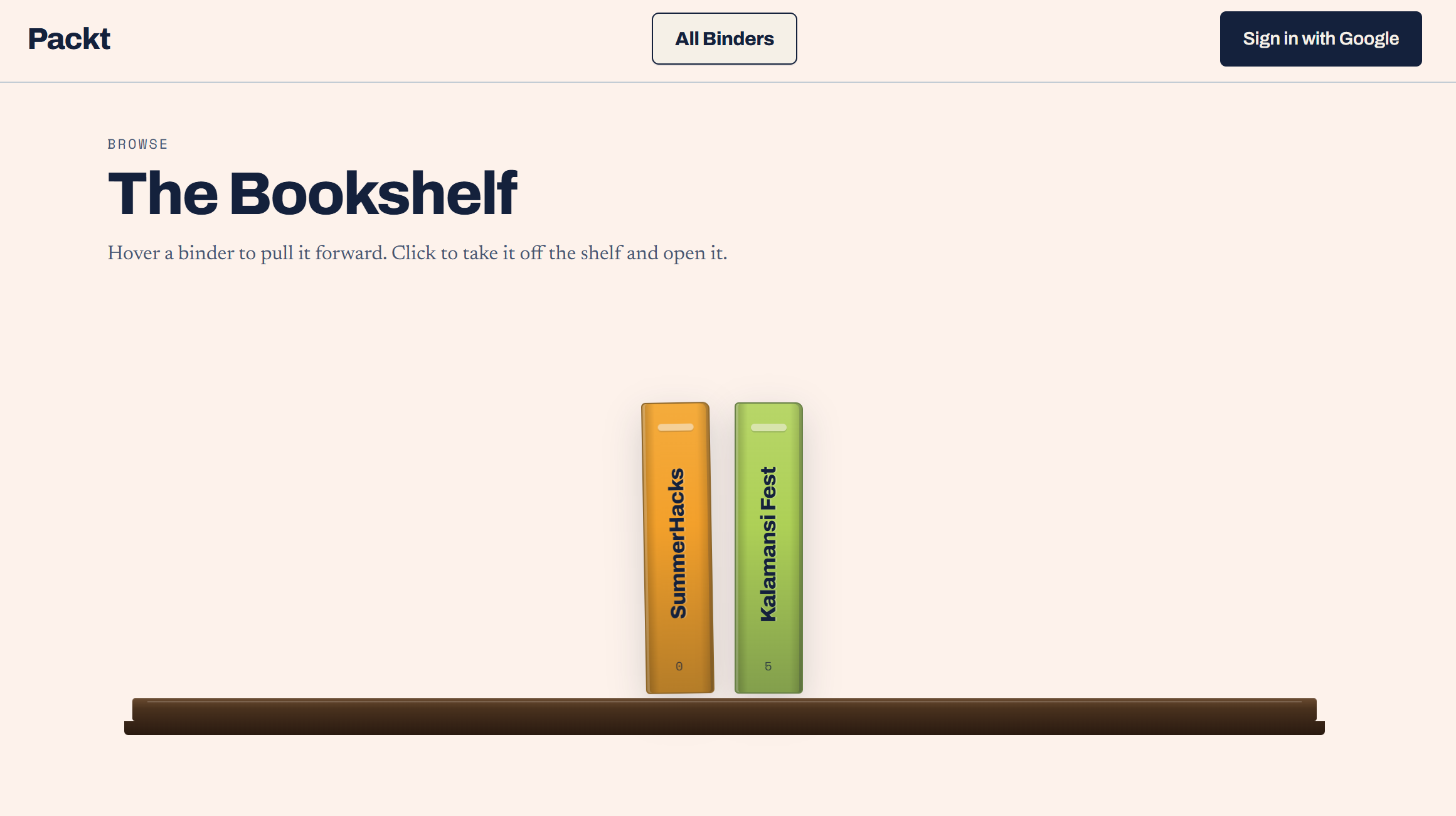
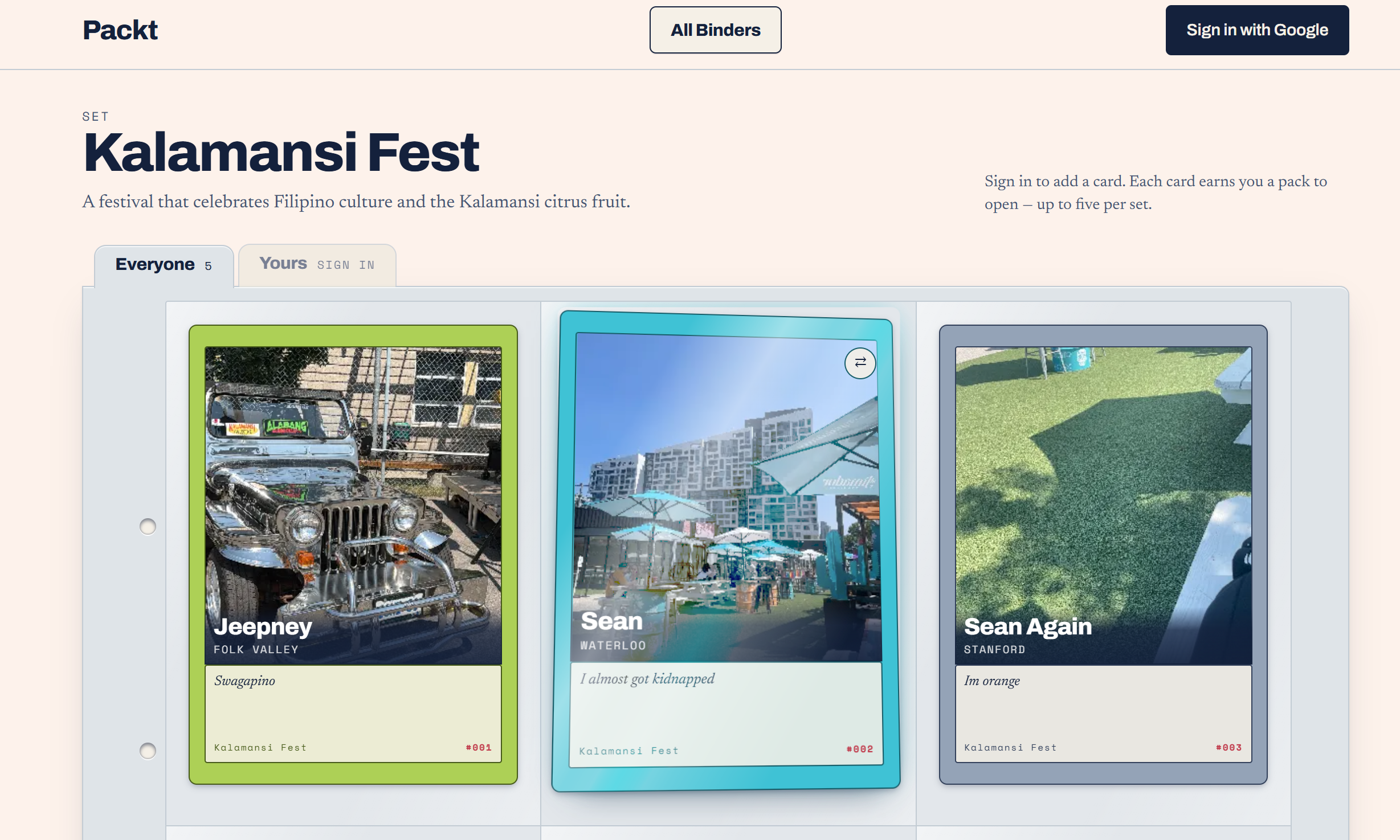
- The binder. Nine-pocket pages, ring holes punched down the margin, empty pockets left visible so the set visibly wants more people in it.
It is a public binder, a collage of memories and experiences of people around you during the event.
How we built it
Next.js 16 (App Router) · React 19 · Tailwind v4 on Vercel, with Supabase for Postgres, Auth, Storage and Realtime.
The architectural bet: the collection rules are database invariants, not application checks.
pulls and pack_grants have no INSERT policy at all. Nothing holding the
publishable key can write them, the only path is a security definer function. A
client cannot fabricate a pull, pull its own card, pull a duplicate, or open a pack
it never earned, regardless of what the frontend does.
| Rule | Where it lives |
|---|---|
| Contributing earns exactly one pack | trigger, same transaction as the insert |
| One card per person per pack | unique (pack_id, owner_id) |
| One pack consumed per opening | UPDATE … FOR UPDATE SKIP LOCKED |
| Never your own card, never a duplicate | excluded in open_pack's WHERE |
| Dry pool refunds the pack | consumed_at reset before raising |
| Serials don't collide | counter bumped under a row lock |
The heart of it:
update pack_grants set consumed_at = now()
 where id = (
   select id from pack_grants
    where user_id = v_user and pack_id = p_pack_id and consumed_at is null
    order by created_at
      for update skip locked            -- a double-click can't spend one pack twice
    limit 1
 )
returning id into v_grant;

select c.* into v_card
  from cards c
 where c.pack_id  = p_pack_id
   and c.owner_id <> v_user             -- never your own card
   and not exists (                     -- never one you already hold
     select 1 from pulls p
      where p.user_id = v_user and p.card_id = c.id
   )
 order by random() limit 1;
Two things we're glad we did that way:
FOR UPDATE SKIP LOCKEDmeans two concurrent calls. A double-click, two tabs can't claim the same grant. Exactly one wins.- Ineligible cards are excluded in the
WHERErather than drawn-and-retried. A duplicate isn't unlikely, it's unrepresentable. No retry cap to tune and no unlucky-streak failure mode in a small pool.
Reads go through Server Components; only the two mutations are Route Handlers.
Business logic sits in framework-free modules under lib/services/ that take a
Supabase client and plain arguments.
Challenges we ran into
The free tier is a design constraint, not a footnote. Supabase gives 1 GB of
storage, and its server-side image resizing is Pro-only. Straight-from-the-phone
photos are 3–5 MB, which would cap an entire event at roughly 250 cards. So we
downscale in the browser before upload a ~150 KB WebP for the card and a ~25 KB
thumbnail for the grid, via createImageBitmap + canvas. The same 1 GB now holds
about 5,700 cards.
That has a sharp edge we hit: createImageBitmap(file, { imageOrientation: "from-image" }).
Without that option, every phone photo carrying EXIF rotation gets drawn sideways
onto the card. And iPhone HEIC won't decode in some browsers at all, so that path
throws a typed error telling you to pick a JPEG rather than failing silently.
No Docker meant no local Postgres. Instead of guessing, we validated all six
migration files against Postgres's own parser (libpg_query via pg-query-emscripten),
which checks the three plpgsql bodies that the outer SQL grammar would otherwise
skip over as opaque strings.
We cut the AI image step. The original plan had a generative transformation. We
dropped it and made the composition carry that weight instead: the card frames your
photo in a keylined art window inside a coloured mat, lays a pointer-driven foil sheen
over it, tilts it in 3D, stamps a serial and set code, and flips to a printed back. A
photo in that frame is not the photo you uploaded, but the transformation is
typographic and material rather than generative. The seam for adding generation later
is a single file, lib/services/cards.ts, the one place a card row is created.
A hydration error that wasn't ours. LanguageTool's browser extension stamps
attributes onto <html> before React hydrates. It cost us more debugging than we'd
like to admit before we noticed the error message's own last line calling it.
Accomplishments that we're proud of
- Rules as invariants, not checks. Six of them enforced by unique constraints, triggers and row locks. The frontend can be wrong and the data still can't be.
- One route serves three views. Whole pack, your lens, someone else's lens, same route, same component, same query. "Mine" is probably not a separate resource, which is what makes "no private binder" true rather than merely promised.
- No service-role key anywhere. Every write goes through RLS or a
security definerfunction. - Zero WCAG 2.1 A/AA violations from
axe-coreacross all five screens. - The nine-pocket page with empty pockets left visible. It argues "this gets better with more people" without a line of copy.
What we learned
- Constraints beat validation. "Retry until you get a non-duplicate" and "exclude duplicates from the draw" sound equivalent only one has no failure mode.
- Free-tier limits belong in the design phase. The 1 GB ceiling changed our upload architecture, not a config value.
- Merging create-card and contribute-to-pack into a single insert removed a whole class of half-failed demo states, and made "contributed but earned nothing" unreachable, because the grant trigger fires in the same transaction.
- Modelling the entitlement as a row (
pack_grants) rather than deriving it from "has this person contributed?" is exactly what makes double-opening impossible via a conditional update onconsumed_at.
What's next for Packt
- Exercise the invariants against live Postgres. They're designed and they parse,
but they aren't yet proven: no-grant open, double open, self-pull refund, concurrent
opens, and direct
INSERTs againstpullsbouncing off RLS. Highest priority. - The generative step we cut, slotted into
lib/services/cards.ts. - Rarity that means something. The column exists and everything is
commontoday earliest contributors as holos, that sort of thing. - Trading, with two-sided consent. The constraint work is already the right shape.
- A global binder across communities, plus per-event set codes so one person can appear in several sets.
Built With
- canvas-api
- google-oauth
- next.js
- plpgsql
- postgresql
- react
- row-level-security
- server-components
- supabase
- supabase-auth
- supabase-realtime
- supabase-storage
- tailwind-css
- typescript
- vercel
- webp
- zod


Log in or sign up for Devpost to join the conversation.