-
-
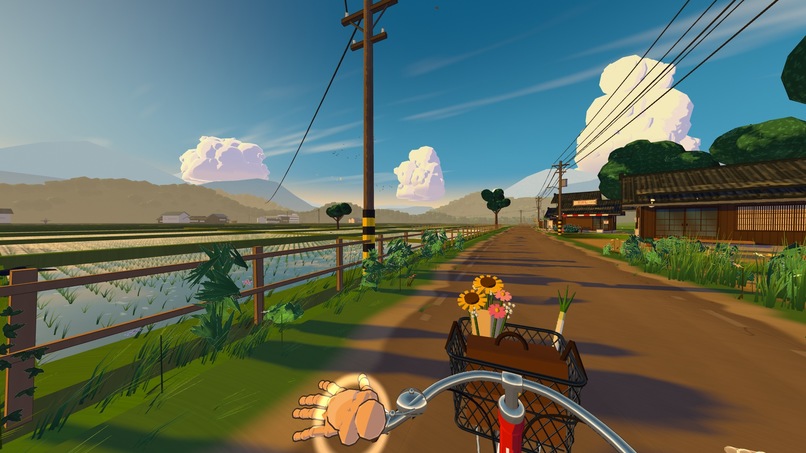
-
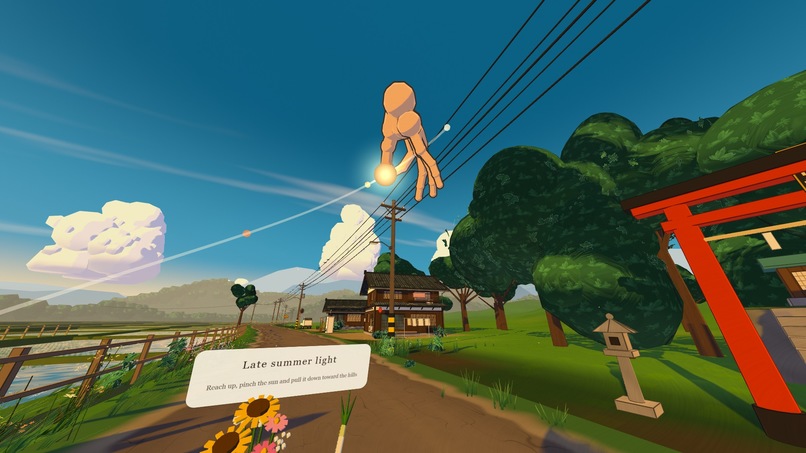
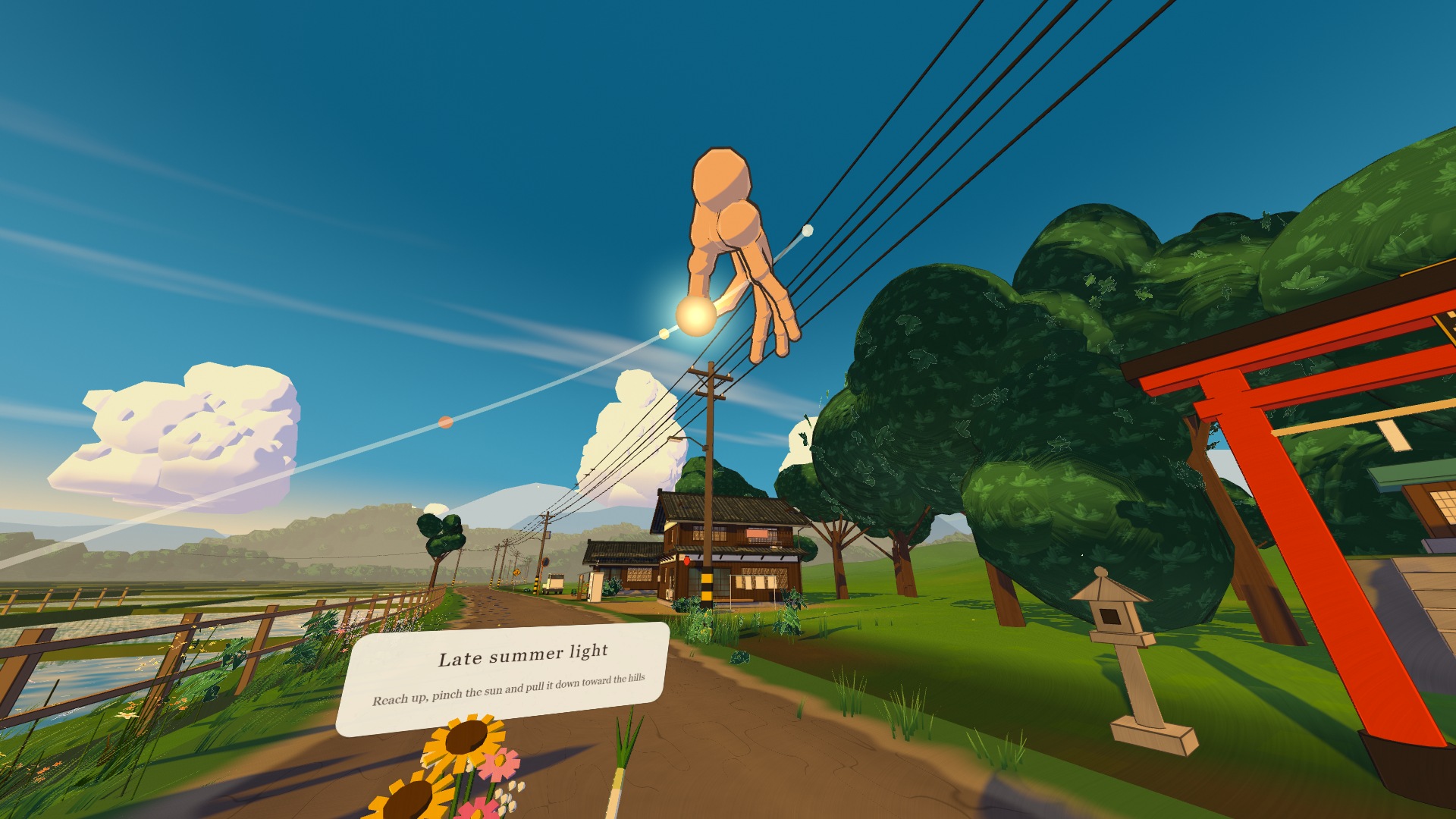
Reach up, pinch the little sun and pull it down its arc. The light turns golden as your hand moves.
-
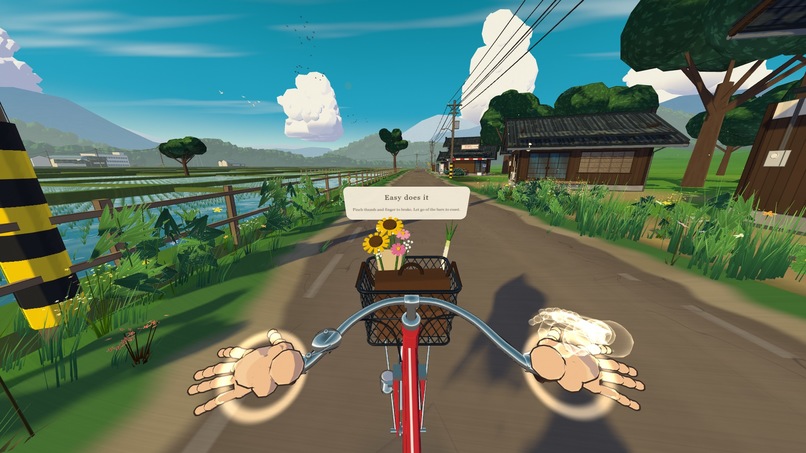
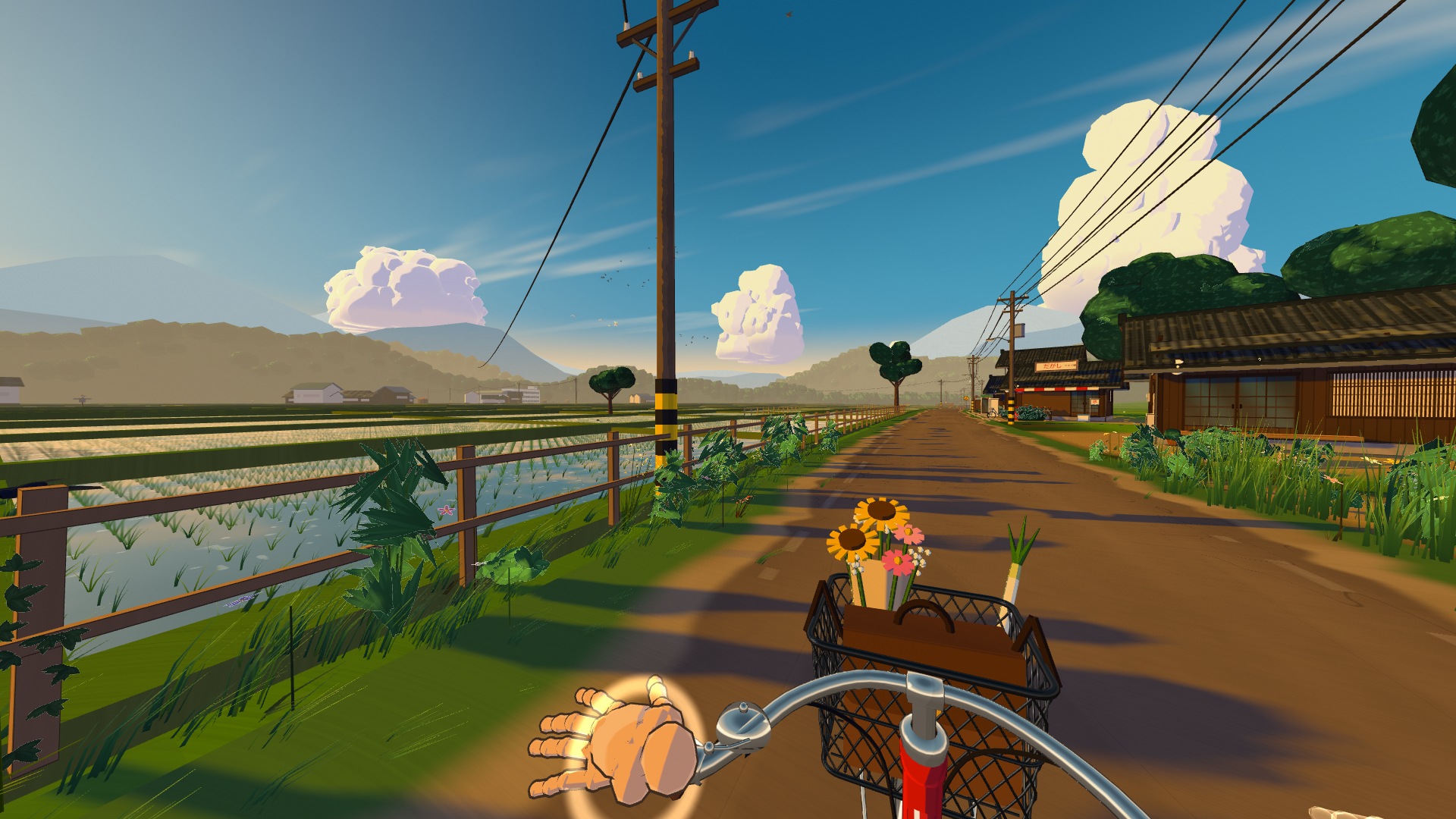
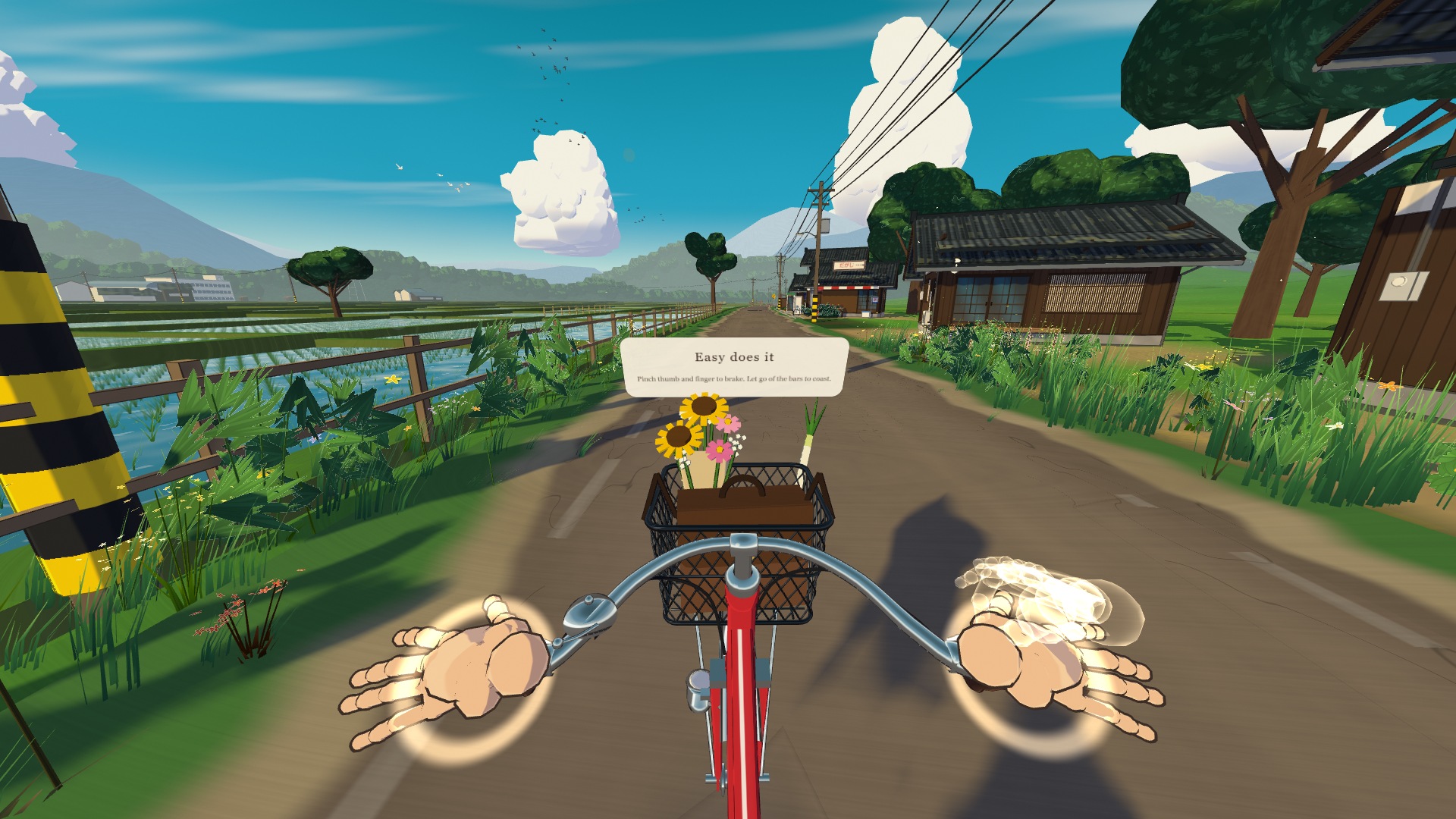
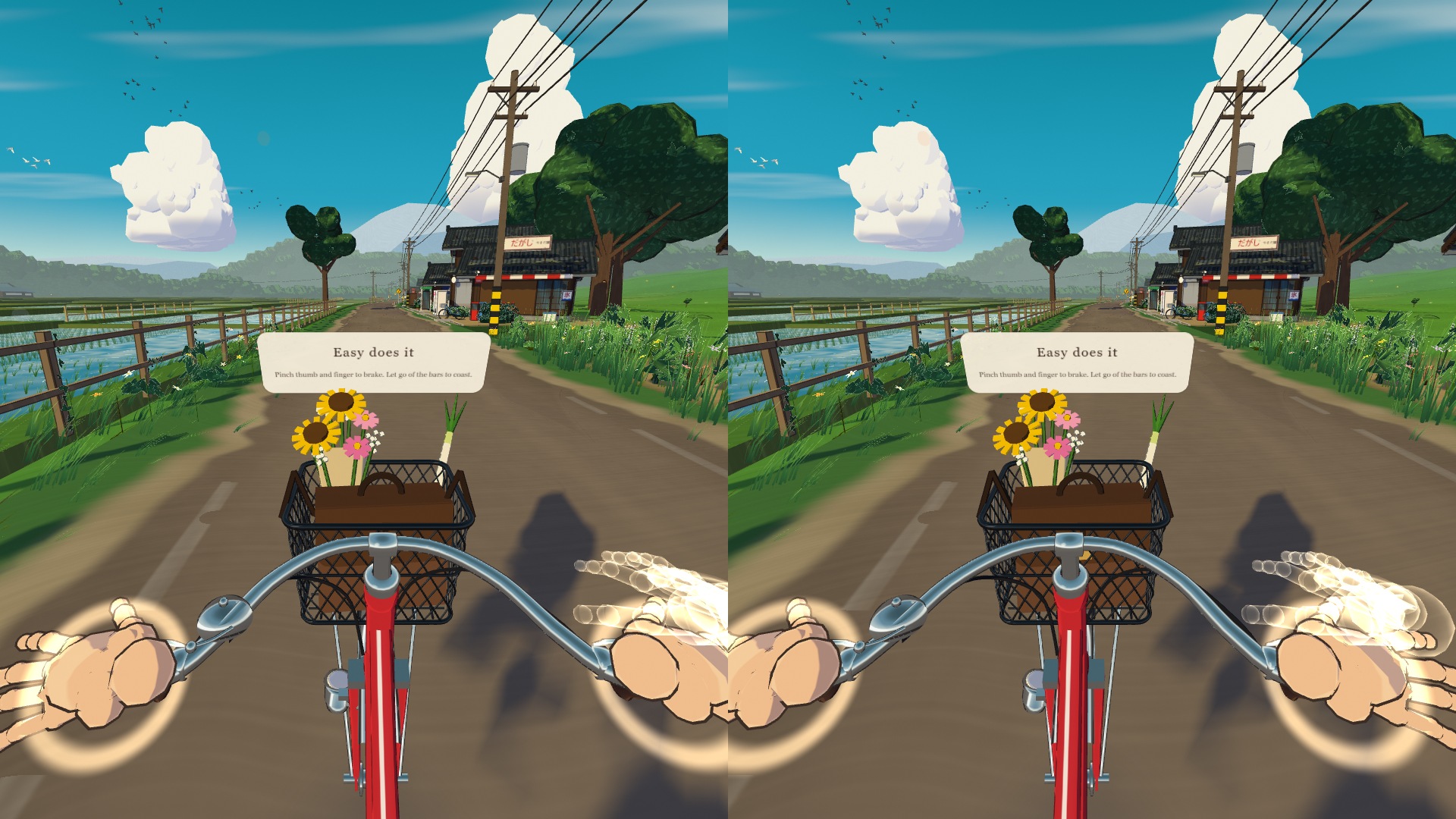
Hands on the grips and she's riding. For the next lesson a ghost hand of light pinches above the right grip, showing how to brake.
-
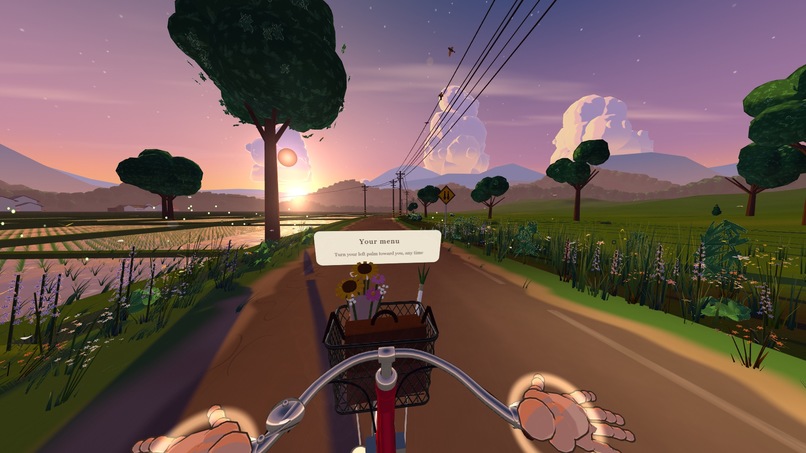
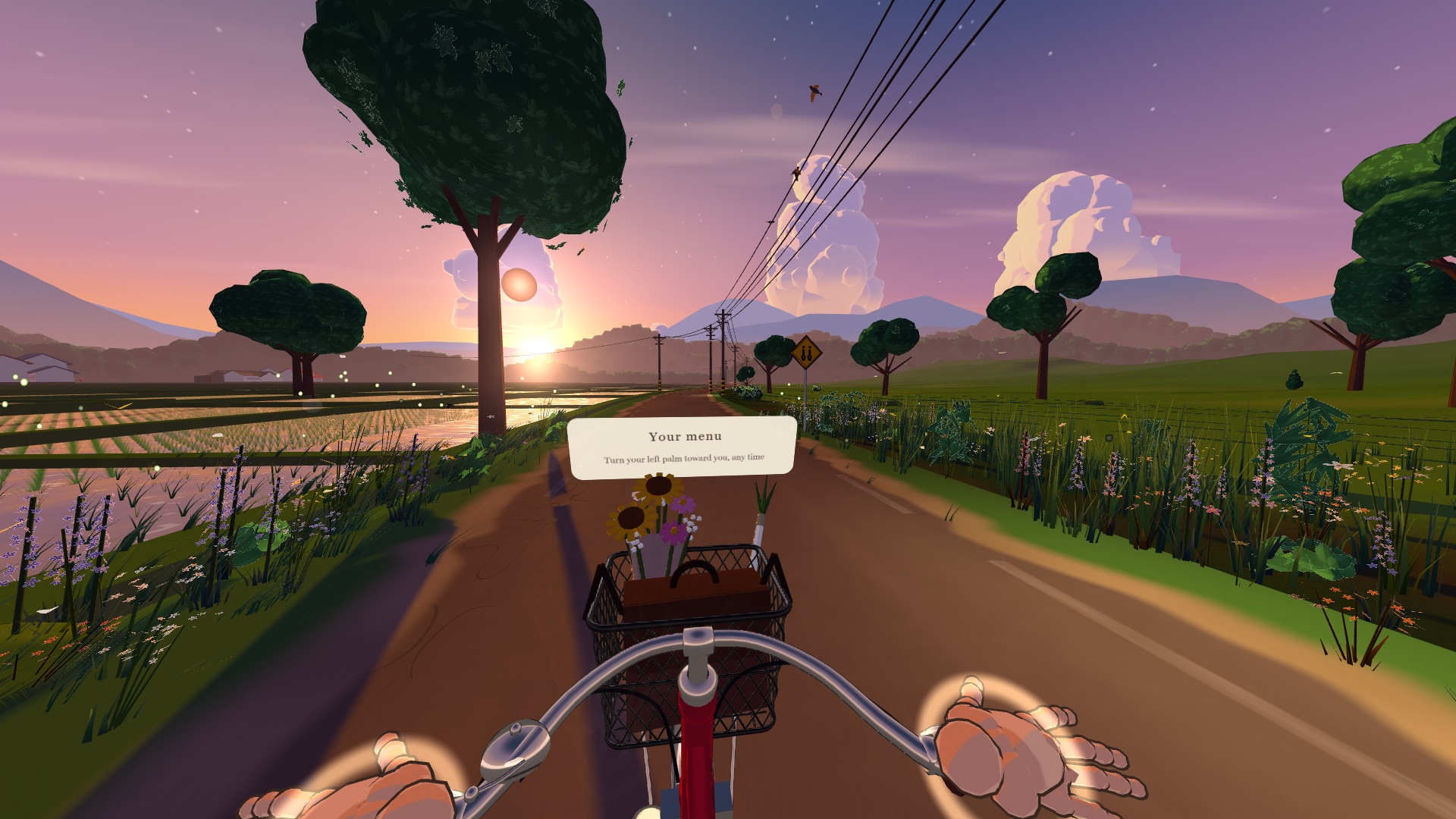
Further down the arc it's sunset, with a soft glow around the sun. The next card teaches the wrist menu: turn your left palm toward you.
-
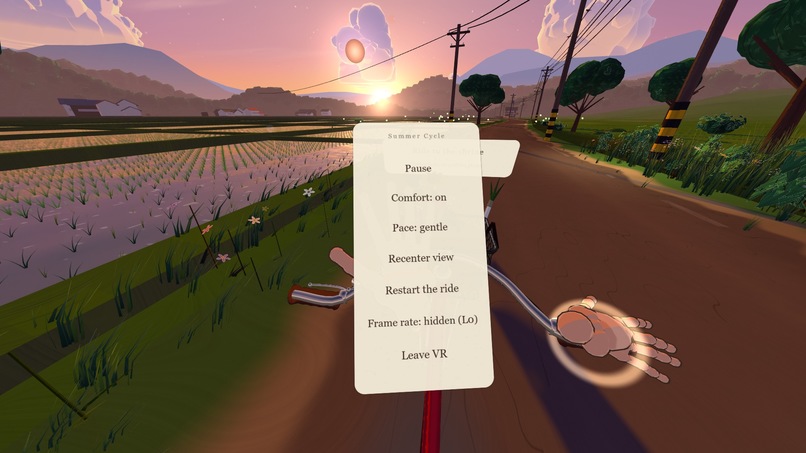
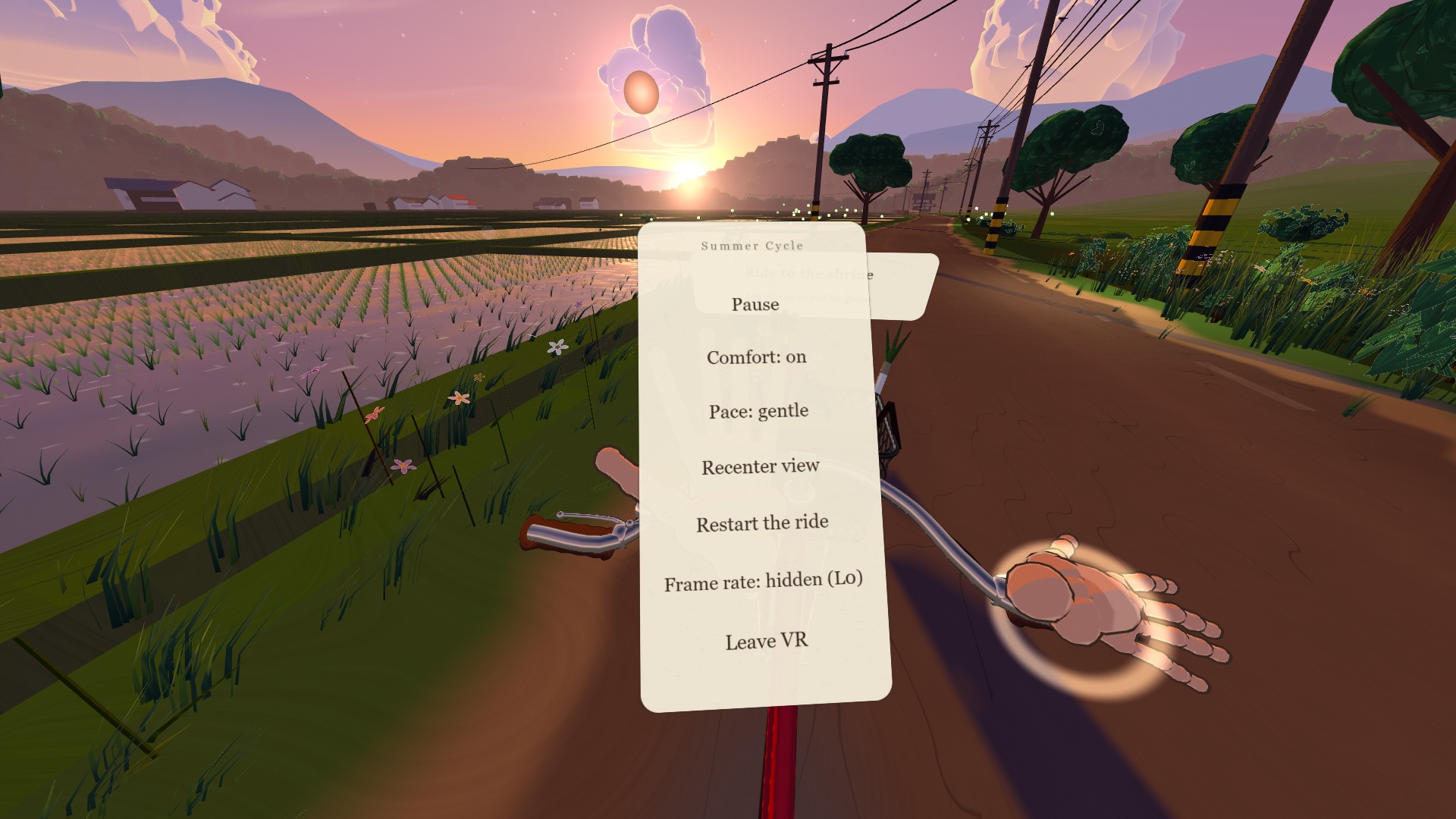
Turn your left palm toward you for the wrist menu: pause, comfort, pace, recenter, restart. A poke with the other hand chooses.
-
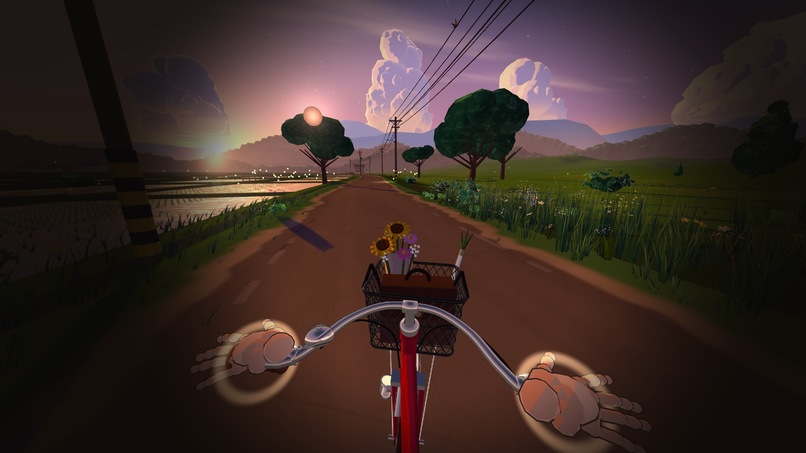
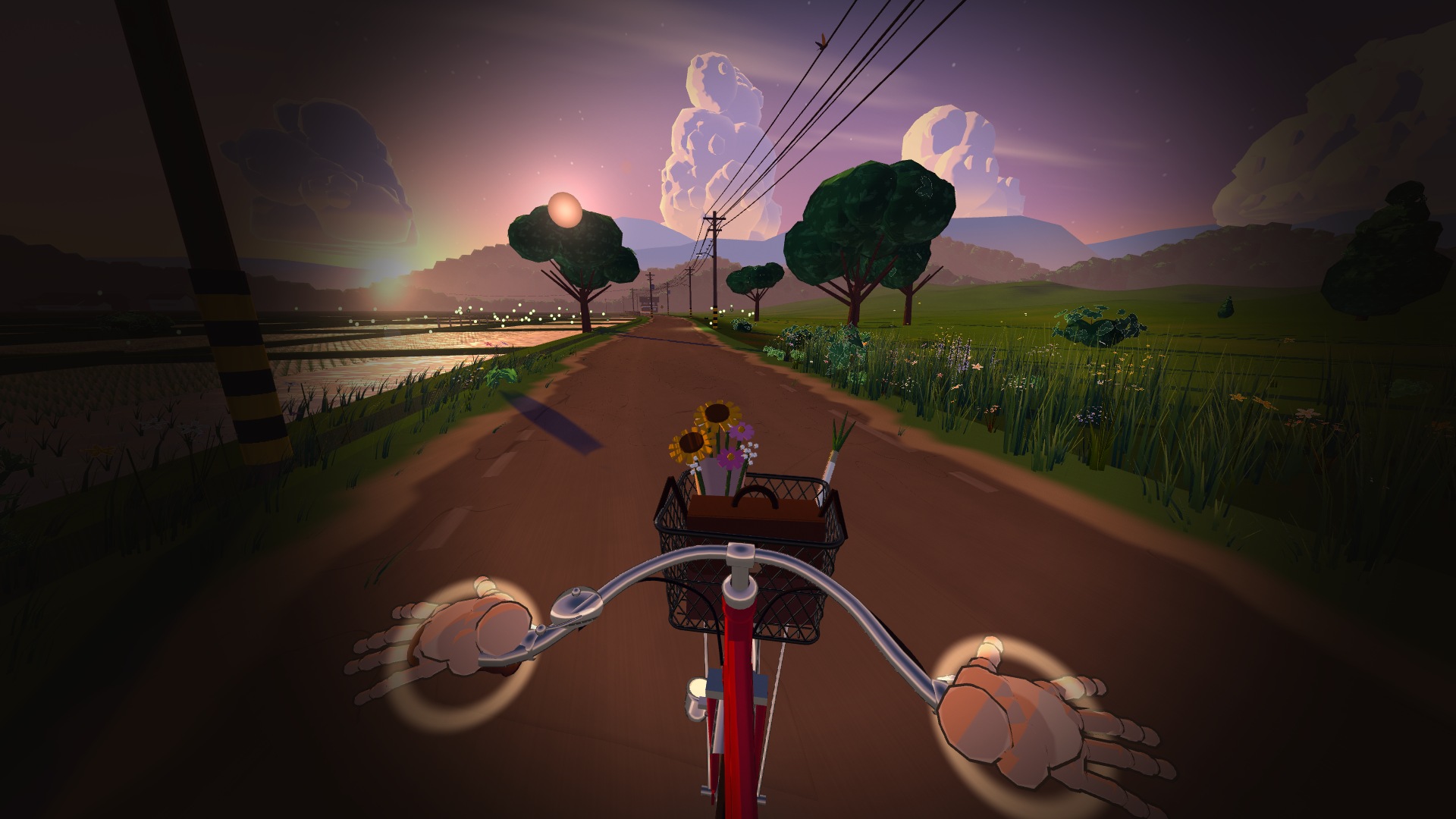
The comfort vignette softly darkens the edges of your view while you turn, and the horizon stays level.
-
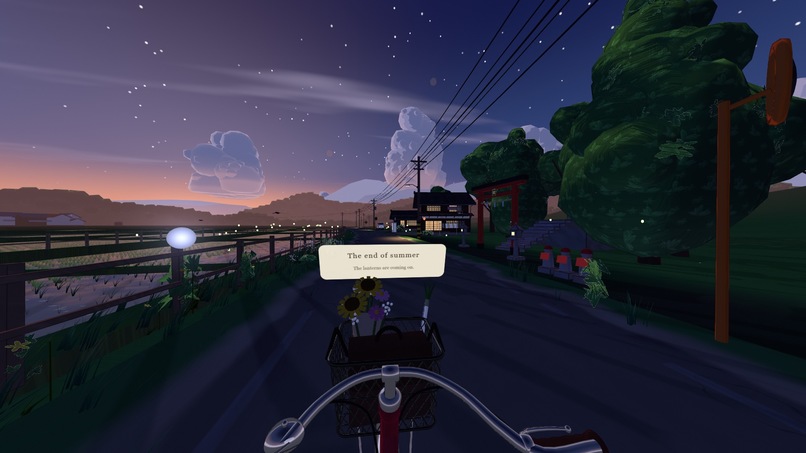
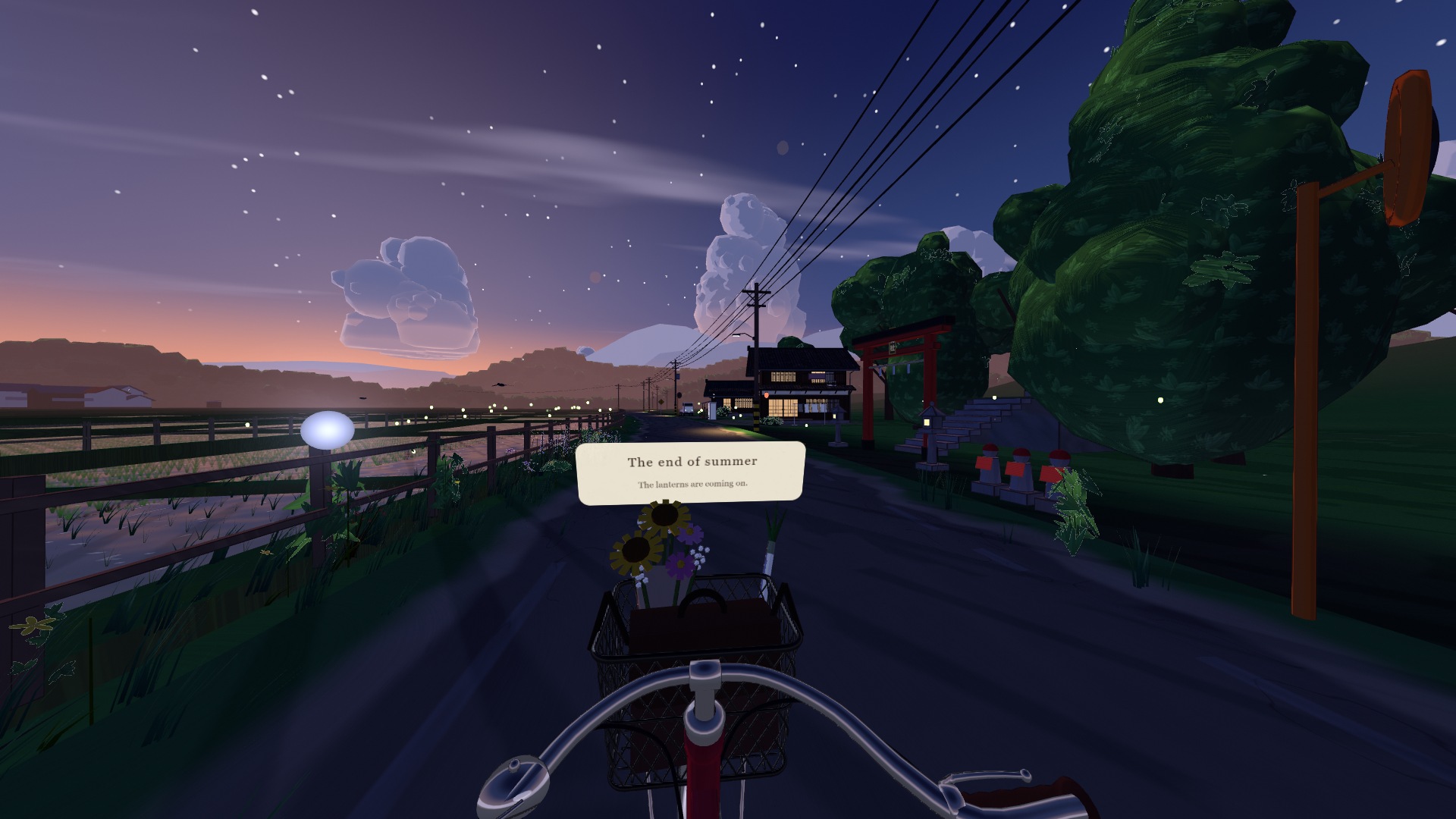
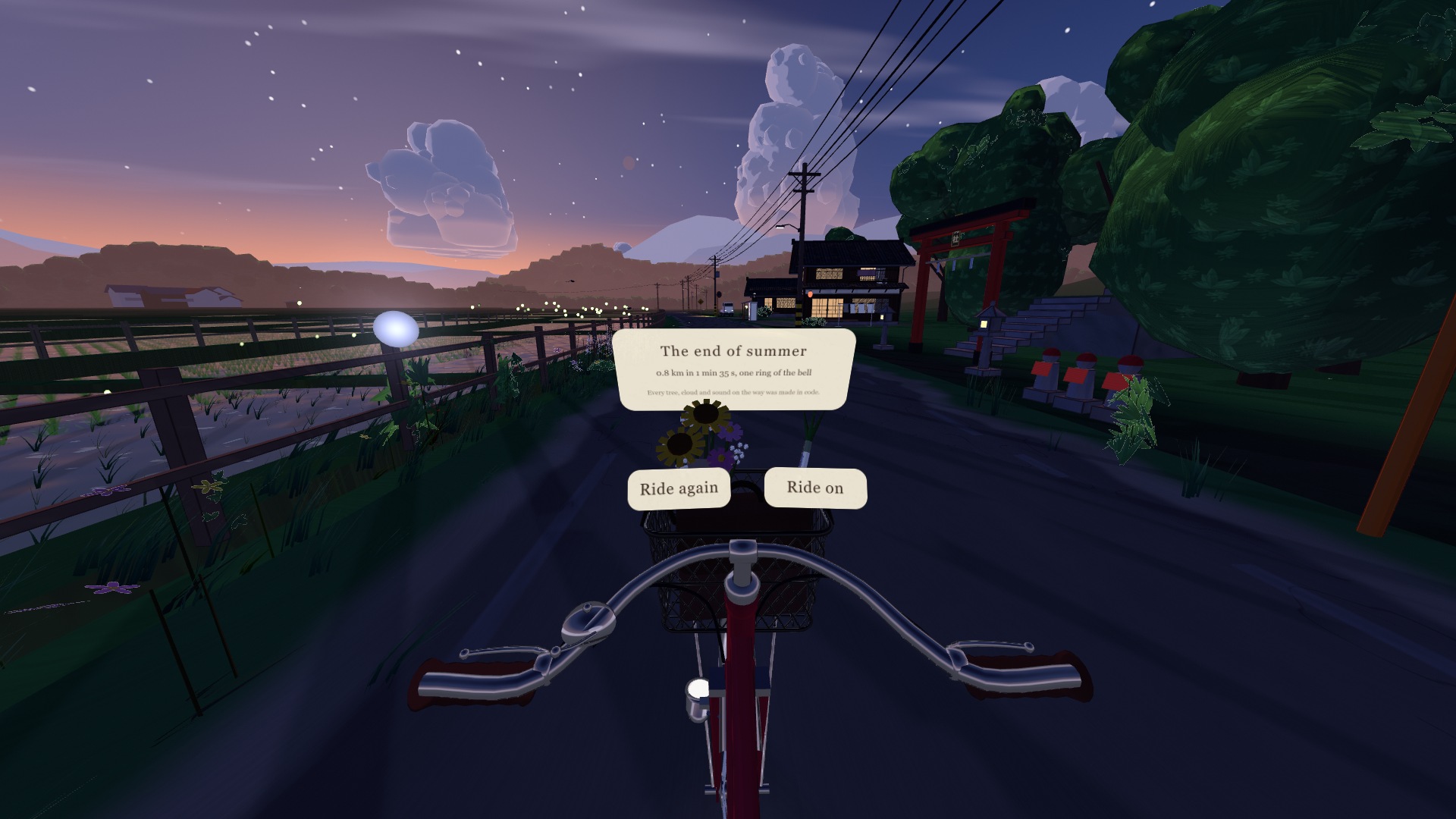
The end of the guided ride: the shrine at dusk, the lanterns coming on and the first stars out.
-
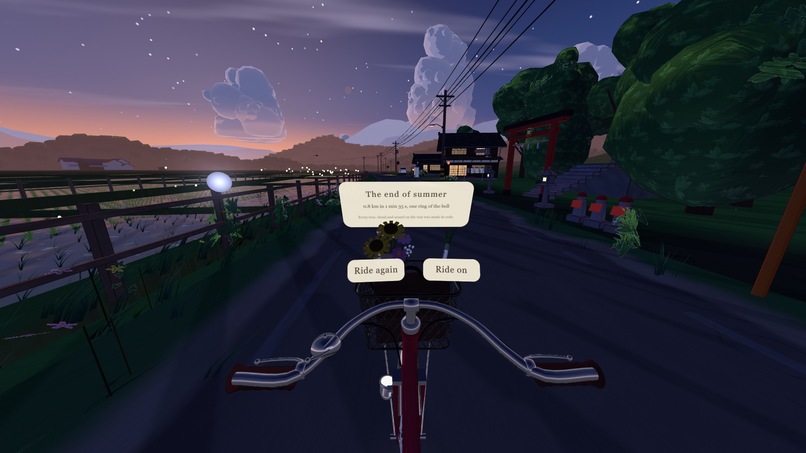
A few seconds later, the end card: how far you rode, how long, how often you rang the bell. Then Ride again, or Ride on into the dusk.
-
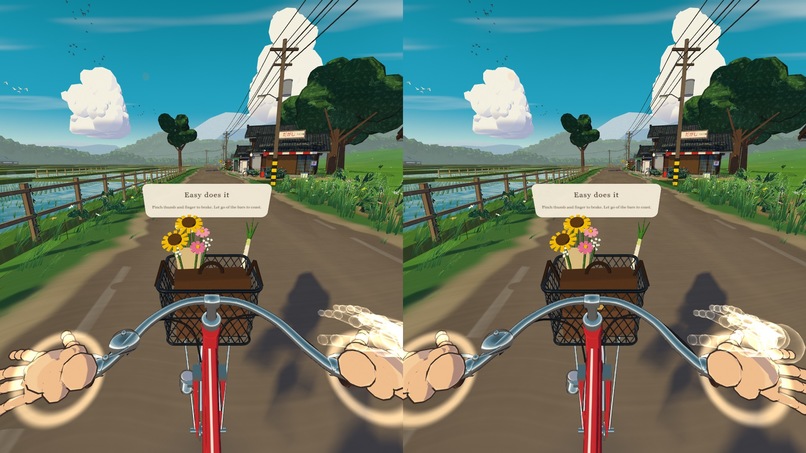
Both eyes on the Quest render tier, captured in Meta's IWER emulator.
Inspiration
Earlier this year I made Summer Cycle, a small desktop browser game: a bicycle ride down a Japanese country road on a late summer afternoon, drawn like a hand-painted animation background. There's no score and nothing to win. You ride past flooded rice paddies, a row of old wooden shops and power lines sagging over the road, and the sun goes down if you let it. Every tree, sign, cloud and sound is generated in code; the repo ships no image, model or audio files. I posted it on X and it reached around 66,000 views, and the replies kept saying the same thing: "I want to be there."
That's the part a flat screen can't give you. On a monitor you watch her ride. In a headset you could be the one sitting on the bike, with the bars in your hands and the cicadas all around you. So for this competition I set out to turn a game you watch into a place you sit in, for a few quiet minutes, on a sofa or in a plane seat.
What it does
Summer Cycle VR is a seated, hands-only bike ride in Meta Quest Browser. One button on the start screen and you're on the saddle.
- Rest your hands on the handlebars and she rides. There is no gesture to learn: a hand near a grip holds it. Let go and the bike coasts gently to a stop.
- Steer by turning the bars, with one hand or both.
- Pinch to brake, thumb and index finger on the bars. It's analog, so a light pinch slows you a little.
- Ring the bell with your left thumb.
- Pull the sun down. A little sun sits on a faint arc just above you. Reach up, pinch it, and drag it toward the hills, and the whole valley follows your hand: the light goes gold, then pink, the lamps come on, stars appear and fireflies rise over the verges.
- Wrist menu. Turn your left palm toward your face and a small paper menu appears. Poke it with your right index finger: pause, comfort on or off, pace, recenter, restart, frame rate, leave VR. A pinch resumes.
- Lessons you can see. Paper cards over the basket teach each thing once, and a ghost hand made of soft light shows the gesture right where you make it: settling onto the grips, a pinch above the right grip, your left thumb on the bell, a reach up to the sun, your left palm turning toward you for the menu. A soft chime tells you when you've got it.
- If the headset loses your hands, the bike coasts and a card at eye height tells you, with a soft cue. The glowing rings on the grips invite your hands back, and a second cue plays when they're found.
- A complete ride in about four minutes, with an ending. A guided route takes you through the village and along the paddies to a little shrine with a red gate. You roll to a stop, dusk comes in, the stone lanterns light and a temple bell sounds somewhere far away. Then an end card shows what you rode (how far, how long, how often you rang the bell), with two paper tags within reach: Ride again fades back to the afternoon at the start, and Ride on lets you keep riding at dusk for as long as you like. Poke one, or just take the bars and ride off.
It's lean-back entertainment: no fail state, no timer, gentle speed, a level horizon, and a soundscape of tyres, chain, cicadas, birds, water and wind chimes that follows what you do. Controllers work too, but you never need one.
How I built it
It's plain three.js on WebXR (immersive-vr, local reference space, hand tracking), written in TypeScript and built with Vite. There's no engine and no asset pipeline; the only runtime dependency is three.
The seated rig. At the start of the session your head pose is calibrated onto the rider's eye point, so any chair height works. The rig follows the bike's position and heading only, so the horizon never tilts, bobs or leans. The handlebars, basket and bouquet stay fixed in the lower part of your view as a steady reference for your body.
Hands. Each frame I read the 25 tracked joints per hand and derive a few simple features: a palm point where a grip would sit, a pinch amount with hysteresis (on under 2 cm, off over 3.5 cm), and palm direction for the wrist menu. The hands are drawn cel-shaded from those joints in four instanced draws, ink outline included, so they match the painted world. The ghost hands in the lessons are hand poses recorded in Meta's IWER emulator, drawn as additive light with a bright rim so they never hide your real hands. If neither hand nor a controller has been seen for most of a second, the ride treats your hands as lost until they come back. Every interaction sits within about 60 cm of a seated player, and the prompts sit in a narrow cone above the basket, so nothing needs a wide field of view or a stretch.
The sun dial. The sun lives on an arc 46 cm from your eye. A pinch near it takes hold; the nearest point on the arc to your fingers sets a continuous time of day between four hand-tuned presets (about forty parameters each: sun angle, sky gradient, fog, shadow colour, grade, how many birds are in the air). The drag is eased so small tremors don't flicker the sky.
A headset render path. The desktop game gets its look from a heavy post chain: ink outlines, a paint filter, bloom, a colour grade, and a mirrored paddy reflection. None of that fits in a Quest's frame budget at stereo resolution, so in the headset the scene draws straight into the XR framebuffer and I rebuilt the look inside the scene shaders. Every scene shader applies the warm grade and sRGB encoding itself. The ink is drawn in the same pass: outlined surfaces darken where they turn away from your eye, measured against the screen-space rate of change so the line stays about 1.5 px wide at any distance, and the houses, street furniture, shrine gate and fences also carry their hard edges per triangle corner, so creases get lines too. That costs no extra draws and no extra triangles. In place of bloom, a soft additive glow sits around the sun while it's low (one draw). The XR target uses a linear colour space, so the headset draws with the shader programs the page already compiled while loading, and the few headset-only materials (prompt cards, ghost hands, the end card, the glow) compile while the loader waits for your click. Nothing compiles during the session: in the emulator there are 90 shader programs before Enter VR and still 90 at the end of the guided ride.
Performance on a mobile GPU. The desktop game drew about 540 calls a frame. For Quest I rebuilt how the scenery is submitted: every kind of plant, grass, tree and rock becomes one world-space instanced mesh filled only with the instances near the rider, refilled as you move, with per-instance level of detail. Grass and flowers shrink into the ground at the edge of the radius instead of popping. The bike and basket merge from about 130 meshes into a handful. Measured in the emulator at the shop row, per eye, scene draw calls went from 307 to 114 and triangles from 1.34 million to 325,000; the sun shadow went from 316 draws to 56, every other frame. On top of that, adaptive quality watches real frame intervals and steps through four levels (smaller detail radii, less frequent or no shadow, shorter view distance, more foveation) and back up when there's headroom, without ever recompiling a shader. Detail eases in and out over about a second, so a change of level is hard to notice.
With the new look, lessons and ending in place, I measured every level along the whole guided ride, again in the emulator and per eye, taking the worst of ten spots. At full quality (L0) the worst spot is 124 draw calls and 388k triangles, and the mean is 113 calls and 336k triangles. The lighter levels L1, L2 and L3 peak at 116, 113 and 108 calls and 356k, 324k and 298k triangles.
Fixing the frame loop. Two bugs had been hiding in every headset frame. Starting the XR loop after the session had begun also restarted three.js's loop on the browser window, so every headset frame ran twice, with interleaved timestamps. Now the session's own loop drives the headset. And because the hands were read before the bike moved, the drawn hands and grip rings trailed the bike by one frame (about 6 cm at riding pace), so the sun, the wrist menu and the end card were comparing your fingers with a rig that had already moved on. Now what was read moves with the rig. I also removed a second copy of three.js that a development-only tool had pulled into the core bundle: about 500 KB of JavaScript that every page load downloaded and never used.
Pause and resume. The wrist menu pauses; a pinch resumes. When the Quest system menu covers the session (a WebXR visibility change), the ride pauses too and waits for a pinch, so it never moves off without you.
Building without a headset. I don't own a Quest, so I built all of it in Meta's IWER emulator, which runs a simulated Quest 3 with tracked hands in a desktop browser. That forced a useful discipline: Playwright scripts walk the whole guided ride with scripted hands, check every step, save the headset view, count draw calls and triangles per eye, and test the adaptive quality by injecting artificial frame cost. The demo video was captured the same way, frame by frame, with hands driven through the real hand-tracking path.
I built this with AI coding agents in Cursor (Claude Opus did much of the implementation), working in a builder and critic loop against rendered frames. I steered the design, the interactions and every trade-off.
Challenges I ran into
- No headset. Every grab distance, every prompt position and every performance number came from the emulator. I leaned on automated checks and conservative choices (generous grab radii, a 72 Hz target, adaptive quality as a safety net) because I couldn't just put it on and look.
- Losing the post chain without losing the look. The painted feel of the desktop game comes mostly from post-processing, which the headset can't afford. Moving the grade into every shader kept the colour, and in this update the ink came back the same way, drawn inside the scene shaders, with a glow around the sun standing in for bloom. The paint filter is still desktop-only: it needs a full-screen pass, which is exactly what the headset can't spare.
- Stereo in WebGL. three.js only implements the multiview extension in its WebGPU renderer, and this game's custom GLSL materials need the WebGL renderer. So both eyes render the full scene, which is why the draw call work mattered so much.
- Small WebXR surprises. three.js uses render layers 1 and 2 for the left and right eyes, and my shadow and reflection layers were using the same numbers, so shadow-only meshes showed up in one eye. The first frames of a session can arrive without a viewer pose, which broke calibration until I waited for a real one.
- Comfort. Riding a bike in VR is forward motion you don't physically feel. I kept the speed rider-controlled with gentle ramps, never backward, the horizon level and the bars fixed in view, and added a turn vignette that darkens the edges while turning or changing speed.
Accomplishments that I'm proud of
- Pulling the sun down with your fingers. It's the moment I made this for, and it works exactly as I hoped: you hold the light in your hand and the whole valley answers.
- The whole experience, from the start screen to the end card at the shrine, works with hands alone, seated, inside a small radius.
- Bringing the ink back to the headset at no extra draw cost: the lines come from the shaders the scene already runs, with no extra draws or triangles.
- Cutting the headset scene to about a quarter of its original triangles and just over a third of its draw calls without it looking cut.
- Zero shader compiles during the ride, checked in the emulator. Everything the headset needs is compiled before you press Enter VR, so nothing hitches when you enter VR, when a lesson card first appears or at the end card.
- The scripted walkthrough of the whole ride in the emulator (23 checks, including every lesson, losing and finding hands mid-ride, the end card and Ride again) passes at every adaptive quality level, with no console errors.
- It's still one self-contained web page with no downloaded assets. Everything you see and hear is made in code.
What I learned
- Seated VR is mostly about what you take away. The bike doesn't lean, the camera doesn't bob, and the calm makes it better.
- Hands-first works best when there's nothing to learn: holding the bars is the control, not a gesture that stands for it.
- An emulator plus scripted checks gets you remarkably far, and it makes you measure things instead of guessing. It still isn't a headset, and I know the real test is on a Quest.
- On a mobile GPU in stereo, draw calls are the budget. Instancing and distance-based detail mattered far more than shader tweaks.
What's next for Summer Cycle VR
- Test on a real Quest 3 and 3S and tune frame rate, grab distances and pinch sensitivity from real hands.
- More rides: a morning ride with mist on the paddies, a rain ride, and a seaside road, each a few minutes long.
- Target launch date: the judges' build is live now. I plan a public web launch on December 11, 2026, the day winners are announced, as a free link that opens in Quest Browser. After that, an installable PWA listed on the Meta Horizon Store in Q1 2027.
What's new in this update (Adapted division)
Before September 24, 2026 (already existed): Summer Cycle was a desktop browser game, publicly released on GitHub Pages. It had the painted world (one cel-shaded material specialised for 31 kinds of surface, ink outlines, a paint filter, mirror paddies), a 640 m looping road, four time-of-day presets on the T key, a fully synthesized soundscape, an on-foot mode, a pause menu, and keyboard and mouse controls. It ran at about 118 fps on a desktop GPU. It had no VR, no hand input and no guided ride. The last pre-competition commit is dated September 23, 2026.
Added during the competition window (full list in CHANGELOG.md):
September 27, 2026: VR, phase 1
- A seated WebXR mode in Meta Quest Browser: Enter VR from the start screen, a calibrated seated rig with a level horizon and fixed handlebars in view.
- Hand interactions as a new feature: hold the bars to ride, turn them to steer, pinch to brake (analog), touch the bell, pinch and drag the sun to set the time of day continuously.
- A palm-up wrist menu (pause, comfort, pace, recenter, restart, frame rate, leave VR), and pause and resume by hand, including when the Quest system menu opens.
- Cel-shaded hands drawn from the 25 tracked joints. Optional controller support.
- Comfort: rider-controlled speed with two paces, a turn vignette, and a Comfort mode on by default.
- A guided four-minute ride with paper prompt cards, ending at the shrine at dusk with lanterns, fireflies and a temple bell.
- A Quest render path: the grade moved into the scene shaders, no post chain, a smaller shadow map every other frame, fixed foveation, a 72 Hz target, and no scene shader recompiles on entry.
- Emulator tooling: IWER in dev builds, a scripted walkthrough of the whole ride with 14 checks and screenshots, and a draw call and triangle probe.
September 27, 2026: VR, phase 2 (Quest performance)
- World-space instancing for all scenery with per-instance level of detail and fading edges, merged bike and basket meshes, lighter clouds and ridges. Per eye, in the emulator: 307 to 114 draw calls, 1.34M to 325k triangles; sun shadow 316 to 56 draws, every other frame. A lighter fallback (
?xrlite=1) at 52 calls and 143k triangles. - Sound feedback: a soft rattle when a hand takes the bars, a glass wind-chime note when you take the sun or poke the menu.
- A demo capture tool that records the hands-only ride in the emulator frame by frame.
September 28, 2026: adaptive quality
- Four quality levels chosen from measured frame times, with hysteresis, eased so detail fades rather than pops, and no shader recompiles. The current level shows in the wrist menu.
- Fixes: scenery now fills in before the bike first moves; calibration waits for a real head pose.
October 6, 2026: the headset look, hands-only lessons and an ending
- Ink in the headset, drawn inside the scene shaders: outlines that stay about 1.5 px wide at any distance, plus crease lines on the houses, street furniture, shrine gate and fences. No extra draws or triangles.
- A soft glow around a low sun in place of bloom (one draw), a lighter haze on the horizon, a faint watercolour wash in the sky, and a dither so dusk gradients don't band. The sun on the dial is a small shaded sun in a halo, and its arc shows only when a hand is near or a lesson points to it.
- Ghost-hand lessons: translucent recorded hands show each gesture where you make it (the grips, the brake pinch, the bell, the sun, the wrist menu), with a new short lesson for the wrist menu.
- Hands lost and found: if tracking loses both hands for most of a second, the bike coasts and a card at eye height says so, with a soft cue each way.
- An ending: an end card at the shrine shows what you rode (distance, time, rings of the bell), with Ride again and Ride on tags within reach.
- New synthesized sound cues for a lesson done, a hand found or lost, and the end card.
- Fixes: every headset frame was running twice; the hands trailed the bike by one frame; a duplicate copy of three.js (about 500 KB) no longer ships. Nothing compiles during the session any more.
- Measured in the emulator, per eye, at the worst of ten spots along the guided ride: 124 draw calls and 388k triangles at full quality (mean 113 and 336k), and 116, 113 and 108 calls with 356k, 324k and 298k triangles at the three lighter levels.
How it maps to the judging criteria
Innovation & Creativity. The desktop game let you press T to change the time of day. In VR you reach up and pull the sun down yourself, and that only makes sense with hands in space: it's a physical gesture with a whole sky attached to it. The handlebars work the same way. They aren't a menu or a button, they're the thing you hold, so the controls are just riding a bike. And it's a world with no downloaded assets at all, painted entirely in code.
Experience Design. It's designed around a person sitting still. Everything is within about 60 cm of you and inside a narrow cone in front, so it fits an airplane seat and a narrower field of view. The first card asks you to rest your hands on the bars, and the ride teaches braking, the bell, the sun and the wrist menu one at a time, right when you need them. Each lesson has a ghost hand that shows the gesture where you make it, so there's nothing to decode. If the headset loses your hands, the bike coasts and a card tells you, so nothing happens behind your back. It's a complete moment in about four minutes with a real ending: a card of what you rode, then the choice to ride again from the afternoon or ride on into the evening. It pauses cleanly by hand or from the system menu, and comfort mode is on by default. I didn't use passthrough on purpose: this is about being somewhere else for a few minutes, and your room wouldn't add to it.
Technical Implementation. Hand tracking is the only input the ride needs, read straight from the WebXR joints with hysteresis so a relaxed hand doesn't brake by accident. The render path was rebuilt for a mobile GPU in stereo: world-space instancing with per-instance detail, merged meshes, a half-rate shadow, the colour grade and the ink folded into the scene shaders, and four levels of adaptive quality as a safety net for the 72 Hz target. Nothing compiles during the session, from Enter VR to the end card. This update also fixed two bugs in the frame loop itself: every headset frame was running twice, and the hands trailed the bike by a frame, which put every reach a few centimetres off. The numbers above were measured in the emulator; I haven't been able to measure them on a Quest yet, and I've tried to build enough headroom and fallback that it holds up when I do.
Polish & Presentation. The art direction carries over from the desktop game that people responded to: cel shading, ink lines, hand-tuned light presets, fireflies at dusk. In the headset the ink is back, on everything from the houses to the shrine gate, and a soft glow sits around the low sun. The hands are drawn in the same style as the world, the prompts are soft paper cards, and every sound, from the bell to the cicadas to the temple bell at the end, is synthesized and reacts to how you ride. Small glass chimes mark a lesson done, a hand found or lost, and the end card. The video is real footage from the emulator with nothing composited.
Links
- Play in Meta Quest Browser: https://starknightt.github.io/summer-cycle-vr/
- Source: https://github.com/StarKnightt/summer-cycle-vr
- Demo video: https://vimeo.com/1232563965
- Original desktop game: https://starknightt.github.io/summer-cycle/
- Me: Prasenjit Nayak, solo developer. X @prasenx, prasen.dev, GitHub StarKnightt
Built With
- cursor
- ffmpeg
- github
- glsl
- iwer
- meta-quest-browser
- playwright
- pnpm
- three.js
- typescript
- vite
- web-audio-api
- webxr
- webxr-hand-input

Log in or sign up for Devpost to join the conversation.