-
-
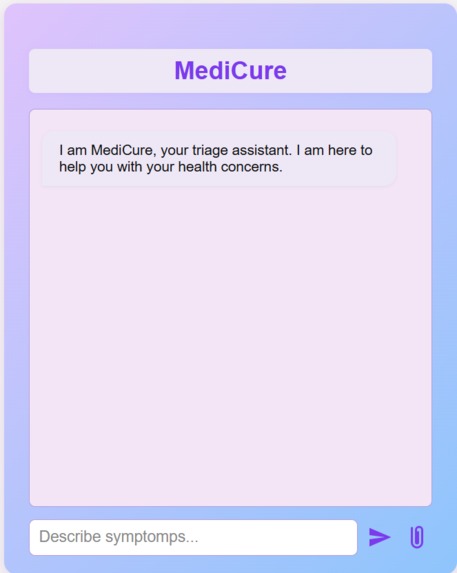
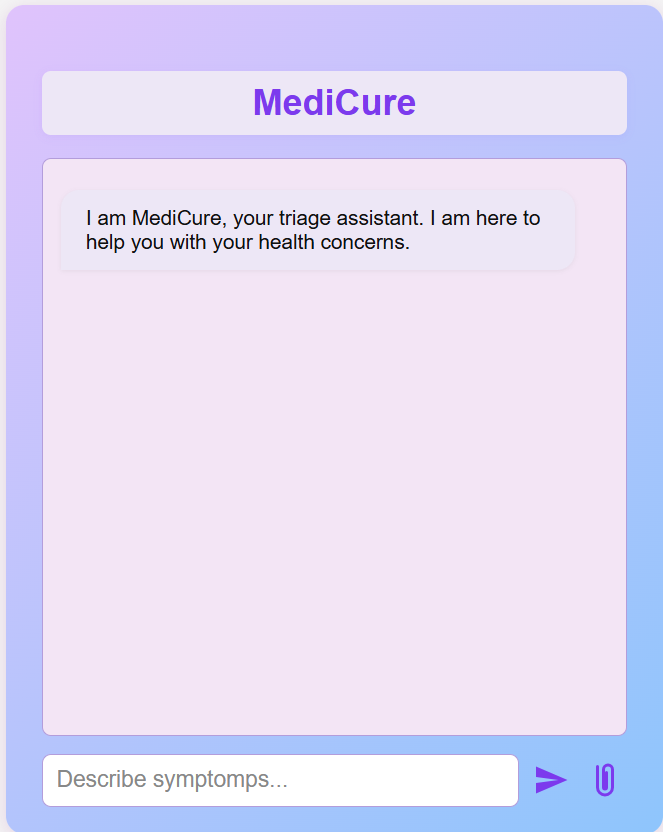
MediCure Chatbot Initial View
-
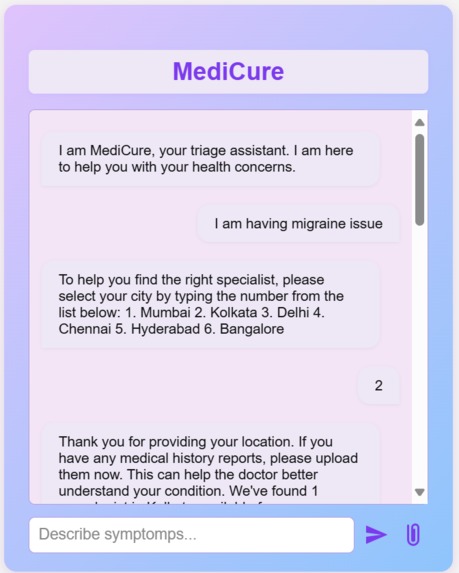
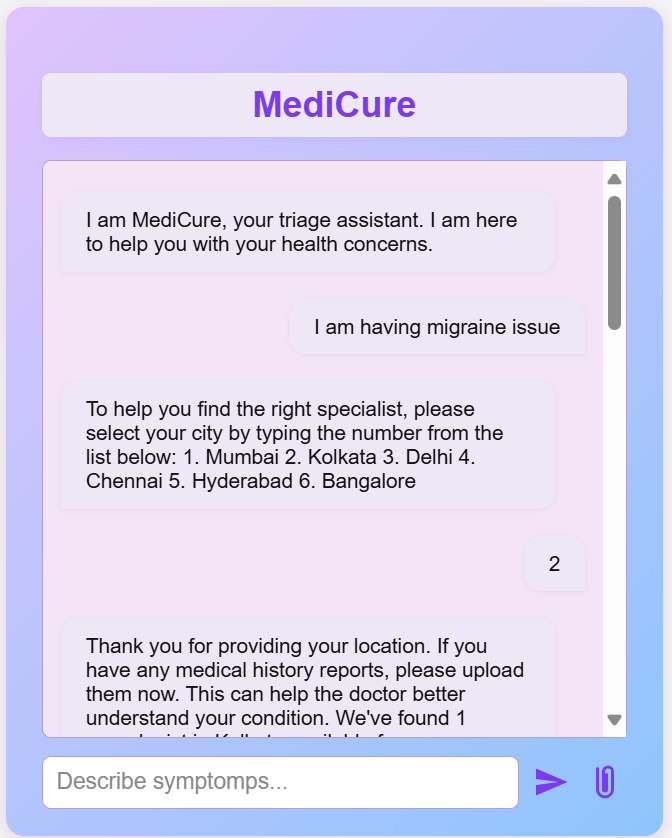
MediCure Chatbot Specialist Matching View
-
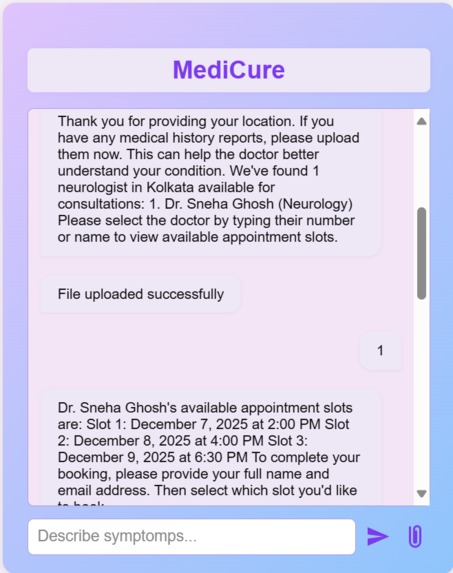
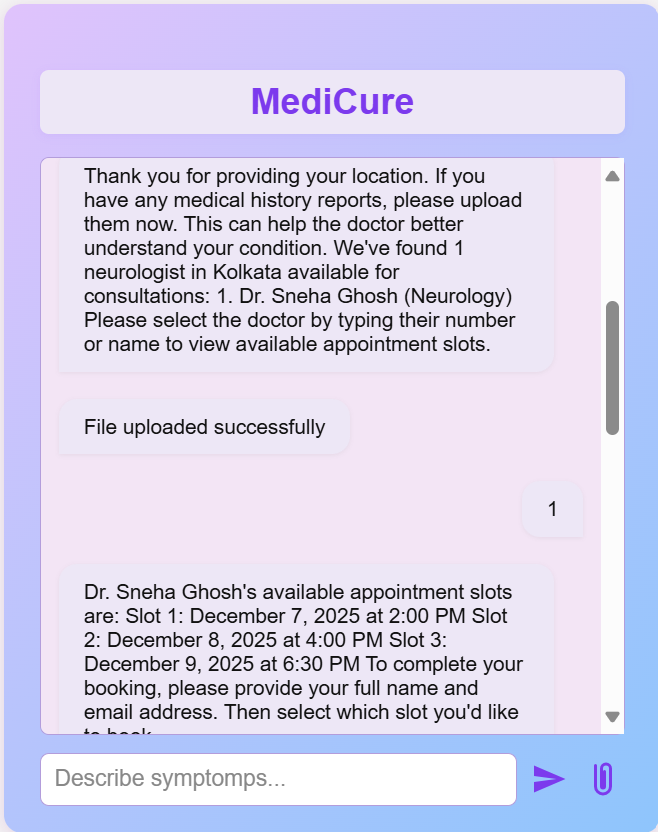
MediCure Chatbot Medical Report Upload View
-
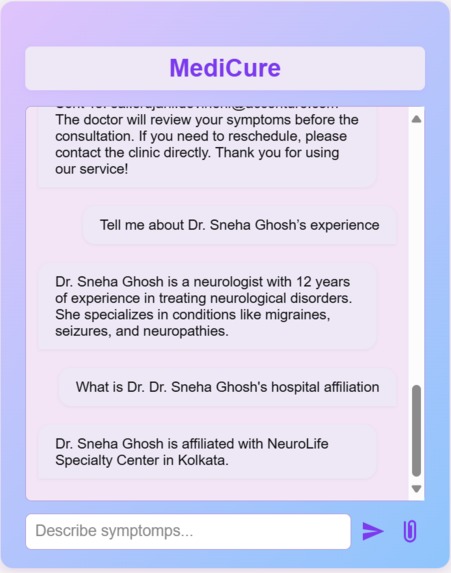
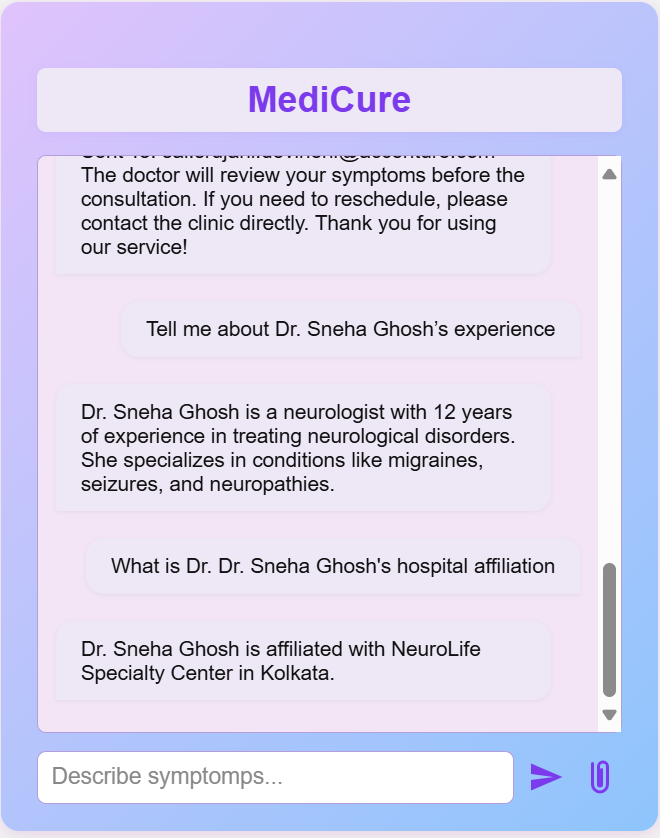
MediCure Chatbot QnA View
-
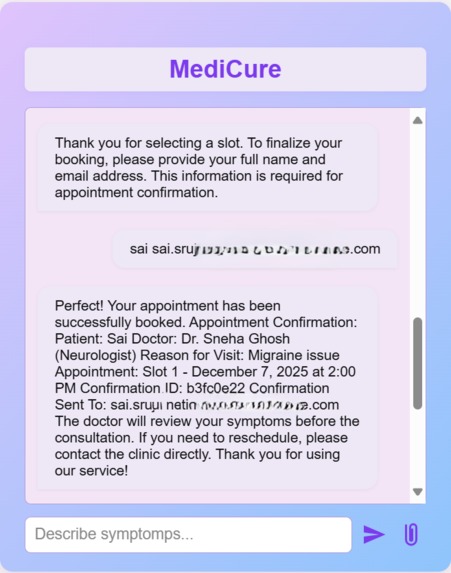
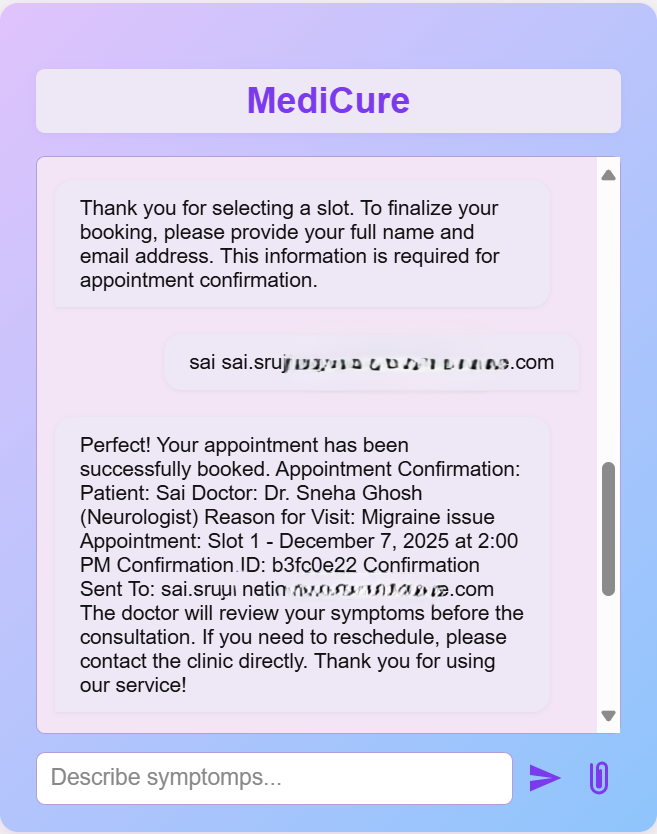
MediCure Chatbot Slot Confirmation View
-
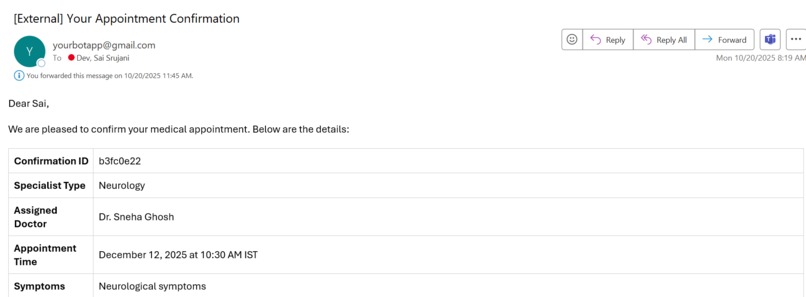
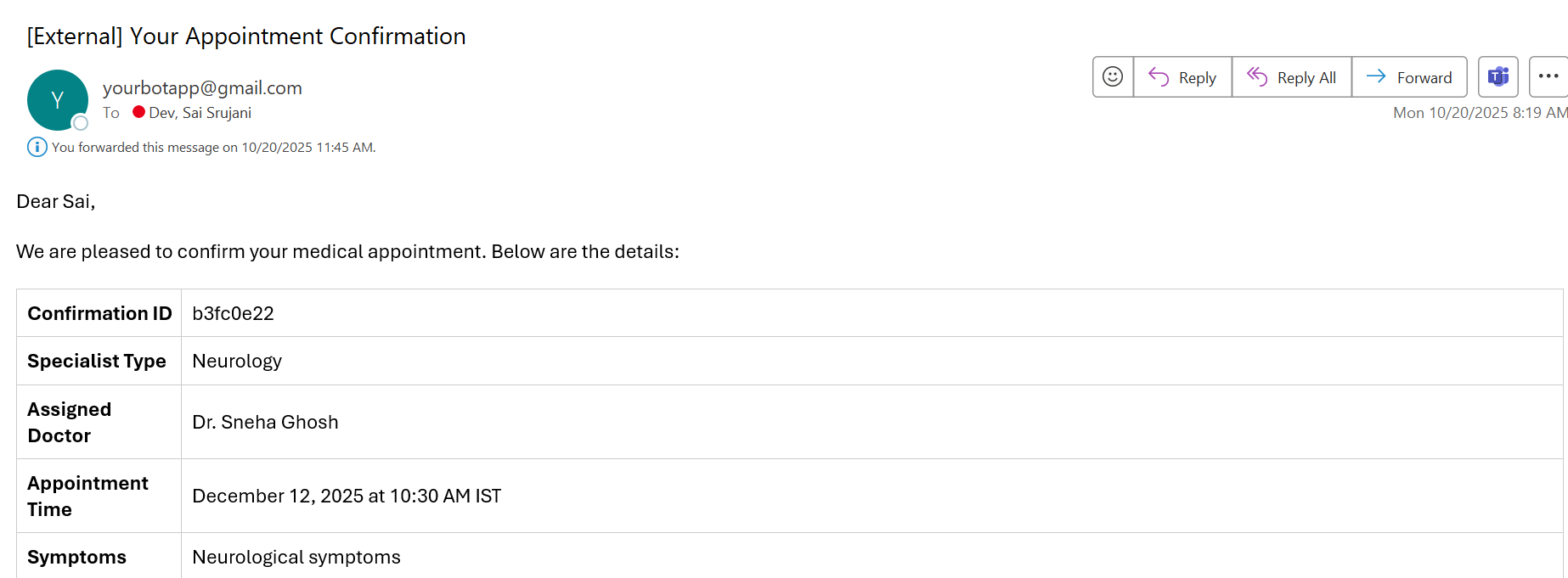
MediCure Appointment confirmation email View 1
-
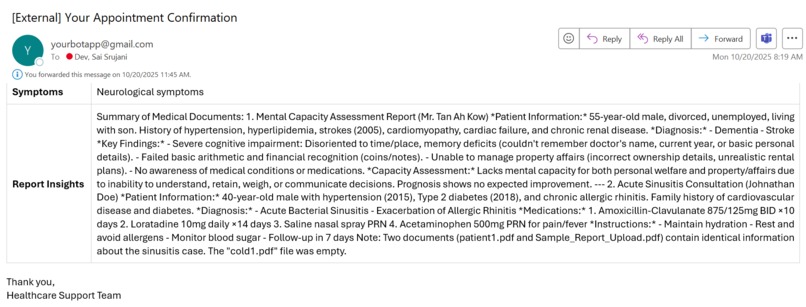
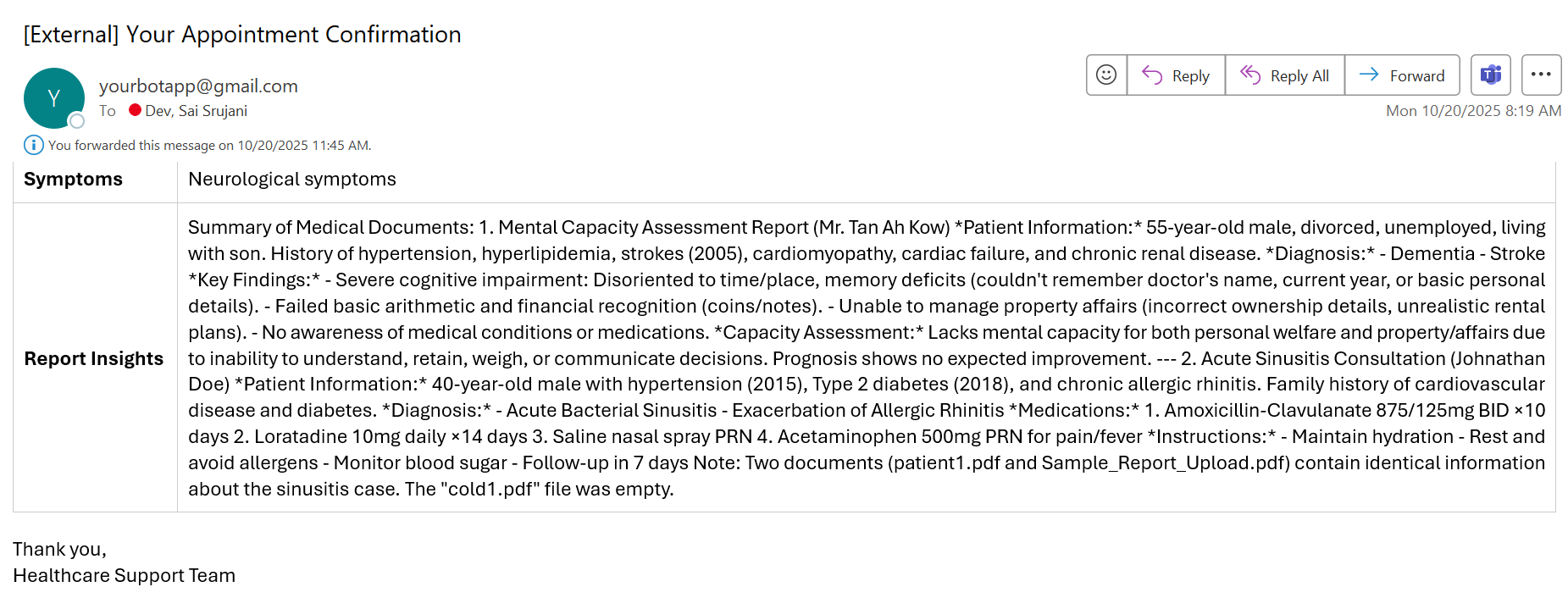
MediCure Appointment confirmation email View 2
-
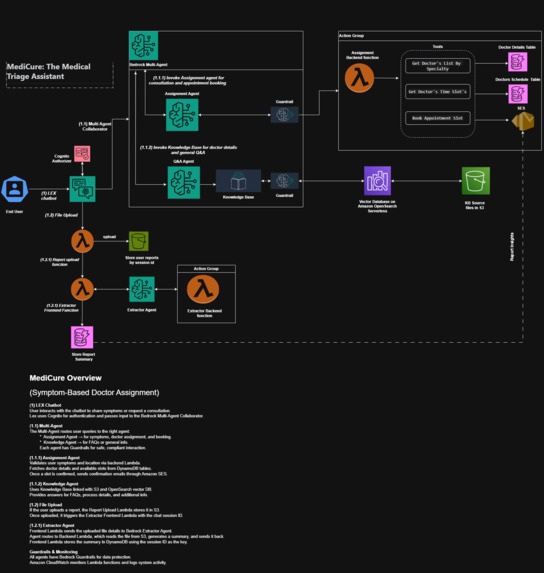
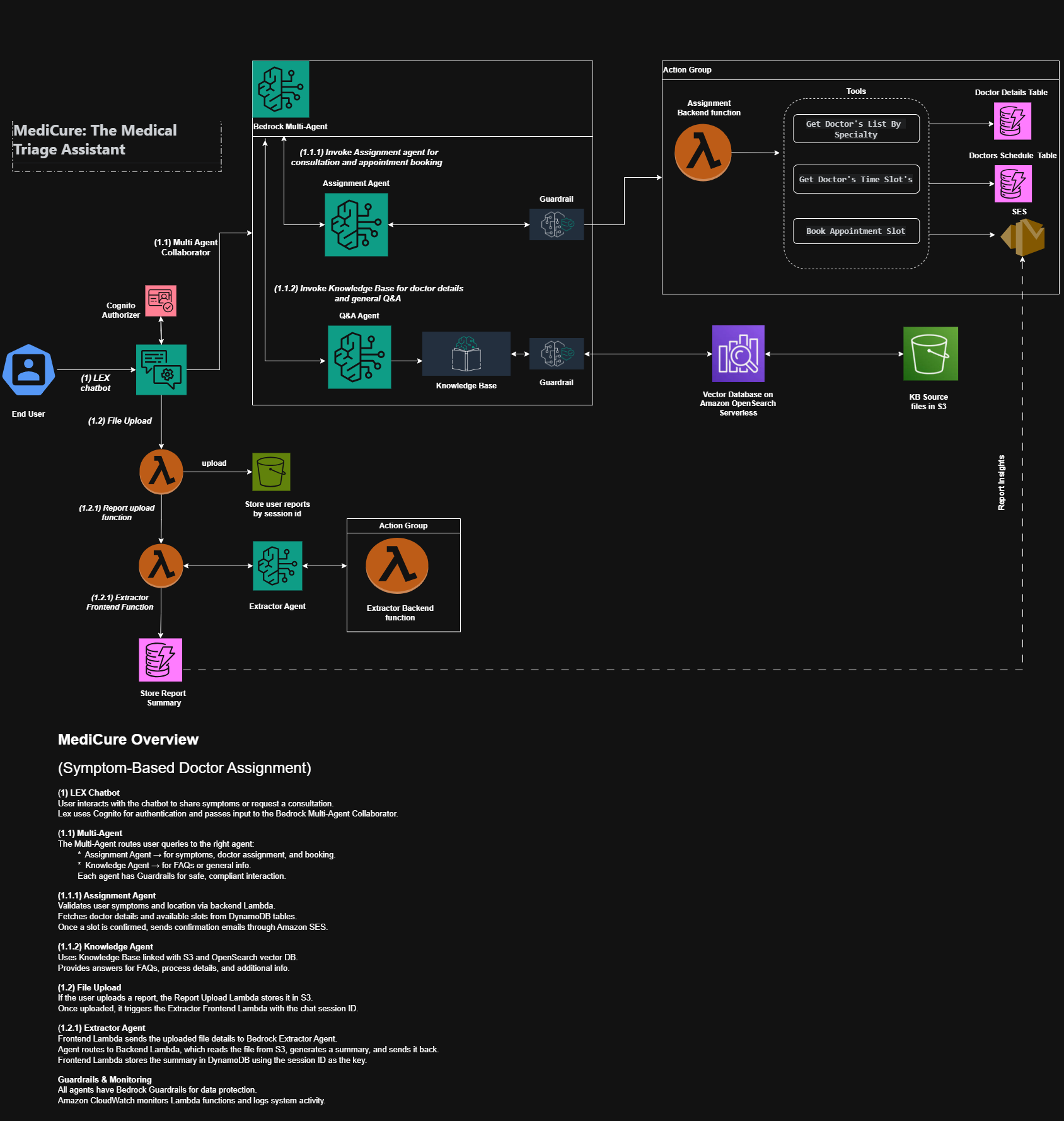
MediCure Architecture Diagram
Inspiration
In today’s healthcare systems, patients often struggle to identify the right specialist based on their symptoms. This leads to: Unnecessary general consultations Delayed access to specialist care Increased burden on administrative staff We were inspired by the potential of AI to automate this triage process — accelerating access to appropriate care, reducing manual workload, and improving continuity through structured patient history. To ensure ethical deployment, we followed Responsible AI principles, including safety filters via guardrails.
What it does
MediCure is an AI-powered healthcare triage assistant that:
- Accepts patient symptoms or medical reports (PDFs) via a conversational Amazon Lex chatbot
- Uses Amazon Bedrock Agent to interpret inputs and determine the appropriate medical specialty
- Matches patients with available doctors from a database
- Summarizes and stores patient history to support continuity of care This system reduces delays, minimizes manual triage, and helps doctors quickly understand patient context. It also leverages Retrieval-Augmented Generation (RAG) to ground AI responses in relevant process knowledge, improving accuracy and reducing hallucinations.
How we built it
We used a serverless, AI-driven architecture focused on simplicity, automation, and conversational access. The system integrates multiple AWS services to deliver intelligent triage, secure data handling, and seamless user experience. Below are the key components and their roles in the solution:
- Amazon Lex – Chatbot frontend for collecting symptoms and uploading medical reports
- Amazon Bedrock Agent – Core AI engine for interpreting inputs, assigning specialists, and summarizing symptoms/medical records.
- Amazon Nova Premier (Foundation Model) – Processes unstructured inputs (text or PDFs) and generates structured JSON outputs for triage and summarization
- AWS Lambda – Implements backend logic for doctor lookup, availability checks, and summary storage
- Amazon DynamoDB – Stores session data, doctor profiles and patient summaries
- Amazon S3 – Secure storage for uploaded medical reports
- Amazon SES – Sends confirmation emails to patients
- Amazon Cognito – Manages user authentication and access control
- Amazon OpenSearch – Vector store for knowledge base and semantic search, enabling RAG-based augmentation
- Amazon Guardrails – Enforces safety, content filtering, and responsible AI usage
Challenges we ran into
- Processing medical PDFs with LLMs → Required prompt engineering and document chunking to handle long reports and extract relevant data.
- Ensuring reliable structured outputs → Bedrock Agent needed to consistently return machine-readable JSON for downstream processing.
- Handling ambiguous symptoms → Some inputs didn’t clearly map to a specialty, so we implemented fallback logic to assign a general physician.
- Integrating Lex with backend AI → Seamless flow between Lex, S3, and Bedrock Agent required careful session and permission management.
Accomplishments that we're proud of
- Built a conversational AI assistant for intelligent medical triage
- Eliminated the need for traditional OCR/NLP by leveraging foundation models
- Designed a modular system with LLM orchestration and doctor matching
- Showcased how AI + conversational UI can enhance patient access and provider efficiency
What we learned
- LLMs can handle end-to-end workflows when guided with structured prompts and tools
- Lex is well-suited for healthcare triage, especially for accessibility-focused use cases
- Context handling and state management between Lex and backend services is a key to smooth user experience
- Prompt design is crucial — clear instructions yield consistent results
What's next for MediCure: AI-Powered Medical Triage Assistant
- Add support for follow-up questions within the Lex chatbot
- Integrate appointment scheduling with calendar and confirmation features
- Implement confidence thresholds for LLM decisions to enable human-in-the-loop review
- Expand to multilingual chatbot capabilities for broader accessibility
- Launch mobile voice/chat interfaces for real-time symptom triage
Built With
- amazon-bedrock
- amazon-cloudwatch
- amazon-dynamodb
- amazon-lex
- amazon-ses
- amazon-web-services
- aws-sdk
- cognito
- css3
- guardrails
- html5
- iam
- javascript
- json
- knowledge-base
- lambda-function
- lambda-function-url
- llm
- nova-premier-1.0
- python
- retrieval-augmented-generation(rag)
- s3

Log in or sign up for Devpost to join the conversation.