-
-
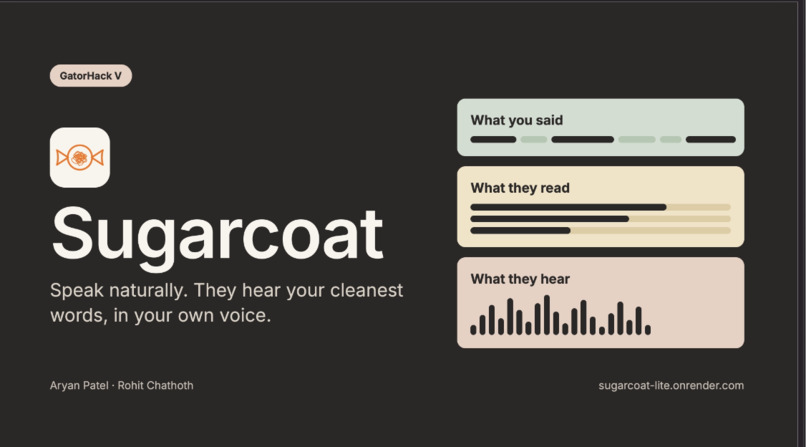
Welcome!
-
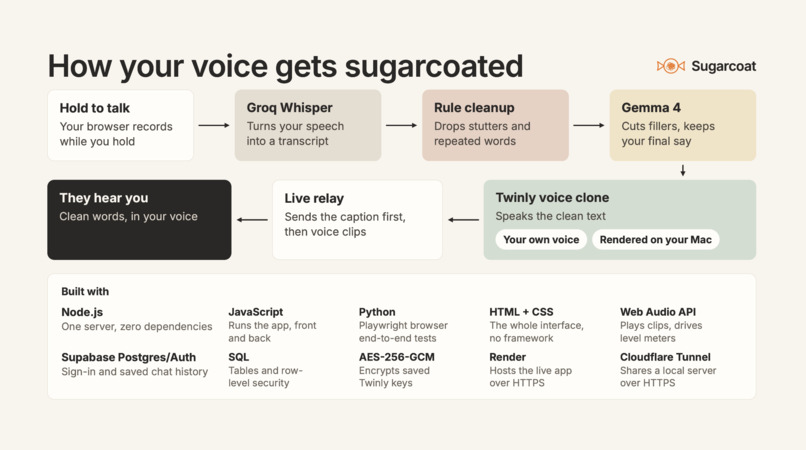
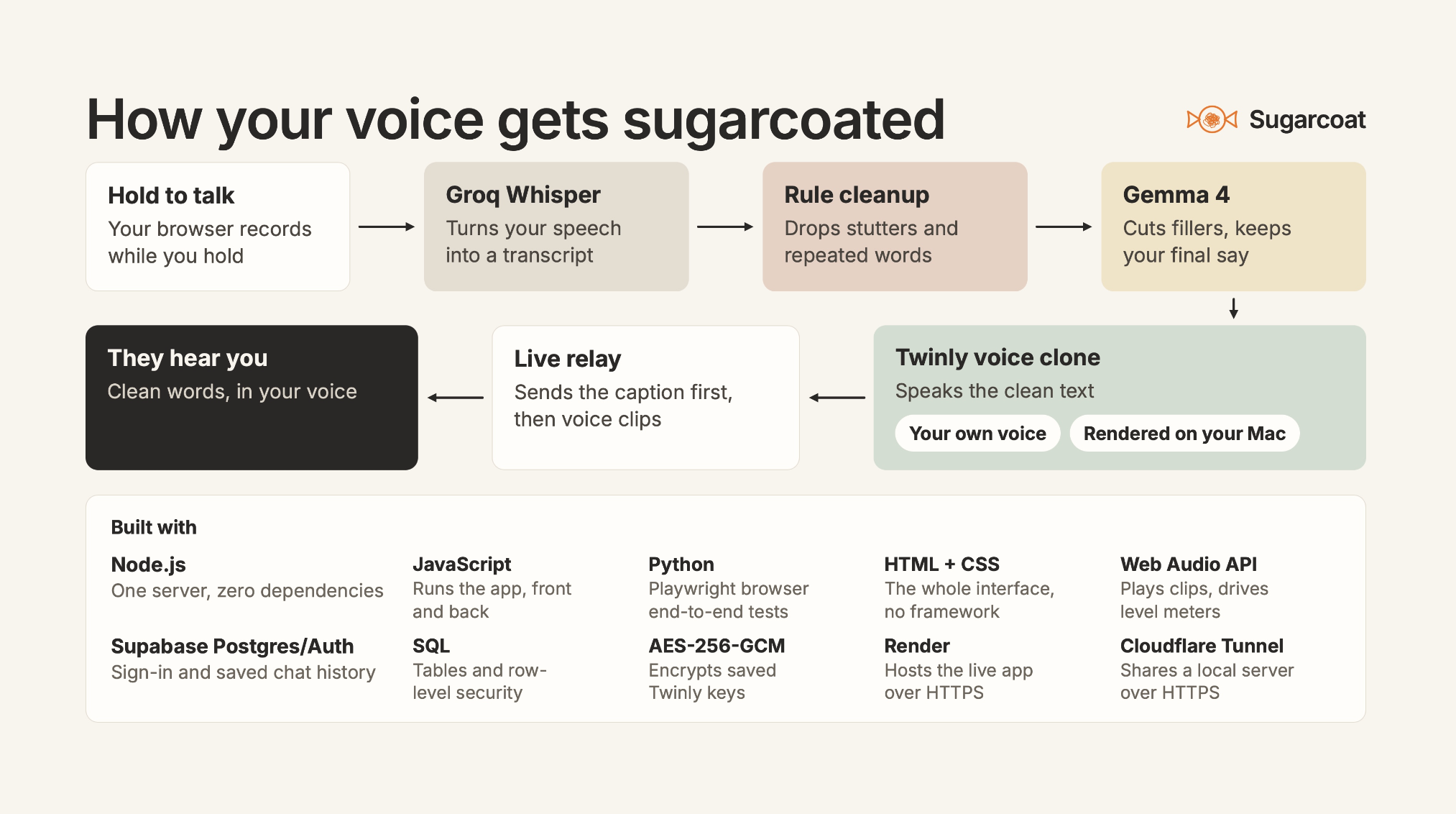
Our speech to sugar-coated speech pipeline!
-
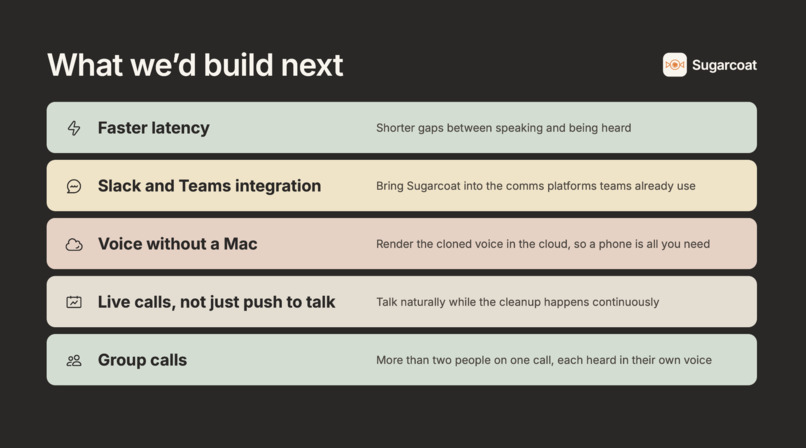
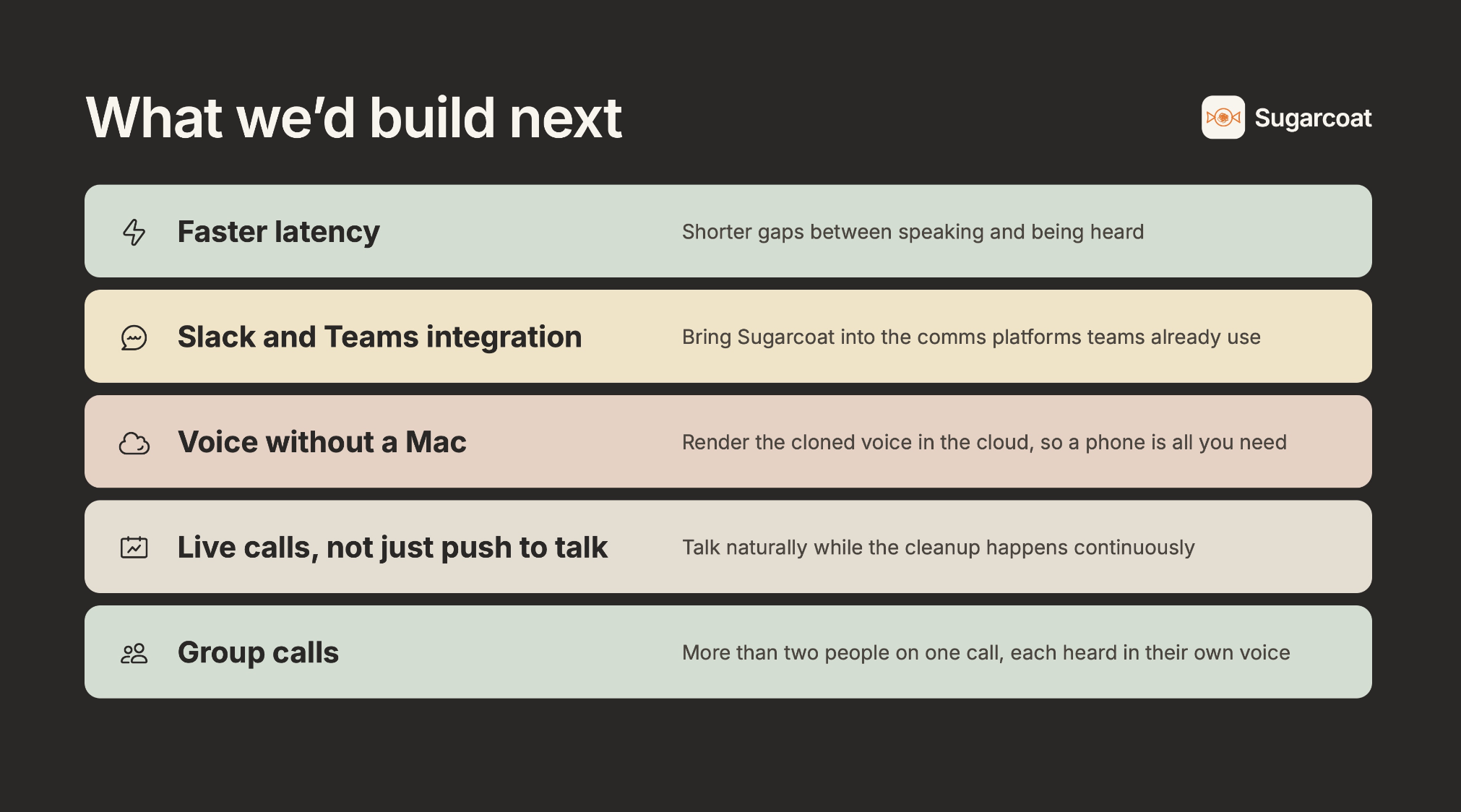
Future implementations.
Inspiration
We've all had that one coworker or teammate who makes us question our career choices. Sometimes, you just want to tell them exactly how you feel.
We built Sugarcoat to solve this problem. What if you could say exactly what's on your mind, with absolutely no filter, and still sound like the most professional person in the office?
What it does
Sugarcoat is a speech-to-speech tool that turns your unfiltered rants into polished, corporate-friendly communication, all in your own voice.
Simply record what you actually want to say. Sugarcoat takes your angry, frustrated, or wildly inappropriate workplace rant and transforms it into a cheerful, diplomatic, and excessively professional message.
Your coworker hears a respectful, collaborative team player. You get the satisfaction of saying what you really think.
Speak your mind. Keep your job.
How we built it
We built Sugarcoat by combining speech recognition, AI-powered text rewriting, and voice cloning into a real-time messaging platform.
Here's how it works:
Record your voice: Users hold a button to record their unfiltered thoughts using the browser's MediaRecorder API.
Transcribe the audio: We use Groq Whisper to convert speech into text, then clean up filler words, stutters, and repetitions.
Sugarcoat the message: The transcript is sent to Google Gemma 4, which transforms angry or unprofessional language into cheerful, corporate-friendly communication while preserving the original context.
Clone the voice: We use Twinly to turn the rewritten text back into speech using the sender's own voice. Voice generation runs locally on a Mac.
Deliver the message: We deliver the transformed text and audio to the recipient, allowing them to read and hear the sugarcoated message.
For the application itself, we used Node.js, JavaScript, HTML, and CSS. Supabase handles authentication and PostgreSQL database storage, Render hosts our backend, and Cloudflare Tunnel connects our local voice generation system to the deployed app. We also use AES-256-GCM encryption to protect messages.
The result is a messaging experience where you can say exactly what you're thinking while your coworkers hear the most professional version of you.
Challenges we ran into
Our biggest challenge was reducing latency. Since Sugarcoat is a speech-to-speech communication tool, we wanted conversations to feel as natural and responsive as possible.
Our first version used a Python/FastAPI backend with several AI processing steps. Audio was transcribed locally, passed through multiple AI checks, rewritten, and finally converted back into speech. While it worked, the entire process was too slow for real-time communication.
To fix this, we completely rebuilt our backend using Node.js and simplified the pipeline.
- Faster transcription: We replaced our local speech recognition model with Groq Whisper, bringing transcription time down to approximately 500 milliseconds.
- Fewer AI calls: We eliminated unnecessary processing and approval steps, using lightweight rules for basic cleanup and Gemma 4 for rewriting.
- Optimized AI processing: We configured Gemma for minimal thinking, bringing text processing time down to approximately 1.9 seconds.
- Improved responsiveness: We streamlined requests and introduced cancellation handling to prevent outdated messages from playing.
After these changes, our entire speech-to-speech pipeline takes approximately 6.8 seconds, with voice cloning accounting for around 4.4 seconds.
Another challenge was supporting two-person conversations without users blocking each other. We implemented per-user voice-generation queues and adjusted our message delivery system after discovering that Cloudflare Tunnel was buffering Server-Sent Events (SSE). For call mode, we switched to long-polling to ensure reliable message delivery.
Our biggest remaining limitation is voice generation. Twinly produces complete audio clips rather than streaming audio, so playback cannot begin until the entire clip is ready.
Ultimately, we learned that making AI feel fast isn't just about choosing faster models. It's about designing a smarter pipeline and eliminating unnecessary steps.
Accomplishments that we're proud of
We're particularly proud of turning a simple, relatable workplace frustration into a fun and intuitive AI experience.
Rather than just censoring profanity or removing negativity, Sugarcoat completely reimagines hostile communication as enthusiastic corporate positivity.
We're also proud of the contrast between the original recording and the transformed output. Hearing someone furiously complain about a teammate, only for the final message to sound like an appreciation speech in their own voice, captures exactly what makes Sugarcoat entertaining.
Beyond the humor, we're proud of building a working speech-to-speech platform that combines transcription, AI rewriting, voice cloning, and two-person communication into a single experience.
What we learned
We learned that prompt engineering can dramatically change how AI interprets emotional intent.
Getting an LLM to make something professional is relatively straightforward. Getting it to consistently transform anger into humorously exaggerated positivity, while keeping the message short and contextually relevant, requires much more experimentation.
We also learned the importance of latency optimization and system architecture. Combining multiple AI services into a responsive application requires more than just connecting APIs. Every processing step matters, and simplifying the pipeline can make a significant difference in the user experience.
Most importantly, we learned that AI applications don't always have to solve serious problems in serious ways. Sometimes the best ideas come from taking an everyday frustration and making it ridiculous.
What's next for Sugarcoat
We want to make Sugarcoat faster, more accessible, and easier to integrate into everyday workplace communication.
Here's what we're planning next:
Reduce latency: Further optimize our speech-to-speech pipeline to make conversations feel more natural, with less delay between speaking and hearing a response.
Slack and Microsoft Teams integration: Bring Sugarcoat directly into the communication platforms teams already use.
Cloud-based voice cloning: Move voice generation from a local Mac to the cloud, allowing users to access Sugarcoat from anywhere, including their phones.
Real-time conversations: Move beyond push-to-talk voice messages toward continuous conversations where speech is automatically transformed as users talk.
Group calls: Expand beyond two-person conversations to support entire teams, with everyone's messages delivered in their own cloned voice.
Ultimately, our goal is to make Sugarcoat a seamless communication layer that lets anyone speak freely while keeping every conversation workplace-friendly.
Sugarcoat. Speak your mind. Keep your job.
Built With
- cloudflaretunnel
- css
- html
- javascript
- mediarecorderapi
- node.js
- render
- sql
- supabaseauth
- supabasepostgres


Log in or sign up for Devpost to join the conversation.