-
-
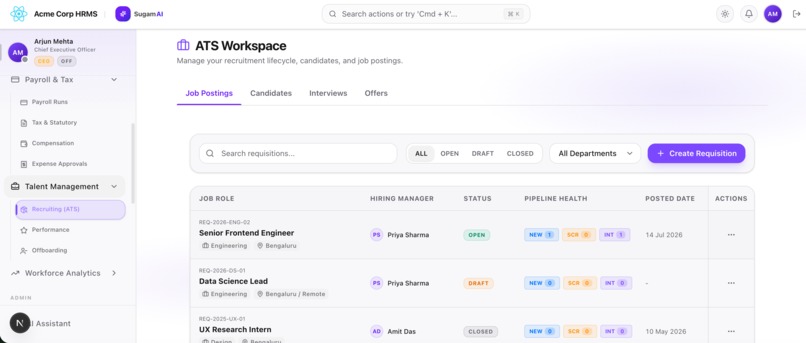
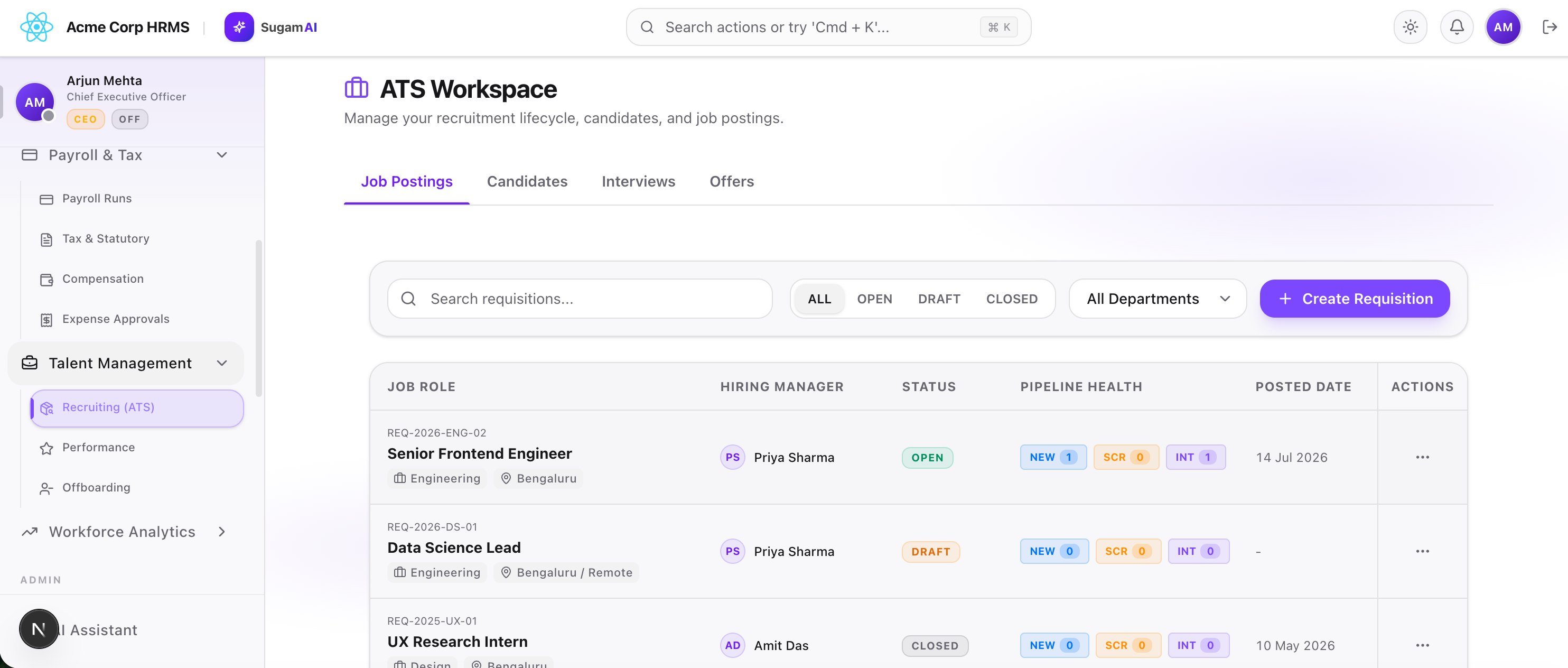
Full recruitment lifecycle — create requisitions, track pipeline health, and manage candidates from sourcing to offer.
-
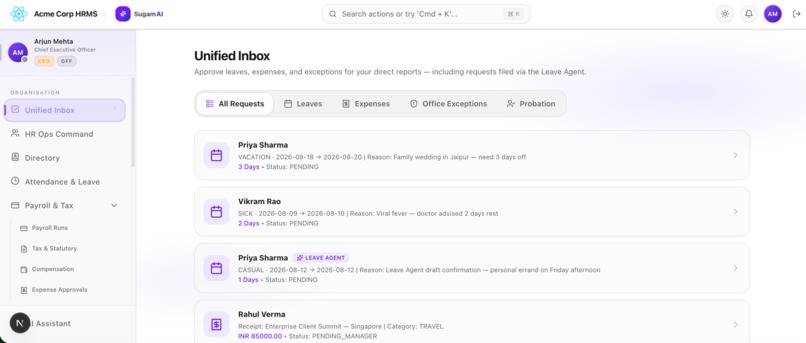
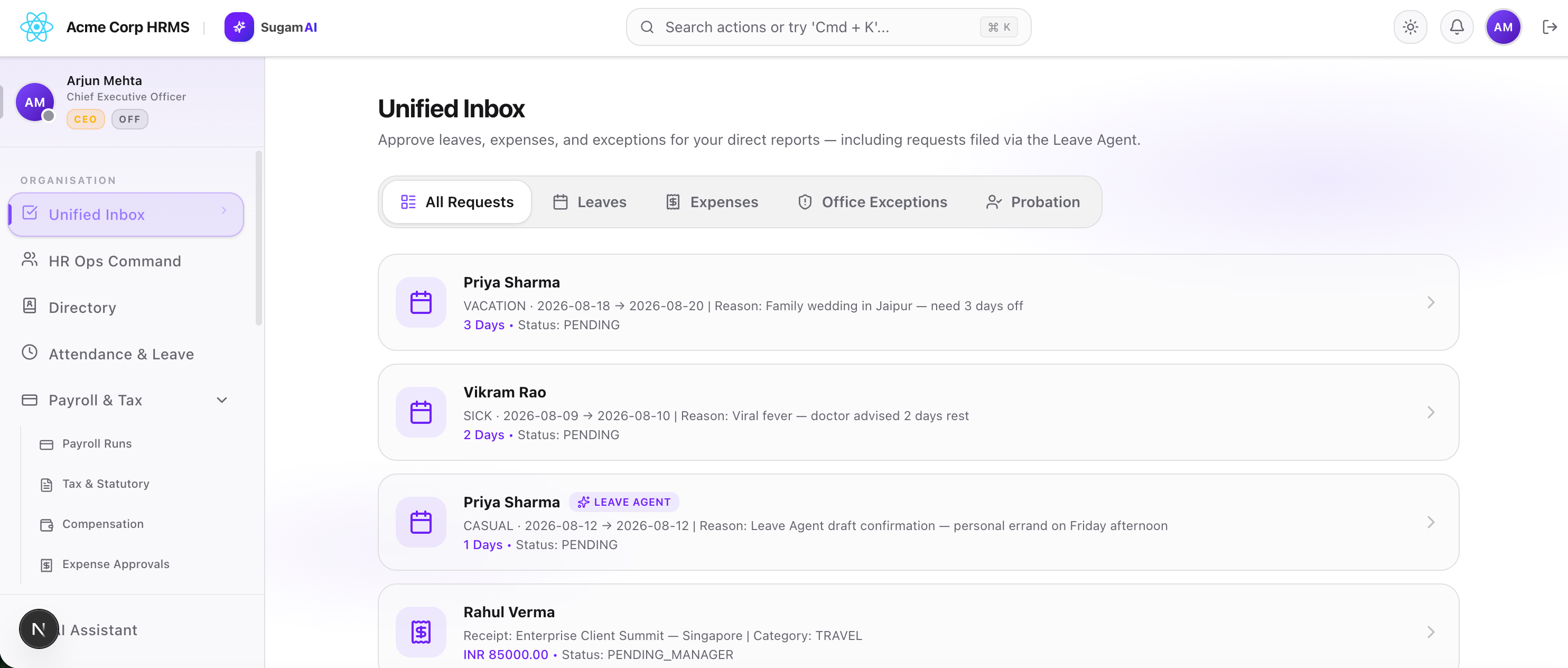
One inbox to approve leaves, expenses, and AI-filed requests from direct reports — with smart filters by category.
-
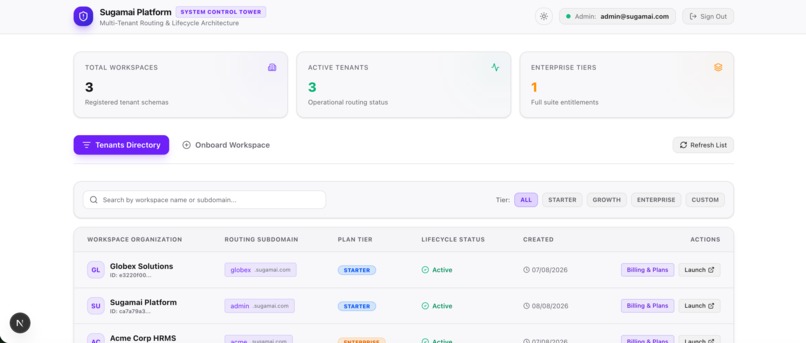
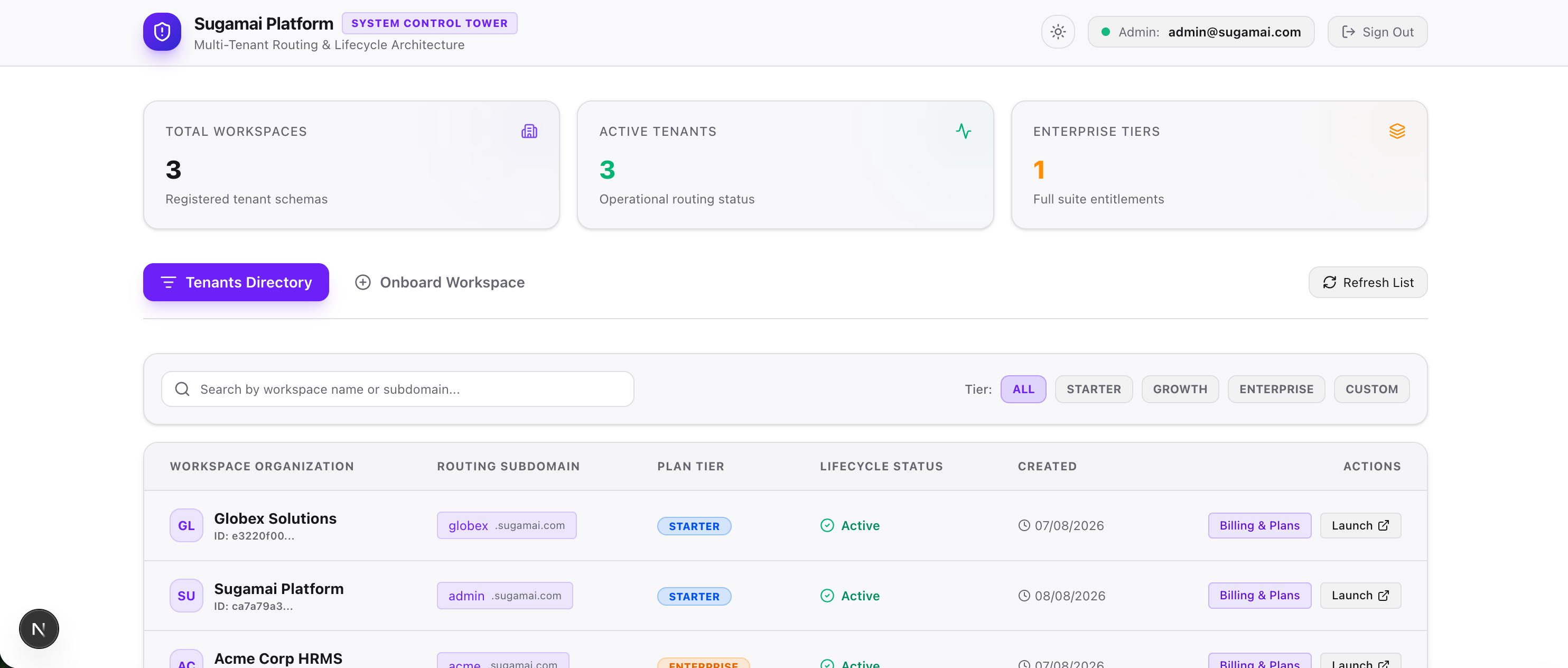
Multi-tenant admin console to manage workspaces, routing subdomains, plan tiers, and tenant lifecycle at scale.
-
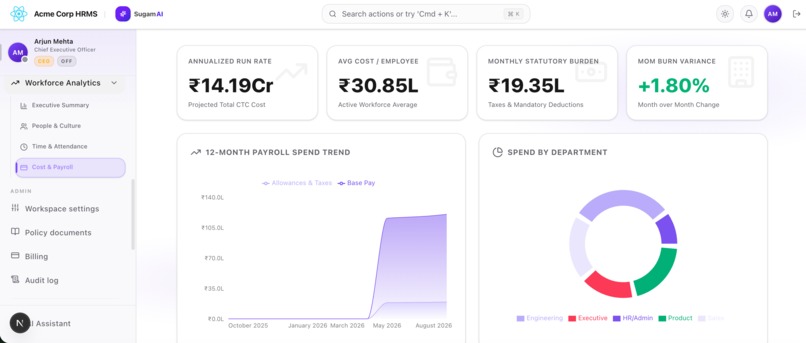
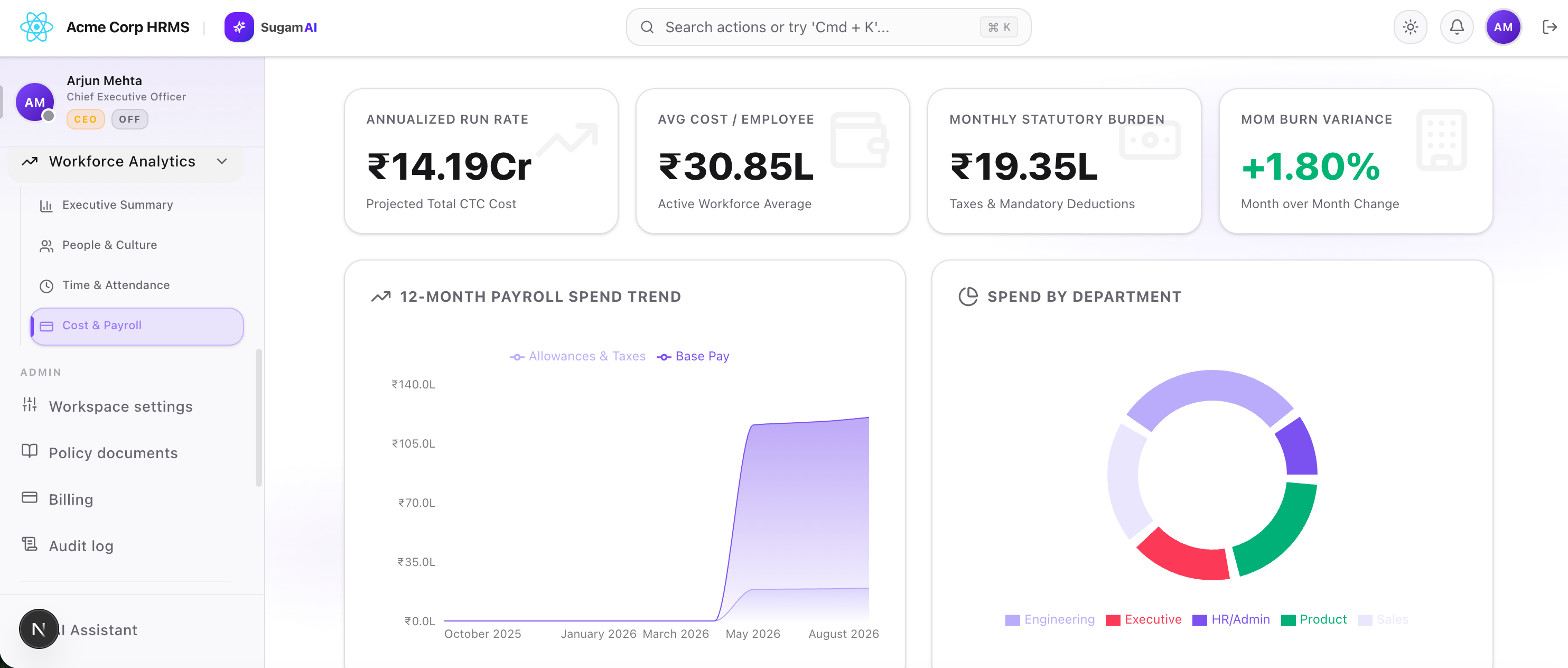
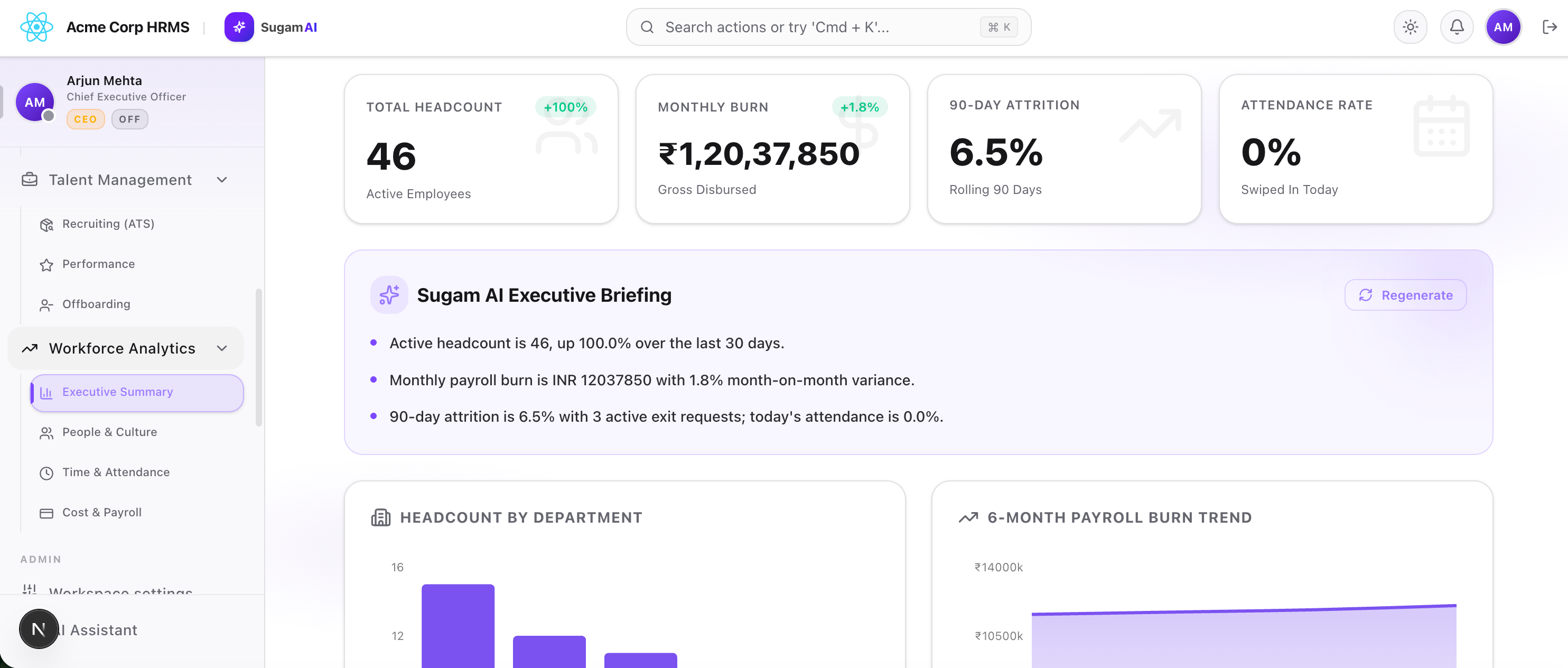
Executive CHRO dashboard with annualized payroll trends, department spend breakdown, and month-over-month burn variance.
-
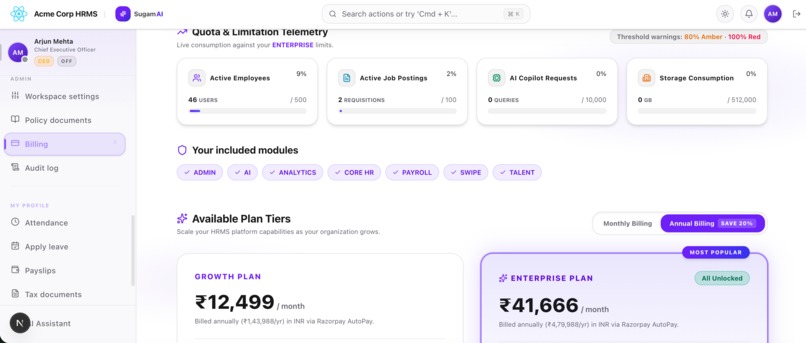
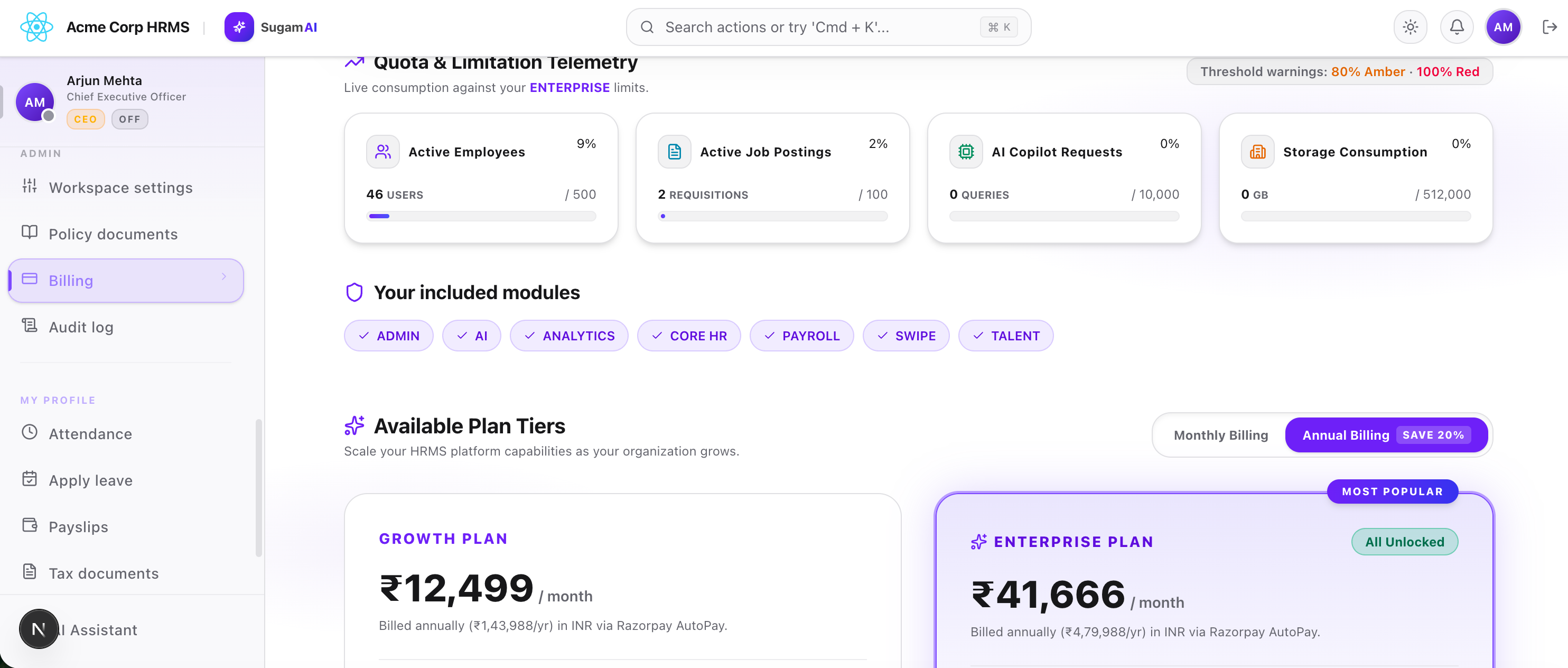
Live usage telemetry against plan limits, modular entitlements, and tiered pricing with Razorpay-powered billing.
-
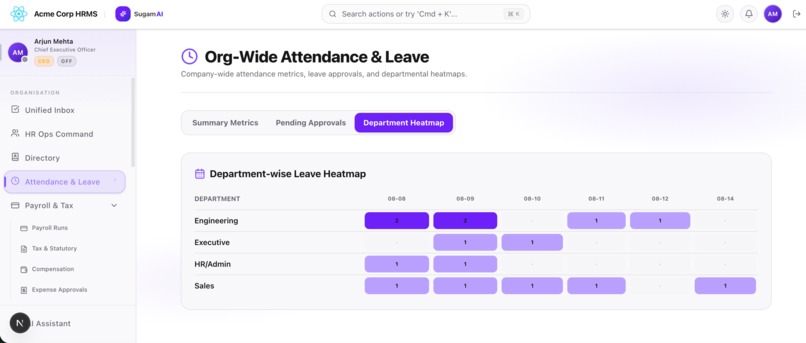
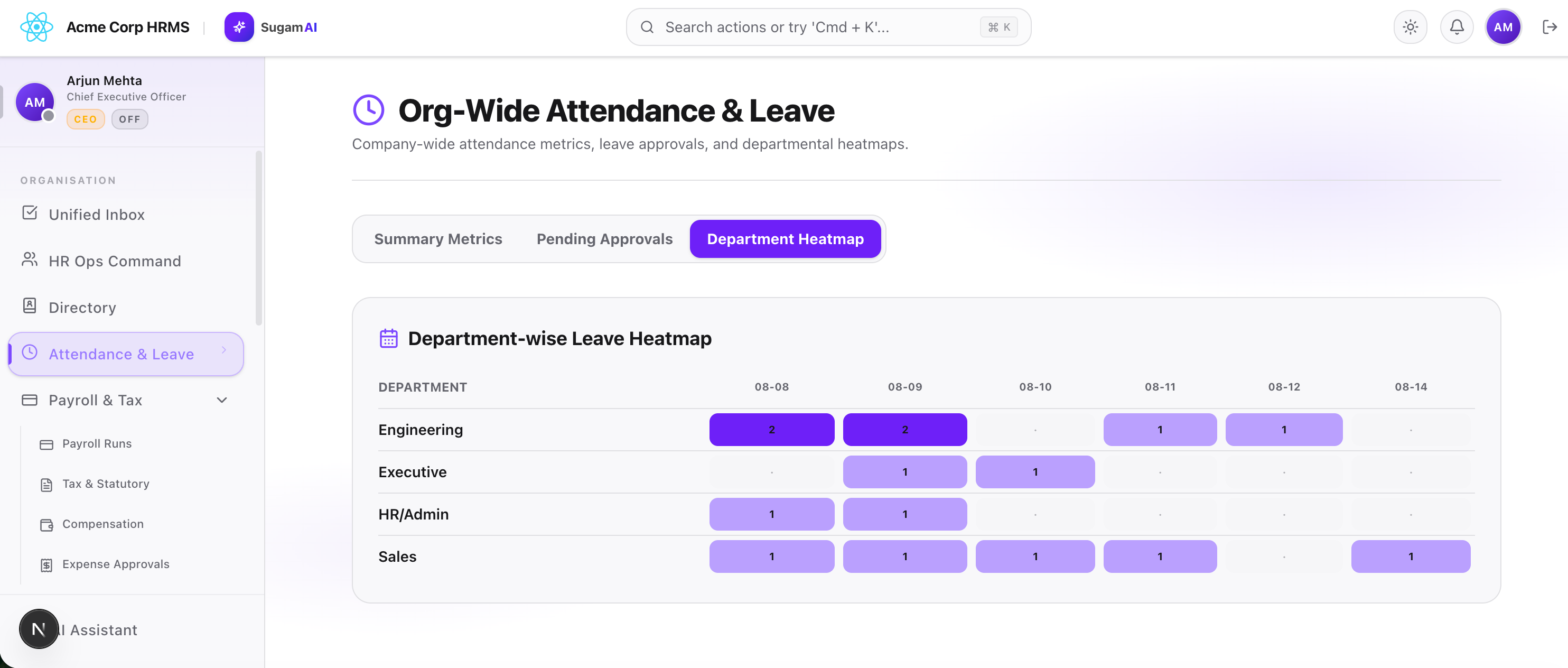
Department-wise leave heatmap with color-coded density — spot staffing gaps across Engineering, Sales, and HR at a glance.
-
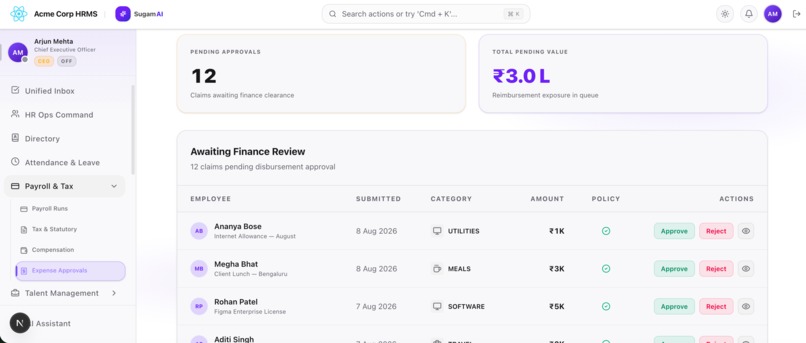
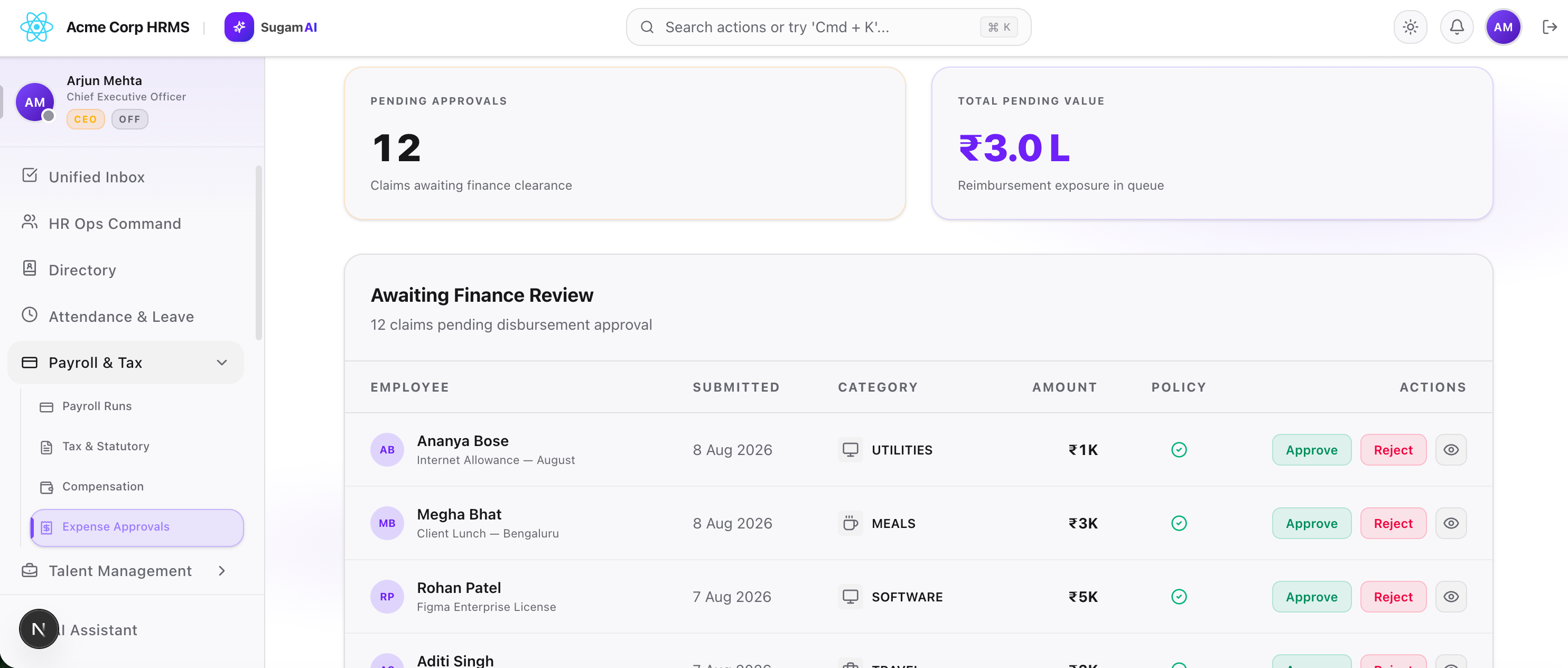
Finance review queue for manager-cleared claims — approve or reject with one click, with live pending value exposure.
-
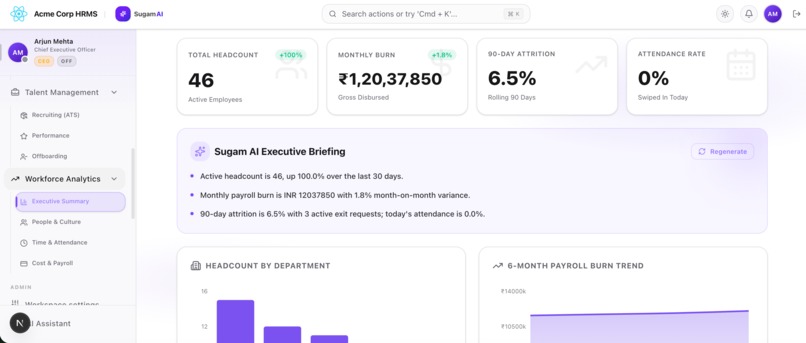
AI-generated CHRO briefing with headcount, payroll burn, attrition rate, and department analytics — regenerate on demand.
-
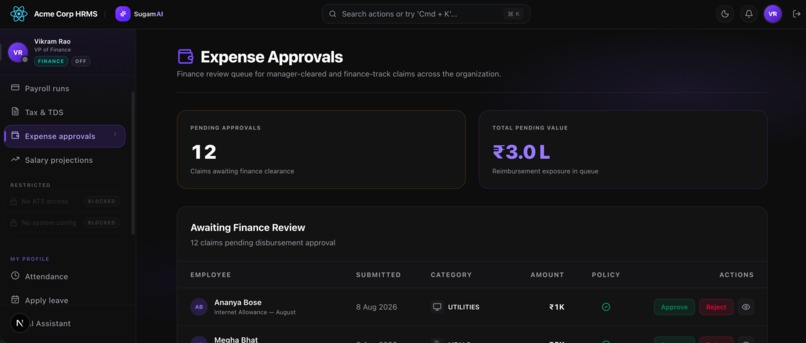
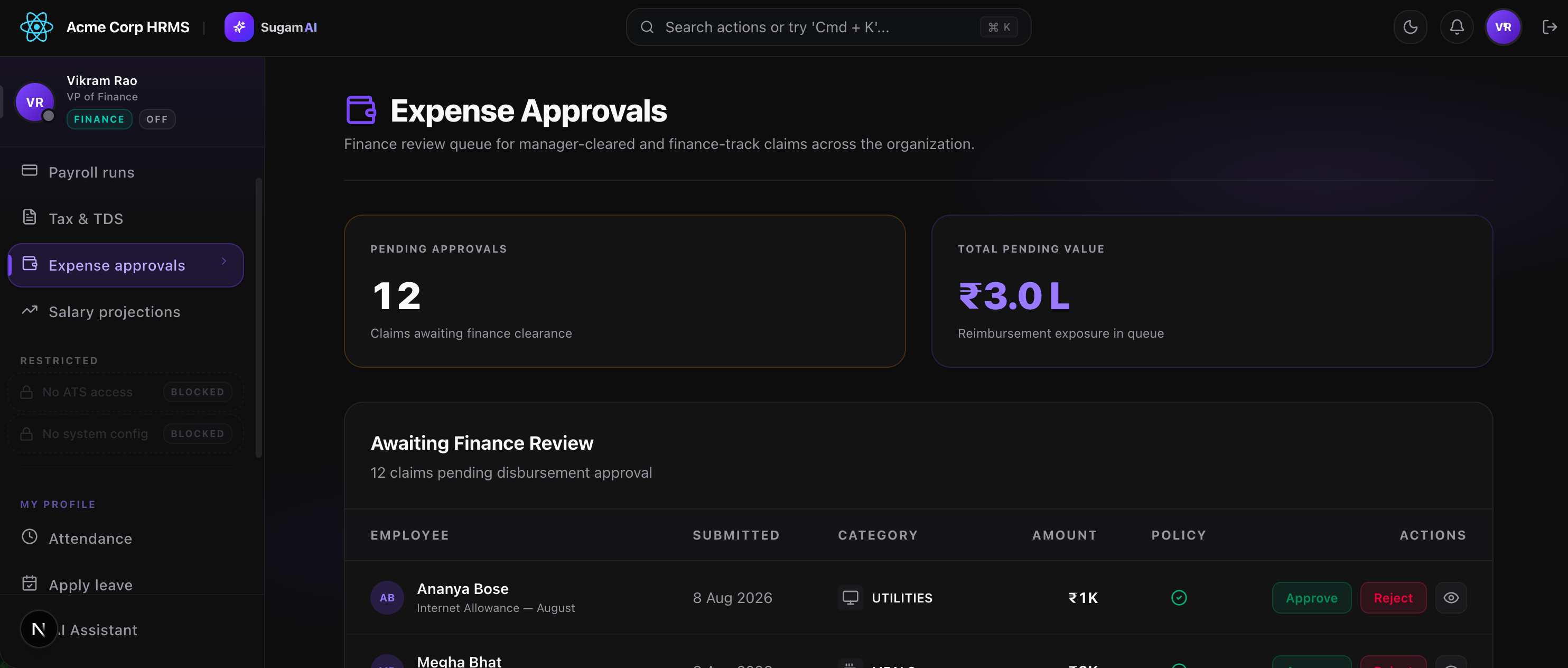
Role-based view for VP Finance — same approval queue, but with RBAC-restricted sidebar hiding ATS and system config.
-
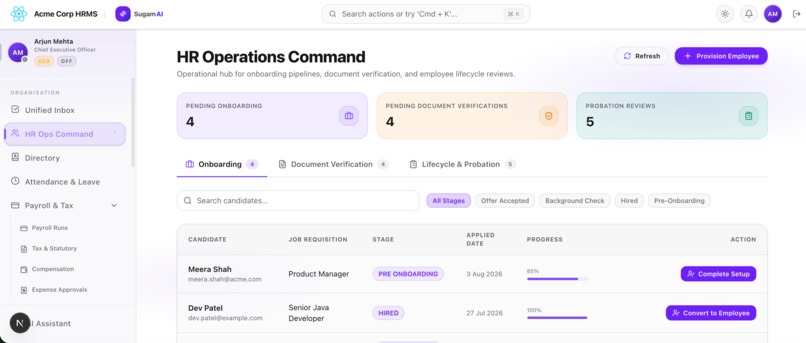
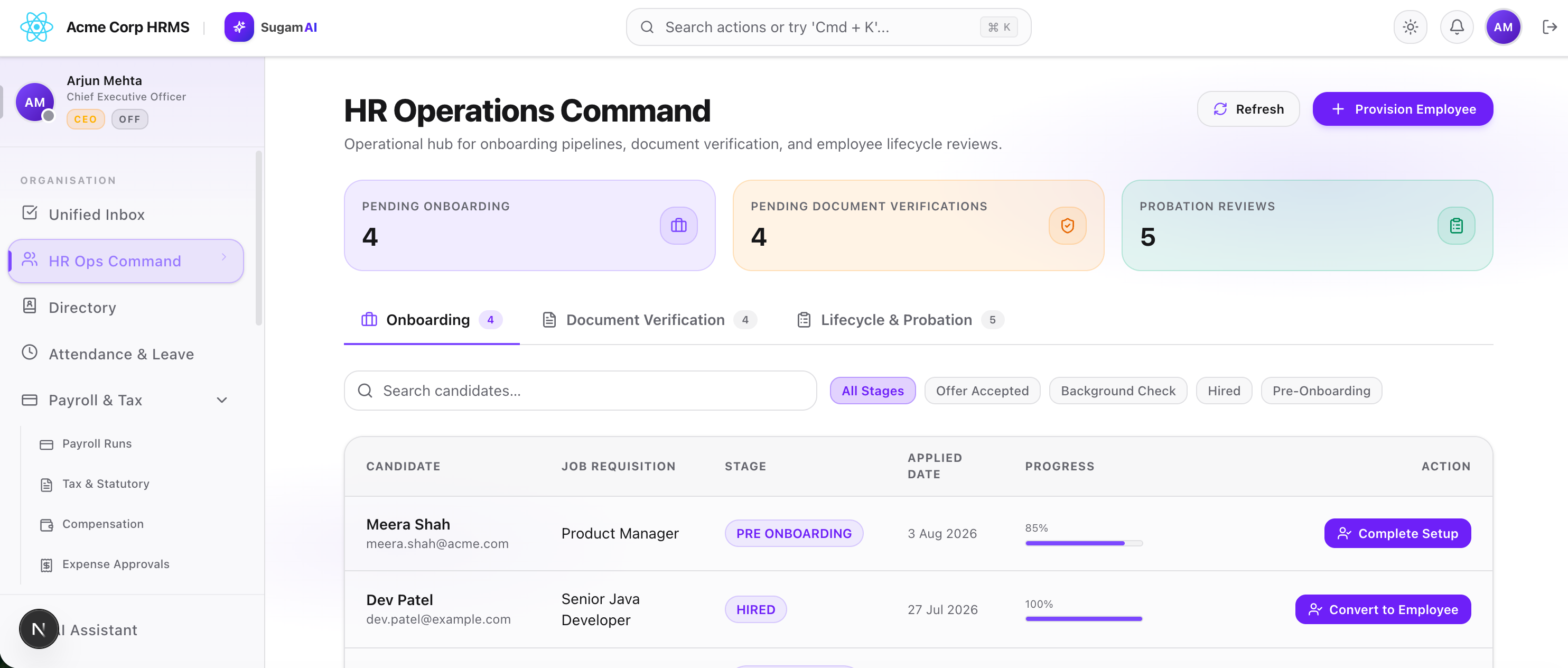
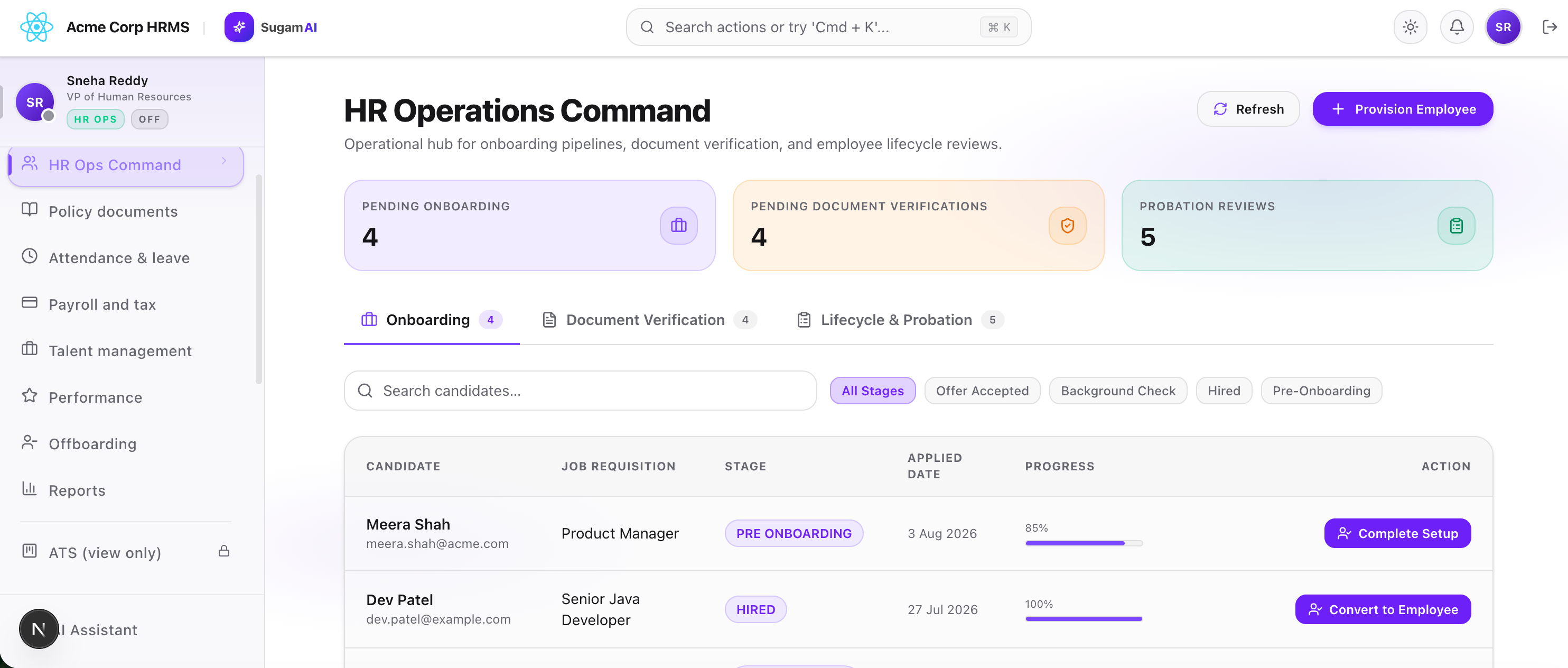
Onboarding pipeline tracking candidates from offer acceptance through document verification to employee conversion.
-
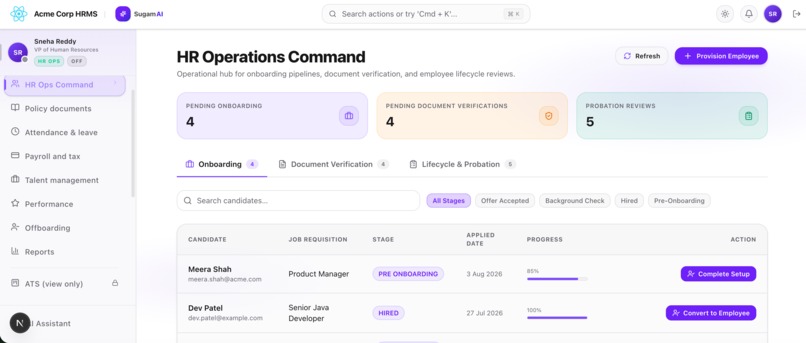
Org-wide operational hub for the VP of HR to monitor pending onboarding, document verification pipelines, and probation reviews.
-
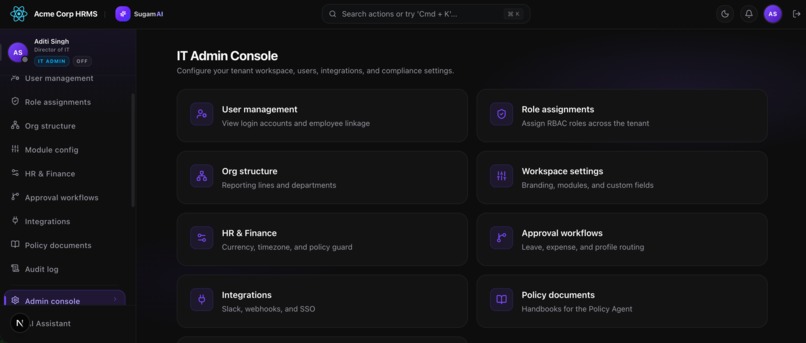
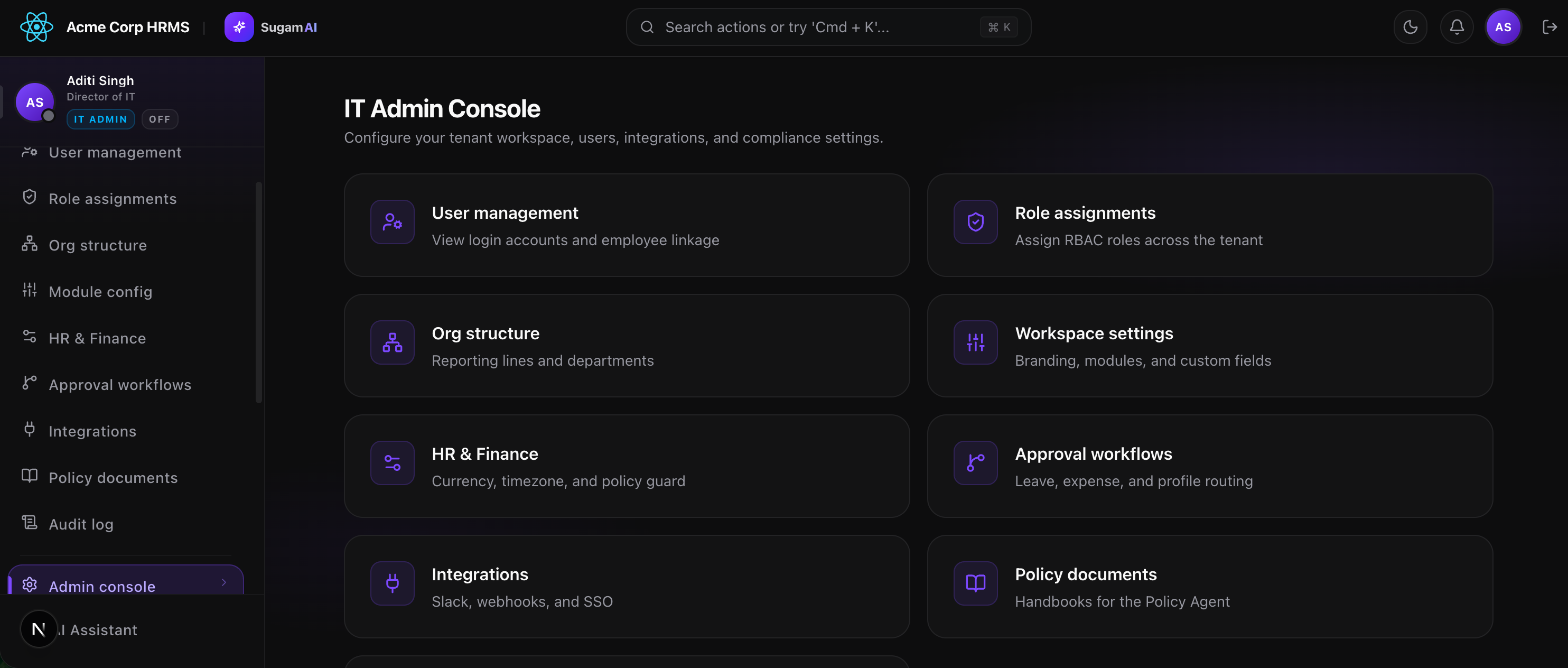
Centralized tenant configuration for user management, role-based access control (RBAC), org structure, and integration webhooks.
-
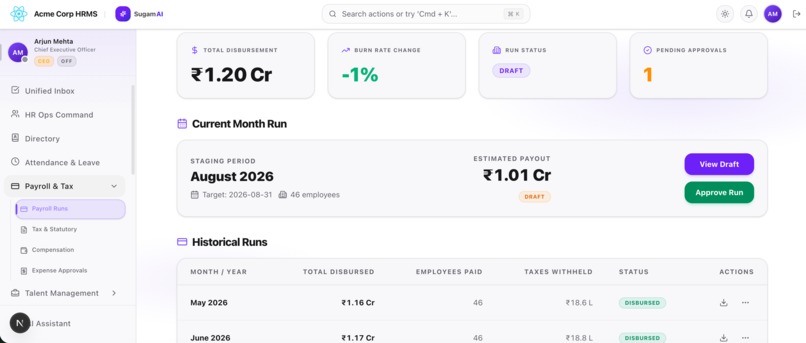
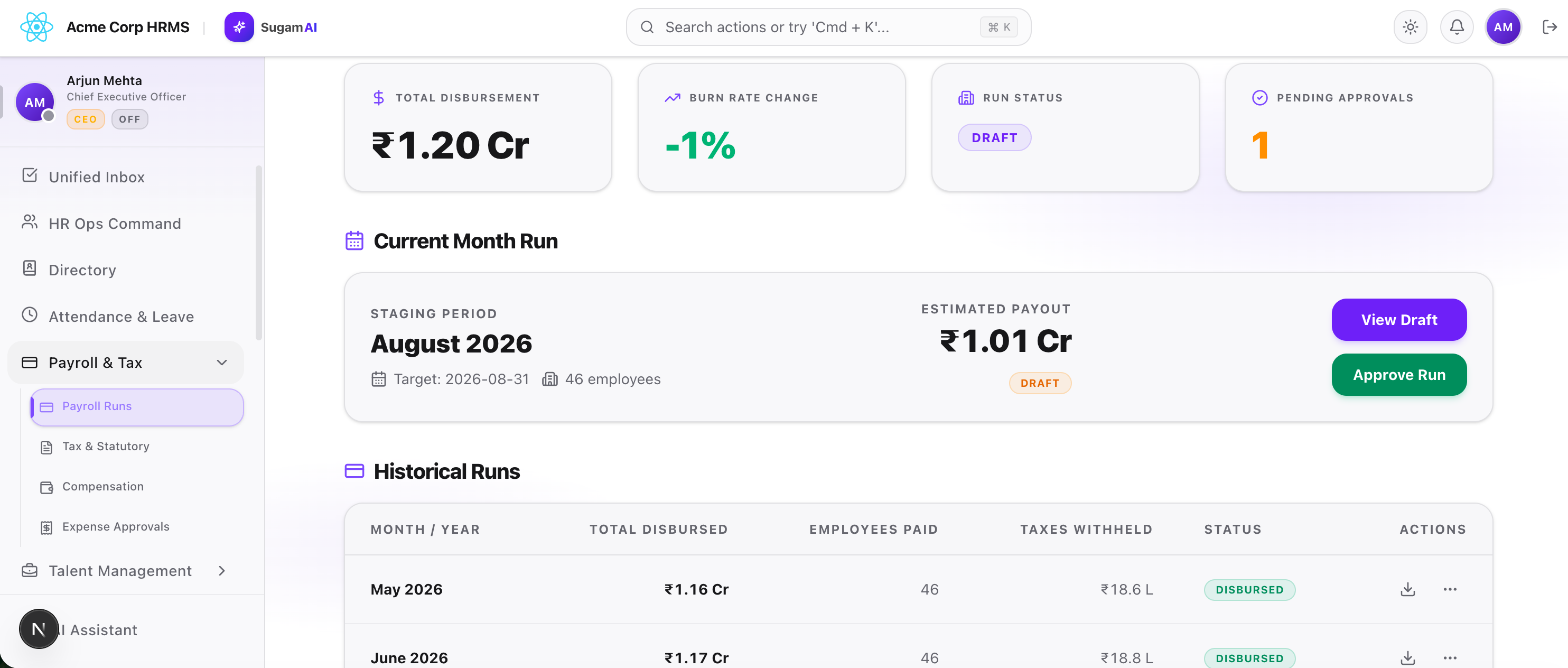
Full payroll processing engine view draft payout estimates, analyze month-over-month burn rate changes, and track historical disbursements.
-
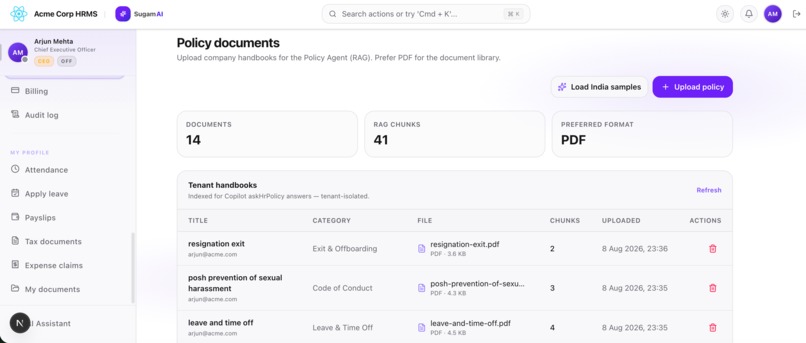
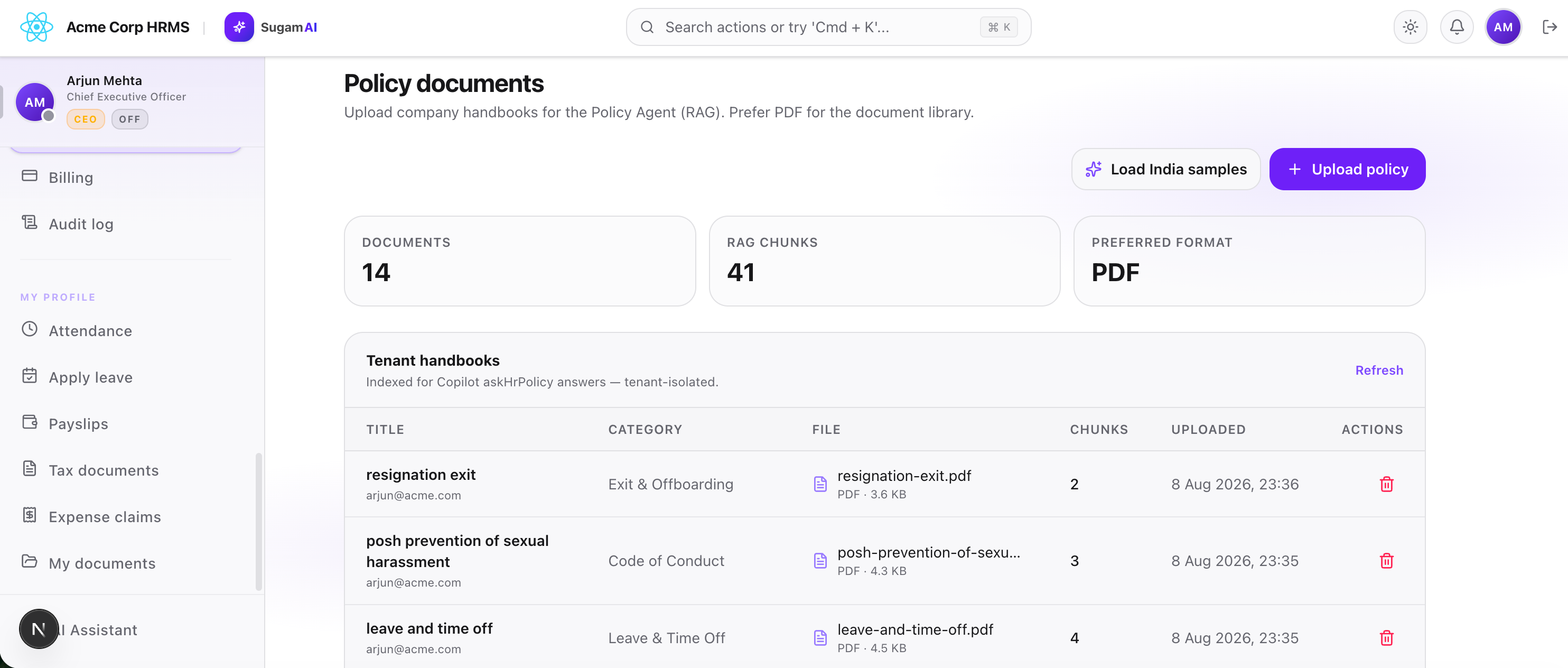
Knowledge base ingestion hub — upload PDF handbooks that are automatically chunked and indexed into pgvector for the Policy RAG Agent.
Inspiration
Working closely with AI and Large Language Models, I noticed a distinct gap in the B2B market. While large corporations have the capital to deploy massive, AI-driven ERP systems, small and medium enterprises (SMBs) are often left with fragmented, manual tools. I wanted to build an "agentic" HRMS that allows SMBs to optimize their resources and compete with larger firms. However, a major constraint for small businesses is operational cost. Therefore, the core inspiration was to build a powerful, multi-agent platform that strictly minimizes LLM token consumption to maintain viable, startup-friendly unit economics.
What it does
Sugam AI is an Agentic AI-First Enterprise HRMS. Instead of forcing managers to navigate clunky static forms or read paragraphs from a text-chatbot, the platform uses a Universal Orchestrator to emit Generative UI (GenUI) cards directly onto the user's canvas.
It acts as an autonomous HR department through eight specialized agents:
- Semantic Recruitment Copilot: Uses vector similarity to shortlist candidates and draft interview invites and outreach emails.
- Leave & Attendance Agent: Calculates exact business days and drafts time-off requests.
- Compensation & Finance Agent: Projects tax/TDS from real payroll data and files expense claims.
- Data Alignment Agent: Ingests legacy CSV rosters, auto-maps schemas, and masks sensitive PII.
- Finance Anomaly Guardrail: Runs statistical audits on payroll and expense claims to flag irregularities.
- Policy RAG: Answers handbook queries with exact PDF citations and walks employees through HR processes.
- Performance / OKR Agent: Turns a stated goal into a SMART objective with key results.
- Offboarding Orchestrator: Generates dynamic, role-aware clearance checklists for exiting employees.
A Navigation Agent also sits underneath the canvas, routing natural-language requests like "take me to payroll" straight to the right module via GenUI instead of a menu click.
How we built it
I chose a tech stack optimized for long-term maintainability, serverless scaling, and minimal technical debt.
- Backend & Orchestration: The core logic is powered by Spring Boot 17, Spring AI, and LangChain4j, deployed on Google Cloud Run for highly scalable, serverless execution.
- Frontend & UI: The interface is built on Next.js 14 and hosted seamlessly on Vercel to handle our CopilotKit Generative UI components.
- Database & Migrations: Data persistence and
pgvectorsemantic searches are managed through a serverless PostgreSQL database on Neon, using Flyway for migration scripts. - Infrastructure: We secured our web presence using GoDaddy for our domain (
sugam-ai.com) and email routing.
To accelerate development and ensure clean architecture across these platforms, I extensively utilized AI coding assistants, primarily Google Gemini and Cursor.
Challenges we ran into
Building a production-ready agentic system presented several practical hurdles:
- Controlling Infrastructure Costs: As an early-stage startup, keeping the initial deployment costs near zero was critical. Architecting the platform to leverage free tiers (like Vercel and Neon) and scale-to-zero container execution (Cloud Run) was challenging but necessary to strictly control our burn rate.
- Implementing Generative UI (GenUI): Moving beyond standard text-based chatbots required finding and integrating the right tools to seamlessly bridge backend Java logic with interactive React components on the frontend.
- Preventing LLM Hallucinations: Ensuring the AI agents performed accurately in a financial context was difficult. I had to design architectural workarounds to prevent math hallucinations by offloading those tasks to deterministic Java and SQL functions.
Accomplishments that we're proud of
I am incredibly proud of achieving enterprise-grade Human-In-The-Loop (HITL) execution safety. The AI prepares actions (like filing leave or sending emails), but execution strictly halts until a manager clicks "Confirm" on the GenUI card, ensuring zero accidental database writes.
I am also proud of our token economics. By utilizing sliding window memory and strict agent routing, we successfully kept our average request consumption under 1,000 tokens, dropping our LLM operating costs to a fraction of a cent per interaction. Finally, the zero-LLM math guardrail works flawlessly; our Finance Anomaly Agent calculates Z-scores directly in the PostgreSQL database using standard deviation logic:
$$ Z = \frac{x - \mu}{\sigma} $$
If $Z > 2.5$, the system triggers a visual alert entirely independent of the LLM.
What we learned
This project was a masterclass in balancing probabilistic AI with deterministic enterprise software. I learned that you cannot rely on LLMs for everything—they are brilliant for semantic routing, translation, and text extraction, but terrible at arithmetic and date-math. I gained deep practical experience in offloading the right tasks to the right tools, ensuring the application remains both intelligent and mathematically flawless.
What's next for Sugam AI (HRMS)
The immediate next step is officially incorporating the company in India. While setting up the legal entity, we are actively executing our go-to-market strategy. This involves shortlisting potential SMB clients, initiating direct outreach via targeted emails, and sharing our progress through LinkedIn posts to secure our first three beta clients.
From a technical standpoint, we plan to deepen our compliance engine to handle complex, multi-state tax regimes automatically, and expand our Data Alignment Agent to integrate directly with legacy HR API endpoints via Webhooks, moving beyond just CSV uploads.
Built With
- aceternity
- copilotkit
- css
- docker
- flyway
- gcs
- gemini
- java
- langchain
- langchain4j
- next.js
- pgvector
- postgresql
- radix
- react
- recharts
- redis
- shadcn
- spring-boot
- springai
- sql
- tailwind
- typescript
- vercel
- vertexai


Log in or sign up for Devpost to join the conversation.