Suffa is named after the Ashab al-Suffa - the "People of the Platform".
Companions of the Prophet Muhammad ﷺ who lived at the mosque in Medina and were sustained by the community so they could devote themselves entirely to learning. The funding model deliberately mirrors that precedent.
The concrete problem: Muslim families in Quebec who want to homeschool face a four-way trade-off with no good corner quality (one parent can't teach every subject), cost(private Islamic school runs ~$8–15K per child per year and is tuition-dependent), compliance (Quebec requires a learning project and periodic evaluation), and socialisation (homeschooling alone is isolating).
Community-run pods a few families, a shared room at the masjid, a rotating volunteer teacher to solve cost and socialisation. But they live and die by their volunteers. When the one teaching a subject leaves, teaching in that subject stops until someone else ramps up, and the thread of how that group was learning is lost. High volunteer churn is the single operational failure mode we set out to fix.
What it does -
- Suffa is one Next.js app with three dashboards over a shared data model:
- Student playground - a self-paced curriculum surface. The AI delivers the actual instruction: a lesson, then an objective checkpoint that gates progression, then a unit assessment, then a timed term exam. A grounded AI tutor answers questions about the current lesson only, and refuses to hand over checkpoint answers.
- Parent dashboard - read-only. Every checkpoint / assessment / exam result appears the moment the child finishes it, alongside a live "on track / watch / gap forming" evaluation status per course, so there are no term-end surprises.
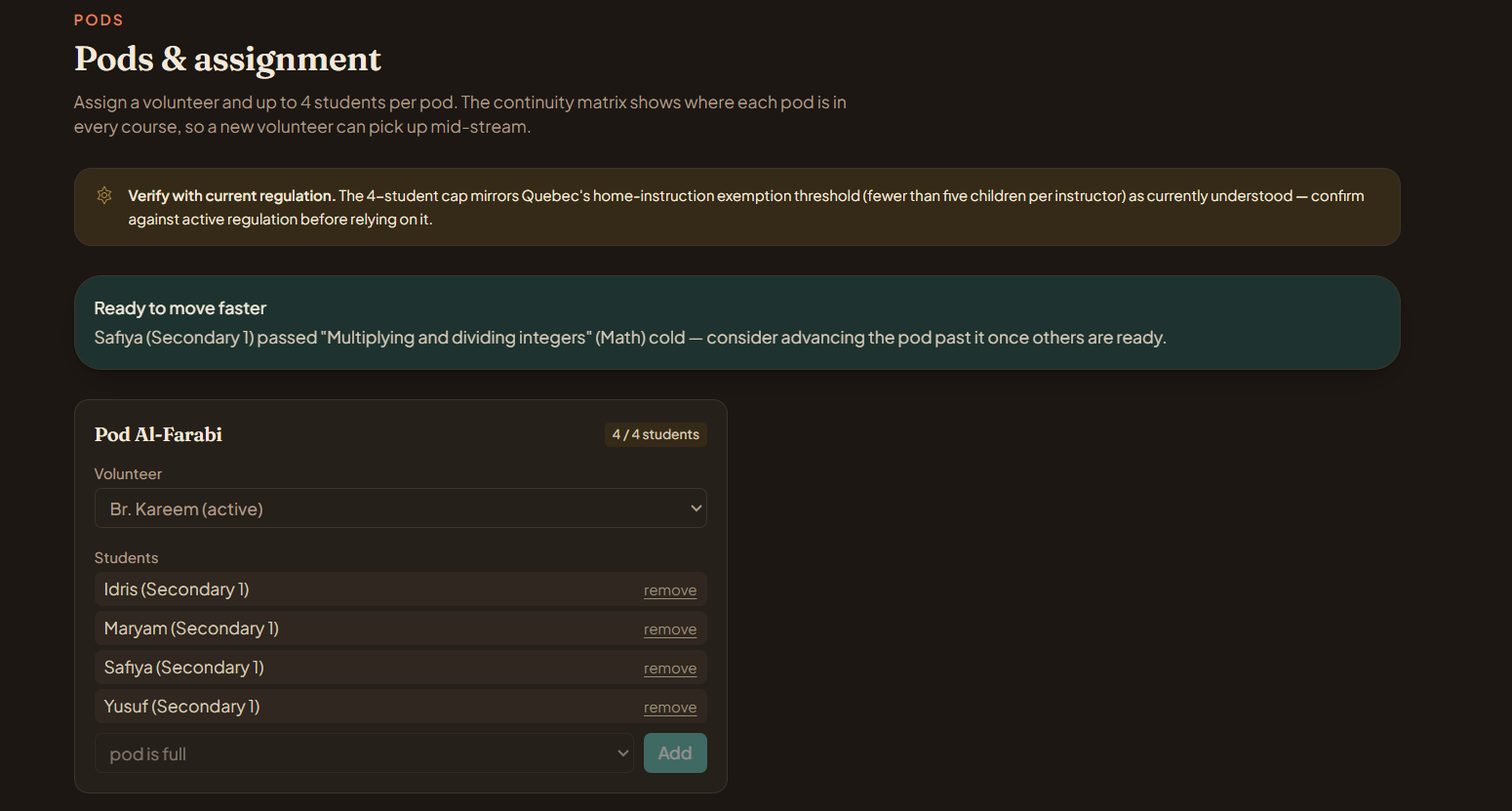
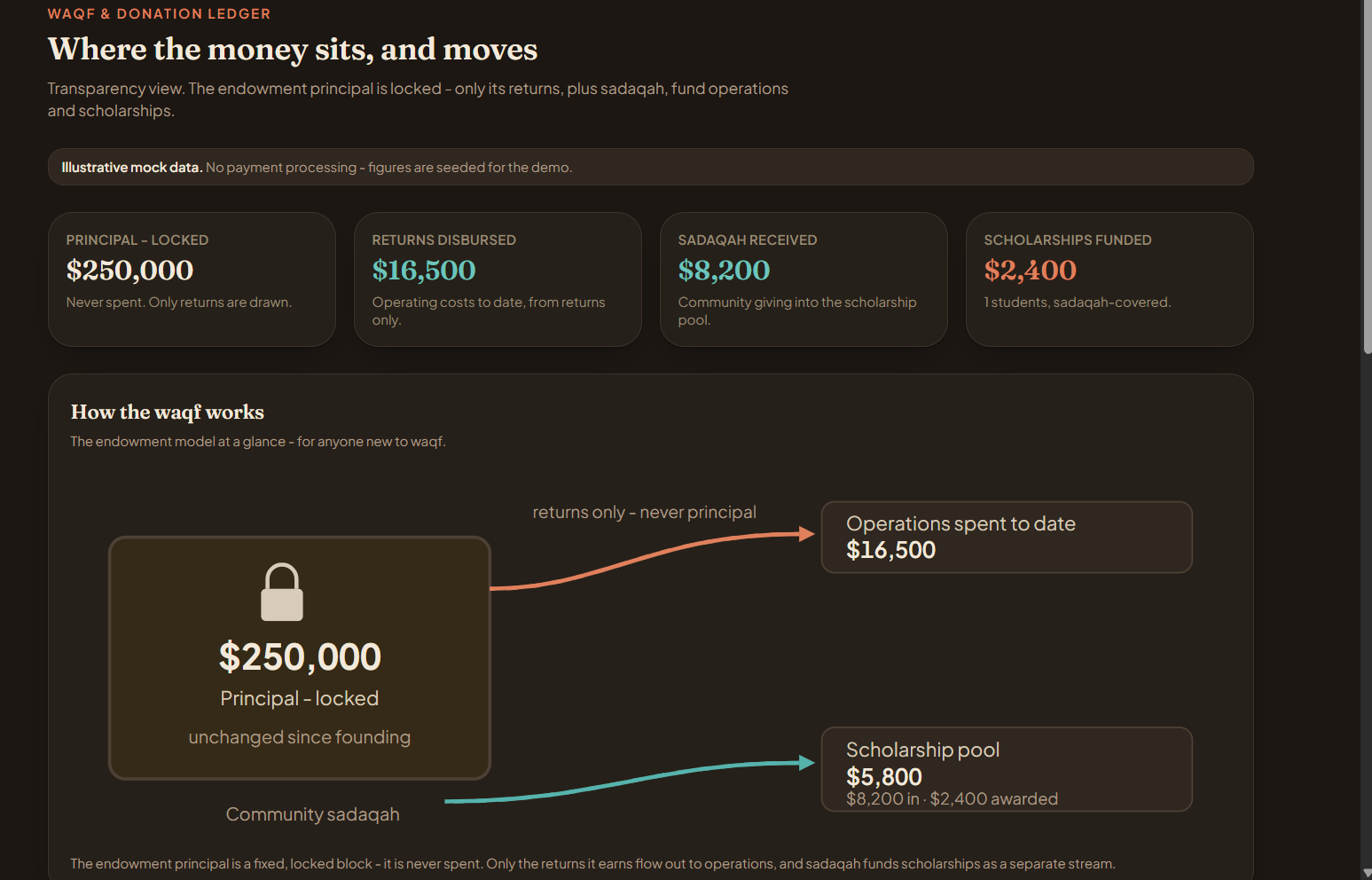
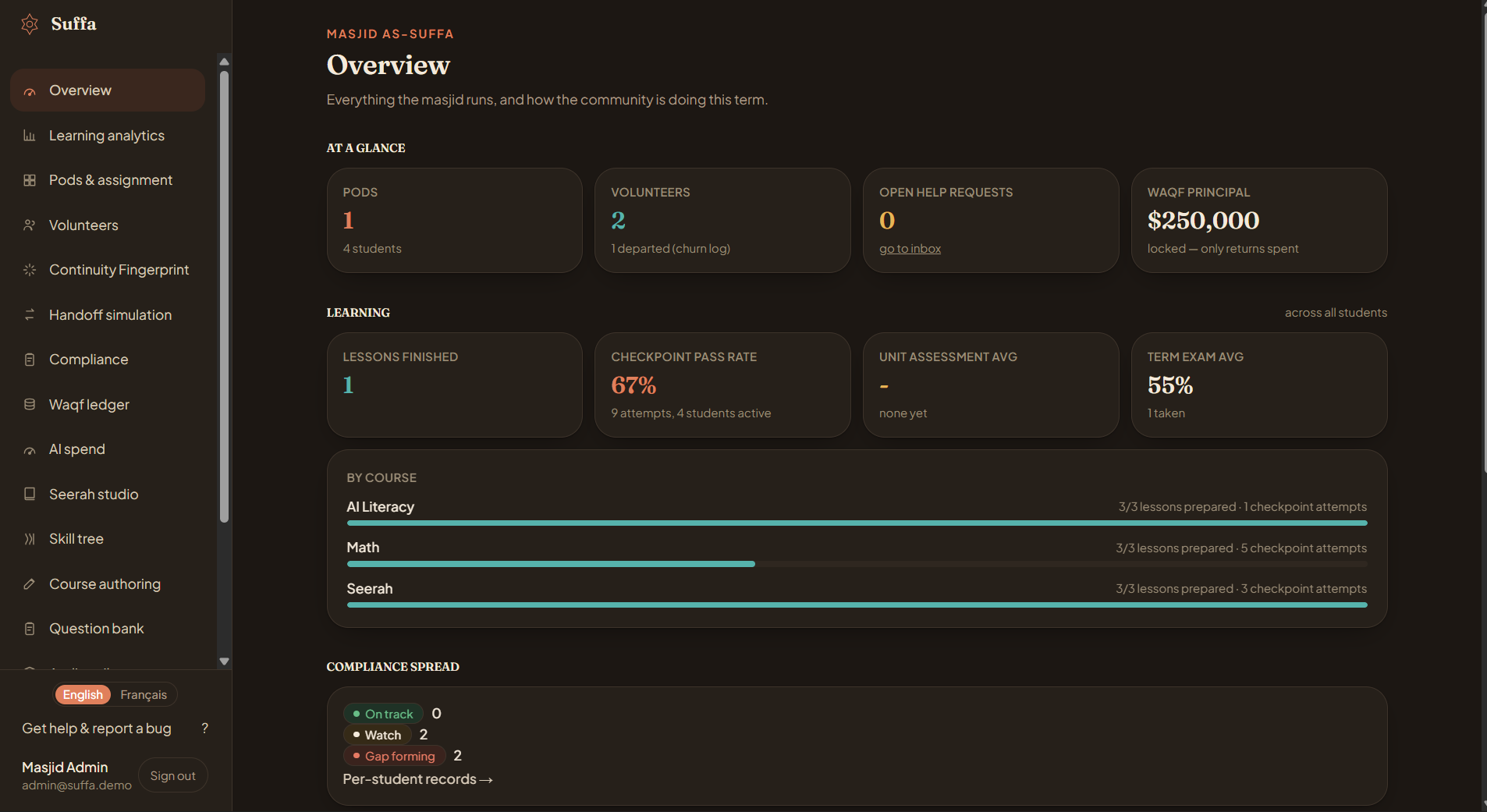
- Masjid admin dashboard - pod assignment (hard cap of 4 students, matching Quebec's home-instruction exemption threshold), volunteer onboarding and churn log, the Continuity Fingerprint (an AI briefing that tells the incoming volunteer how a pod has been learning and where it got stuck, who needed extra attempts, what the session notes say), the living compliance report (an early-warning record assembled continuously from real results, with a snapshot and printable view), and a waqf ledger that shows the endowment principal locked and untouched with a donation traced to a pod's actual unit completion.
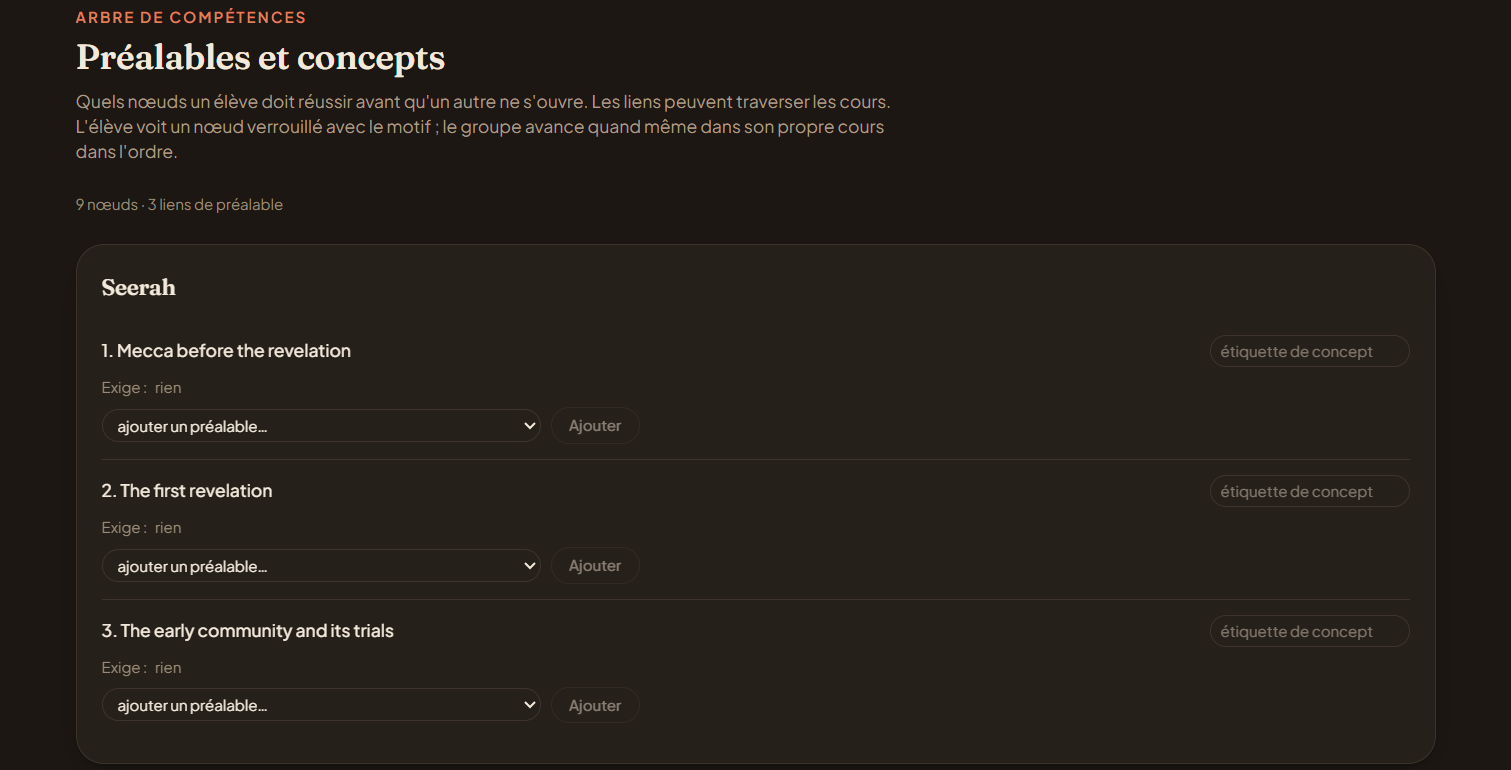
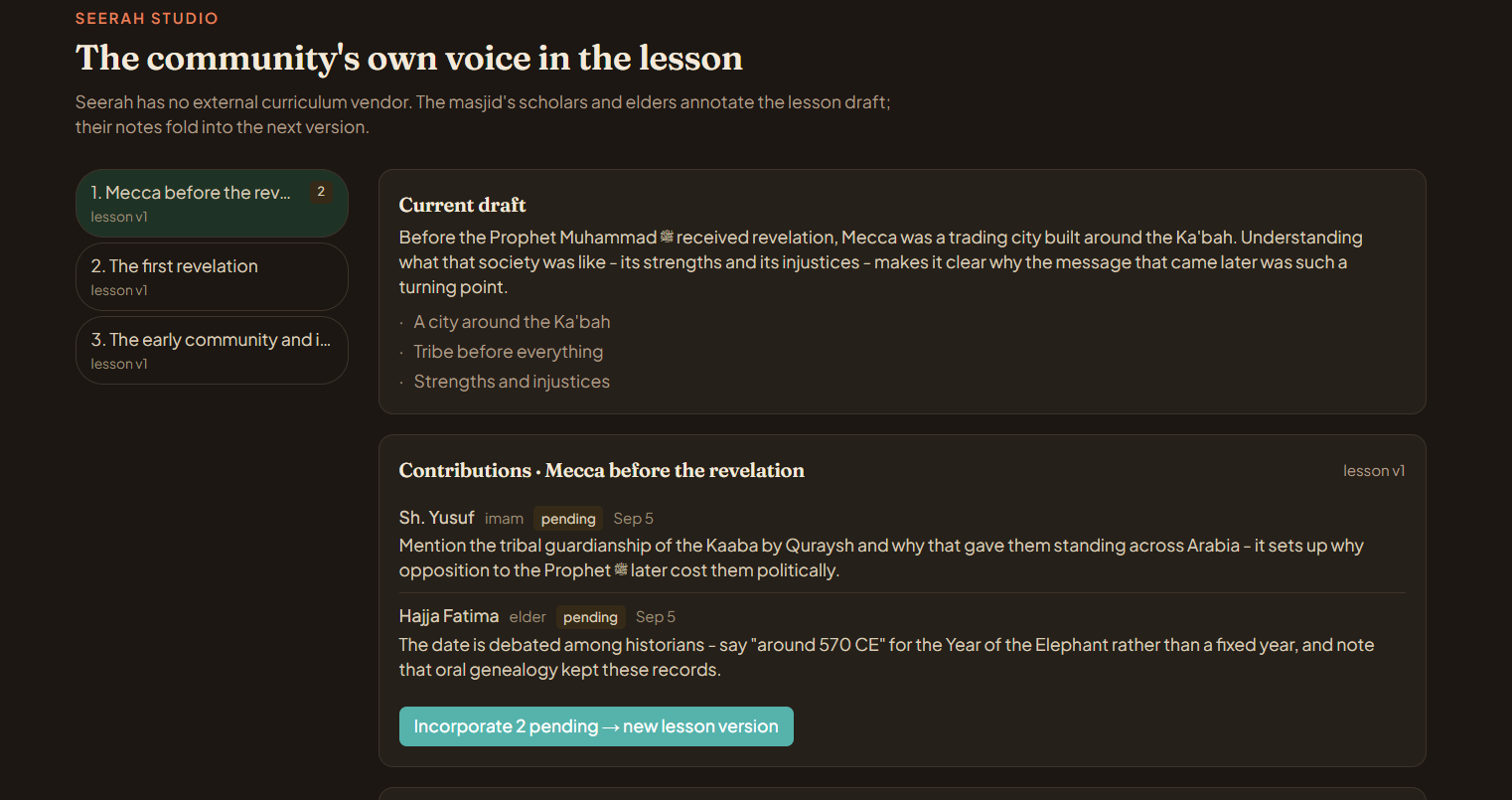
The core loop we built end to end, across three courses (Math → maps to the Quebec Secondary 1 program; Seerah → community-authored, no external vendor; AI literacy → the meta-narrative), one full unit each:
- A student finishes a lesson, passes the checkpoint, and the pod advances.
- The parent sees the result and the updated evaluation status immediately.
- An admin takes a volunteer offline mid-session, the playground keeps running and assigns a replacement, and the Continuity Fingerprint briefing generates on screen.
- The admin opens the living compliance report: one student "gap forming," another "on track," each backed by the actual evidence; snapshot + printable.
- The admin opens the waqf ledger: principal never touched, only the ~4% annual return drawn, and one contribution linked to the unit it funded.
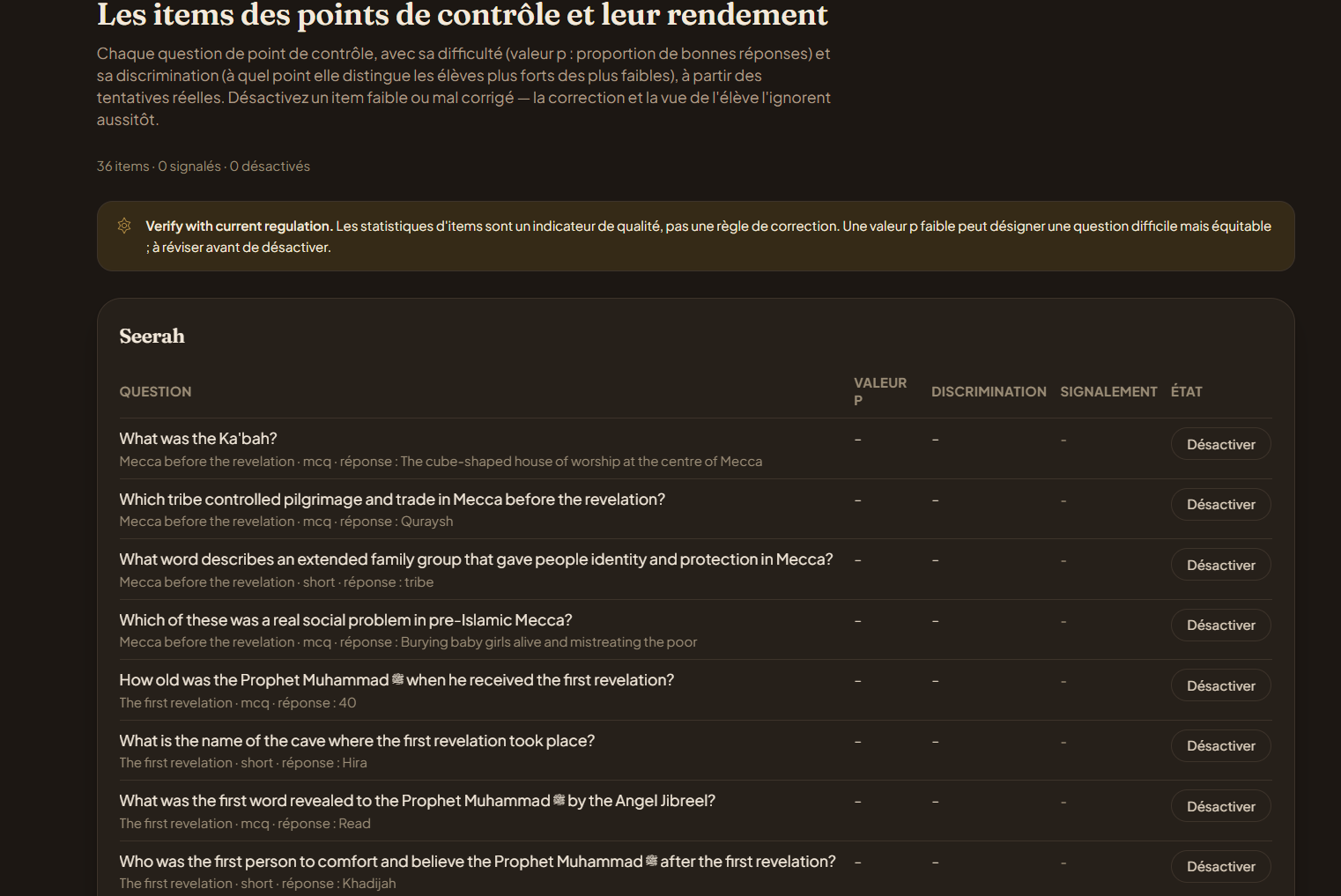
Everything AI-generated, the lessons, checkpoints, assessments, exams, briefings can also be produced in Quebec French, and the entire UI switches EN ⇄ FR from one control.
How we built it -
- Next.js 16 (App Router, TypeScript, Tailwind v4). Three route groups (student, parent, admin) over shared components; a proxy.ts route guard; role-based auth scoped per masjid, multi-tenant from day one.
- Supabase — Postgres + Auth. Row-level security on all 32 tables with SECURITY DEFINER helpers, per-table SELECT/INSERT/UPDATE/DELETE policies, and a standalone check:rls script that proves cross-tenant reads and writes are refused at the database, not just in app code. Append-only triggers on the audit and consent tables.
- Anthropic API (Claude Sonnet 5) for every generative surface: lesson, checkpoint, unit-assessment and term-exam generation, the grounded lesson tutor, and the volunteer handoff briefing. Structured output via Zod schemas. Grading is done in code, never by a rubric model - every question format is objective (MCQ, short numeric / short answer), which keeps grading free and deterministic (a hard PRD non-goal to avoid rubric grading).
- Content is generated once and persisted, never regenerated on view - a pod's continuity depends on stable, referenceable content. That's also why the unit economics work: ~$0.30 of one-time model spend per curriculum unit per masjid, ~$0.02 per handoff briefing, and ≈$0 to add another student.
- i18n - a hand-rolled EN/FR framework (the app has no locale-prefixed routes and the catalogues are small), 1087 message keys with a CI check that fails on any EN/FR mismatch, fr-CA date/number/currency formatting, and a migration that adds _content_fr columns, so French generated content co-exists with English without touching it.
- PWA + offline - download the current unit, work through the lesson and checkpoint offline, sync on reconnect.
- Accessibility — a WCAG 2.2 AA pass with an automated axe gate in CI (check:a11y) reporting no serious/critical violations, jsx-a11y rules promoted to errors, a focus-trapped mobile drawer, and a cognitive-load simple view.
- CI runs lint + typecheck + build + 68 Vitest tests + the i18n check + the a11y gate on every push. Also in the repo: a data-integrity check, a backup/restore runbook, AI-spend metering with budget alerts, and a concurrency-safe multi-agent progress tracker under progress/.
- Demo delivery — "python scripts/demo.py" builds, starts the server, opens an ephemeral Cloudflare quick tunnel, and prints a shareable URL; Ctrl+C tears it all down.
Challenges we ran into -
- Grading without a rubric model. Keeping every assessment format objective so it grades in code and designing the generation prompts so the model only ever produces checkable questions. took several iterations, but it's what makes the cost model real.
- Row-level security that's actually provable. Getting
SECURITY DEFINERhelpers, per-role write policies, and append-only triggers to coexist with tenant/cascade deletes and writing a script that demonstrates isolation against a live second tenant that was more involved than expected. - French without breaking the demo. The demo runs in English; French had to
be additive. We externalised 1087 UI strings, then threaded a
localethrough every AI generator and grader and added_content_frcolumns so a French lesson is generated on demand and stored alongside the English one, which stays byte-identical. - Continuity as a first-class feature, not a footnote. Making the handoff briefing genuinely useful and grounded in a pod's checkpoint history, remediation events and session notes rather than a generic summary. It is the thing the whole pitch rests on.
- Keeping
maingreen across parallel work with a hand-rolled, concurrency-safe task tracker so multiple agents/sessions could build without colliding.
Accomplishments that we're proud of
- The full core loop works end to end — lesson → checkpoint → assessment → term exam → auto-assembled compliance report - across three real courses.
- Database-enforced multi-tenant isolation with an automated proof, not just app-layer checks.
- The whole product is bilingual - every screen, and the AI-generated content too switchable from one control, with a CI check that keeps the catalogues in sync.
- A defensible business model, not just a demo: content generated once, marginal cost of a student ≈ zero, viable from the first family, funded by a waqf drive masjids already know how to run.
- Green on lint, typecheck, build, 68 tests, i18n parity, data integrity, RLS isolation, and an automated accessibility gate.
What we learned
- When grading is objective and content is generated once, an "AI-taught" curriculum is genuinely cheap to run. The cost is a one-time content cost per masjid, not a per-seat cost. That reframes what a community can afford.
- Volunteer churn is better modelled as a knowledge-transfer problem than a staffing problem. Briefing the next person on how the group learns is a small feature with outsized leverage.
- Compliance is far more useful as a live early-warning view than as a term-end artifact, the same data, surfaced continuously, changes what a family can do about a gap.
- Building multi-tenant and RLS-first from commit one is much cheaper than retrofitting them.
What's next for Suffa
- Pilot partnership with 3–5 Greater-Montreal masjids: one pod each for a term, a modest founding waqf per masjid, measuring completion, family retention, volunteer-churn resilience, and cost per active student against the model.
- Real payment rails and background-check integration (both mocked for the hackathon), Canadian data residency, and a full Quebec Law 25 pass.
- Native Quebec-French review of the localisation, and French generated content wired through the remaining surfaces (handoff briefing, remediation).
- Broaden past one unit per course toward full-year curriculum coverage, and onboard a second masjid end to end to exercise the per-masjid content library.
Built With - next.js, typescript, react, tailwindcss, supabase, postgresql, row-level-security,
anthropic, claude, zod, vitest, node.js, pwa, service-workers, web-accessibility, i18n, vercel, cloudflare-tunnel
Try it out
- Repo: "github.com/LameenCore/suffah"
- Run the demo: "python scripts/demo.py" - prints a shareable URL. Then open `/login' → "Explore the demo" → pick Admin, Family, or Student. Toggle EN ⇄ FR from the control in the sidebar.
Built With
- anthropic
- claude
- i18n
- next.js
- node.js
- postgresql
- pwa
- react
- row-level-security
- service-workers
- supabase
- tailwindcss
- typescript
- vercel
- vitest
- web-accessibility
- zod


Log in or sign up for Devpost to join the conversation.