-
-
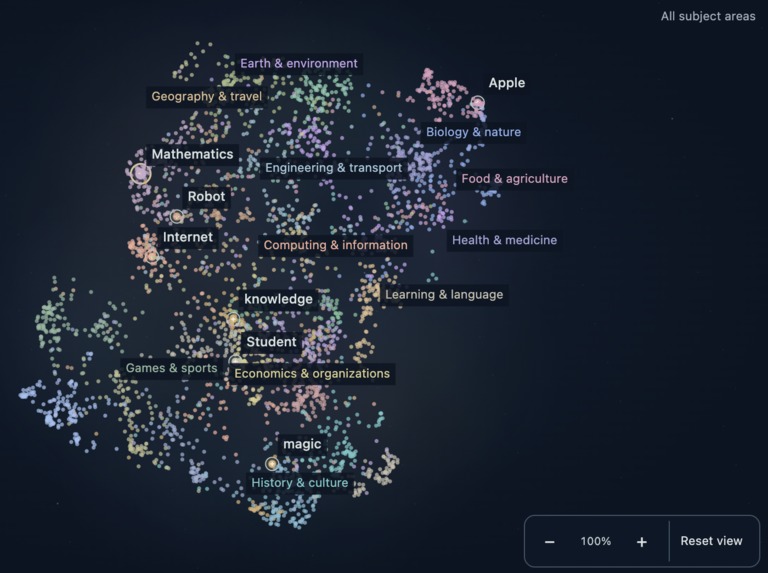
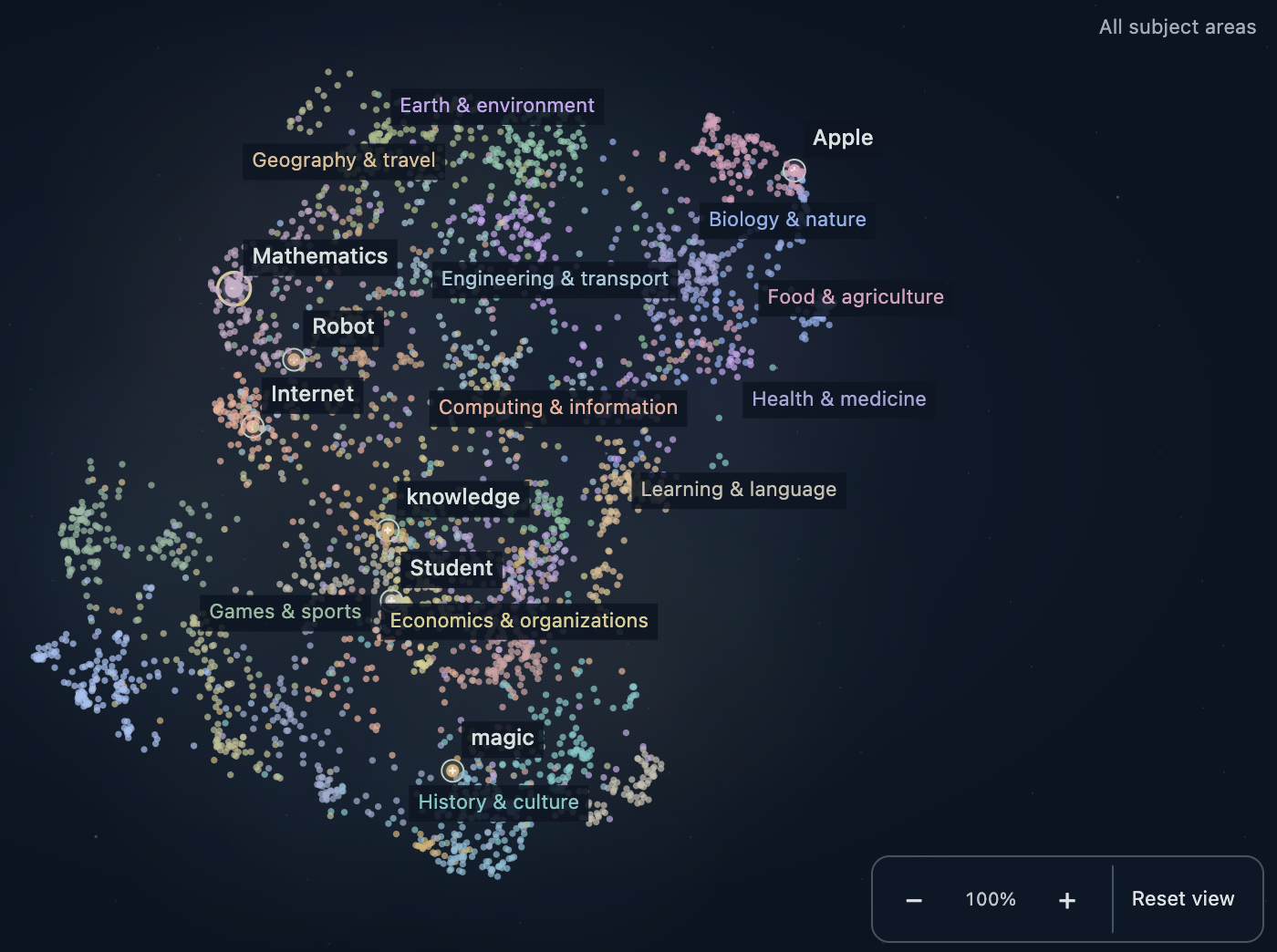
Interest Galaxy
-
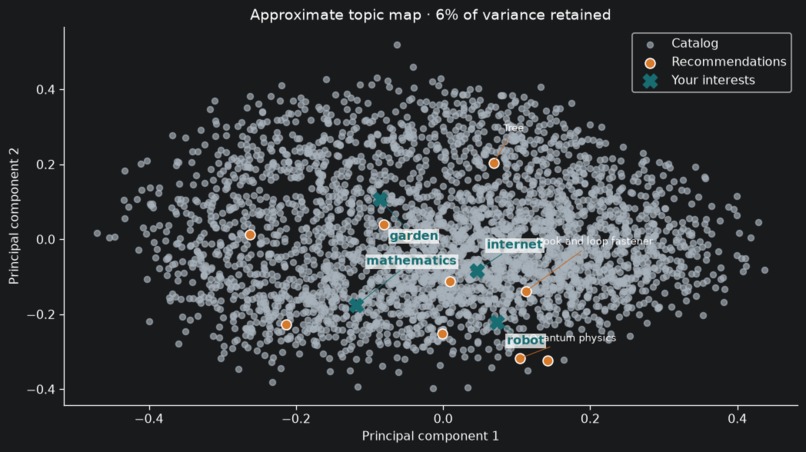
2D view of topic map
-
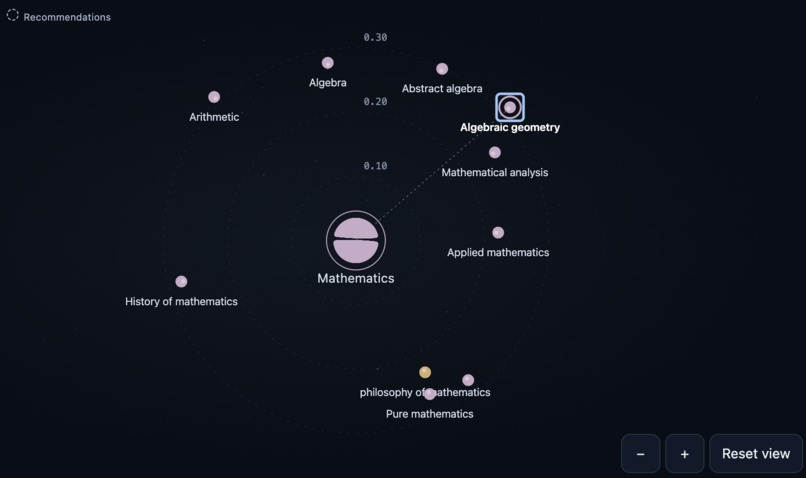
Focused view
-
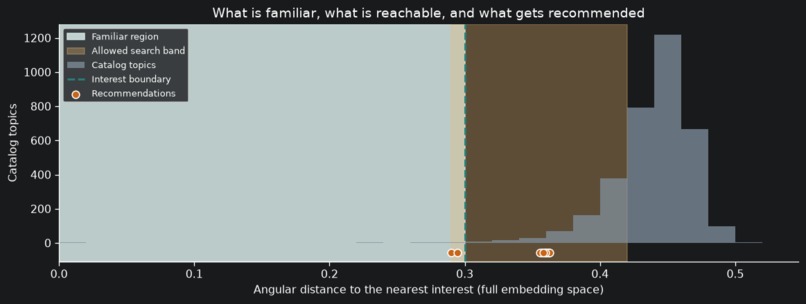
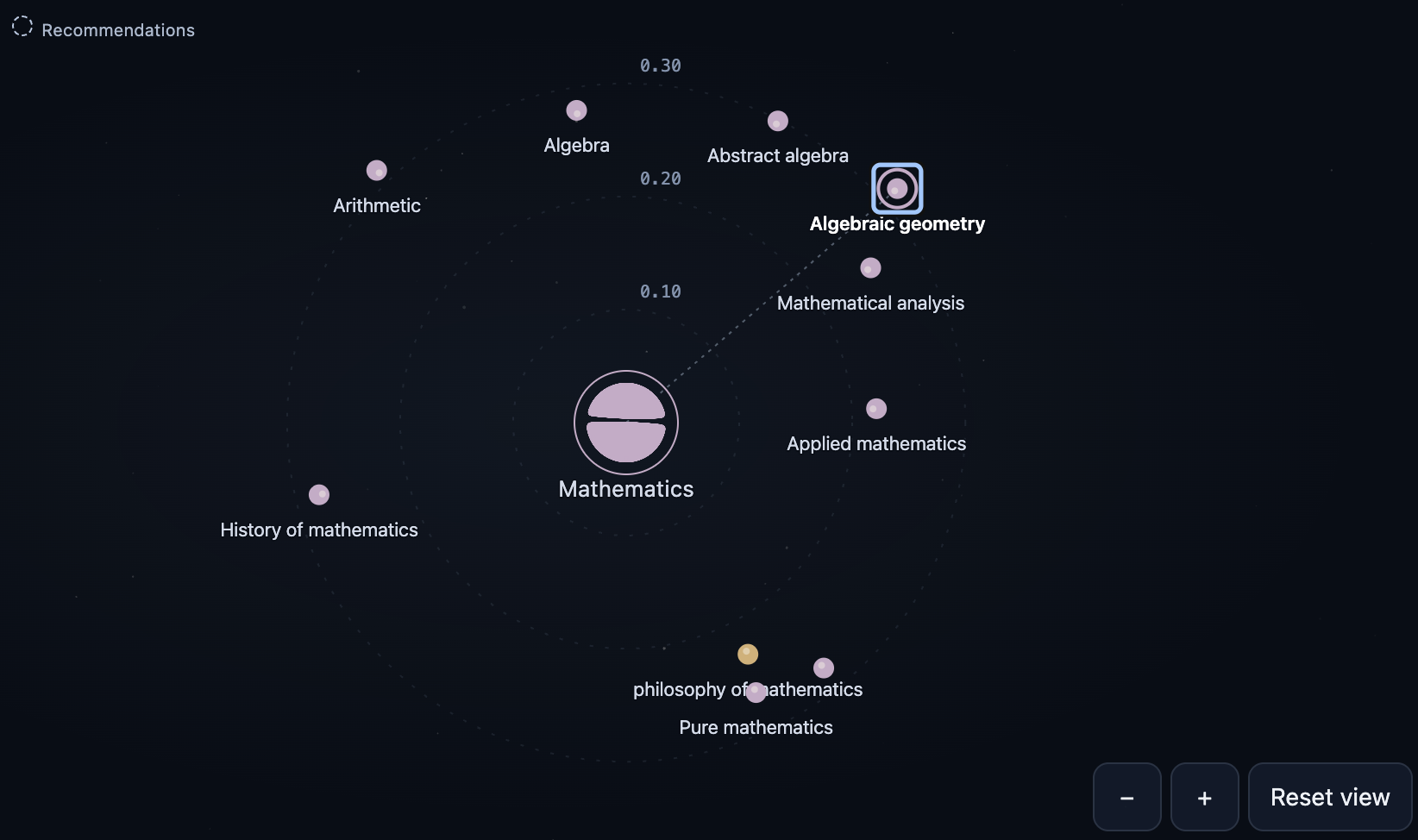
Recommendation area
-

Logo

What We Built
OtherWise is an application that helps individuals explore beyond their usual feed without changing browsing behavior. As users search and watch content, OtherWise picks out keywords related to the topics they're engaging with. A panel then appears at the side of the screen, suggesting related subjects, close enough to feel relevant but new enough to widen users' perspective. Users can search any suggestion on any search engine in one click, save it for later, or simply ignore it. Every topic a user explores is added to their personal "universe." This map places subjects in orbits based on how far they sit from the user's starting interests, making their growth visible.
Target Users and Pain Points
Our broader audience is anyone who wants to use AI and online platforms more deliberately. Our initial focus is students and curious learners who rely on feeds and AI chat to understand new topics.
These users face two reinforcing problems. First, recommendation systems narrow what they see. Research shows that recommenders trained on our clicks gradually make users' tastes more alike. Most regretted YouTube videos reached viewers through recommendations rather than their own searches. These feeds increasingly shape how young people stay informed: 43% of US adults under 30 now get news from TikTok. Second, AI encourages accepting the first answer. Research also shows that people who trusted AI more are less likely to check or question its answers. Heavier AI use is also linked to lower critical thinking scores, with the largest gap among 17–25-year-olds.
Our user research surfaced two specific barriers. Many people lack the motivation to start learning something unfamiliar. Others aren't sure whether they truly understand a topic or are missing part of the picture.
How OtherWise Addresses the Prompt
OtherWise lowers the barriers to meaningful learning by meeting users where they already are. It doesn't require advanced prompting skills or a new habit. It builds on searches they are already making.
To address low motivation, suggestions start close to familiar interests and gradually stretch outward. A user's first step stays within their interests, the next follows a related connection, and only later do they cross into a new field. To address uncertainty, OtherWise shows users where a topic sits and what lies around it, which helps them notice gaps they couldn't see from a single answer.
Alongside the extension, each user has a personal universe: an interactive map of their learning progress. Their starting interests sit in the inner orbit. Topics they explore appear as planets further out, grouped into three rings: familiar, related, and new field. Each planet shows how far it is from the topic it grew out of, so users can see not just how much they've explored, but how far they've stretched. Users can drag, zoom, and click any planet to revisit it. As more of the map fills in, users see their own growth, which motivates them to keep exploring.
The extension suggests it never decides. Users choose which topics to keep, which suggestions to follow, and what to conclude. Our aim is to strengthen independent judgment, not replace it.
How We Built It and Tools Used
We built OtherWise as a connected system with a Chrome extension, a Python recommendation backend, and a web dashboard. Each part supports a different step in the experience: the extension helps users collect and manage interests while browsing, the backend finds meaningful connections between topics, and the web dashboard gives users more space to explore those connections visually.
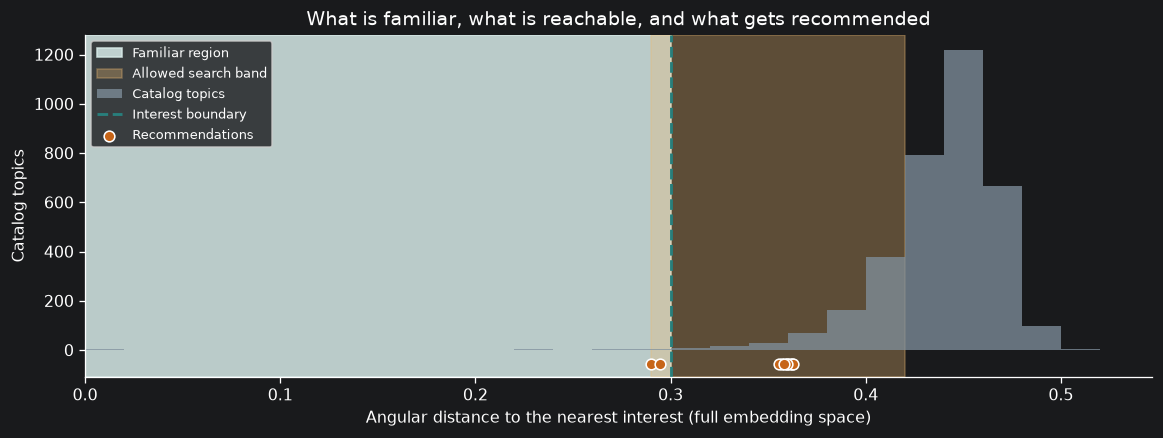
The recommendation engine converts interests and topic descriptions into 768-dimensional semantic embeddings. This allows OtherWise to compare topics by their meaning, even when they do not share the same words. The catalog contains 3,452 topics across 23 domains, combining everyday interests with concepts from Wikidata. Instead of recommending only the closest matches, the system searches within an adjustable range beyond a user’s existing interests. Users can control how far they want to explore and how varied the results should be.
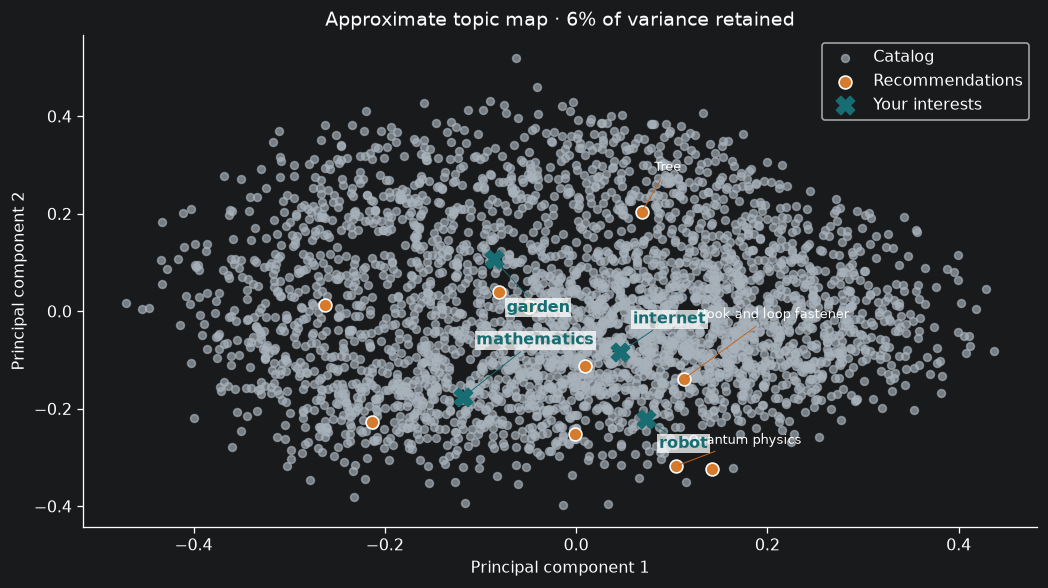
We also developed the Interest Galaxy visualization to make the topic space easier to explore through the web experience. We experimented with PCA, UMAP, and domain anchors to turn the embeddings into a readable 2D map. The map provides a visual overview, while the recommendation engine continues to calculate relationships using the original embeddings.
Challenges and How We Solved Them
Balancing familiarity and discovery was a major challenge: nearby topics can feel repetitive, while distant ones can feel unrelated. We introduced an adjustable discovery range and a diversity setting to reduce similar suggestions. When fewer topics fit, the system returns fewer results rather than changing the user’s limits.
Another challenge was translating a high-dimensional semantic space into a useful visual map. Topics that appear close together in two dimensions are not always equally close in the original embedding space. We compared different projection methods and explored a UMAP layout with light domain guidance to make broad subject areas easier to recognize. To prevent the visualization from changing recommendation quality, we kept the two calculations separate: the map uses projected coordinates for display, while search and recommendations use the original 768-dimensional vectors. This lets the visualization support exploration without treating screen distance as an exact measure of semantic similarity.
Future Development
Our next major feature is "Friends." People are often more willing to explore a topic when it comes from someone they know rather than from an algorithm. With "Friends," users can visit a friend's universe, see what they have been exploring, and click any of their planets to learn more about that topic. Because every friend starts from different interests, their universes offer topics someone would rarely come across on their own.
Beyond Friends, we plan to support more languages other than English and expand our keyword database. We'll then run a two-week pilot to test whether users' interests actually broaden and use the results to fine-tune how far suggestions stretch before a wider public launch.


Log in or sign up for Devpost to join the conversation.