Inspiration
Record Subway Ridership is causing increases in:
- Delays
- unpleasant crowding
- crime / violence
- fatalities: 50 fatalities per year
Can measurable improvement be achieved through optimizing?
- Context (measurement driven) train scheduling
- Limiting quantity of passengers on platforms
- Measuring traffic patterns
What it does
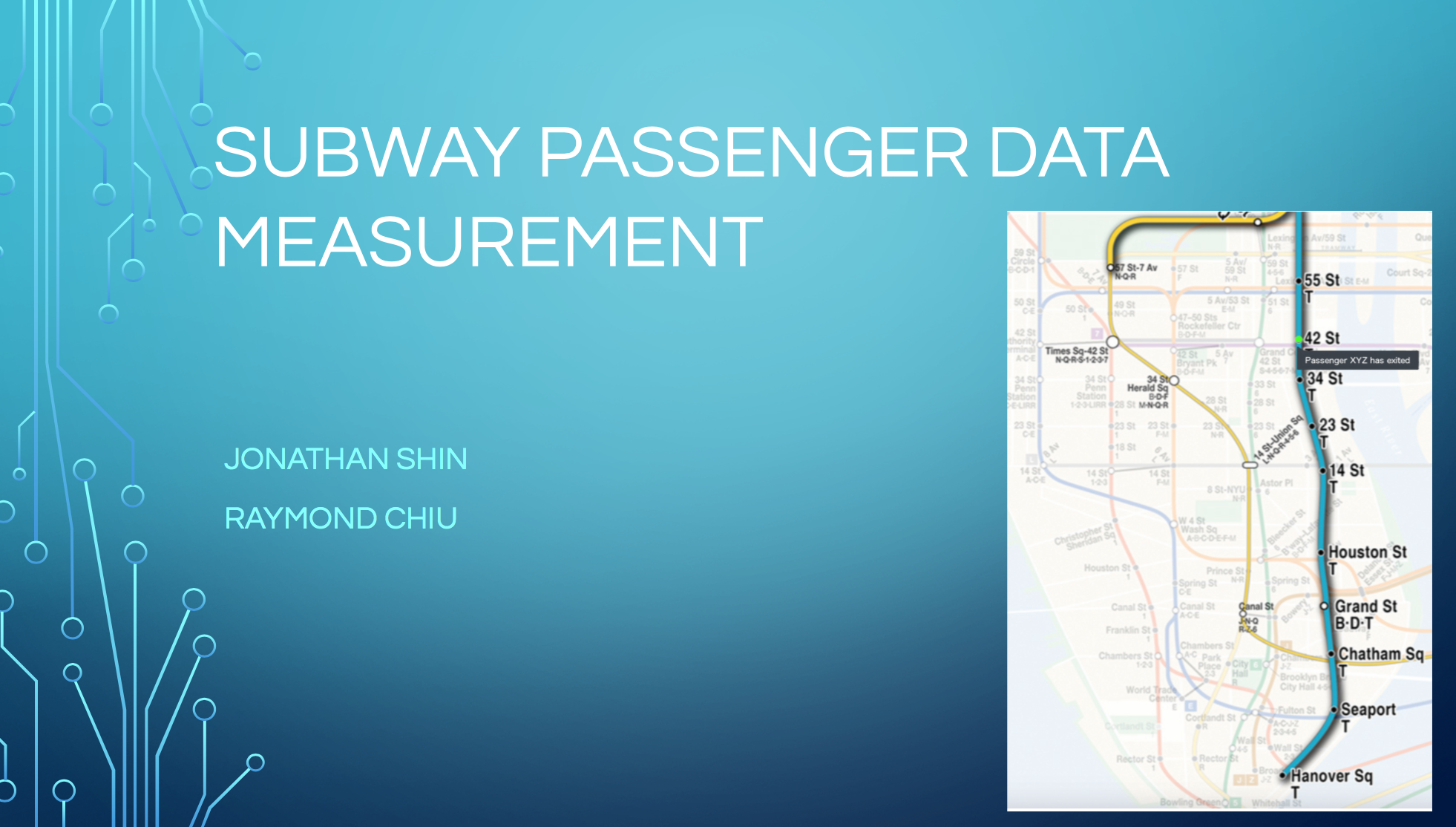
We've built the data-collection node, which is the cornerstone to a model that collects passenger routes. We can see when a single passenger enters a station and exits another station. Once rolled out we would have a subway model enables forecasting the effect of system changes. Allowing key decisions to be made
- When to increase / decrease train capacity?
- How to optimize stops to maximize throughput within safety constraints?
- How to optimize stops within comfort constraints?
- Is train capacity expansion cost-effective?
- Are Delay objectives achieved?
How we built it
The smartphone-beacon transmits a BLE advertisement and the RasPi base-station listens. Changes in bluetooth signal strength (RSSI) is provide proximity estimates
Challenges we ran into
Power variance is non-linear and is a challenge to indicate near-proximity. We created an algorithm that accounted for these fluctuations.
Accomplishments that we're proud of
Proof of concept and objective (detect passer-by) achieved within 8 hours
What we learned
BLE would be a suboptimal solution to run this system to scale. To make this work for a larger population, we would need to use a secure-RFID class radio-technology to process at scale
What's next for Subway Passenger Simulator
- Integrate data collection into MTA ticketing system-requirements
- Formulate questions / hypothesis to identify system levers
- Develop \ Validate Model and measure parameters
- Simulate experiments and Validate field decisions

Log in or sign up for Devpost to join the conversation.