-
-
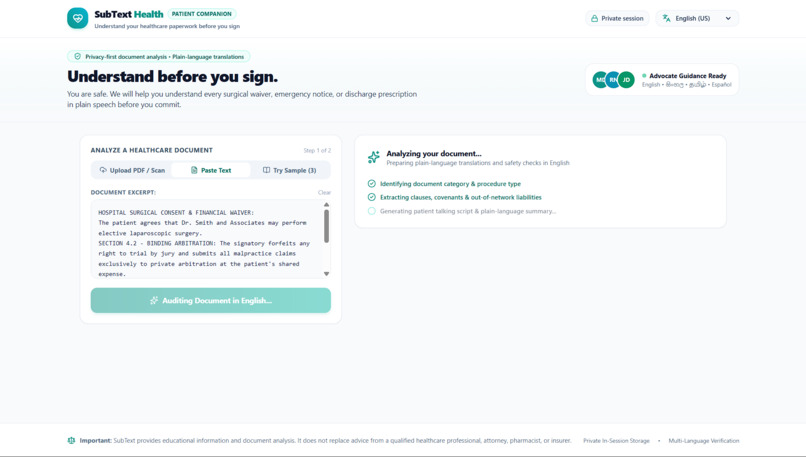
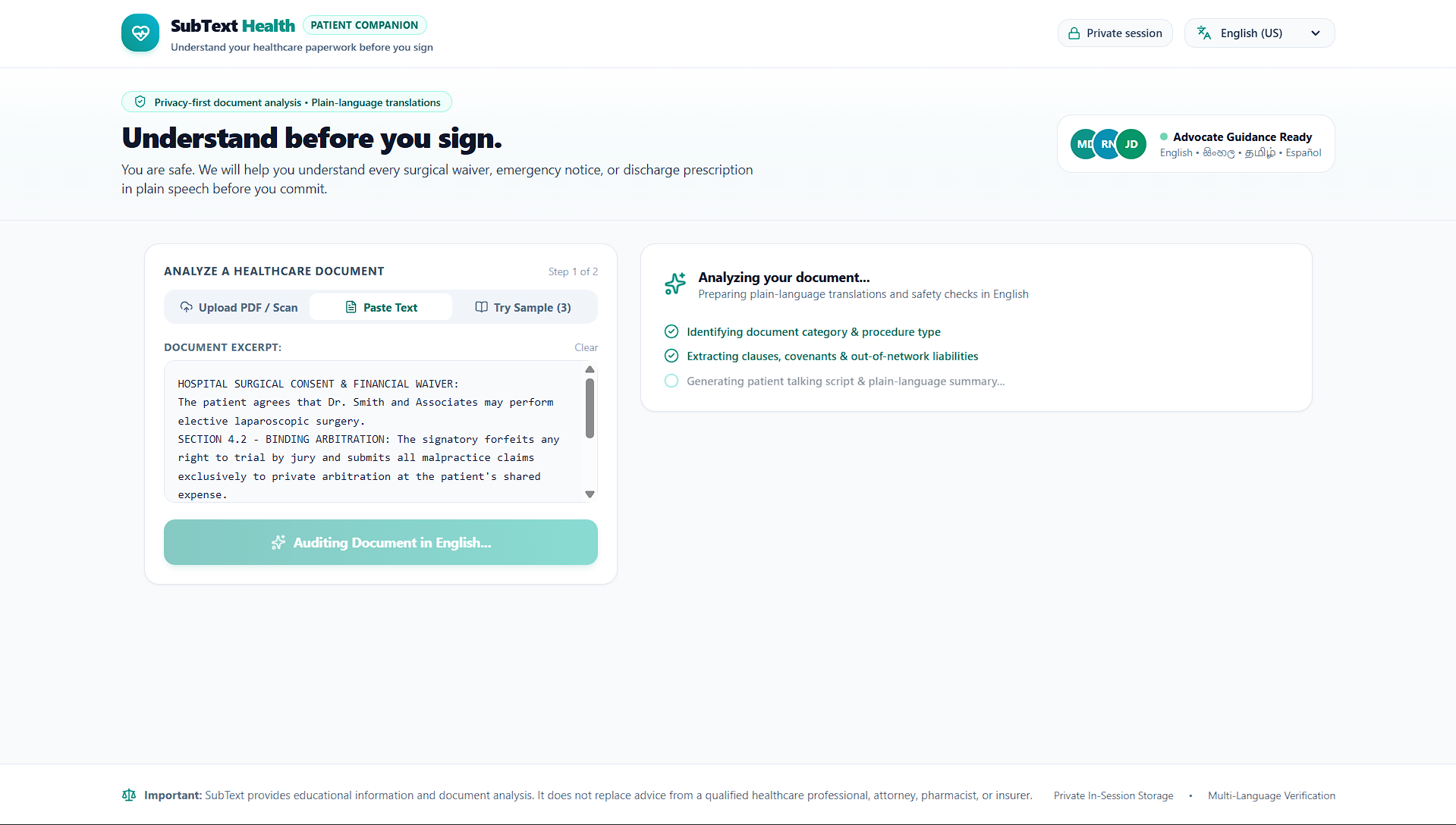
Real-Time Step-by-Step AI Analysis
-
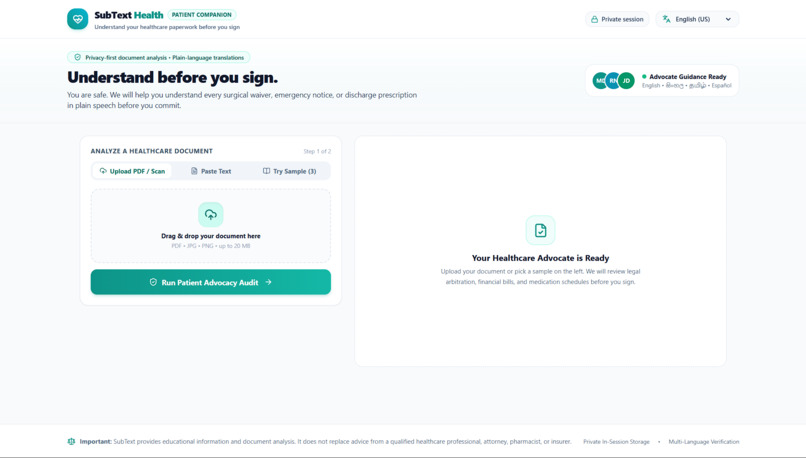
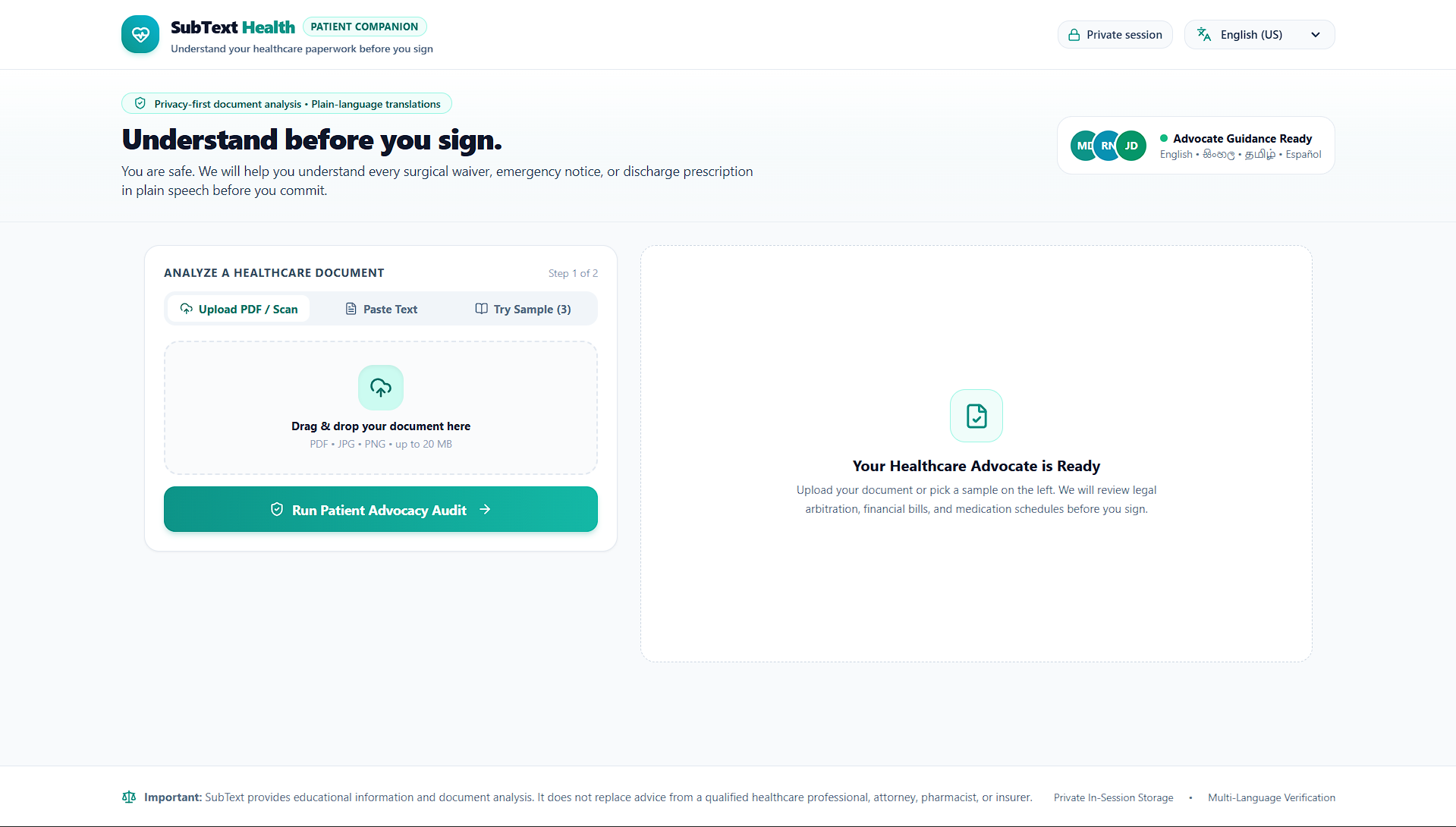
Clean Intake Console & Empty State
-
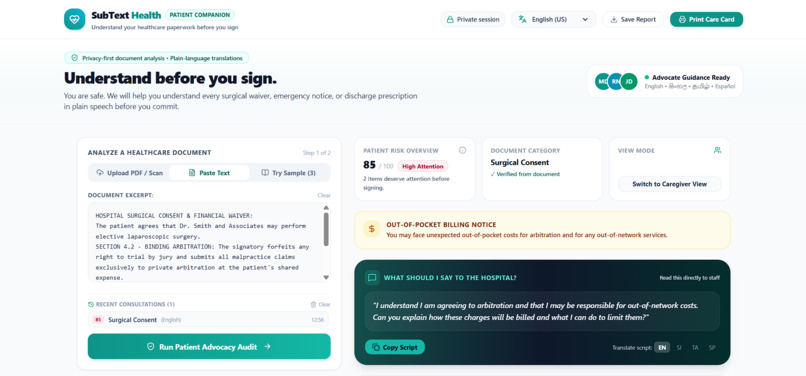
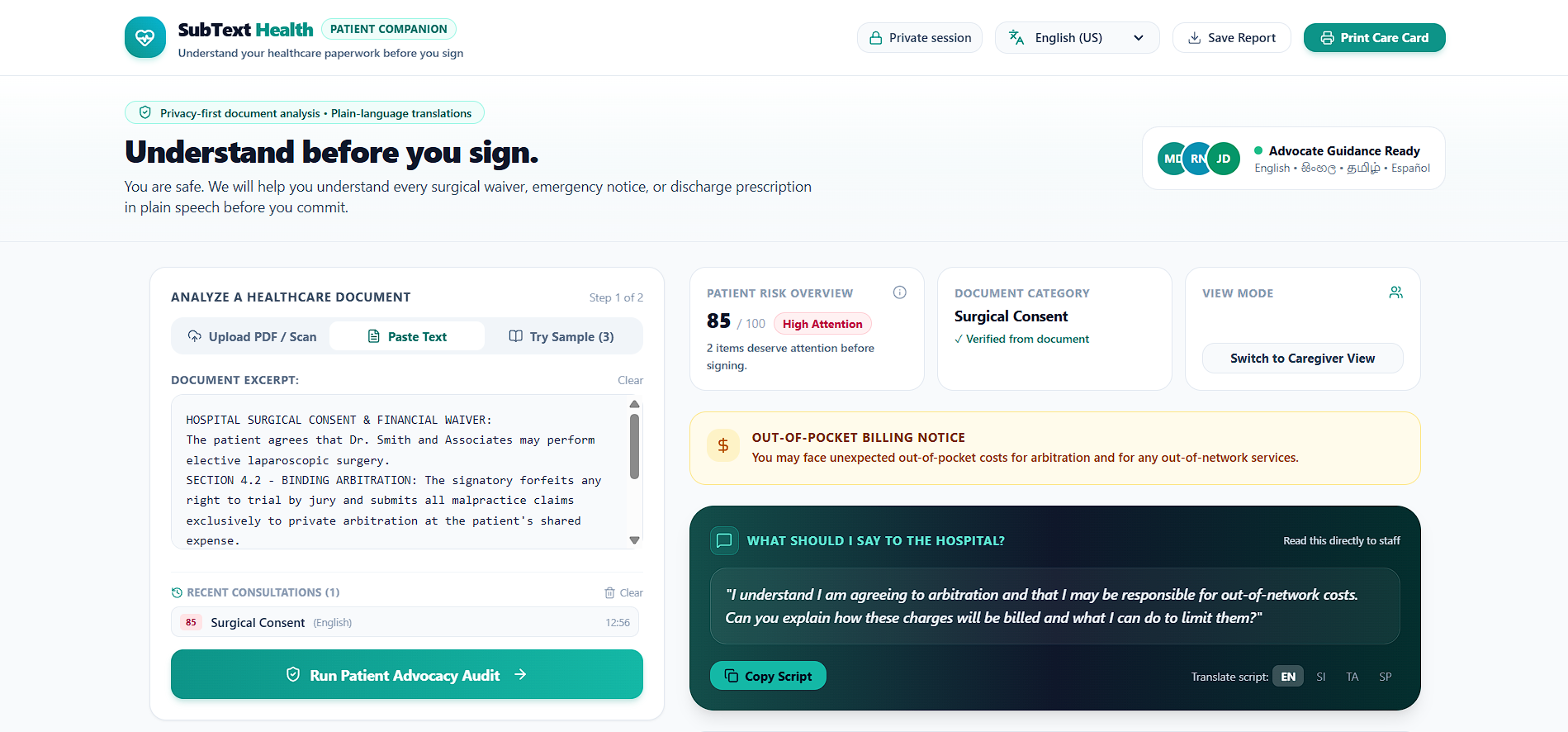
Advocate Dashboard & Signature Talking Script
-
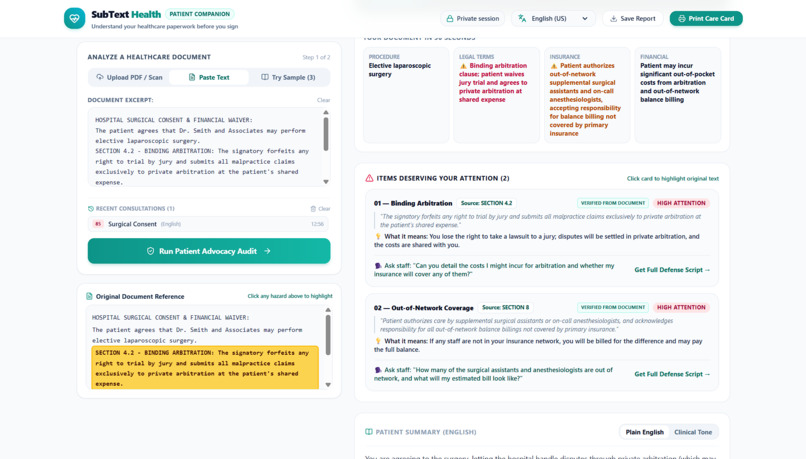
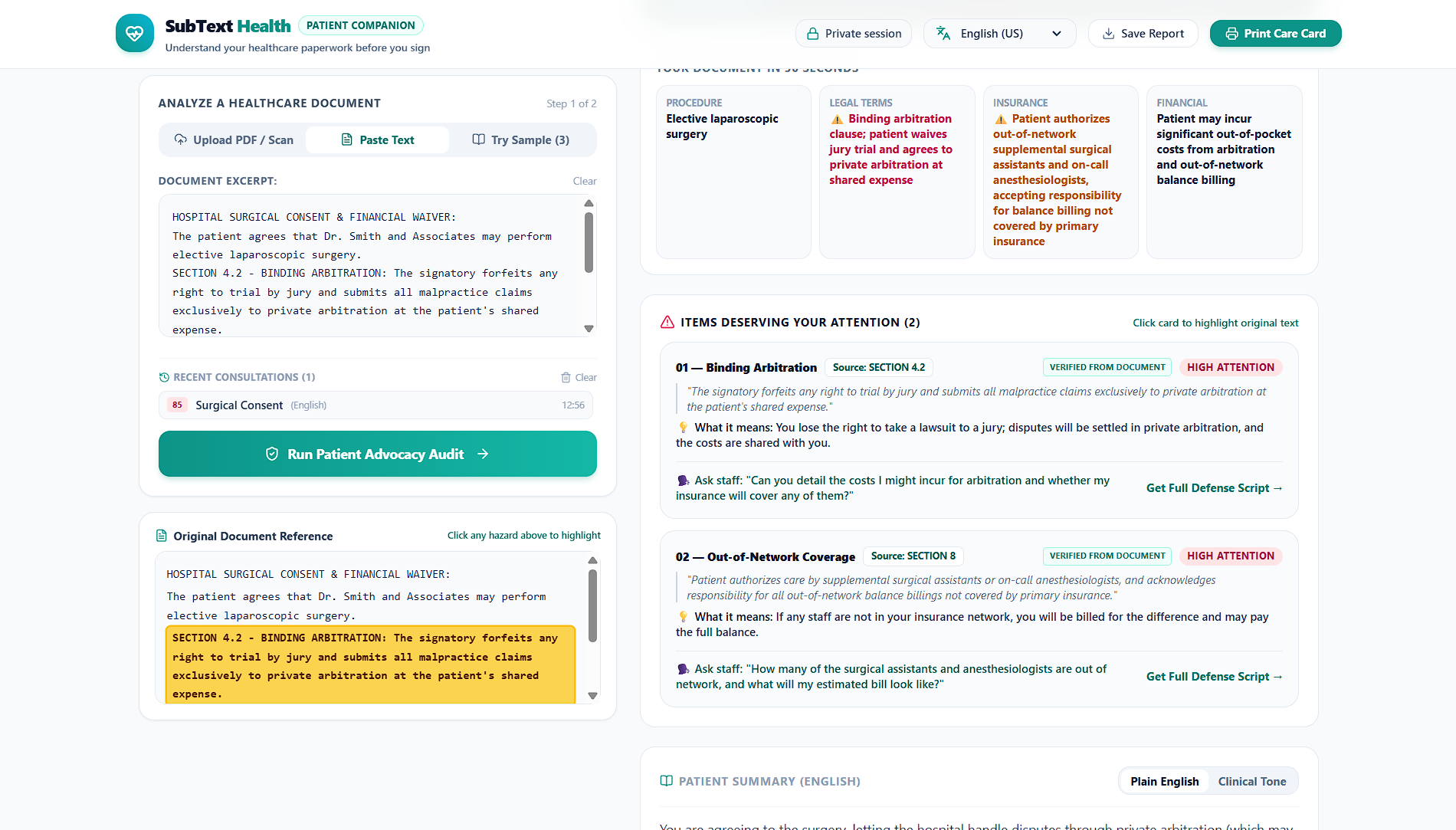
Interactive Document Mapping & Section Highlighting
-
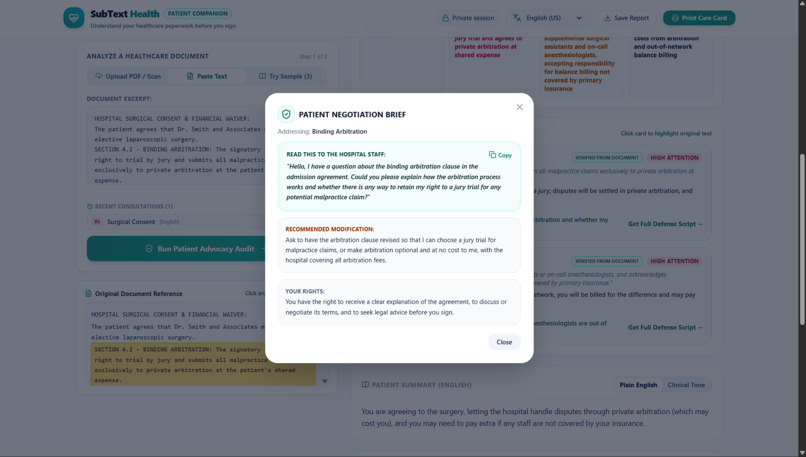
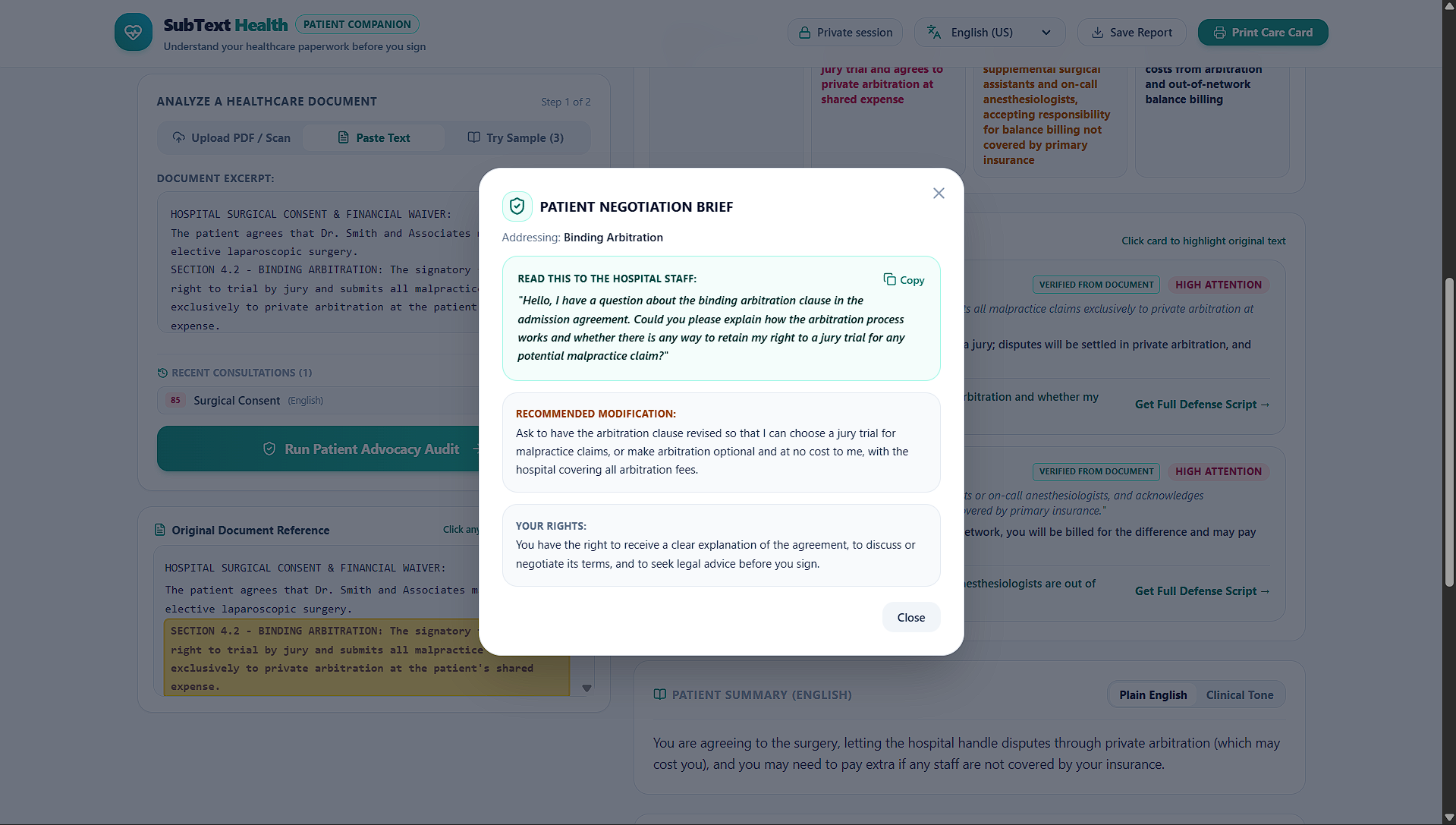
Patient Negotiation Brief Modal
-
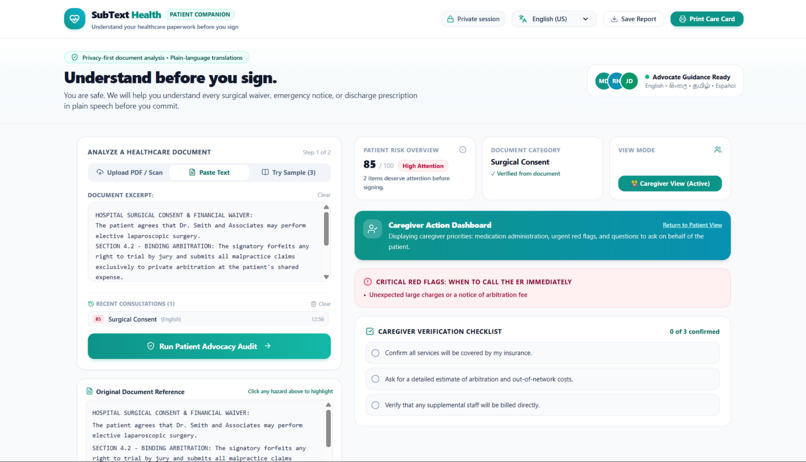
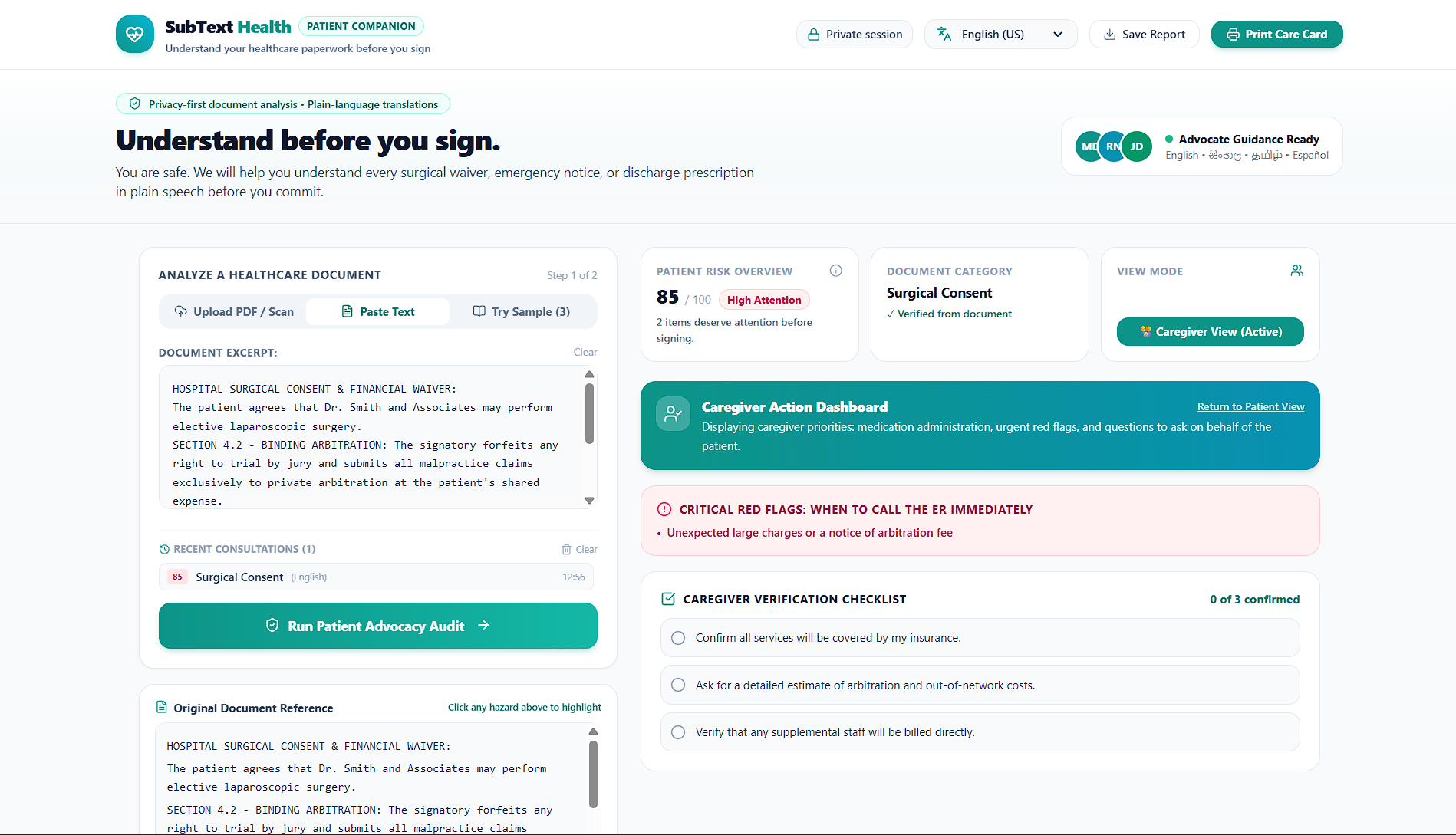
Dedicated Caregiver Mode View
-
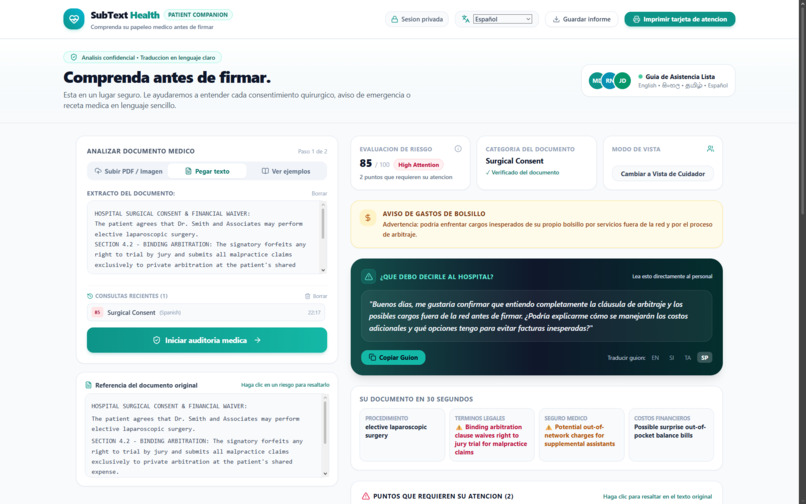
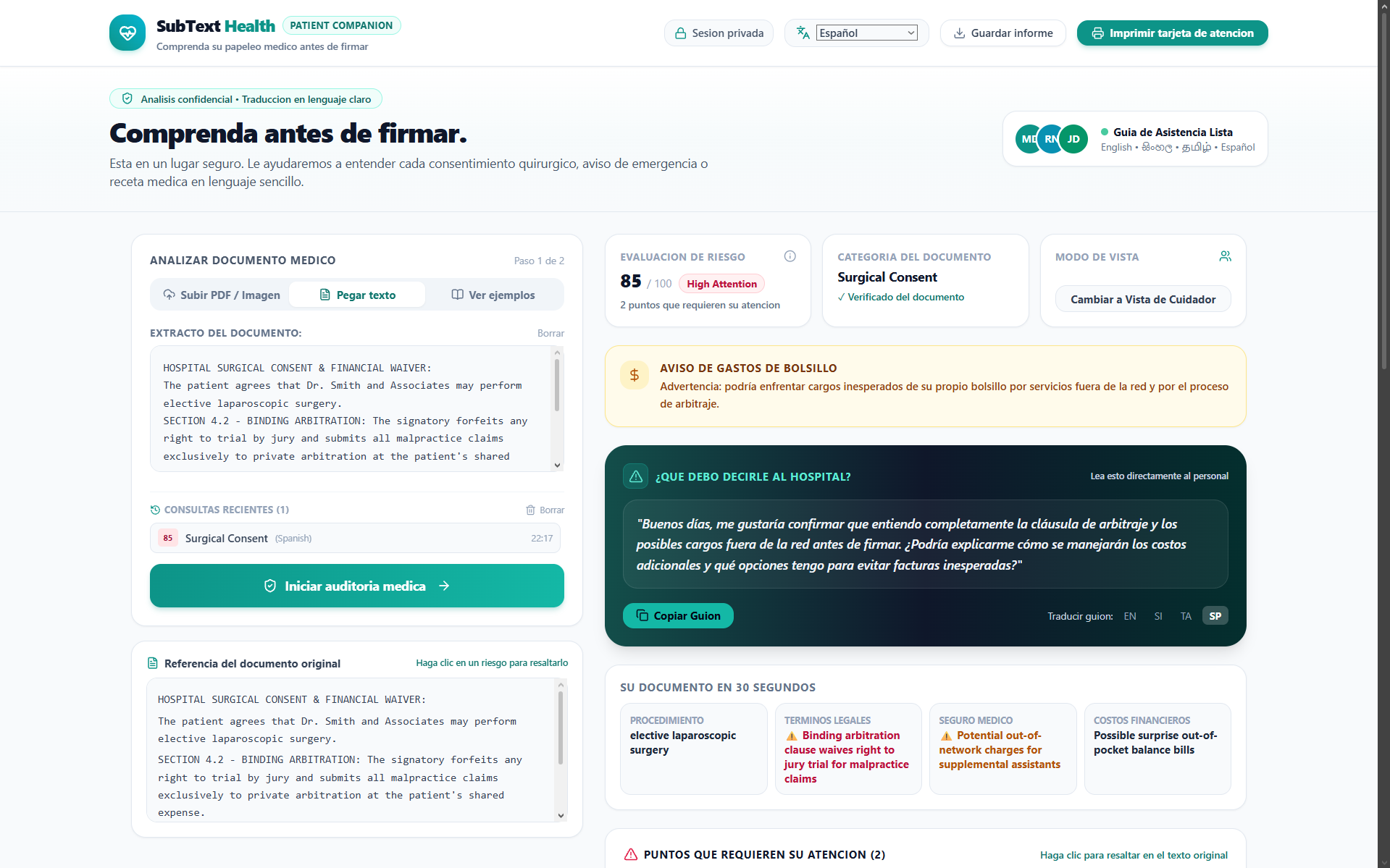
Native Multilingual Translation (Español)
Inspiration
Every day, millions of vulnerable patients sign surgical consent waivers, emergency admission undertakings, and complex discharge forms while under severe physical or emotional distress. Tucked inside this paperwork are binding private arbitration clauses, waivers of legal rights, and out-of-network balance billing commitments that can lead to unexpected debt.
Most health applications focus solely on electronic records or appointment booking, ignoring the critical legal and financial liabilities patients unknowingly accept. We were inspired to build SubText Health to serve as a patient advocate companion: transforming dense, predatory medical legalese into clear, reassuring, and actionable patient guidance across multiple native languages before anyone signs.
What it does
SubText Health is an AI-powered patient advocacy companion that converts dense clinical and legal documents into transparent, plain-language insights:
- Patient Risk Overview (1–100): Evaluates documents across legal covenants, financial liabilities, and care clarity with calm, non-threatening severity badges (High Attention, Review, Information).
- Interactive Split-View Document Highlighter: Directly maps every identified risk or concern back to its exact clause in the original document with instant auto-scrolling and highlighting.
- "What Should I Say to the Hospital?" Defense Assistant: Generates polite, assertive talking scripts that patients can read directly to hospital staff or admissions desks to negotiate or clarify clauses.
- Multilingual Native Script Engine: Translates complex discharge summaries, medications, and risk explanations into native Sinhala (සිංහල), Tamil (தமிழ்), Spanish (Español), and Plain English.
- Caregiver Mode: Instantly toggles the interface to prioritize home caregiver needs: administration timetables, medication dosages, and critical red-flag emergency symptoms.
- "Before You Sign" Checklist & Export: Provides interactive pre-signing verification items, client-side session privacy, plain text report downloads, and single-page printable Care Cards.
How we built it
- Frontend: Built with React 19, Vite, and Tailwind CSS. We designed a clean, hospital-grade interface with a sticky dual-pane layout, tabbed intake console, and accessible semantic badges.
- Backend API: Powered by Node.js and Express, orchestrating multi-modal document parsing (
pdf-parse,multer) and handling high-speed analysis streams. - AI Intelligence: Integrated the Groq SDK with ultra-fast LLM inference (
gpt-oss-120b/qwen) configured with strict JSON schemas to deliver factual, structured analyses without hallucination. - Privacy Architecture: Built with a client-first design—uploaded documents are processed in-memory during active sessions without permanent cloud database tracking, ensuring complete user privacy.
Challenges we ran into
- Emotional Calibration in UX: Earlier iterations felt too much like an intimidating legal auditor with alarmist phrasing. We spent considerable effort refining prompts and UI microcopy so patients feel supported and safe rather than frightened.
- Script-Accurate Multilingual Extraction: Directing LLMs to output fluent Sinhala and Tamil medical terms in their native Unicode scripts required fine-tuned prompt directives to avoid awkward transliterations.
- Bidirectional Document Mapping: Accurately anchoring extracted risks to specific sections in raw extracted OCR text and auto-scrolling to the matching excerpt without performance lag.
Accomplishments that we're proud of
- Delivering a fast, end-to-end pipeline that scans, analyzes, and translates dense clinical waivers in under 2.5 seconds using Groq.
- Building the signature "What Should I Say?" feature that empowers patients with immediate, practical dialogue.
- Designing an empathetic healthcare portal that balances clinical credibility with patient reassurance.
What we learned
- How significantly legal terms in medical paperwork burden non-native English speakers and underserved communities.
- Techniques for prompt-engineering structured JSON outputs reliably across diverse document formats (prescriptions, consent forms, bills).
- The importance of designing digital health tools around the patient journey: Understand → Decide → Ask → Act.
What's next for SubText Health
- Mobile Camera Scan Ingestion: Native PWA camera capture with on-device OCR for photographing physical hospital paper forms on the go.
- Automated Billing Dispute Letters: One-click generation of formal dispute letters citing the No Surprises Act for out-of-network emergency room bills.
- Expanded Regional Language Support: Adding more South Asian and regional languages to assist broader global patient populations.
Built With
- express.js
- generative-ai
- groq
- healthtech
- javascript
- lucide-react
- node.js
- pdf-parse
- react
- tailwindcss
- vite

Log in or sign up for Devpost to join the conversation.