-
-
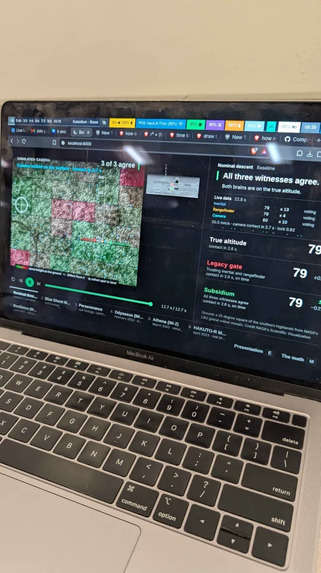
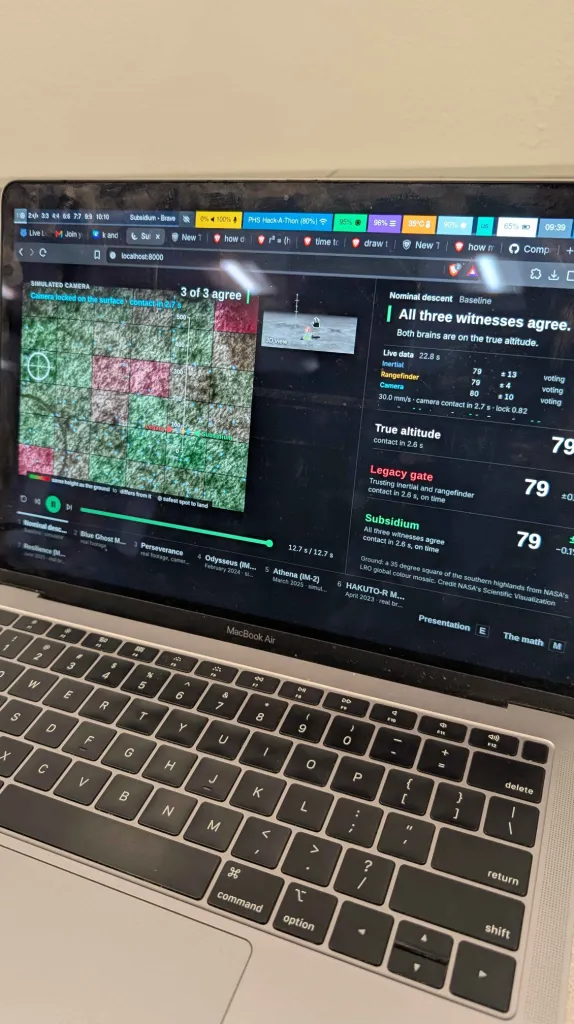
A view of our hazard maps.
Inspiration
As autonomous space missions have become more popular in the 21st century, reliability and effectiveness have become big problems. Companies and space firms lose billion of dollars due to gaps in hardware and unpredictable mistakes that can occur at any given time.
What it does
Our project implements a three-witness algorithm into creating safer and more reliable lunar landings. NASA and other major space travel agencies use this regularly, but smaller, especially privately funded space travel expeditions fail because they lack the money nor computational power. Using cameras as sensors and then using image-recognition algorithms to calculate distance from the ground using the change of distance of certain markers it finds on the ground, this acts as an affordable third sensor that is highly effective in lunar landings. These cameras then allow a multiple-witness algorithm to be implemented.
How we built it
We used Python and image recognition libraries such as cv2 to implement our algorithm. We also used Claude Code to implement the simulations and the web development side of the development process, as well as to expediate other, more tedious parts of the development process.
Challenges we ran into
We ran into issues regarding hardware, with a broken servo and poor planning harming our process.
Accomplishments that we're proud of
We are proud of the results that Subsidium has had on real crashes, where it is able to predict the ground better than the sensors that were used on those actual spacecraft. While this has only been tested in simulation, had a camera been used on some of these spacecraft that implemented our algorithm, we believe that this could have had serious positive impacts to the results of these spacecraft.
What we learned
We learned the competitive aspects of a hackathon, as well as the time and resource constraints to build a project like this one. We learned better teamwork skills as well as to compromise on certain things. We come from different backgrounds on our team, the three of us coming from software, AI development, and CAD. However, we were able to persevere and ensure that all of us had a say and major part of this project.
What's next for Subsidium
Subsidium now requires further testing, especially with more accurate tools and at a larger scale. We currently have only been able to test it with an Arduino, so with a more accurate lander, especially one where we could implement thrust (or a more accurate simulation that could do that) we could better Subsidium. Ultimately, as its goal is to support cheaper lunar landing modules, we hope that cameras are utilized more as a tool, given their flexibility especially in the age of ultra-fast image recognition.
Built With
- 3d
- css
- cv2
- python
- simulation
- typescript
- web


Log in or sign up for Devpost to join the conversation.