Inspiration
I’m a student living in the US and a lot of apps here let you try them out with a free trial. More than once I signed up for one, forgot about it and got charged even though I never meant to actually continue with it. On top of that, it’s easy to end up holding several small subscriptions at once without really noticing, because each one looks cheap on its own, $8 here, $12 there and it’s only when you add them all up that you see how much they actually come to. I wanted one dashboard that would track every trial and subscription in one place, warn me before a trial turns into a real charge and let me ask it questions like “what happens if I don’t renew this?” instead of doing the math myself every time.
What it does
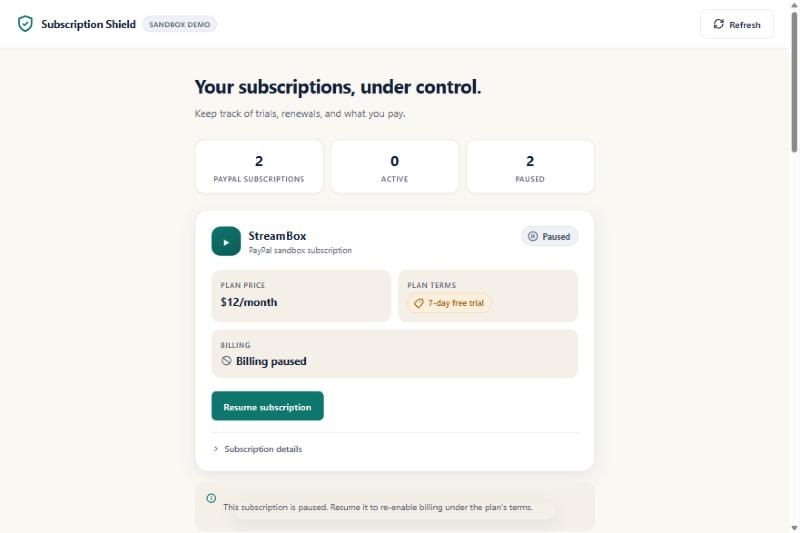
Subscription Shield is a dashboard that brings together two kinds of subscriptions:
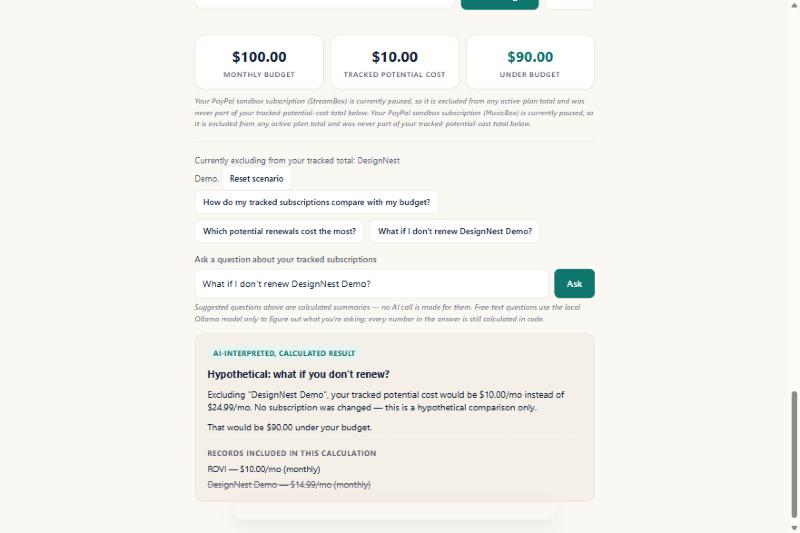
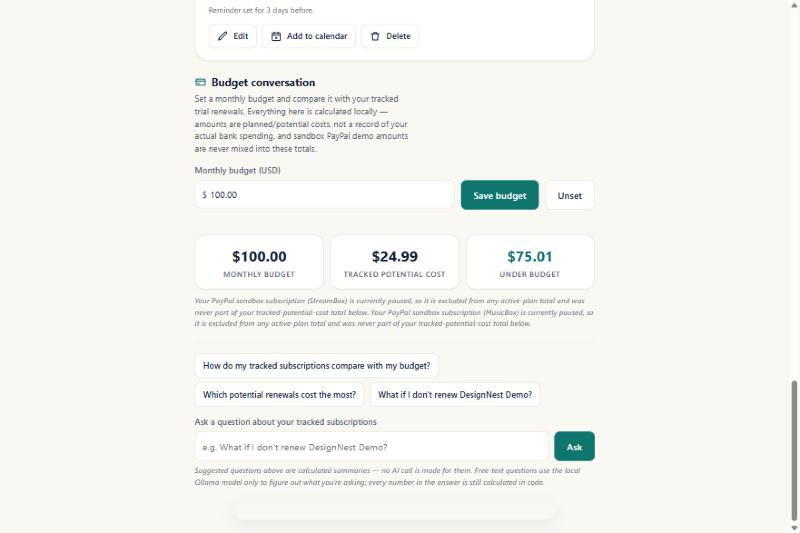
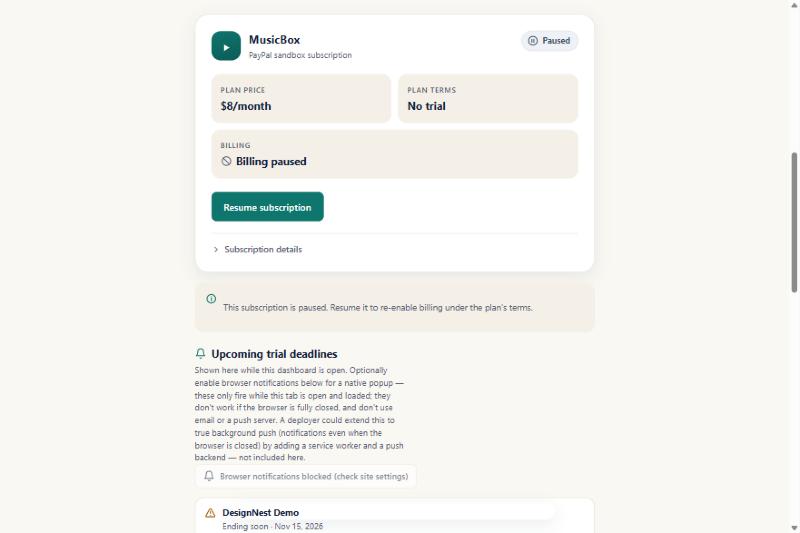
Free trials you track yourself-added manually or pasted in from a confirmation email (AI-extracted, with every field shown next to the exact quote it came from, so you can verify before saving anything). Trials nearing their reminder window show up as upcoming deadlines, with an opt-in native browser notification. Real PayPal sandbox subscriptions- created through this project’s own setup scripts, with live status, price and billing terms pulled from PayPal and a genuine pause/resume control for each one. On top of that sits a budget conversation: set a monthly budget and ask it free-text questions like “what if I resume StreamBox?” or “what if I add $100 to my budget?”. The AI only figures out which question you’re asking and which subscription you mean, every dollar amount in the answer is computed by plain code, never stated by the model itself.
How we built it
It’s a zero-dependency Node.js backend (node:http, no framework) serving a vanilla HTML/CSS/JS frontend; no bundler, no build step. PayPal integration goes through the real Sandbox REST API: OAuth2 client-credentials, Billing Plans, Subscriptions, pause/resume and transaction history, all via plain fetch.
For the AI side, intent classification runs through a single swappable provider; local Ollama (qwen3:8b) by default or Claude through the Anthropic API if you’d rather not install anything locally. The model only ever returns a structured JSON classification (which intent, which service, a literal number it read off the screen); a “trust but verify” layer checks that every value the model returns is actually, verbatim, present in what the user typed before it’s trusted at all. All arithmetic; budget totals, comparisons, hypothetical costs, happens afterward in deterministic JavaScript functions that the model never touches.
Challenges we ran into
Making the AI boundary airtight. Early on, the model would occasionally hand back "$100" instead of a bare number, or "16,060" with a thousands separator, and the strict parser would reject it. Rather than loosening what we trust from the model, we normalized the comparison (so “$100” verbatim-matches “100” in the source) while keeping the actual computation in code. Getting negation right. “What happens if I unpause StreamBox?” and “What if I don’t unpause StreamBox?” need opposite answers, and it’s easy for a classifier to collapse them into the same intent. We added an explicit negated field to the schema and wrote regression tests against both phrasings, verified live against the real model, not just mocked. Scaling to more than one subscription mid-build. Partway through, the single-subscription assumption baked into the conversation pipeline had to become multi-subscription-aware, while a budget-change feature was being built in parallel; merging the two cleanly, with the full test suite green afterward, took real care. Not inferring more than the data shows. When verifying that pausing a subscription actually prevents a charge, it would have been easy to assume a paused subscription “must” have stopped a payment. We only reported what the PayPal transaction history actually proved and were explicit about what a short observation window can’t prove.
Accomplishments that we're proud of
A test suite of 462 passing tests covering validation, calculation, storage and full HTTP integration and an AI boundary where the model is structurally incapable of inventing a dollar figure, because the code never asks it to produce one.
What I learned
That the most trustworthy way to use an LLM next to real financial data isn’t to make it smarter — it’s to shrink its job down to exactly “read this text and tell me what it says,” and let deterministic code do everything that has to be correct.
What's next for SUBSCRIPTION SHIELD
The in-dashboard notifications currently only fire while the tab is open. A natural next step for a deployer would be a service worker and a push backend, to turn that into true background push that works even when the browser is closed.

