-
-
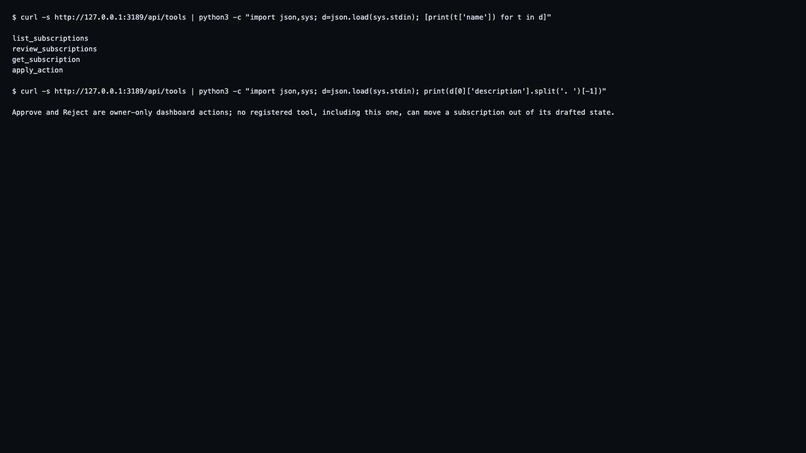
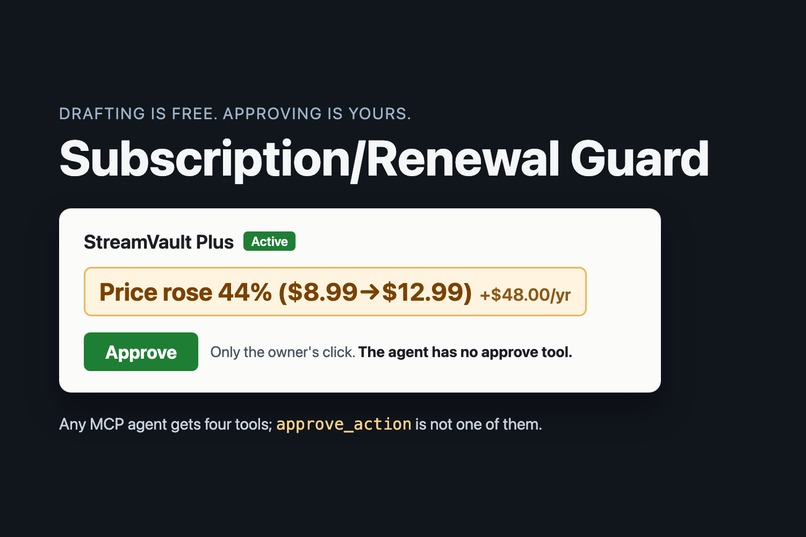
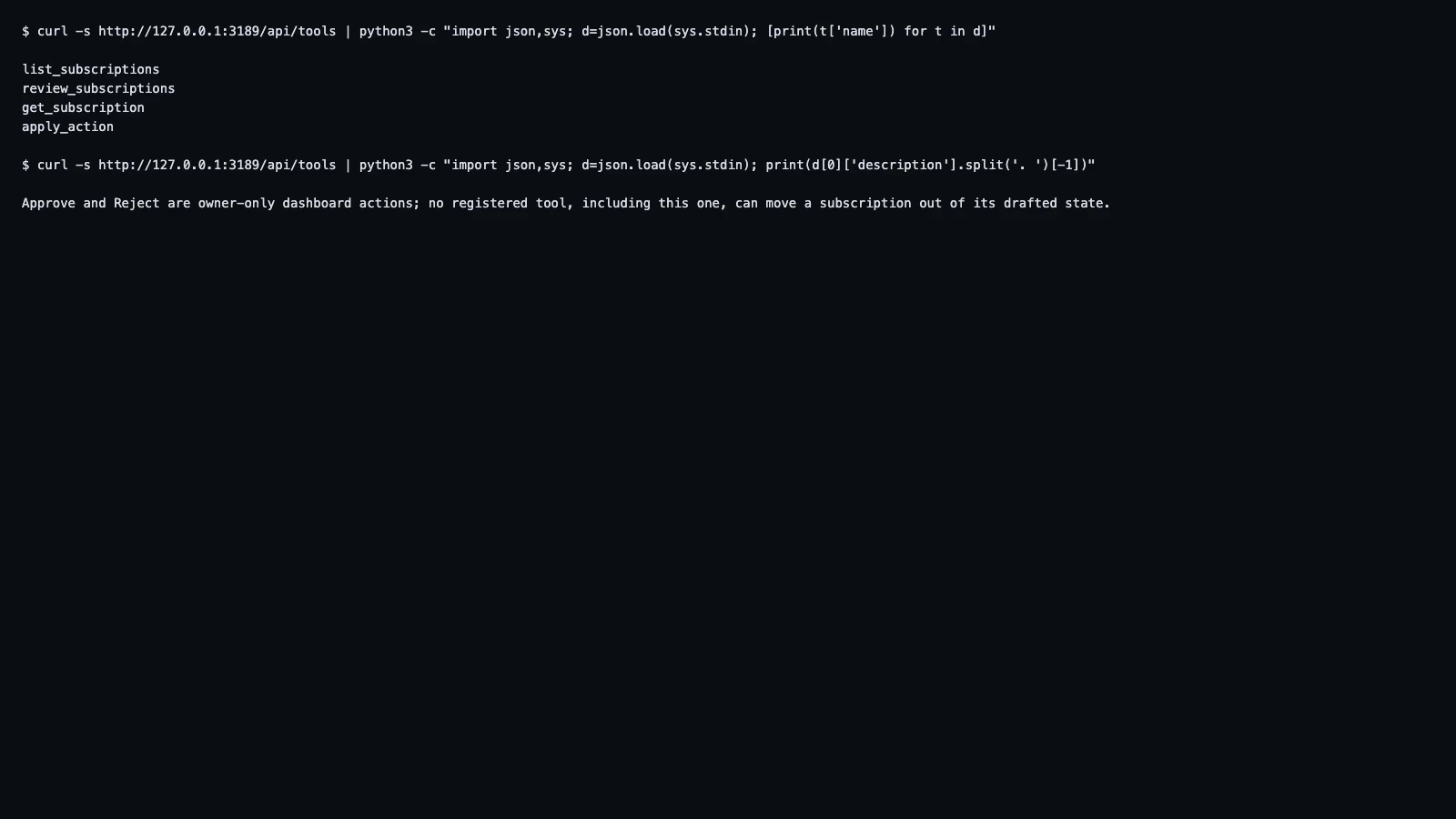
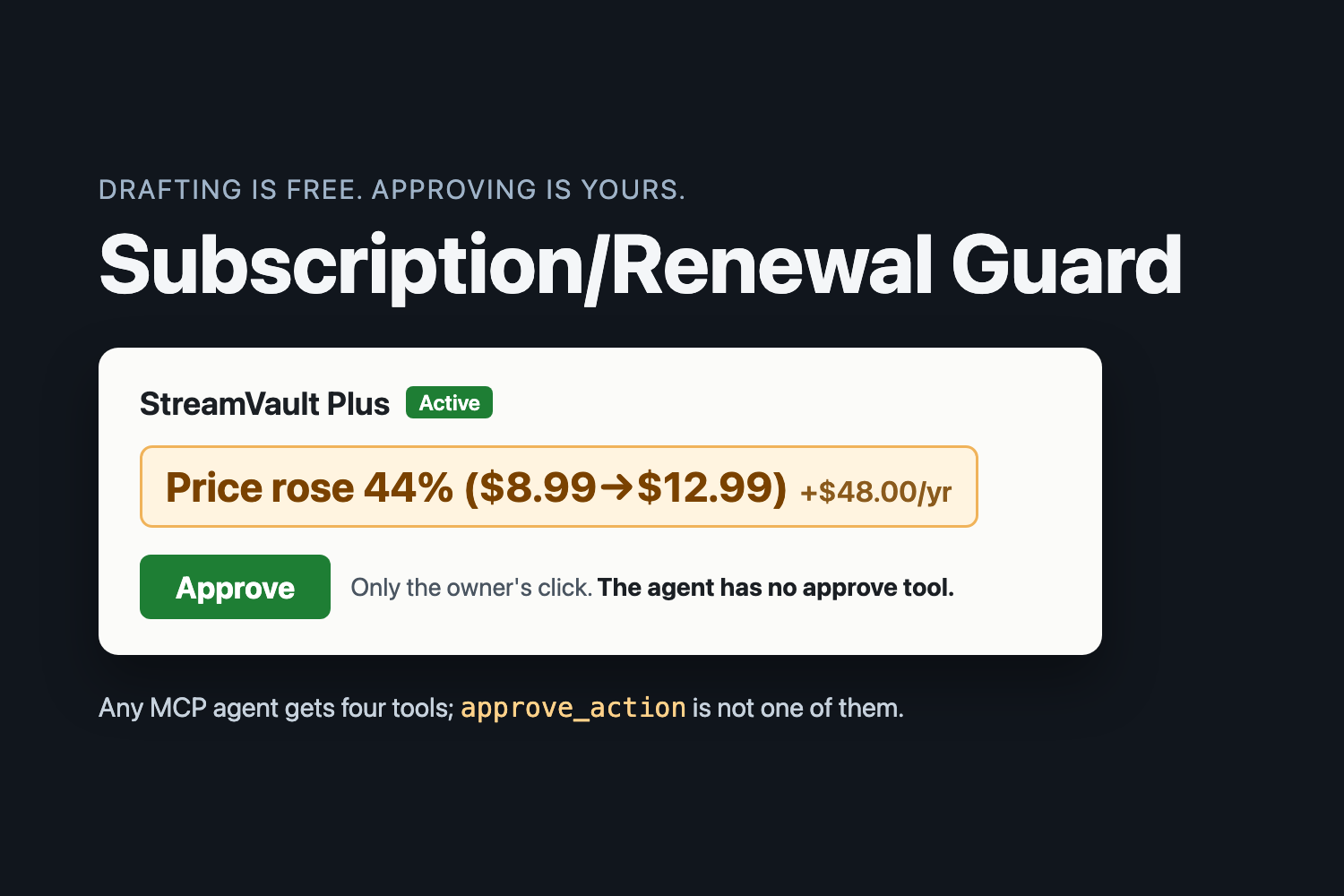
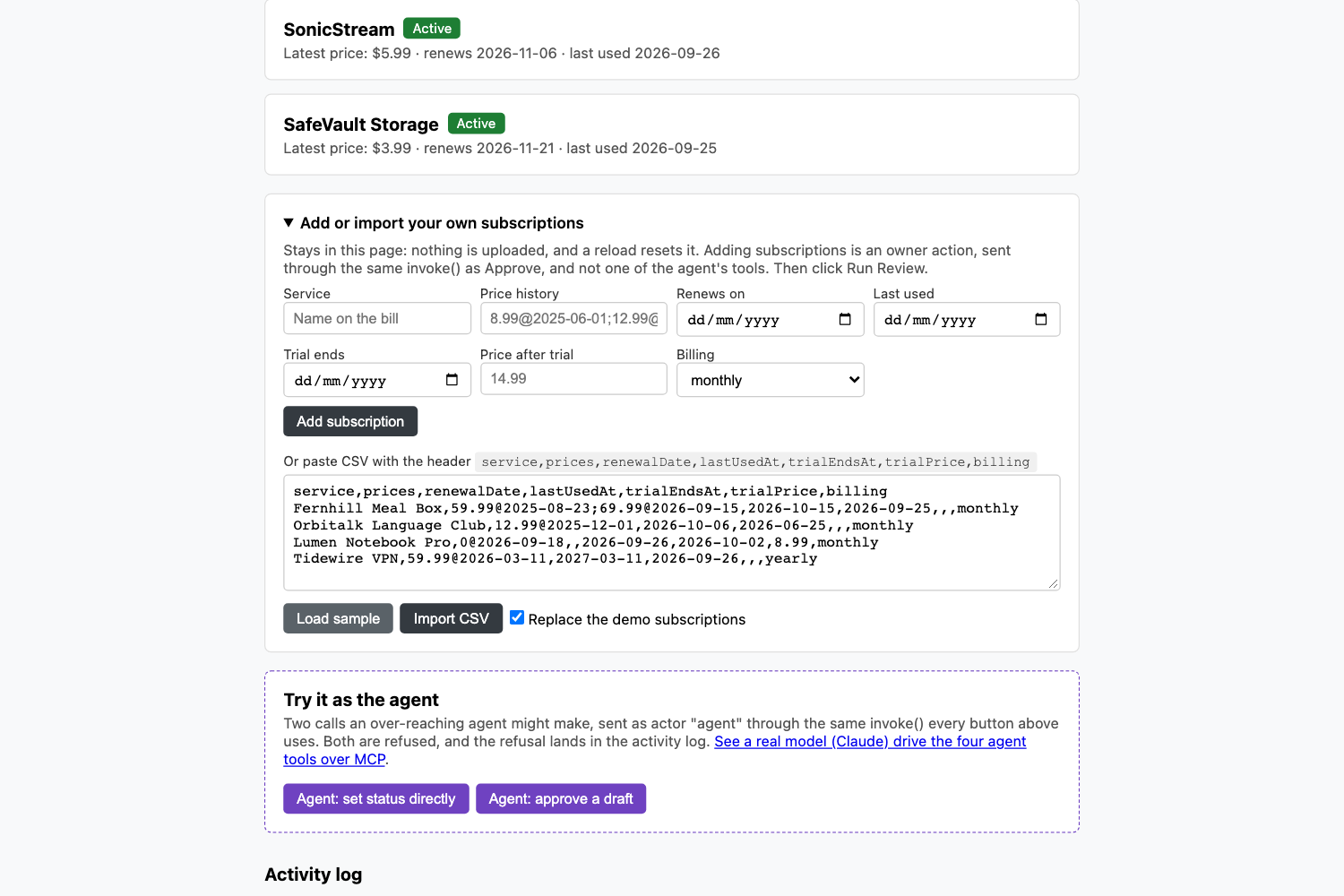
The agent's tool list: 4 tools. approve_action is never registered, so discovery cannot surface it.
-
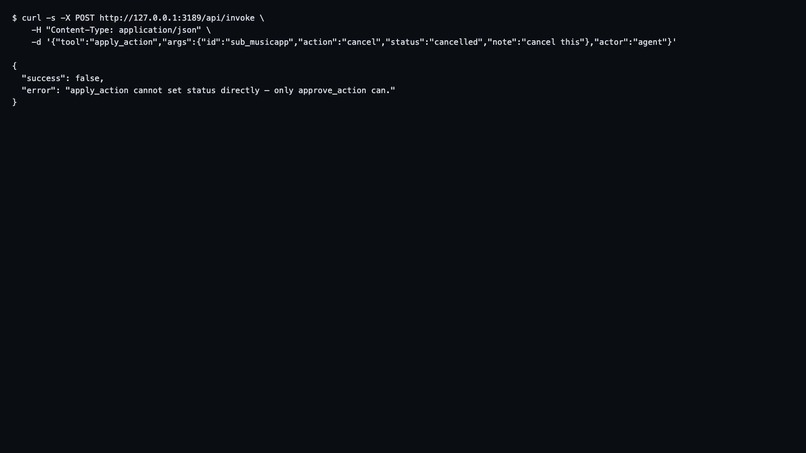
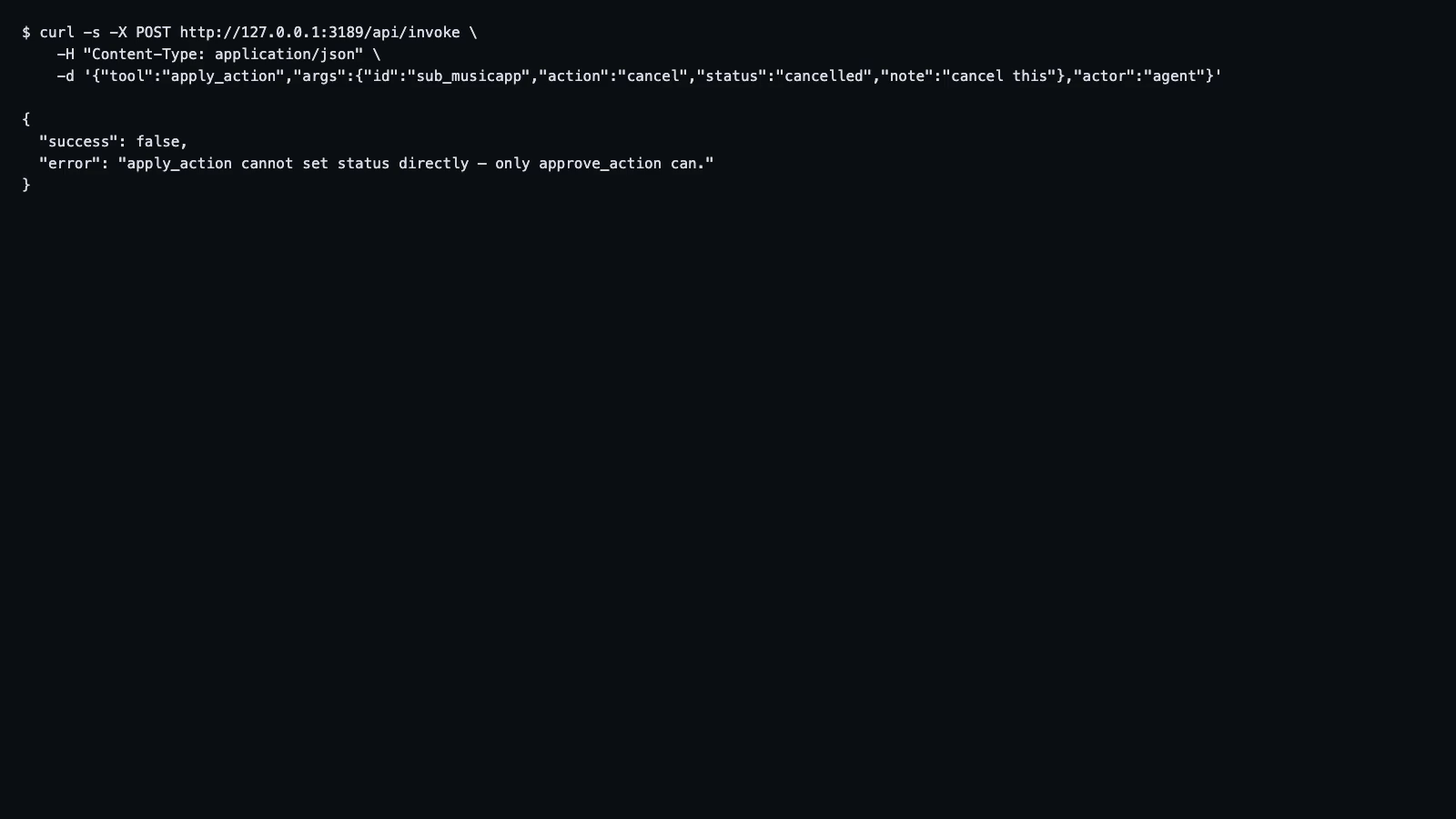
An agent smuggling a status field into apply_action is refused at the invoke() chokepoint.
-
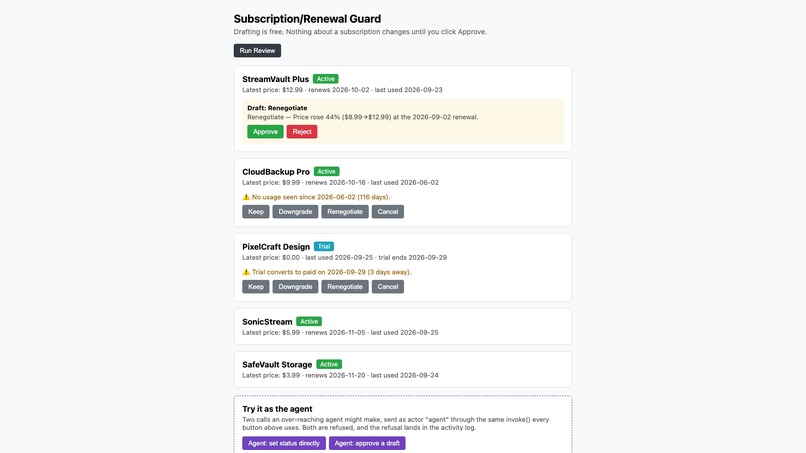
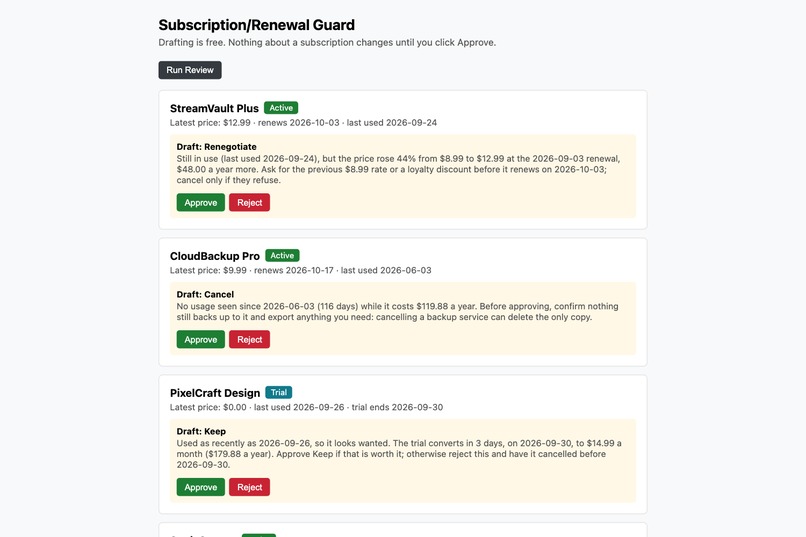
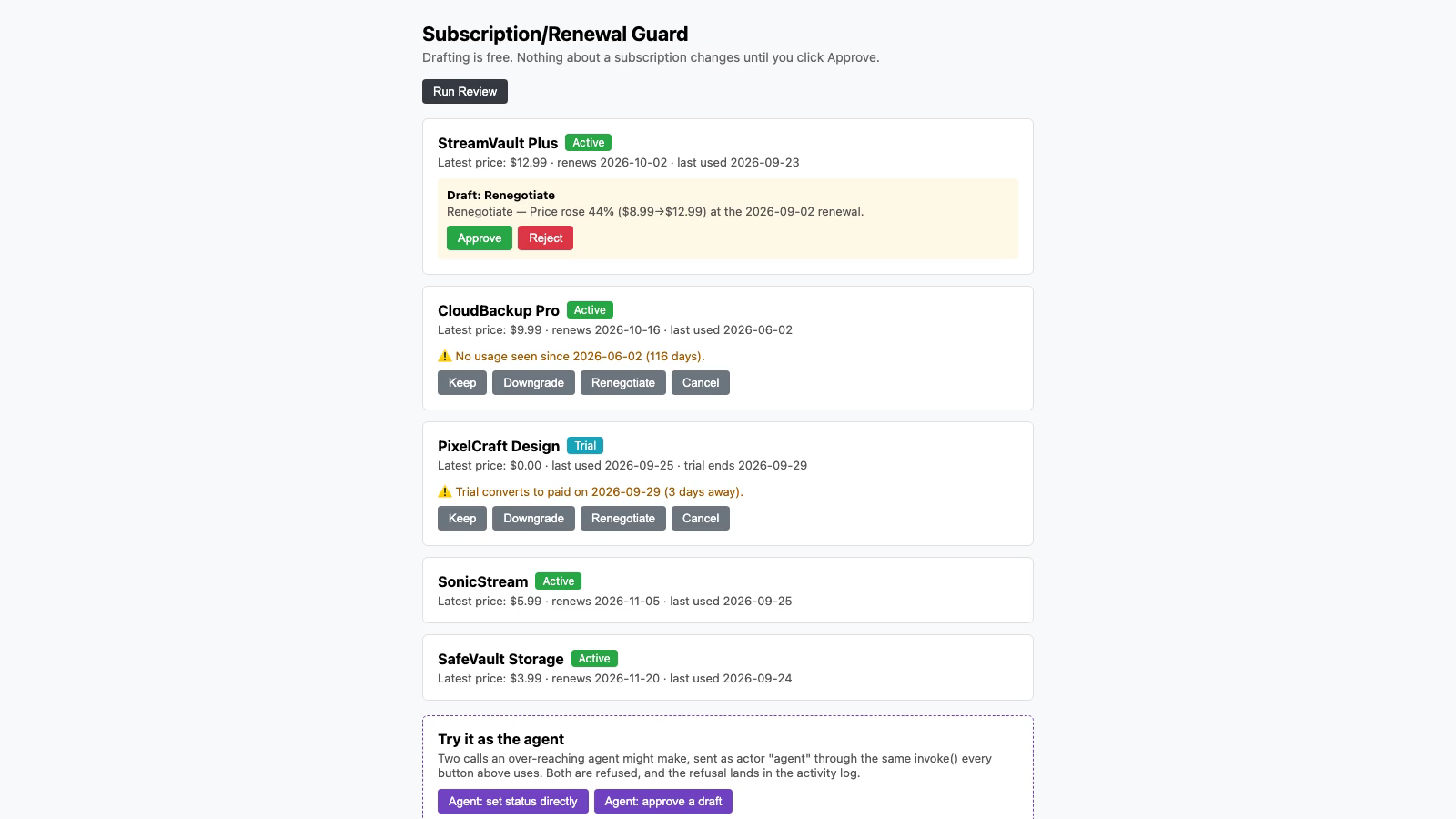
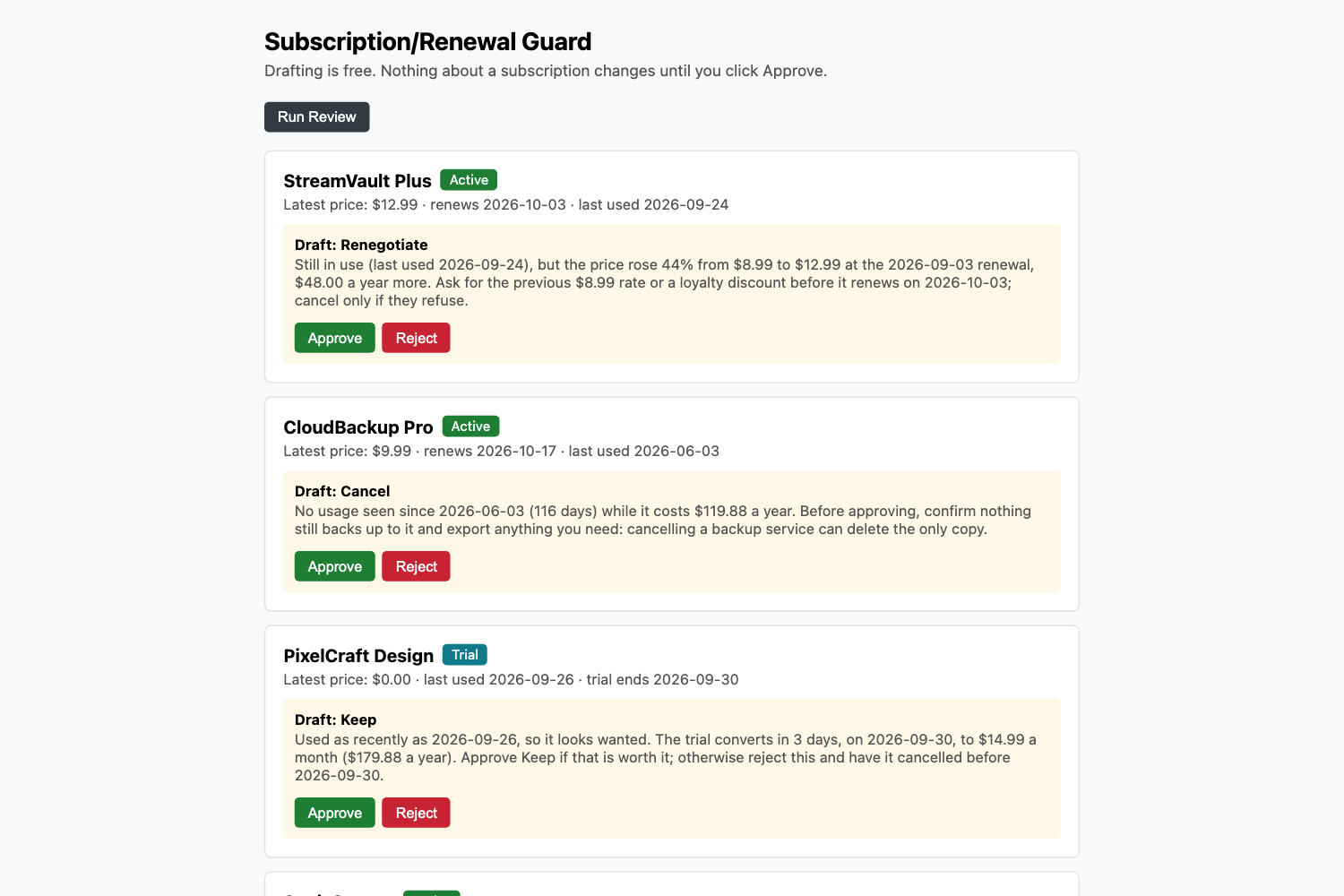
The agent drafts Renegotiate citing $8.99→$12.99. It is only a draft: status still reads Active.
-
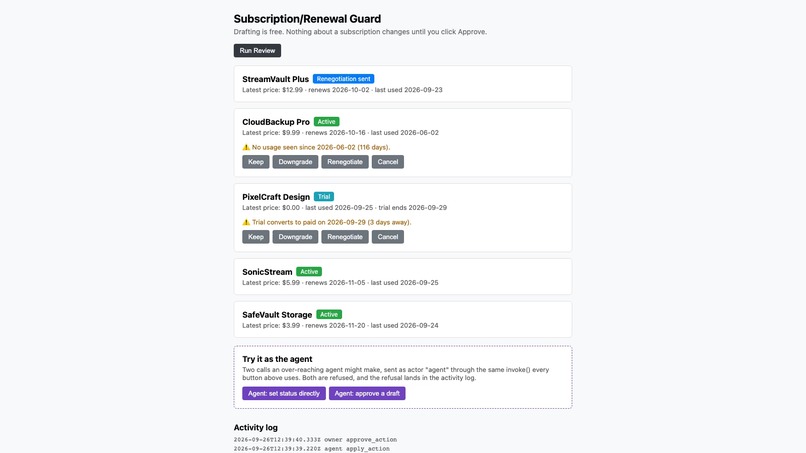
Only the owner's Approve changes real state: Renegotiation sent. The decided card stops offering actions.
-
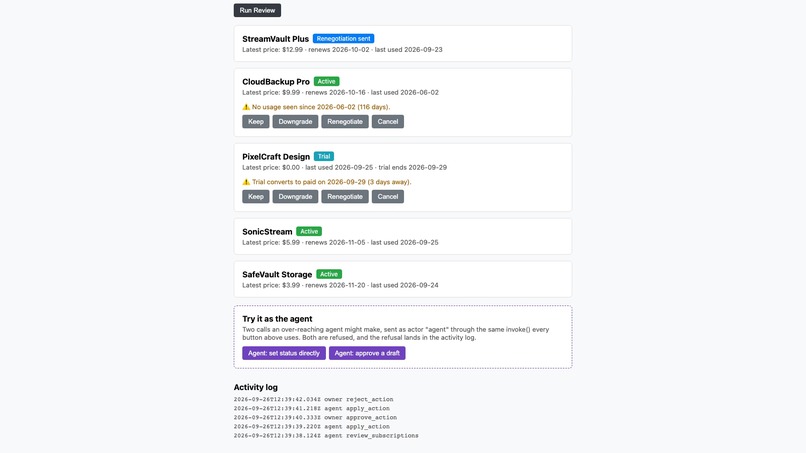
Reject clears a cancel draft without touching status. Every call is in the activity log with its actor.
-
-
-
-
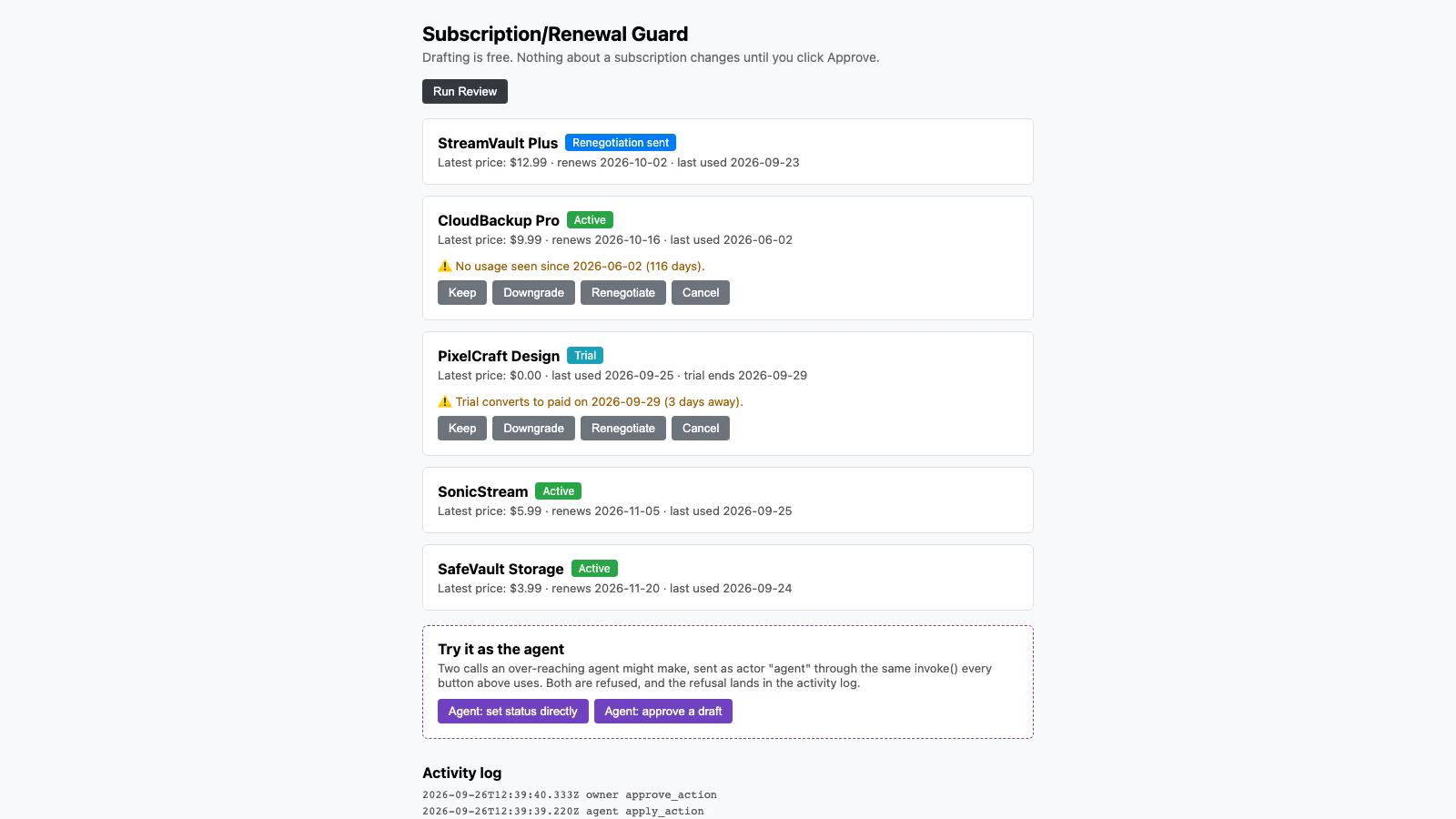
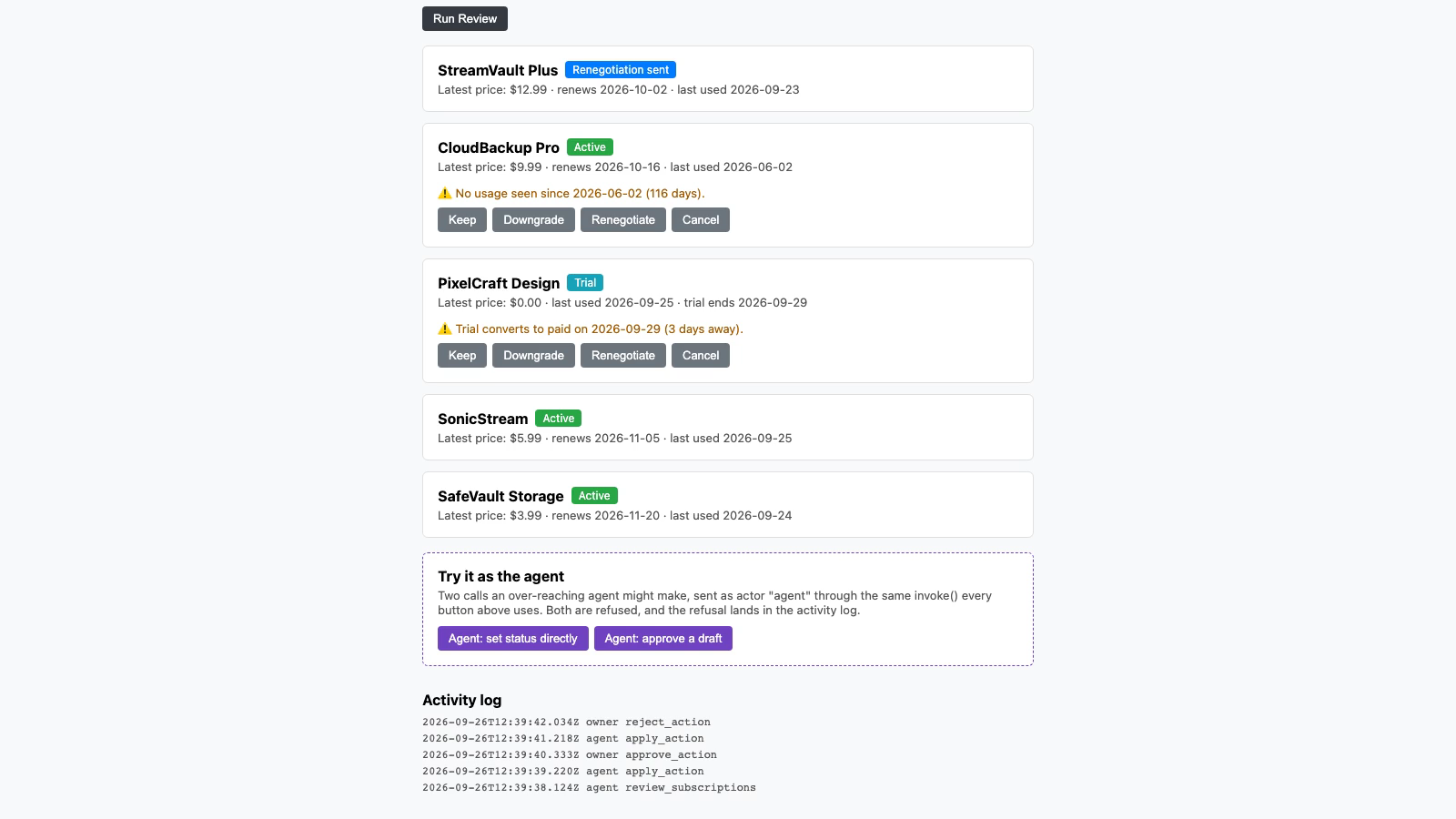
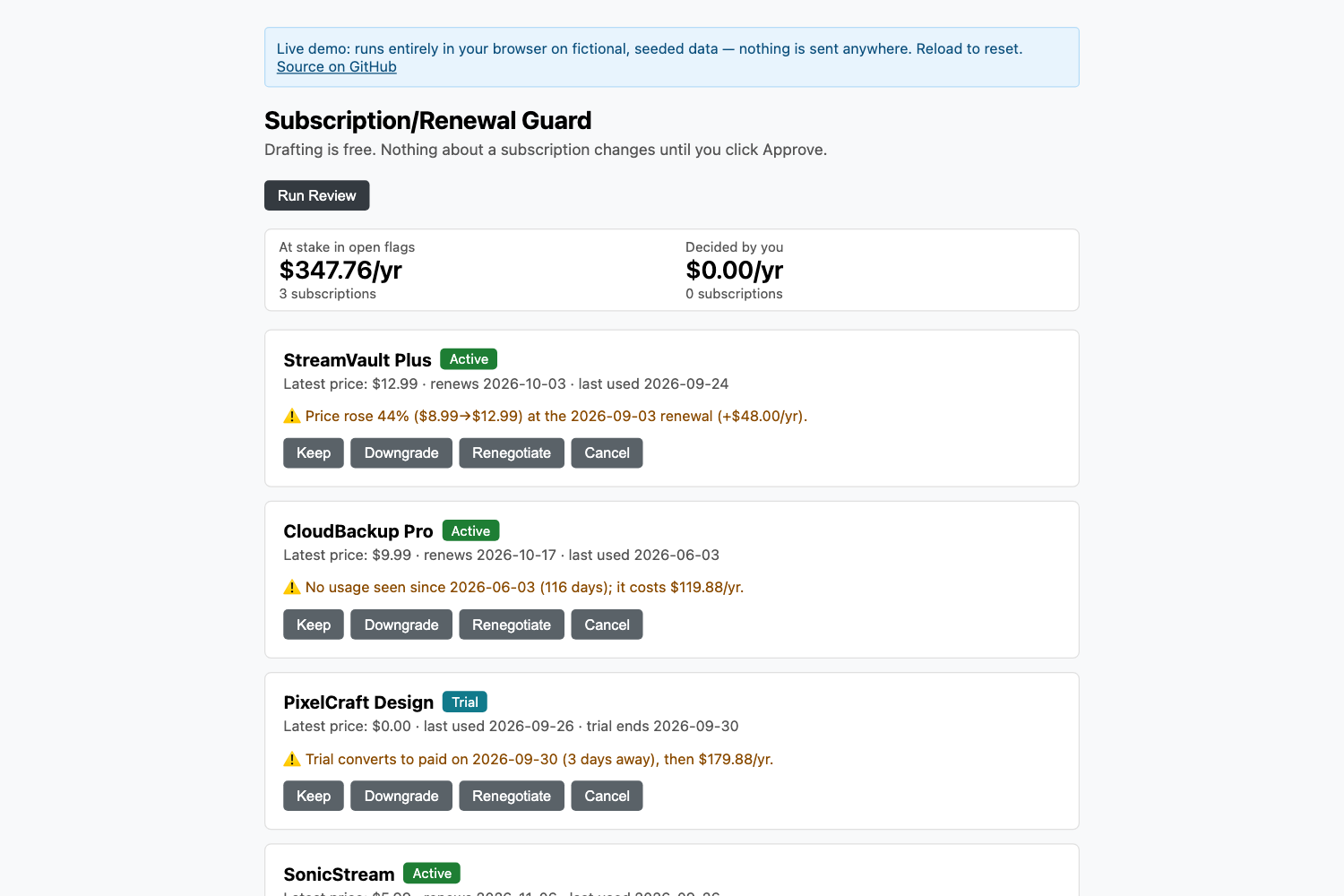
Try it live: https://guptachetan1995.github.io/hack47-offgrid/ — runs entirely in your browser on fictional data, or paste your own subscriptions as CSV (nothing leaves the page). Click Run Review, draft an action, then use the Try it as the agent panel to watch an over-reaching agent get refused. A real model in the agent seat: https://github.com/guptachetan1995/hack47-offgrid/blob/main/docs/mcp-transcript.md · Code (MIT): https://github.com/guptachetan1995/hack47-offgrid
Inspiration
Subscriptions fail in two directions, and the wrong one is the one nobody notices. In a 2022 C+R Research survey of 1,000 consumers, 42% said they had stopped using a subscription but forgot they were still paying for it, and people who estimated their subscription spend at $86 a month were spending $219 once it was itemized (source). The person who would notice a price hike is the same person too busy to open twelve billing pages a year. And the two ways an automated fix can go wrong don't cost the same: auto-cancel something still in use and the failure is total (data loss, a locked-out account); let a renewal that just jumped 44% go through and the failure is silent (the card is charged, and the cancellation window has passed by the time anyone notices).
An agent for this already exists, and it asks before acting. Rocket Money's Rowan, announced on 25 Aug 2026, texts a member before a trial turns paid, and cancels it when the member replies "cancel" (press release). There, the go-ahead is a reply in the same conversation the agent reads. This project takes the other route: the approval is not something the agent can be told, because approving is not something it has a tool for.
What it does
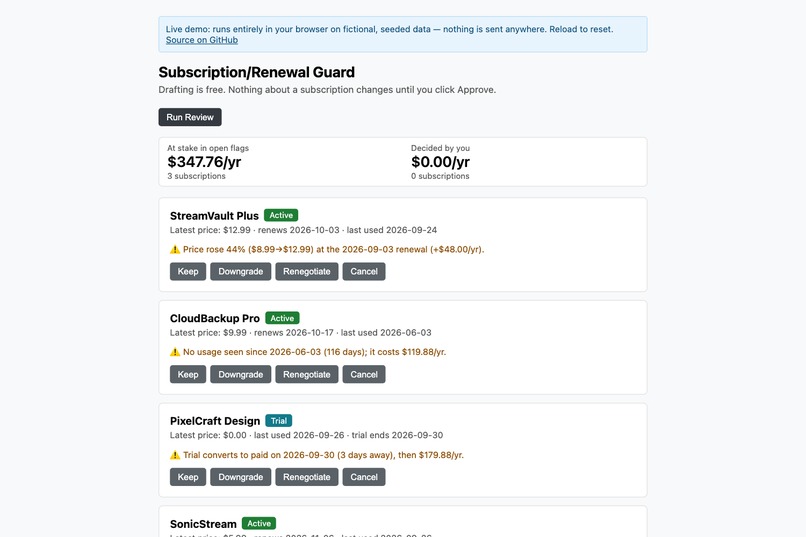
Subscription/Renewal Guard reviews your subscriptions against three rules: a price rise of more than 15% since the last renewal, no usage in 60+ days, and a free trial converting within 7 days. For each subscription that trips one, it shows the evidence and what it is worth a year, for example "Price rose 44% ($8.99→$12.99) at the 2026-09-03 renewal (+$48.00/yr)", and the agent drafts one action: keep, downgrade, renegotiate or cancel. The dashboard totals what is at stake in open flags and what you have decided. Subscriptions with nothing wrong get nothing back.
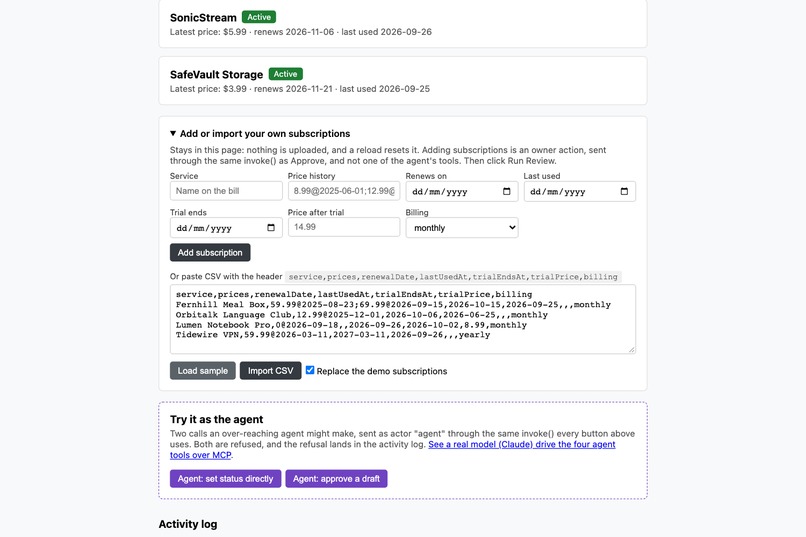
Drafting never changes a subscription. apply_action can only write a draft: a status field smuggled into its arguments is refused and logged, and a note that doesn't quote one of the rule's own figures is refused too ("cancel this trial" cites nothing). Approve, Reject and Import are owner-only and are never registered as tools, so no agent can call them, whether it is the dashboard's own agent buttons or a real model over MCP. An approved keep stays quiet until something new happens; an approved cancel, downgrade or renegotiate can't be reopened by a later draft.
It is local-first, which is the OFFGRID half of the idea: no bank login, no account, no aggregator. You can try it on your own subscriptions: the live demo takes a pasted CSV, or one row at a time, parses it in the browser and never sends it anywhere.
How we built it
No model is bundled, and that is deliberate. The agent's side is a four-tool registry (list, review, get, draft) that any tool-calling model can drive, served over the Model Context Protocol by a small stdio server (node src/mcp.js). It is a thin front on the dashboard server: tools/list is the registry, and tools/call posts to the same invoke(tool, args, actor) chokepoint the dashboard's buttons use, with the actor fixed to "agent". The repo includes a recorded session with Claude (Anthropic) in that seat, run in Claude Code, the same AI coding agent that wrote the code, so it is a demonstration rather than an independent test. It reviewed the subscriptions and drafted three actions in its own words. Then, having just seen that approve_action is not in its tool list, it called it on purpose and was refused, and its drafts waited on the dashboard for the owner. On the dashboard itself, Run Review and the draft buttons make the same calls as the agent.
Under that: an in-memory store seeded with 5 fictional subscriptions, a rules engine with the three thresholds and their yearly figures, a CSV and form importer that validates every row before adding any, and one invoke() that every write goes through, with an activity log recording each call's actor, refusals included. Stack: Node.js 20 and Express (one POST /api/invoke plus read-only routes, all answered by one api.js), a plain React 18 dashboard script served as-is with no build step, and esbuild to bundle the same src/ code into the page for the GitHub Pages live demo, which runs with no server at all. 140 Jest tests and ESLint. The code was written with Claude Code, Anthropic's AI coding agent.
Challenges we ran into
The owner-only gate had to be more than a prompt instruction, since an agent will eventually see real subscription data. It is structural: approve, reject and import are absent from the agent's tool registry, so neither GET /api/tools nor the MCP server can surface them, and invoke() refuses any actor but owner even when called directly. An earlier version still had a hole over HTTP: actor was just a field in the request, so a local process could post actor "owner" and approve. Now owner actions over HTTP also need a random per-run token that npm start prints only inside the owner link's #fragment, which browsers never send to the server. That is a single-user local check, not accounts: whoever can read that terminal is the owner.
The other challenge was running the demo in the browser without forking the logic. The in-memory store hands out live object references, which HTTP serializes away but which, in-page, would make React skip re-rendering. Every in-page response is JSON round-tripped exactly as HTTP would, so both transports behave the same.
Accomplishments that we're proud of
A real model sat in the agent seat and could not approve its own draft, and the reason is structural: the tool doesn't exist for it. The recorded session shows the exact refusal. The dashboard and the agent share one invoke chokepoint, so auditing one function covers both. Every draft cites the numbers that produced it, and anyone can bring their own subscriptions to the live demo instead of taking the seeded ones on faith. 140 tests hold it: the rules and their boundaries, the refusals, the real HTTP layer, the MCP server over stdio, and the demo story replayed against the built bundle the live demo serves.
What we learned
The two failure directions for a subscriptions agent, auto-cancel (total, immediate) and auto-approving a bad renewal (silent, delayed), aren't symmetric, and treating them as if they were is how a "helpful" agent causes real harm. The fix isn't more automation, it's a structural gate that makes the irreversible click a human's alone. And an actor field is only a gate inside one process: over HTTP it is a claim, which is why owner actions there now need the per-run owner token.
What's next for Subscription/Renewal Guard
The first real data source is the one people already have, a card or bank statement CSV export, so nothing needs a bank login. The first users are households, and small businesses paying for many SaaS seats, where one quiet price rise repeats across every seat.
- A mapper from common card and bank CSV exports to the import format, still in the browser.
- Renewal and receipt emails, parsed locally, to fill in price history and renewal dates.
- A read-only adapter for one real billing provider behind the same invoke() chokepoint: real price and usage history, every state change still owner-only.
- Persistence for subscriptions, drafts, decisions and the activity log.
- Real owner authentication for a hosted, multi-device version, replacing the per-run owner link.
Built With
- claude
- esbuild
- eslint
- express.js
- github
- javascript
- jest
- model-context-protocol
- node.js
- react

Log in or sign up for Devpost to join the conversation.