Accomplishments that we're proud of
Inspiration
Personalized tutoring works because a teacher can adapt explanations, practice, and feedback to one learner. But it also scales one teacher-hour at a time, making it unaffordable for many families.
Traditional online courses solve the price problem, but usually create another one: every learner receives the same lessons, the same exercises, and very limited feedback. Meanwhile, teachers spend hours converting their existing knowledge into course materials, writing homework, grading essays, and reviewing spoken or handwritten answers.
SubSchool started in 2019 as an idea for a subscription-based school where experienced teachers would record lectures and tutors would work with students in small groups. We built an early prototype in 2021, but it was not stable enough to use. In 2023, we rebuilt the project as a working course platform.
That version taught us an uncomfortable but useful lesson: a stable LMS without meaningful automation is still just another LMS.
Our mission became clearer: make personalized, teacher-led education more affordable by automating the repetitive work around teaching—not by replacing the teacher.
What SubSchool does
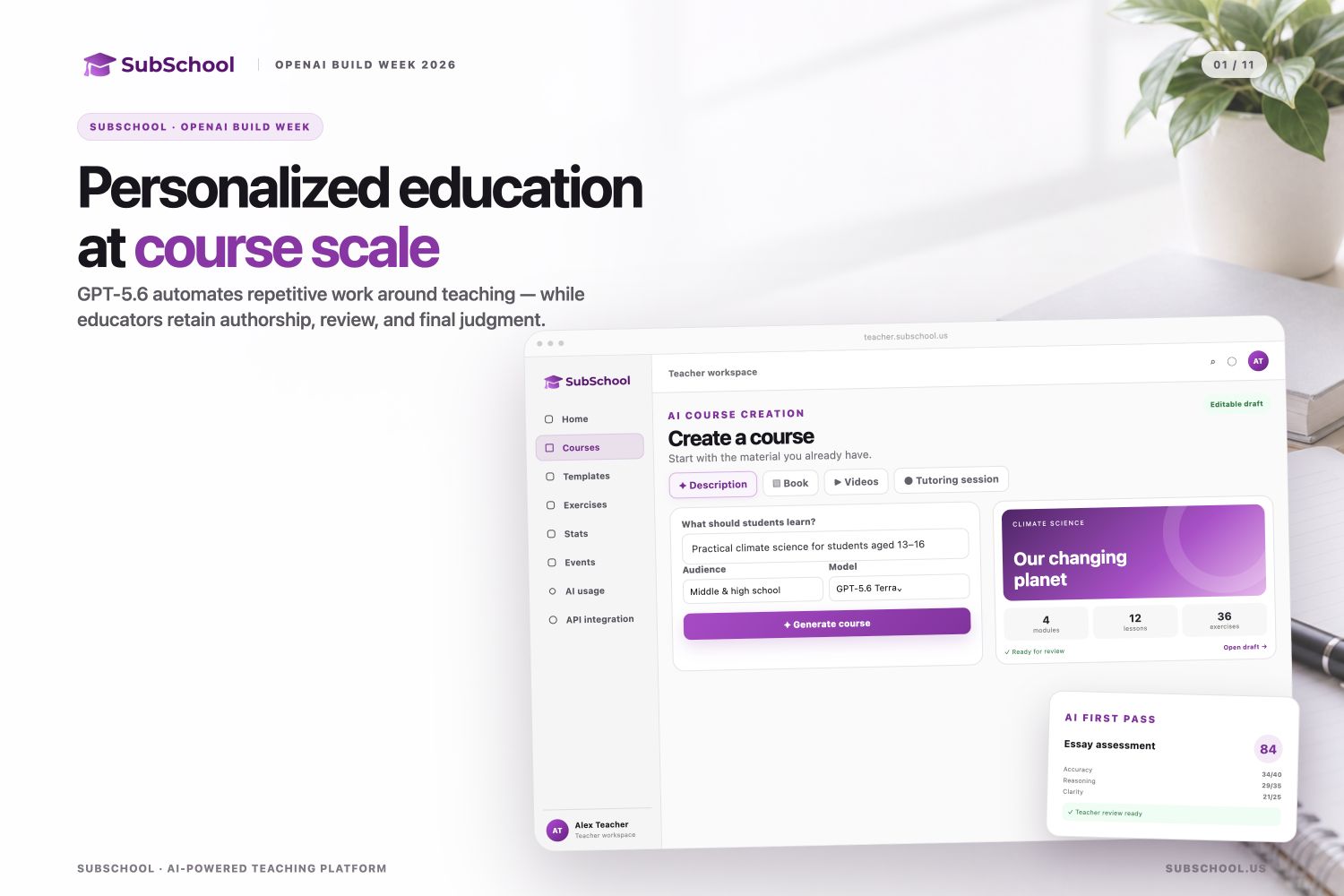
SubSchool is an AI-powered teaching platform where educators can create courses, teach students, generate and assess homework, run tutoring sessions, and sell learning content in one place.
Teachers can begin with:
- a short description of the course they want to create;
- a collection of recorded video lectures;
- a book or other text material they are authorized to use;
- an existing lesson;
- or the recording of a live tutoring session.
GPT-5.6 turns that source material into editable educational entities inside SubSchool: course structures, modules, lessons, descriptions, exercises, homework sets, assessment criteria, scores, and feedback.
The result is not a block of generated text that must be copied into another LMS. It becomes a real course that can be edited, published, assigned to students, assessed, and sold.
What existed before Build Week
SubSchool was already a live platform before July 13, 2026.
The existing product included course creation and delivery, tutoring workflows, student assignments, a course marketplace, progress tracking, and earlier AI-assisted generation and assessment functionality.
Because this is a pre-existing product, we are deliberately separating that previous work from the functionality submitted to OpenAI Build Week.
What we built during OpenAI Build Week
All of the work below was implemented or meaningfully extended after July 13, 2026:
1. GPT-5.6 integration across the learning workflow
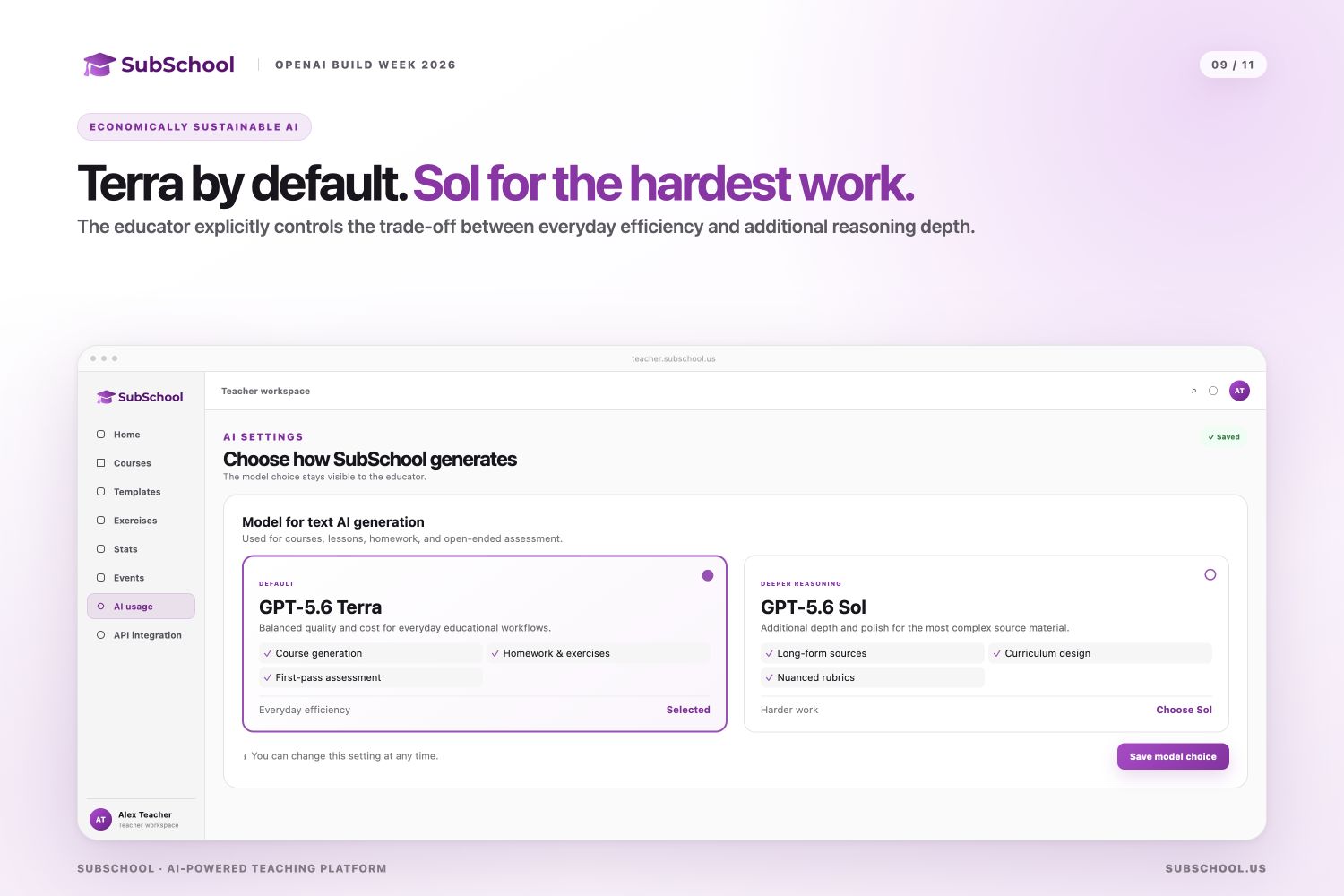
We moved SubSchool's active course-generation, lesson-generation, homework-generation, and open-ended assessment workflows to GPT-5.6 Terra and GPT-5.6 Sol.
GPT-5.6 Terra is used by default for every AI task. It provides the quality and reasoning needed for everyday educational workflows while keeping repeated generation and assessment economically sustainable.
Teachers can switch to GPT-5.6 Sol in their settings when they want additional reasoning depth and polish for more complex source material, curriculum design, exercise creation, or nuanced assessment.
We intentionally made this choice visible to the educator rather than hiding it behind automatic routing. The teacher controls the trade-off between cost and model capability.
2. A SubSchool MCP server for Codex
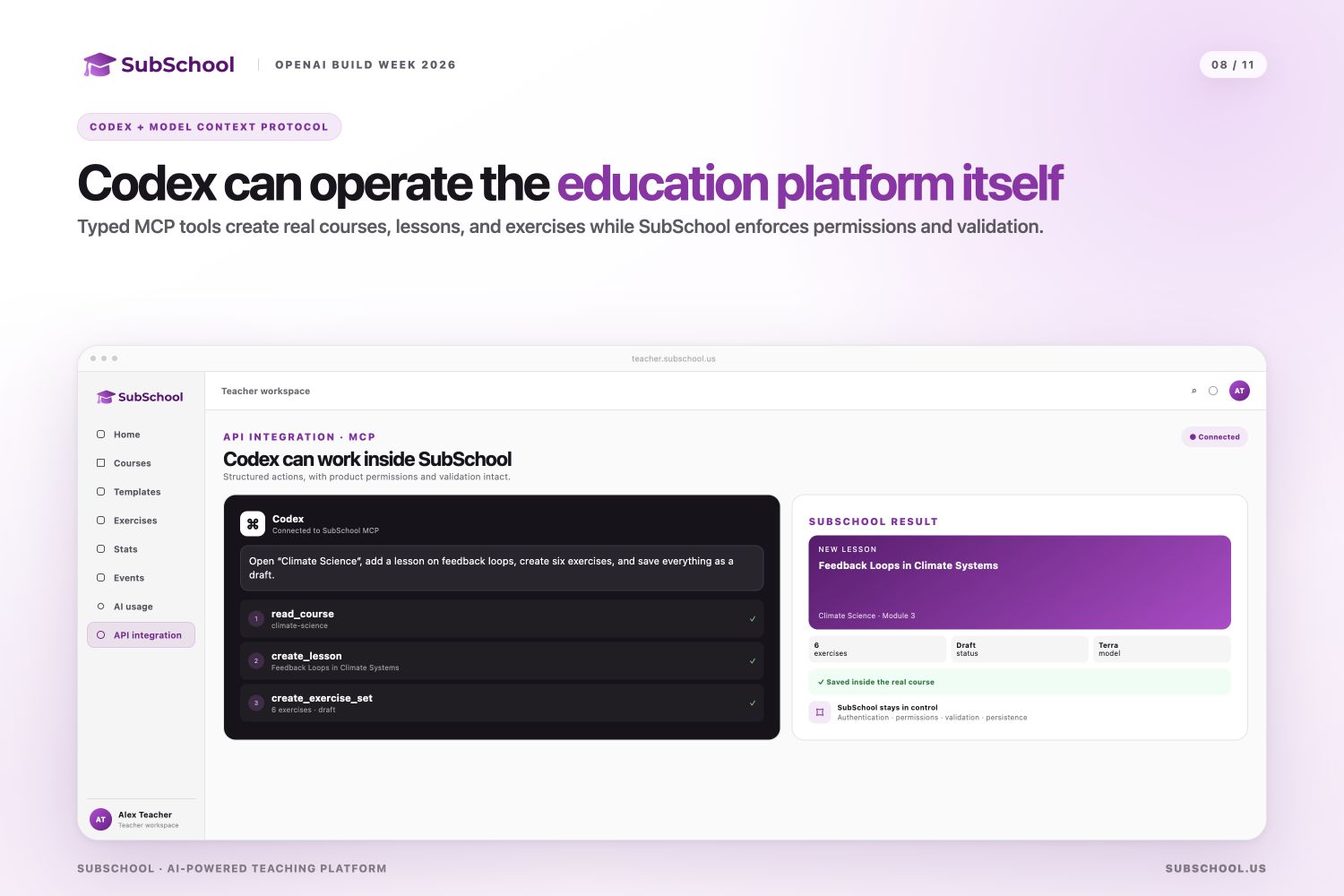
We built an MCP server that allows Codex to work directly with supported SubSchool entities and workflows through structured tools.
Instead of generating content in Codex and manually transferring it into the platform, an educator or platform operator can ask Codex to inspect existing course context, create or update learning content, and perform supported multi-step operations inside SubSchool.
For example, a user can ask Codex to:
Open an existing course, add a lesson based on the supplied material, create an exercise set for that lesson, and save the result as a draft for teacher review.
Codex determines which SubSchool tools are required, calls them through MCP, and returns the result inside the same workflow where the course will actually be taught.
The important distinction is that Codex is not merely writing educational text. It can operate a real education platform through typed, structured actions.
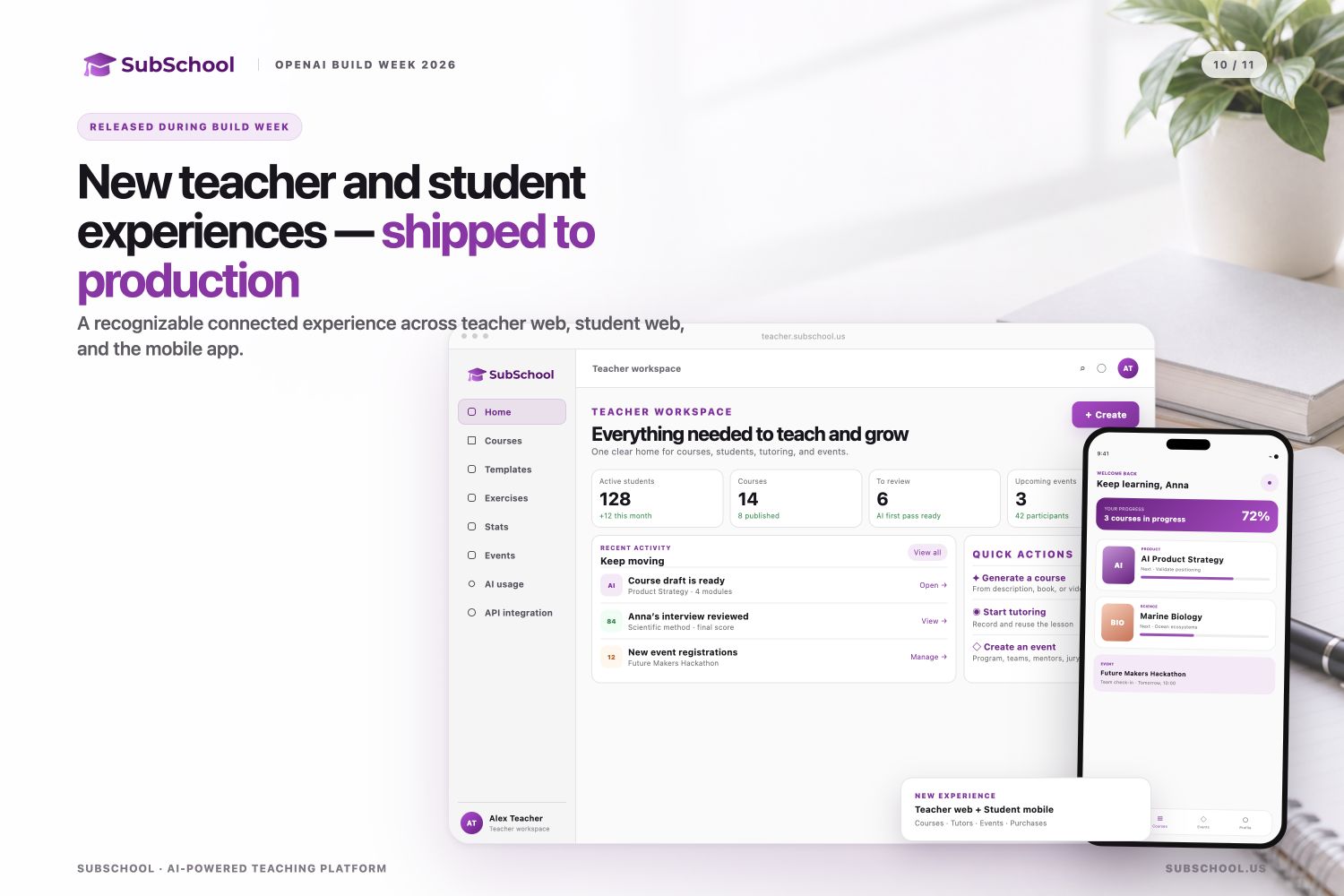
3. New teacher and student web applications
Using GPT-5.6 Sol in Codex's Ultra mode, we substantially reworked and released new versions of both the teacher and student web applications.
The current applications, with the new design and workflows, are available at:
- Teacher application: teacher.subschool.us
- Student application: class.subschool.us
For a direct before-and-after comparison, the previous versions remain available at:
- Previous teacher application: teacher-old.subschool.us
- Previous student application: class-old.subschool.us
This is not a design mockup prepared only for the submission. The new applications are the versions currently deployed on SubSchool's primary production subdomains.
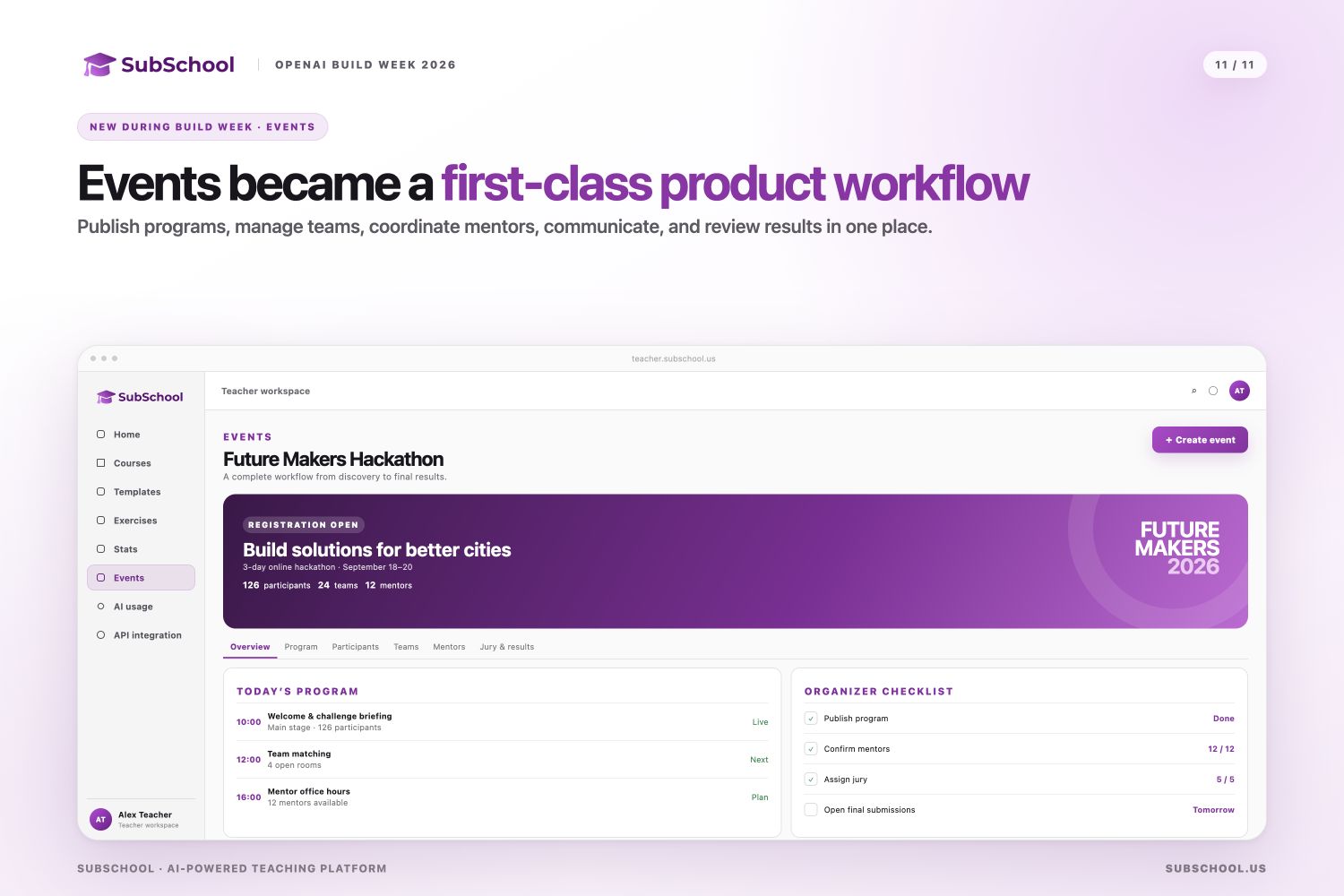
4. Events
During Build Week, we also developed a new Events section as part of the updated platform experience.
This work required changes across the product interface and existing application architecture rather than the creation of an isolated demonstration screen.
Core GPT-5.6 use cases
Use case 1: Creating a course from a description
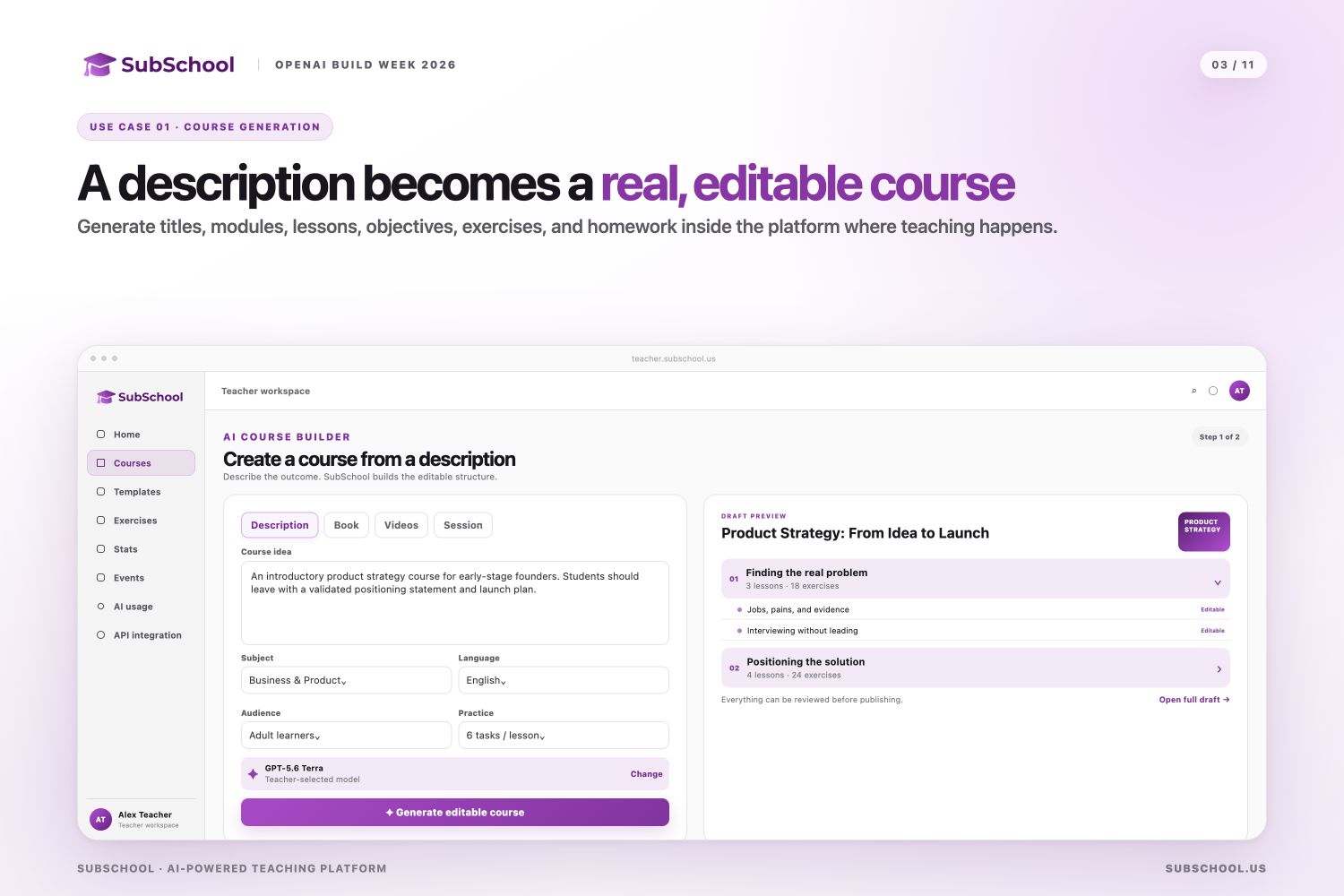
A teacher describes what students should learn, selects the subject, language, target audience, and other course parameters, and chooses Terra or Sol.
GPT-5.6 creates an editable course structure containing:
- a course title and description;
- modules arranged in a logical sequence;
- lessons within each module;
- lesson descriptions and learning objectives;
- and exercises or homework connected to the lesson content.
The teacher remains the author. Every generated element can be reviewed and edited before the course is published.
Use case 2: Turning video lectures into a course
A teacher can upload multiple recorded lectures instead of rebuilding the material manually.
SubSchool processes the recordings, creates transcripts, and uses the content as grounded context for GPT-5.6.
Each recording can become a structured lesson with its own description and practice. GPT-5.6 then organizes the lessons into modules and generates the surrounding course structure.
This allows an educator with an archive of webinars, lectures, or recorded classes to turn that archive into an actual learning product rather than a folder of videos.
Use case 3: Turning a book into a course
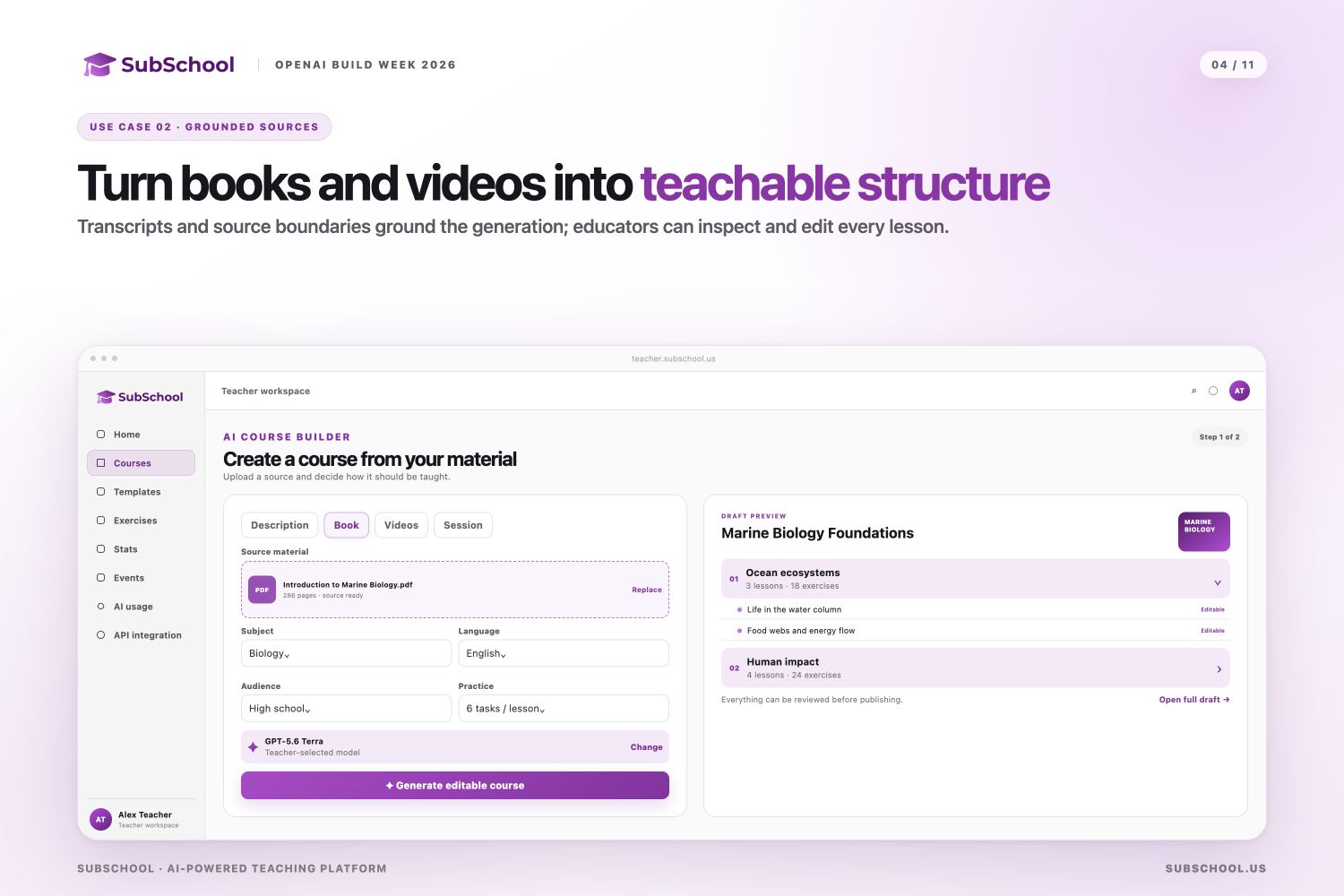
A teacher uploads a book or another long-form text they are authorized to use and specifies the subject, language, audience, and desired amount of practice.
SubSchool analyzes chapters and other meaningful boundaries in the source. GPT-5.6 then creates:
- a structured course;
- modules and lessons based on the source;
- concise and detailed descriptions;
- learning objectives;
- and homework connected to each section.
The source remains the basis of the course, while the generated structure makes it teachable, navigable, and editable.
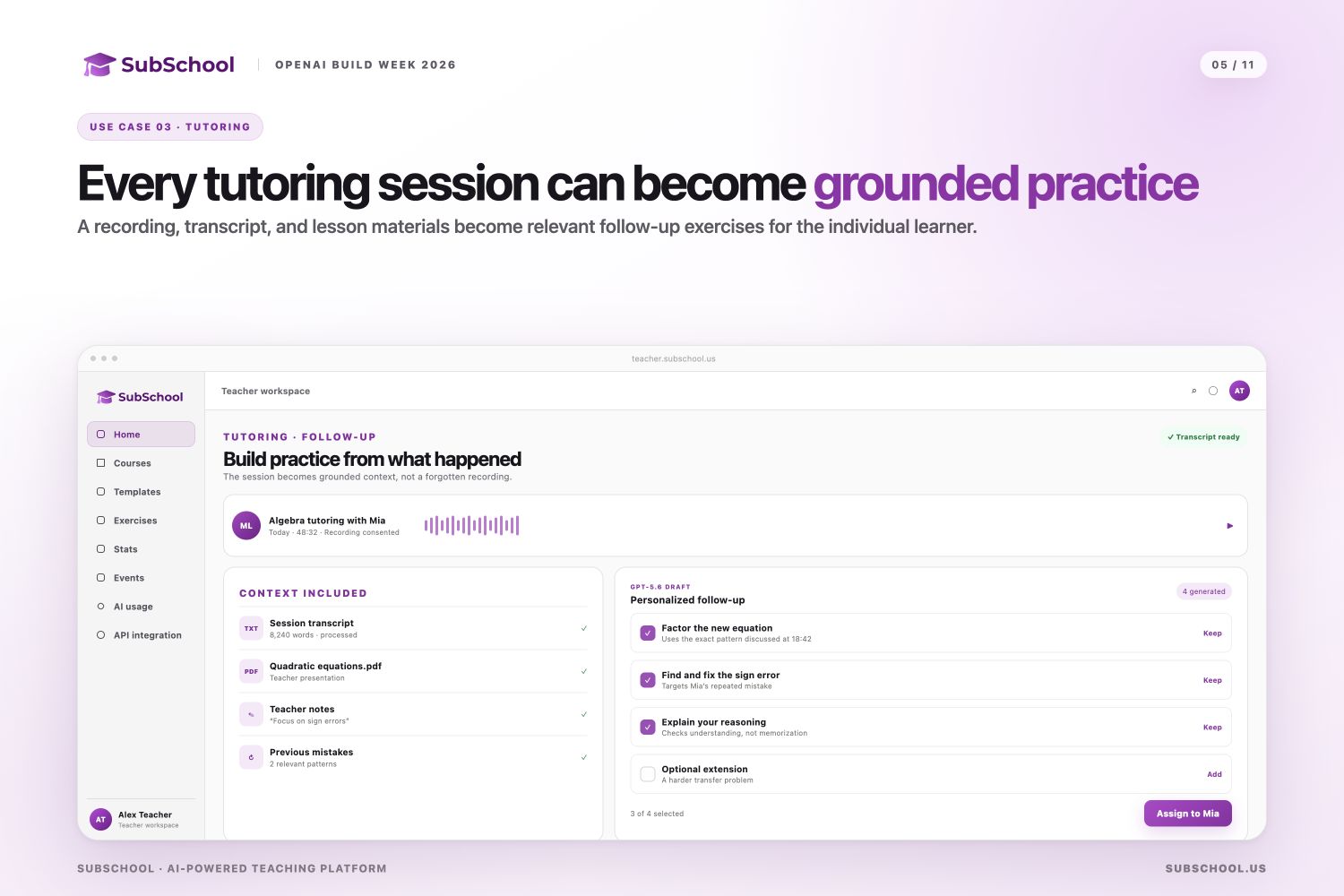
Use case 4: Generating homework after a tutoring session
A teacher can conduct a lesson through the platform.
The lesson is transcribed, and its transcript can be combined with presentations and other materials used during the session. GPT-5.6 generates follow-up exercises based on what was actually discussed rather than on a generic topic label.
The teacher can review the generated exercise pool, remove unsuitable tasks, add their own exercises, and assign an appropriate set to the student.
This turns every tutoring session into reusable educational context and reduces the amount of repetitive preparation required before the next lesson.
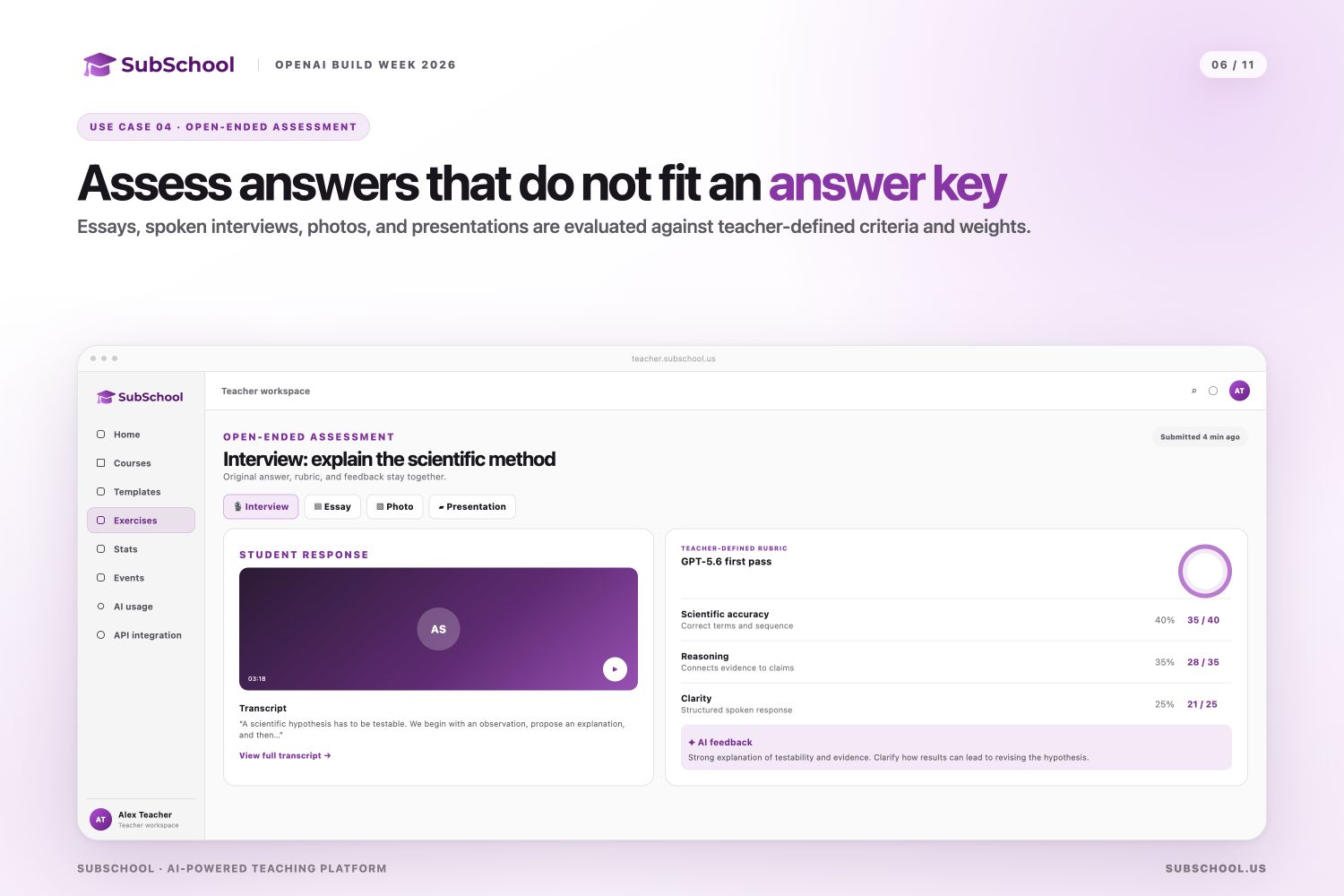
Use case 5: Assessing answers that are not multiple choice
Many meaningful educational tasks cannot be evaluated using an exact answer key.
SubSchool supports submissions such as:
- essays and other extended written answers;
- recorded spoken interviews;
- photos of solutions;
- and presentations.
For an interview assignment, the student records a spoken response. The audio is transcribed and sent to GPT-5.6 together with:
- the assignment;
- the expected answer;
- teacher-defined assessment criteria;
- and the weight of each criterion.
GPT-5.6 produces a score and criterion-specific feedback.
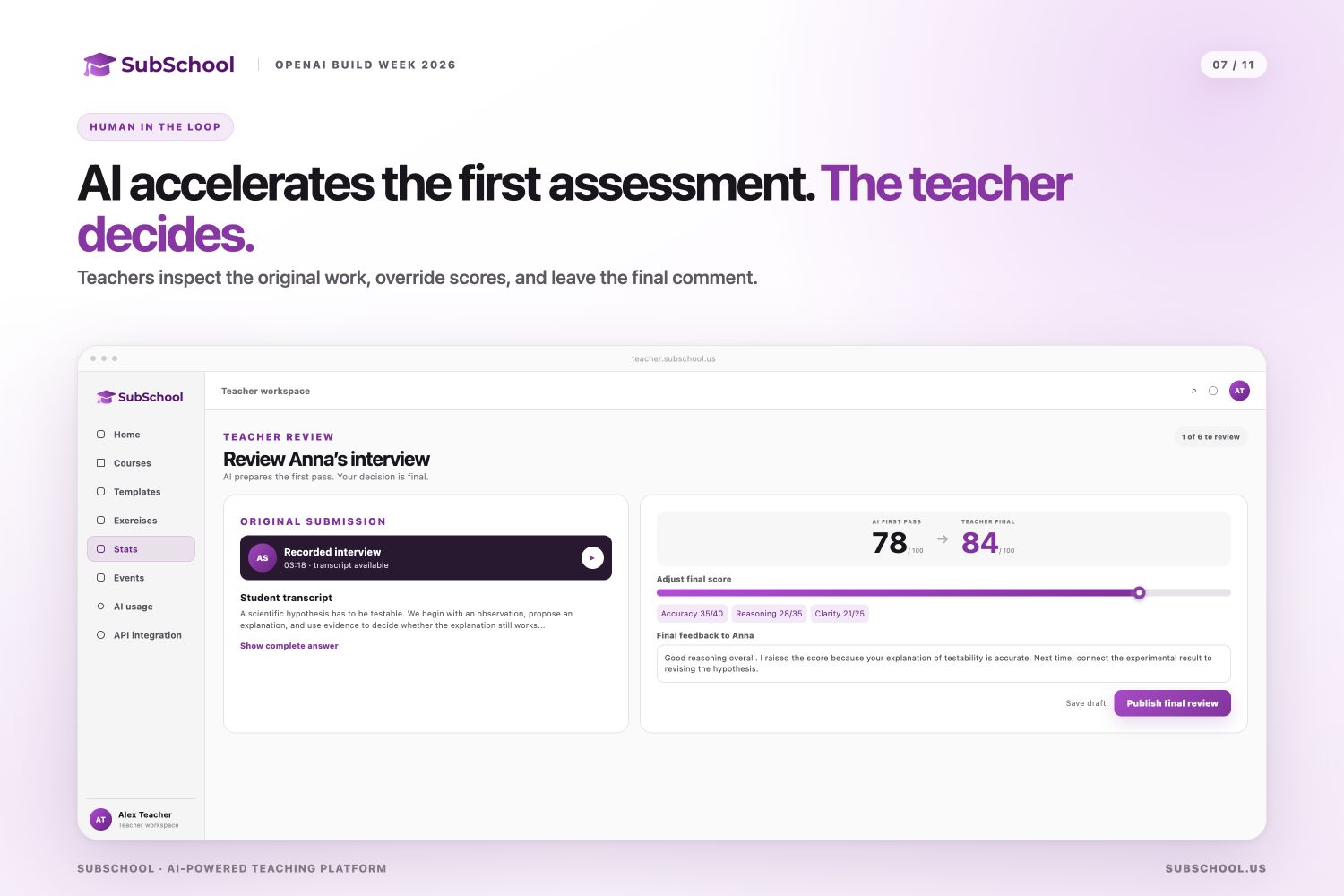
The teacher can then review the student's original submission, inspect the AI assessment, change the score, and add a final comment. The student receives the resulting grade and feedback inside the platform.
AI accelerates the first assessment, while the teacher retains control over the final educational decision.
How we built it
SubSchool is a production system rather than a standalone prompt or chatbot.
The backend is built with Python, with PostgreSQL storing courses, modules, lessons, exercises, assignments, submissions, assessment criteria, and other platform data.
GPT-5.6 outputs are converted into structured SubSchool entities rather than displayed only as free-form text. Those entities can be validated, stored, edited, assigned, assessed, and published through the existing product.
The MCP layer exposes supported platform operations as structured tools for Codex. Codex can reason about the user's request, select the appropriate tool sequence, and interact with SubSchool without requiring unrestricted database access or manual copy-and-paste workflows.
The platform remains responsible for application permissions, validation, and persistence.
How we used Codex
Codex was our primary development workspace during Build Week.
We used GPT-5.6 Sol in Extra Hight and Ultra modes to work across several connected parts of an existing production product:
- integrating GPT-5.6 Terra and Sol into existing generation and assessment workflows;
- implementing the teacher-facing model selection;
- creating and integrating the SubSchool MCP server;
- substantially reworking the teacher and student web applications;
- releasing the new applications on the primary production subdomains;
- and developing the new Events section.
Ultra mode was particularly valuable because the work crossed multiple product areas rather than living inside one isolated repository file or demo page.
Codex accelerated understanding, implementation, iteration, and debugging across the existing system. The team remained responsible for the central product decisions: keeping Terra as the default, giving educators explicit access to Sol, preserving teacher review, defining the educational workflows, and deciding which platform operations should be available through MCP.
Challenges we ran into
A book is not automatically a course
Books are written for reading, not necessarily for teaching. Chapters may be too long, prerequisites may be implicit, and the order of presentation may not match the needs of a specific learner.
The challenge was to preserve the source and the educator's intent while creating a useful, editable learning structure.
A transcript is not automatically a lesson
Recorded lectures and tutoring sessions contain repetition, side discussions, corrections, and information that depends on visual context.
We had to turn imperfect real-world material into grounded practice without pretending that every spoken sentence belongs in the final course.
Open-ended assessment is not binary
Two students may both be partially correct for completely different reasons. A useful assessment must examine separate criteria, explain what was missing, and avoid reducing the entire answer to one unexplained number.
Teacher-defined criteria, weights, visible feedback, and human override are therefore core parts of the workflow.
Quality must remain economically sustainable
Educational platforms may generate large numbers of lessons, exercises, and assessments.
Using the most expensive model for every operation would make low-cost education harder rather than easier. Making Terra the default and Sol an educator-controlled option lets us balance capability and cost without silently degrading the experience.
Extending a production platform is harder than building a clean demo
The new GPT-5.6 and MCP functionality had to coexist with existing users, permissions, courses, lessons, assignments, student submissions, and application workflows.
The new teacher and student interfaces also had to be released without making the previous system unavailable, which is why the legacy applications remain accessible on separate subdomains.
Agentic access must be constrained
Giving Codex the ability to work with a live platform is more useful than asking it to produce text in isolation, but it also requires clearer boundaries.
MCP tools must expose meaningful operations while leaving authentication, validation, and data integrity under the control of SubSchool.
Accomplishments that we are proud of
We connected GPT-5.6 to an end-to-end educational workflow:
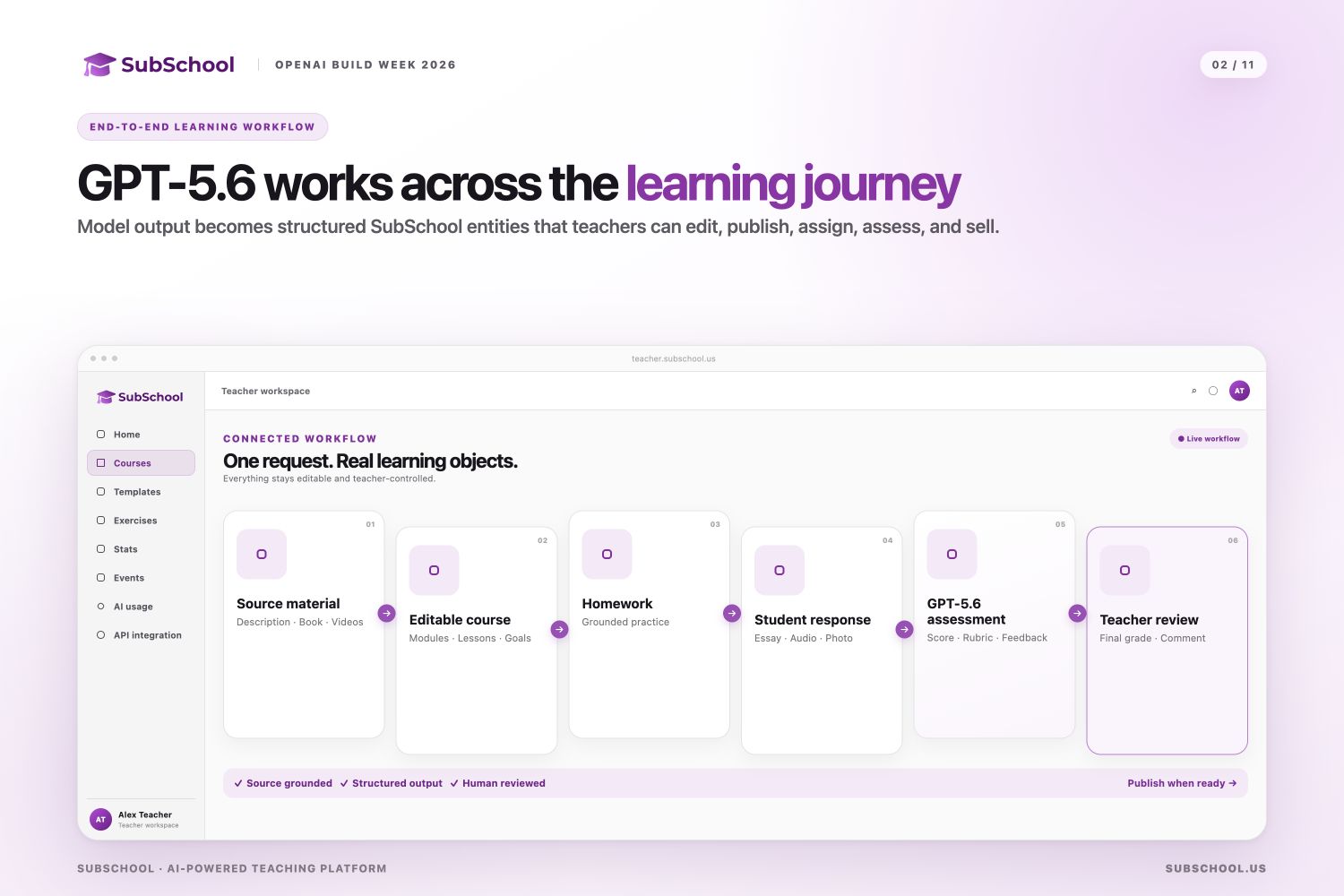
source material → course structure → lesson content → practice → student submission → AI assessment → teacher review
We also connected Codex to the platform itself:
educator request → Codex reasoning → MCP tool calls → structured changes inside SubSchool
Most educational AI products stop at generating text or answering questions in a chat window. SubSchool turns model output into editable objects inside a system where educators can actually teach, assess, and sell learning.
During one Build Week, we integrated the new GPT-5.6 family into production workflows, built the MCP interface, released redesigned teacher and student applications, and added a new product section.
Most importantly, the system does not force educators to choose between automation and responsibility. GPT-5.6 handles repetitive work, while teachers retain authorship, review, and final judgment.
What we learned
We learned that reliable educational AI is not created by one clever prompt.
It requires:
- source grounding;
- structured outputs;
- explicit assessment criteria;
- model selection;
- application-level validation;
- editable results;
- and a clear human review path.
We also learned that model choice is a product decision, not only an engineering decision. Teachers should understand and control when they are using a faster, more economical model and when they want the strongest available reasoning.
Finally, MCP showed us that an AI interface can be more than a chat attached to a product. Codex can become another way to operate the product itself, while the platform continues to own its data model, permissions, and educational workflow.
What's next for SubSchool
Next, we plan to:
- expand the MCP toolset across more teacher and school workflows;
- create evaluation datasets comparing GPT-5.6 assessments with expert teacher grading;
- introduce confidence thresholds that escalate uncertain assessments for manual review;
- generate more adaptive practice using each student's previous results;
- improve source attribution and traceability inside generated courses;
- measure teacher preparation and grading time saved;
- and measure student learning gains rather than only content-generation volume.
Our long-term goal is simple:
make personalized education affordable at course scale while keeping teachers—not algorithms—responsible for what students learn.
Built With
- codex
- codex-ultra-mode
- flutter
- gpt-5.6-sol
- gpt-5.6-terra
- model-context-protocol
- openai-api
- postgresql
- python


Log in or sign up for Devpost to join the conversation.