-
-
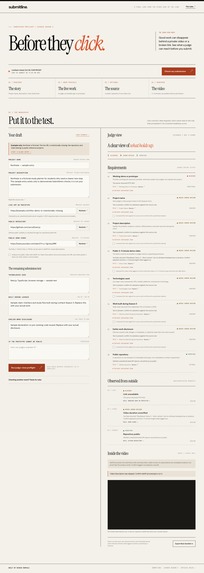
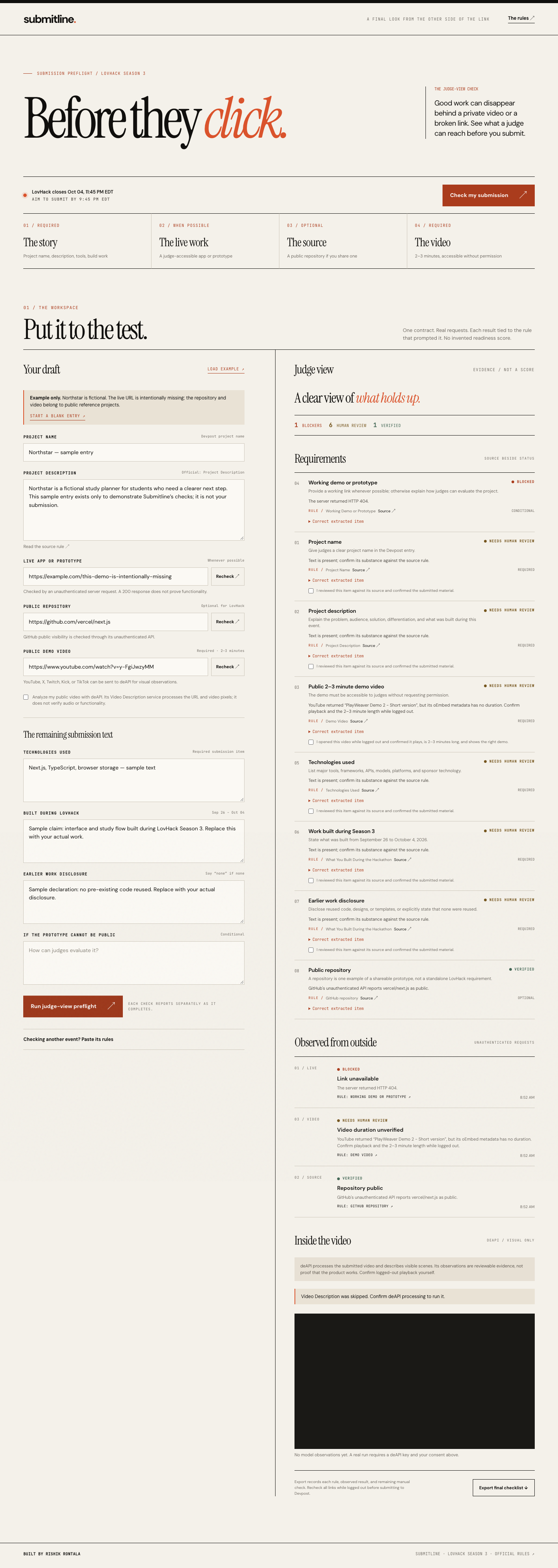
Judge-view evidence: Submitline flags the broken link, verifies the public repository, and keeps uncertain video duration in human review.
Inspiration
I once finished and deployed a hackathon project, then missed its submission deadline by eight minutes. A strong build can still become invisible to judges if its video is private, a link returns 404, or a required item is missing. I built Submitline for solo student builders who need to know what a judge can actually open before they press submit.
What it does
Submitline turns LovHack Season 3's source-linked requirements, or rules pasted from another event, into an editable submission checklist. An entrant adds their project story, live app, optional repository, and video. Submitline checks links from an unauthenticated server request, confirms GitHub public visibility through its public API, and reads available YouTube metadata. It leads with blockers, labels uncertain results for human review, lets an entrant fix and rerun one link, and exports the final evidence as Markdown. There is no synthetic readiness score.
The demo shows a real 404, a corrected link returning 200, and evidence beside the source rule. A 200 response proves reachability at that moment; it does not prove the app works in every judge's browser. Video playback and the required 2–3 minute length still need a logged-out human check when duration metadata is unavailable.
The video panel includes a consent-based integration with deAPI's Marlin_2B Video Description API for timestamped visual observations. This public deployment has no deAPI key, so it shows an unavailable state instead of invented model output. Observations are reviewable evidence, never proof that a button worked or that spoken claims are true.
How I built it
I used Next.js App Router, React, TypeScript, Tailwind CSS, browser storage, Node.js route handlers, GitHub's public REST API, YouTube oEmbed, an optional YouTube Data API duration check, and deAPI's Video Description API. Link checks reject local and private-network targets, pin a vetted DNS address, and revalidate redirects. API keys stay on the server. I verified the result with 22 automated tests, desktop and phone browser walkthroughs, and an accessibility audit of empty and populated states.
Built during LovHack Season 3
I created Submitline's repository, design, requirement parser, link checker, API integration, evidence workspace, export, tests, documentation, and narrated demo during the September 26–October 4, 2026 build period. No earlier project code or design was reused. Third-party npm packages and official API documentation were used as dependencies and references. The built-in Northstar entry is fictional sample data, not the submitted product.
Challenges and what I learned
An automated request is not identical to a judge's browser. Some hosts block bots, and YouTube's title metadata does not provide duration. Submitline keeps those results in human review until the entrant confirms them. A model may describe a scene but cannot prove the app performed correctly. Treating uncertainty as a visible result made the tool more useful than a falsely confident pass.
Built by Rishik Rontala, solo entrant.
Built With
- deapi
- github-api
- next.js
- node.js
- playwright
- react
- tailwind
- tailwind-css
- typescript
- youtube-oembed

Log in or sign up for Devpost to join the conversation.