It found the mistakes that cost me a hackathon yesterday
On 12 August I found out ProofPrint didn't place at the Backblaze Generative Media Hackathon. I spent that evening reading the three winning writeups next to my own, and the gap wasn't engineering. It was four specific, repeatable mistakes:
- I never stated a test count. Two winners led with "358 executable assertions" and "485 tests."
- My best number — a sealed PNG cut 34× to a metadata-stripped JPEG that still resolved at 0/64 bits — was item 3 of a sub-list. The Grand Prize winner's equivalent was their first line, with a job ID and a live URL.
- I named my audience once, in "What's next." The criterion asked "is there a clear audience?" and I postponed the answer.
- I found three real bugs in the sponsor's SDK and wrote them under "Challenges we ran into." The winner filed three pull requests and an issue with reproductions and failing tests — and led with it. Same discovery. Opposite disposition.
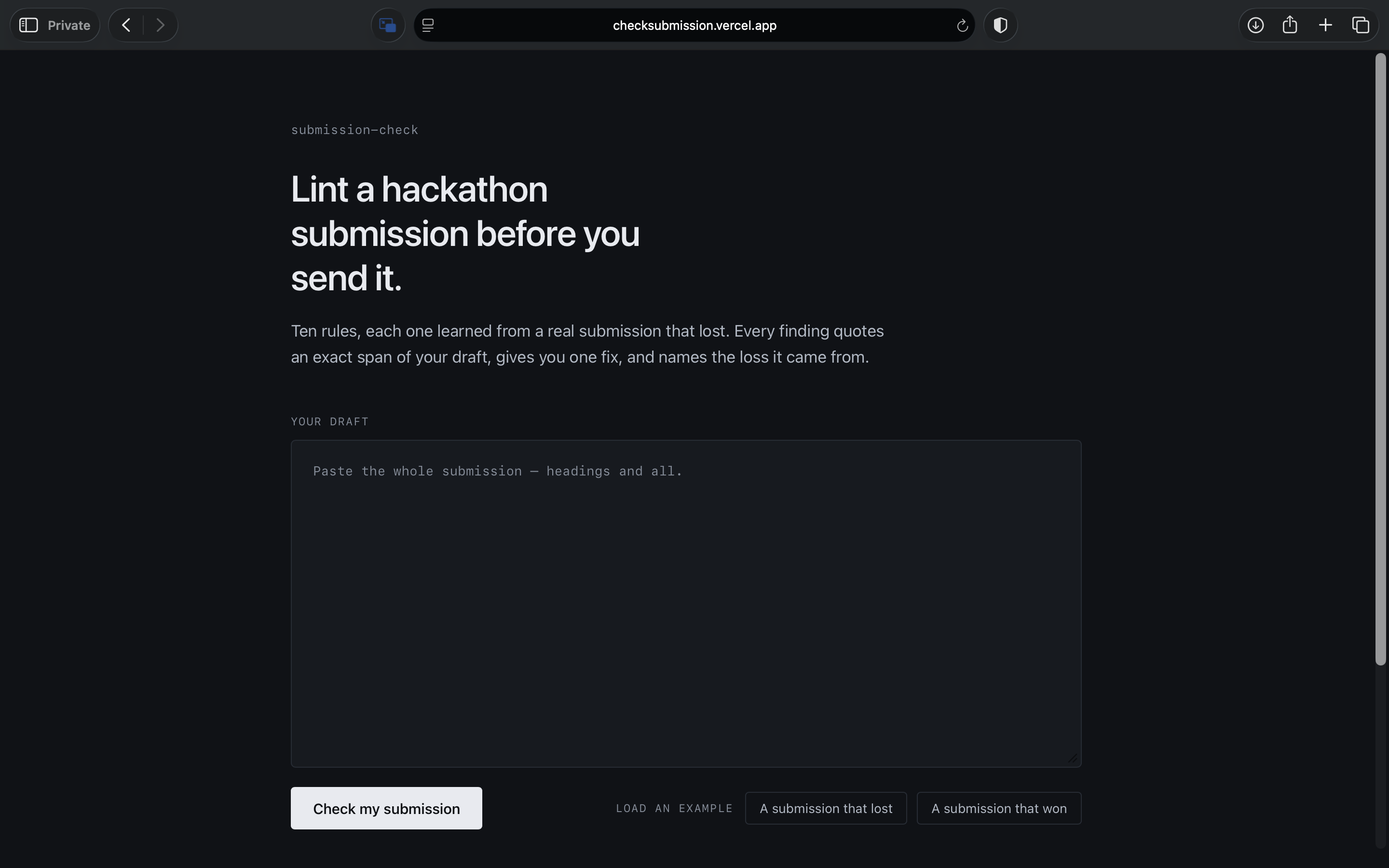
submission-check is those lessons as executable rules. Paste a draft, get back the specific things that will cost you placement — each one quoting the exact span that triggered it, and each one carrying the loss it came from.
The demo is the proof
It runs on my own losing submission and finds every mistake that lost it.
$ python cli.py fixtures/proofprint.md
Then the control: the same linter on a condensed version of the entry that won that hackathon — and it comes back nearly silent. Two files, same tool, opposite verdicts.
That's not a hypothetical linter. Every rule in RULES.md has a provenance column
naming the hackathon it was learned in.
The one guarantee, enforced rather than promised
Every finding must quote a verbatim span of your draft. That isn't a convention the
rules are asked to follow — run_checks() enforces it mechanically. A rule that returns
evidence which is not an exact substring of the input raises EvidenceError and the run
fails.
class EvidenceError(ValueError):
    """A rule produced evidence that is not a verbatim span of the draft."""
So the tool cannot invent a quote to justify a finding, even by accident. Given that its whole job is telling you your evidence is weak, it seemed fair to hold it to the standard it enforces.
Who it's for
Anyone submitting to a hackathon in the next week — and I mean that literally: I have seven results pending and nine deadlines in the next nineteen days. I'm the first user. This is the tool I run before I press submit tonight.
Zero dependencies, no API key, no account
Standard library only. python cli.py draft.md and it works — offline, on a plane, with
no key to acquire. The checks are pure functions over text; there is no model in the
loop, because a model would make the findings unverifiable, and unverifiable findings are
exactly the problem this tool exists to fix.
How AO built it
The board tells the story. I registered submission-check as an AO project and spawned
worker sessions in isolated git worktrees, each with a scoped brief:
| Session | Task |
|---|---|
submission-check-5 |
Rule engine + the ten rules + tests/test_rules.py |
submission-check-6 |
CLI, the two real fixtures, tests/test_fixtures.py |
Two agents in parallel worktrees, tracked on one Kanban board. The demo shows the board, not a screenshot of it.
What went wrong, kept visible
Four earlier worker sessions (submission-check-1 through -4) are terminated on that
board and I've left them there. They died on environment friction — a missing tmux, a
folder-trust prompt, and permission dialogs that stalled every agent until I committed a
.claude/settings.json the worktrees could inherit. Roughly forty minutes of a
two-and-a-half-hour window.
I'm reporting it because rule 6 of my own linter is "no visible failure," and every winner I studied yesterday kept one on the page. A perfect surface reads as an untested one.
98 tests
python -m pytest -q — 98 tests, no GPU, no network, no key. Every rule has its own
test and both fixtures are asserted end to end.
I am stating the number because rule 1 of this linter is 'no test count stated', and I lost a hackathon to exactly that omission yesterday.
Honest limits
It lints structure and placement, not truth. It can tell you your headline number is buried at 68% through the document. It cannot tell you the number is wrong. It flags a missing test count; it cannot verify the count you write. It is a checklist that learned from losing — not a judge.
Built With
- agent-orchestrator
- claude-code
- pytest
- python
- zero-dependencies

Log in or sign up for Devpost to join the conversation.