-
-
-
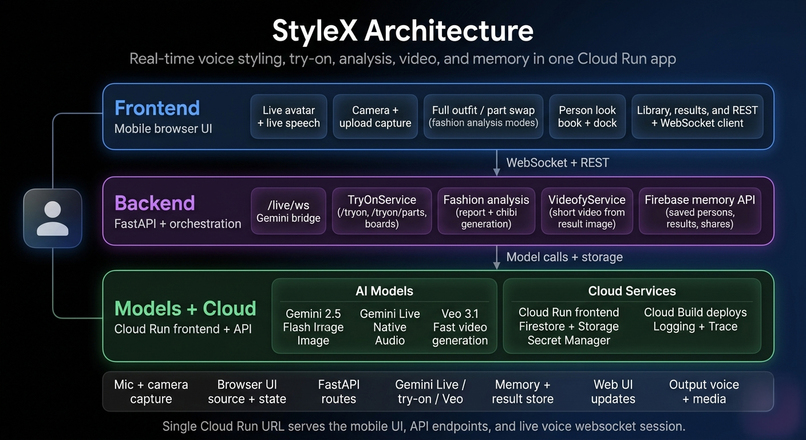
stylex architecture


Inspiration
I wanted to build a fashion interface that feels like a real stylist instead of a standard upload form. The goal was to combine live conversation, visual understanding, try-on generation, and reusable style memory into one fluid browser experience.
What it does
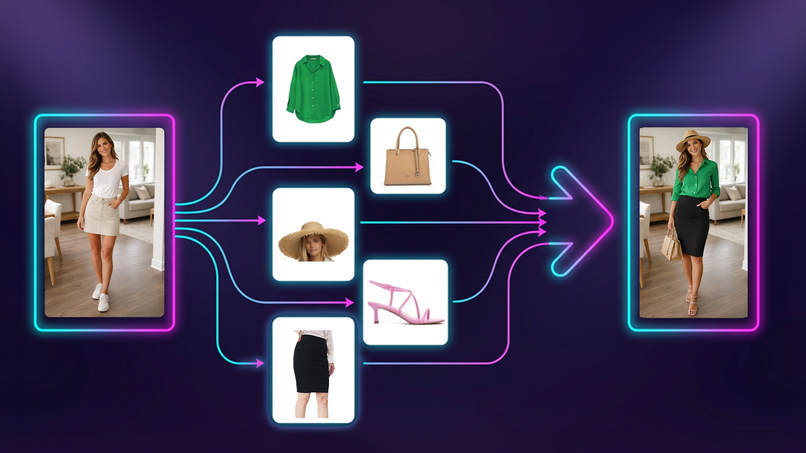
StyleX is a realtime AI styling app that lets a user talk to a live voice agent, upload or capture outfit references, generate full-outfit try-ons, swap individual fashion parts, analyze multiple outfit photos, and create short videos from final results. It also includes a library system for saved people, generated outputs, and reusable styling context.
How we built it
I built StyleX as a single Cloud Run app that serves both the frontend and backend from one URL. The frontend is a custom browser UI in HTML, CSS, and vanilla JavaScript, and the backend is FastAPI with dedicated services for Gemini Live voice sessions, image try-on, fashion analysis, video generation, and Firebase-backed memory. For the AI layer, I used Gemini Live for realtime conversation, Gemini 2.5 Flash Image for try-on and analysis-related image generation, and Veo 3.1 Fast for video output.
Challenges we ran into
The hardest problems were reliability and visual consistency. I had to manage realtime voice state, WebSocket and REST flows at the same time, prevent accidental auto-generation, handle cancellation correctly, and improve try-on quality for difficult cases like long skirts, pants, and multi-part outfit composition.
Accomplishments that we're proud of
I am proud that the app feels like one connected product instead of separate AI demos. I combined live voice, try-on, part swap, fashion analysis, video generation, and memory into a single mobile-first interface, and I pushed it to a working production deployment on Google Cloud with persistent user-facing flows.
What we learned
I learned that the biggest difficulty was not calling a model, but orchestrating state across UI, live conversation, generation pipelines, and storage. I also learned that prompt design alone is not enough for fashion workflows; preprocessing, slot isolation, generation staging, and fallback control matter just as much as the model itself.
What's next for StyleX
Next, I want to improve generation speed, reduce UI rendering cost, make part-swap composition even more stable, strengthen garment-aware preprocessing, and expand the library into a more robust long-term styling memory. I also want to refine the visual system further so the product feels closer to a polished consumer app than a technical prototype.
Built With
- css
- fastapi
- firebase-firestore
- firebase-storage
- gemini-2.5-flash-image
- gemini-live-api
- google-cloud-run
- html
- python
- vanilla-javascript
- veo-3.1-fast
- websockets

Log in or sign up for Devpost to join the conversation.