-
-
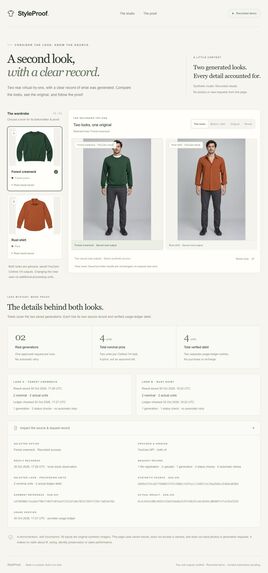
Working recorded-result viewer: two real YouCam Clothes V4 outputs, original inputs and processing records.
-

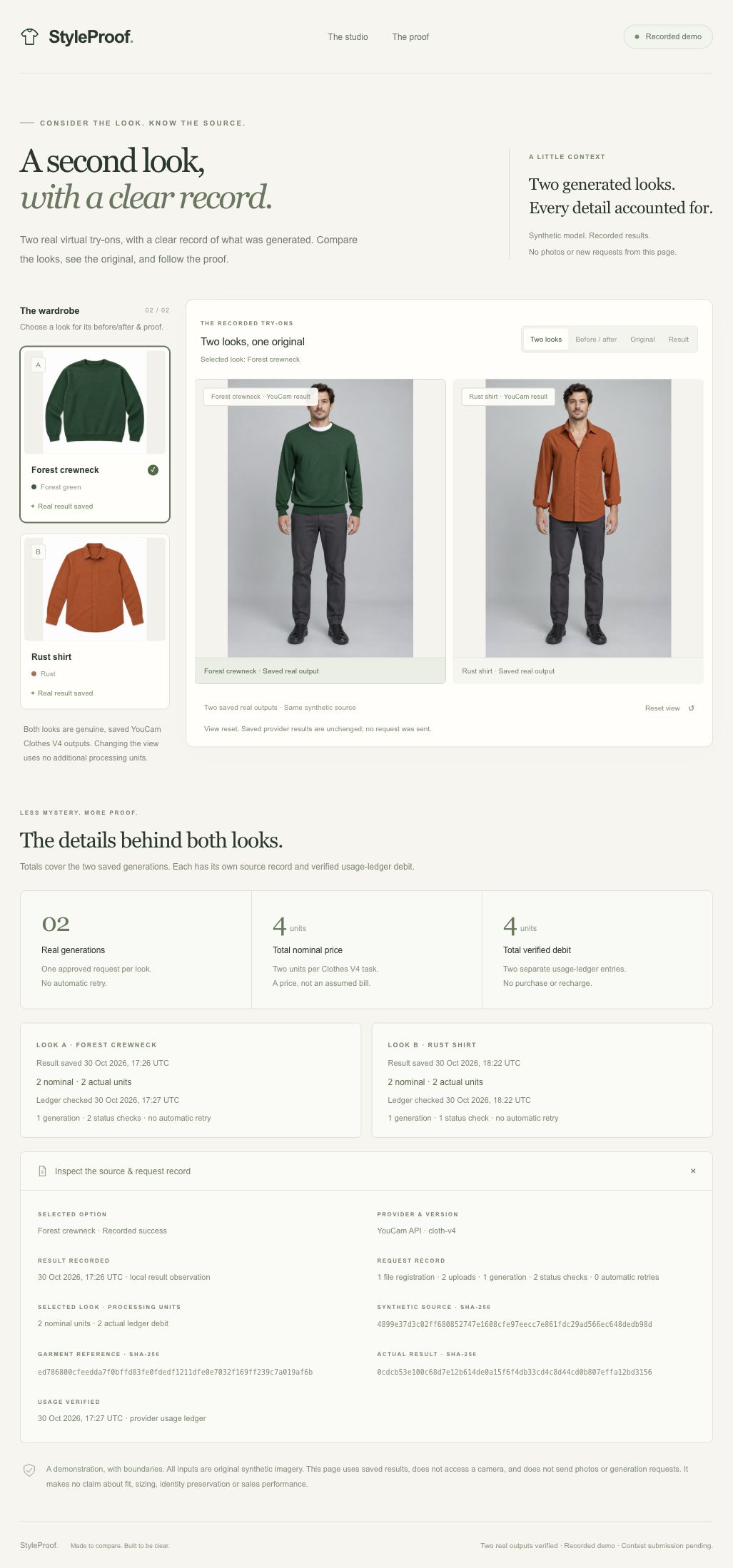
Mobile view of the working recorded comparison, using the same two genuine saved YouCam outputs.

Inspiration
Virtual try-on images can be visually persuasive while leaving basic questions unanswered: Which garment was used? Is this the original image or an AI result? Did switching a view trigger another request? What processing was actually used?
StyleProof is a small eCommerce virtual try-on prototype that makes those distinctions visible. It pairs two genuine YouCam Clothes V4 outputs with the same original synthetic adult model, their unbranded garment references, recorded request status and verified unit consumption.
What it does
The comparison studio offers a forest-green crewneck and a rust shirt. Visitors can compare both saved results together, select either look, inspect before/after, view the original or focus on the selected output. The proof section connects each option to exact source, garment and output fingerprints and its own request and usage record.
Both outputs were genuinely generated by YouCam on 30 October 2026. The viewer displays those recorded results. Switching or resetting a view runs locally, uploads no photograph and creates no generation request.
This is a fixed two-look recorded prototype, not an unrestricted upload or live-generation service. These visual previews do not prove fit, sizing, fabric behaviour, identity preservation, purchase outcomes or sales uplift. No customer adoption, revenue, award or commercial performance is claimed.
Open the free recorded demo. The comparison works in a browser without a login, installation or provider key.
How we built it
A separate private Node.js operator tool registered fixed model and garment files, uploaded them through the provider's storage flow, created one Clothes V4 task per look, polled for completion and downloaded each real output. Each task had its own durable execution journal, fixed input scope, limited polling and no automatic retry. Credentials, signed URLs and raw provider responses are excluded from the viewer and source distribution.
The prototype uses vanilla HTML, CSS and JavaScript, a strict evidence manifest, a read-only local server and responsive layouts. Viewing the recorded comparison requires no dependency installation or provider key. Source/result files are pinned by SHA-256; invalid or unexpected evidence fails closed instead of producing a substitute result.
The published source includes the assets and instructions. The reviewed published commit contains the exact reviewed 39-file source tree. Judges can run the read-only comparison locally with Node.js 24; exact steps are in the pinned README.
OpenAI Codex assisted implementation, tests and documentation. Imagegen created the fictional model and unbranded garments without real-person reference photographs or supplied third-party photos/logos. YouCam generated both actual try-on outputs. No exclusive copyright over AI-generated imagery or real-model endorsement is asserted. Code is MIT-licensed; media provenance and applicable provider rights are described separately.
Challenges
The integration separates private generation from safe browsing. The operator persists intent before mutation so an interrupted or ambiguous response cannot silently become an automatic duplicate task. The viewer distinguishes nominal API price from observed debit and a local result-observation timestamp from an exact provider-generation timestamp. Original inputs, genuine outputs and offline fixtures remain labelled separately.
Fresh generation is a separate authorised operator action requiring the operator's own YouCam access, input rights and allowance. Sponsor acceptance of replay-only testing is not claimed.
Accomplishments
Two real Clothes V4 tasks completed. The provider ledger debit was two units for look A and two for look B: four processing units total. A separate setup bonus is not generation cost or income.
The clean prepared source passed thirty-nine offline checks: eighteen application checks and twenty-one operator-safety and portability checks. These tests are separate from the two actual API executions.
The comparison is reproducible from the included recorded assets. It presents both actual outputs without exposing provider credentials or creating an unrestricted generation endpoint, and the evidence remains available while visitors change views.
What we learned
The concrete integration observations are that the two completed Clothes V4 generations each had a two-unit provider-ledger debit, while switching the recorded viewer does not create another generation request. A nominal API price and an observed debit are different pieces of evidence and are displayed separately.
A local result-observation timestamp is also different from an exact provider-generation timestamp. Connecting each saved result to its source, reference garment and request record preserves those distinctions when the visitor changes views.
What's next
Subject to authorised access, a later version could support a bounded garment catalogue, stronger retention controls and a user-consent workflow. These are future ideas, not implemented features.
