-
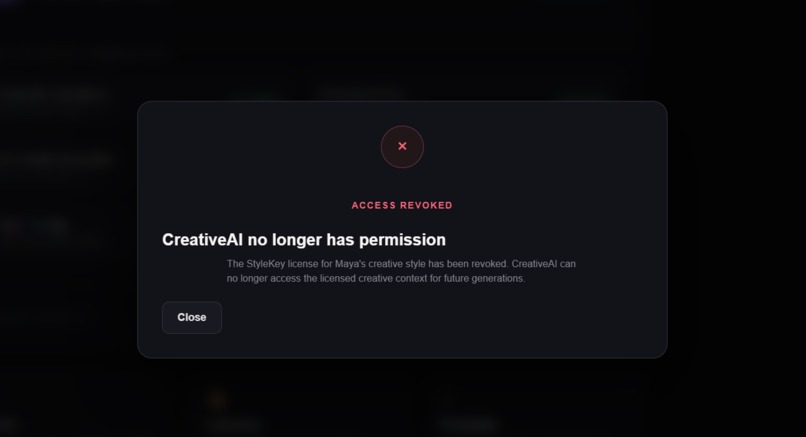
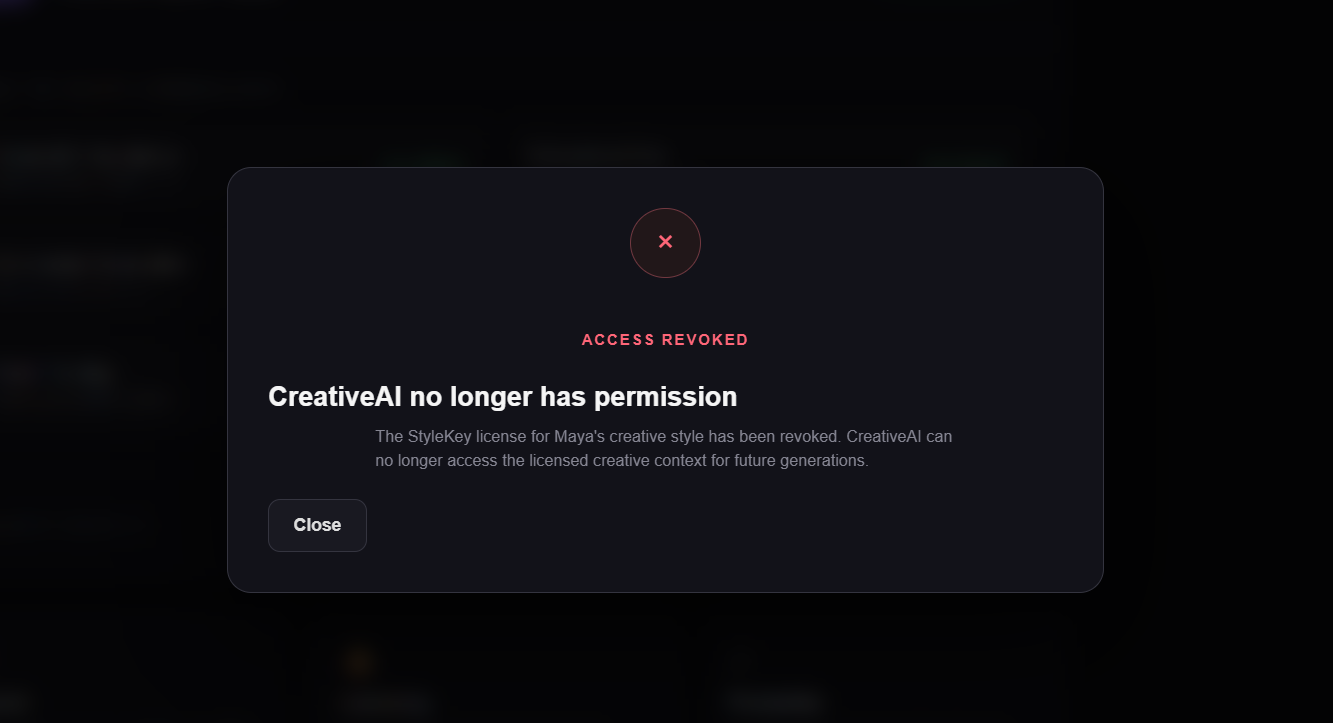
Revocation — Maya can revoke the license, ending future authorized access to her creative context.
-
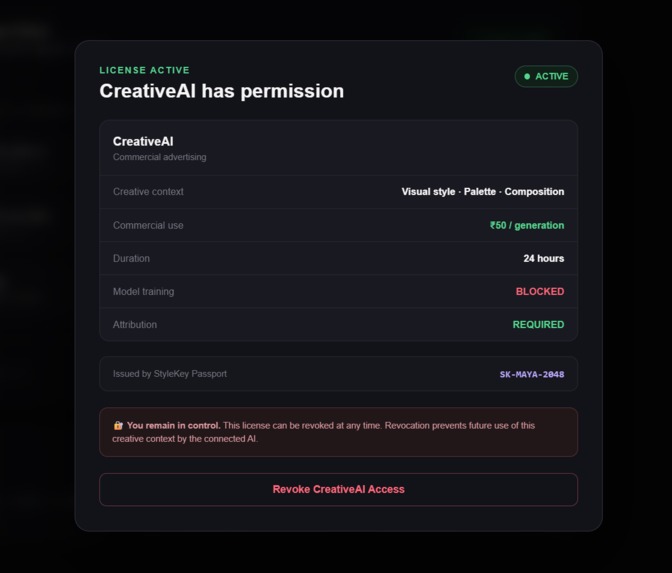
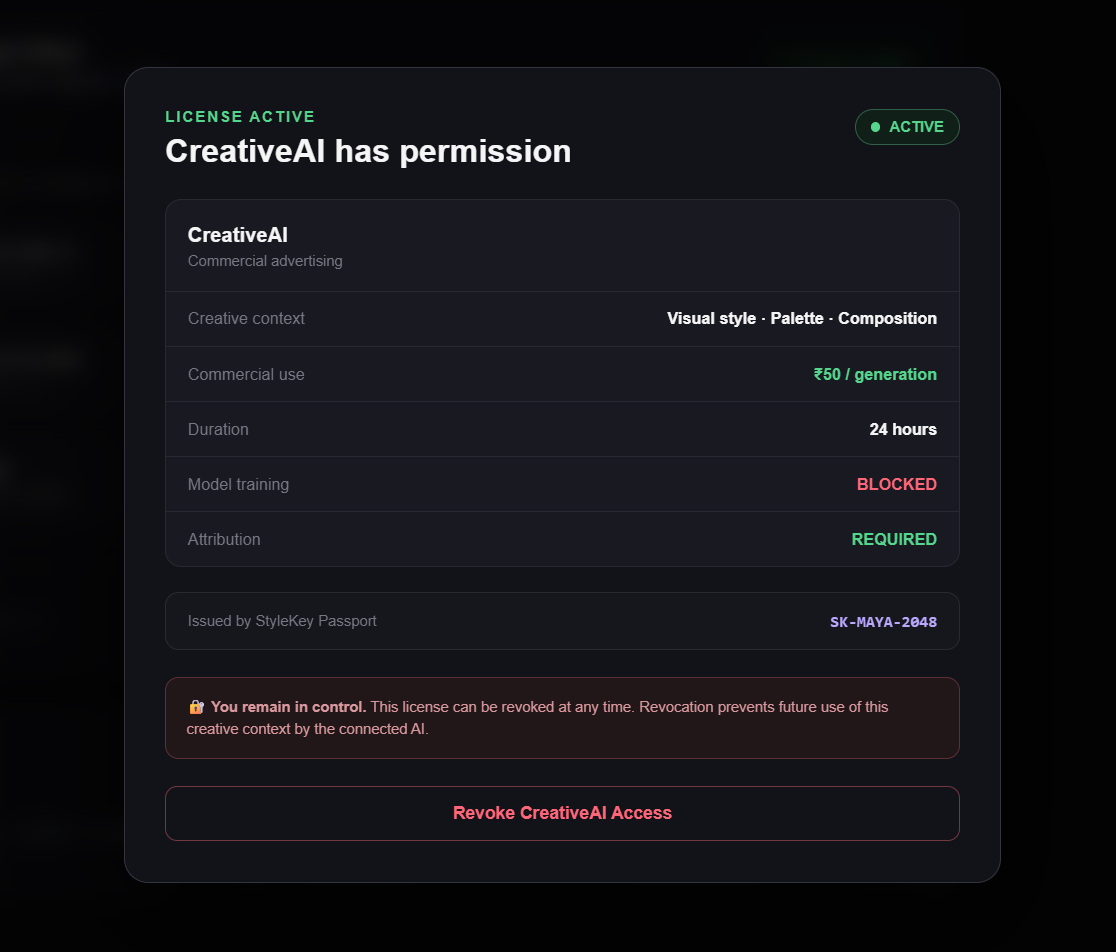
Active License — The approved permission becomes an explicit, time-limited license that the creator can review.
-
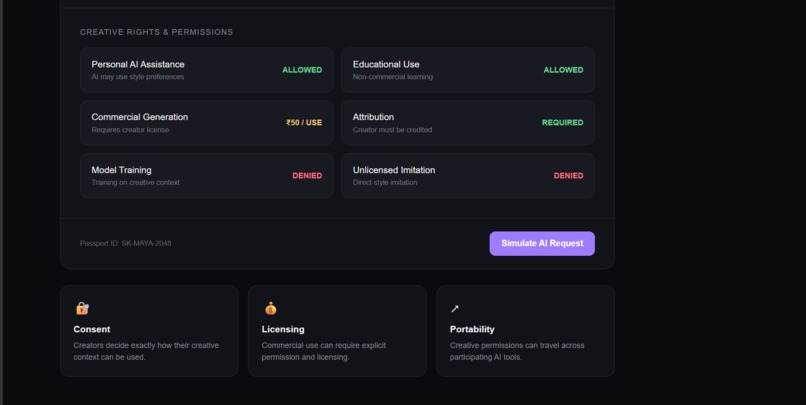
Permission Principles — StyleKey makes creator consent, commercial licensing, and portable permissions explicit.
-
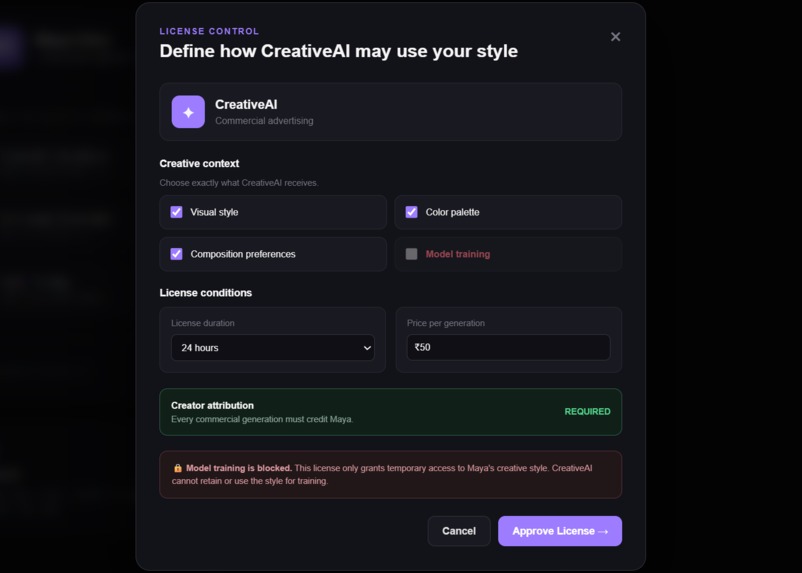
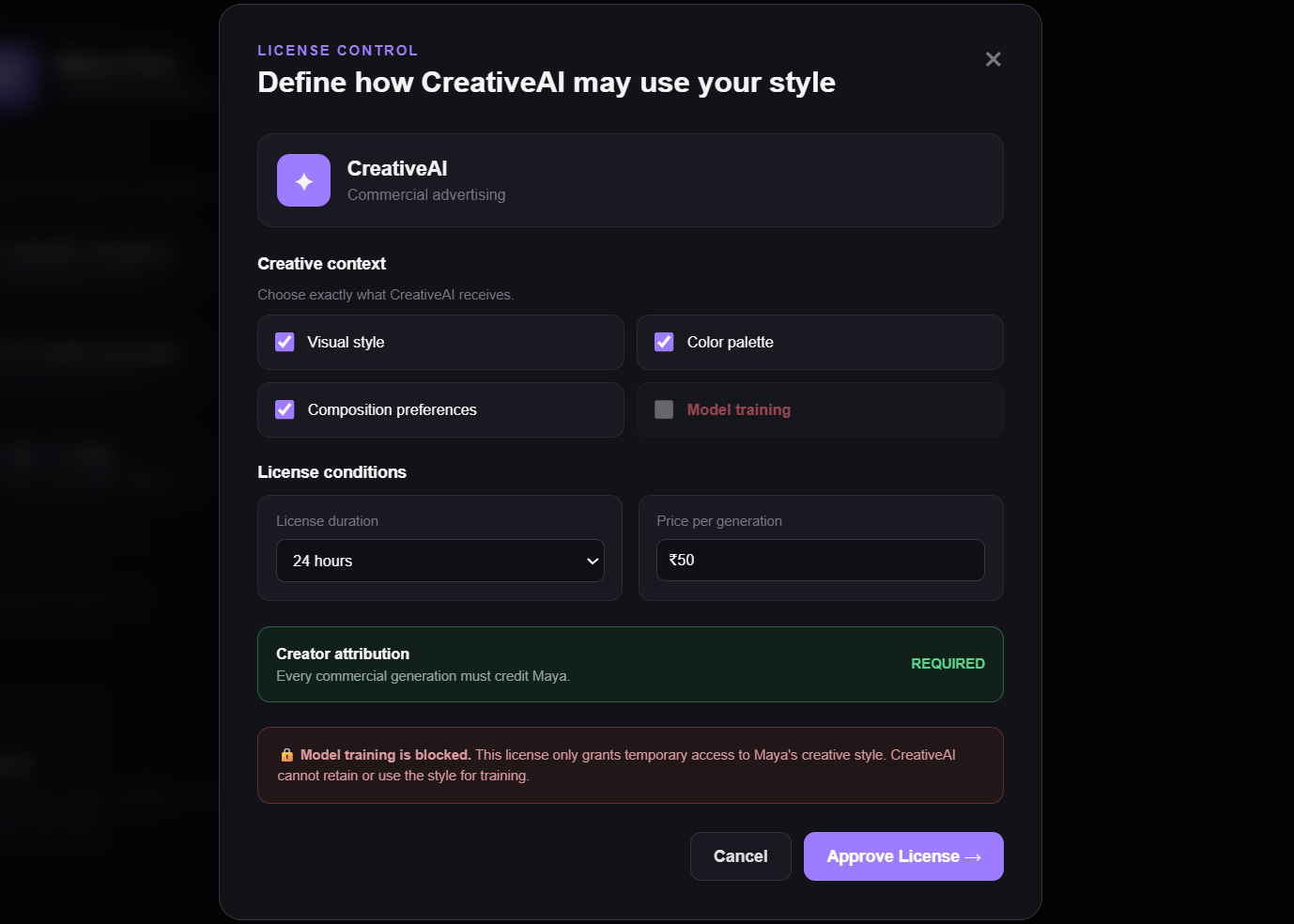
License Control — Maya scopes the creative context, duration, price, attribution, and model-training restrictions.
-
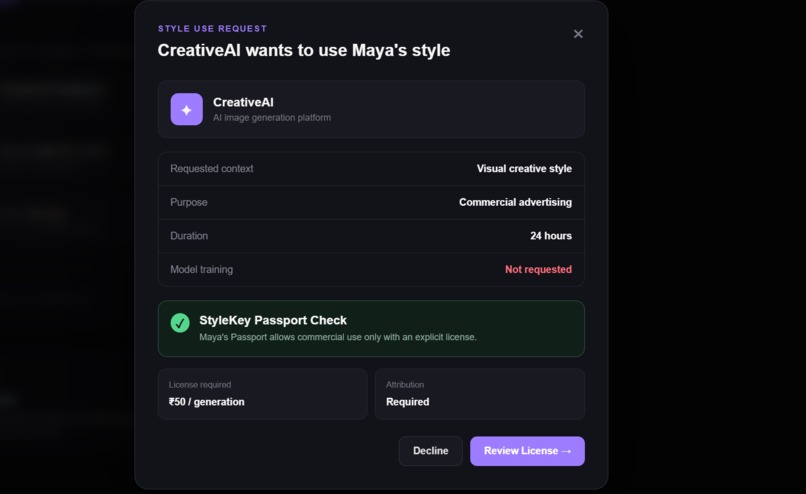
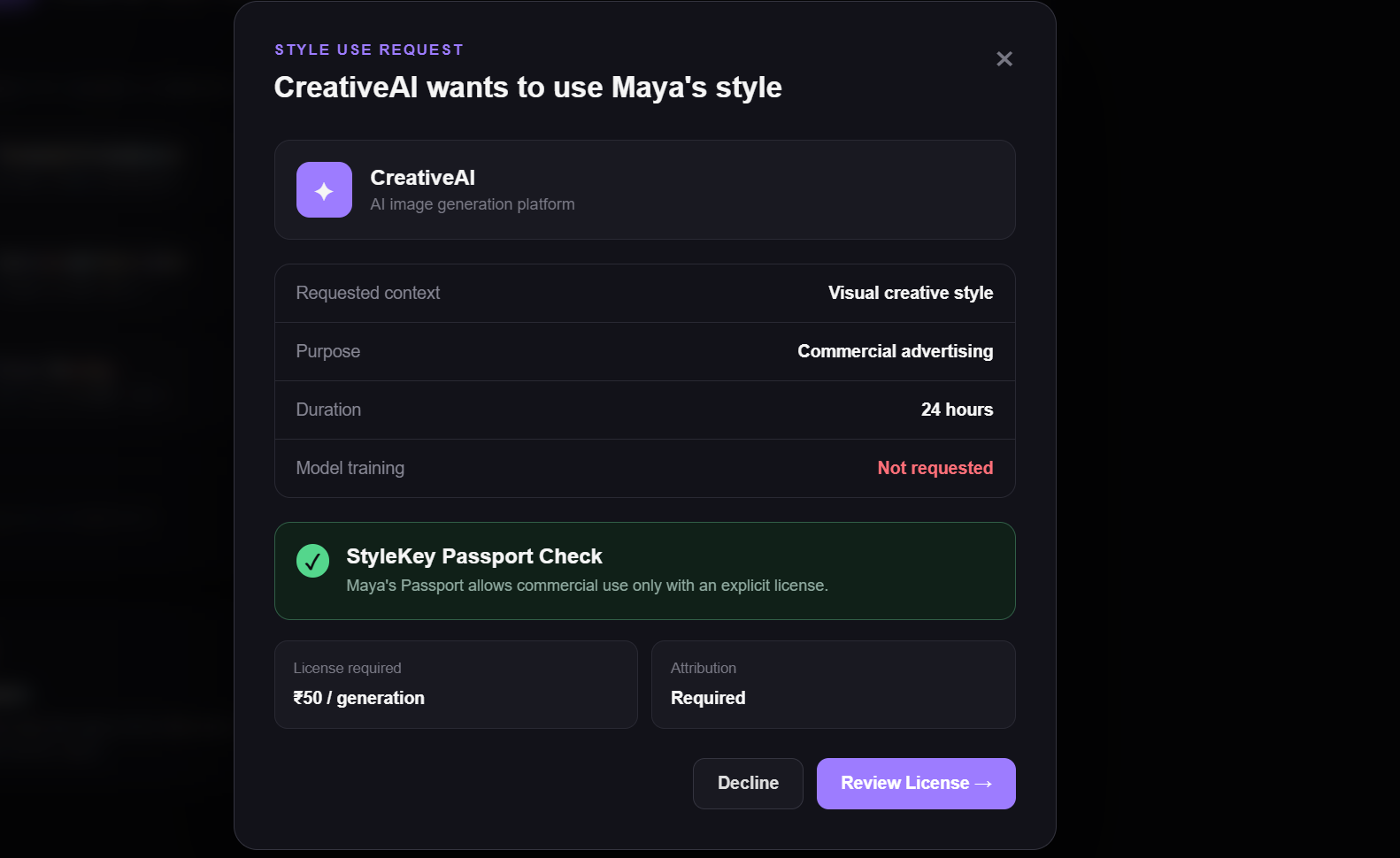
AI Access Request — CreativeAI requests Maya's style for a specific purpose, duration, and use.
-
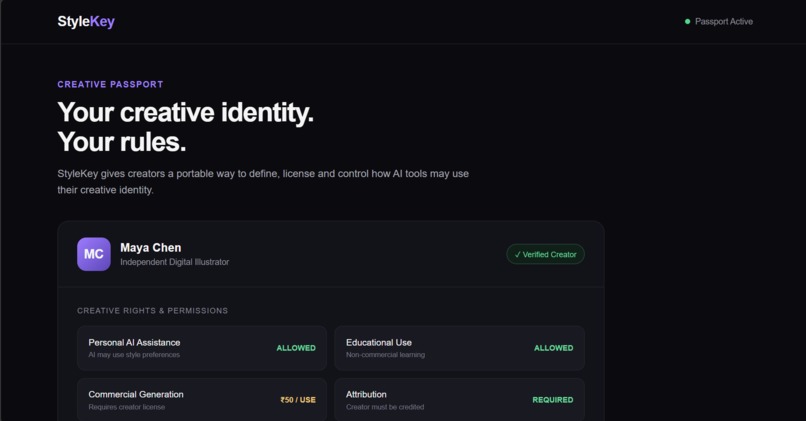
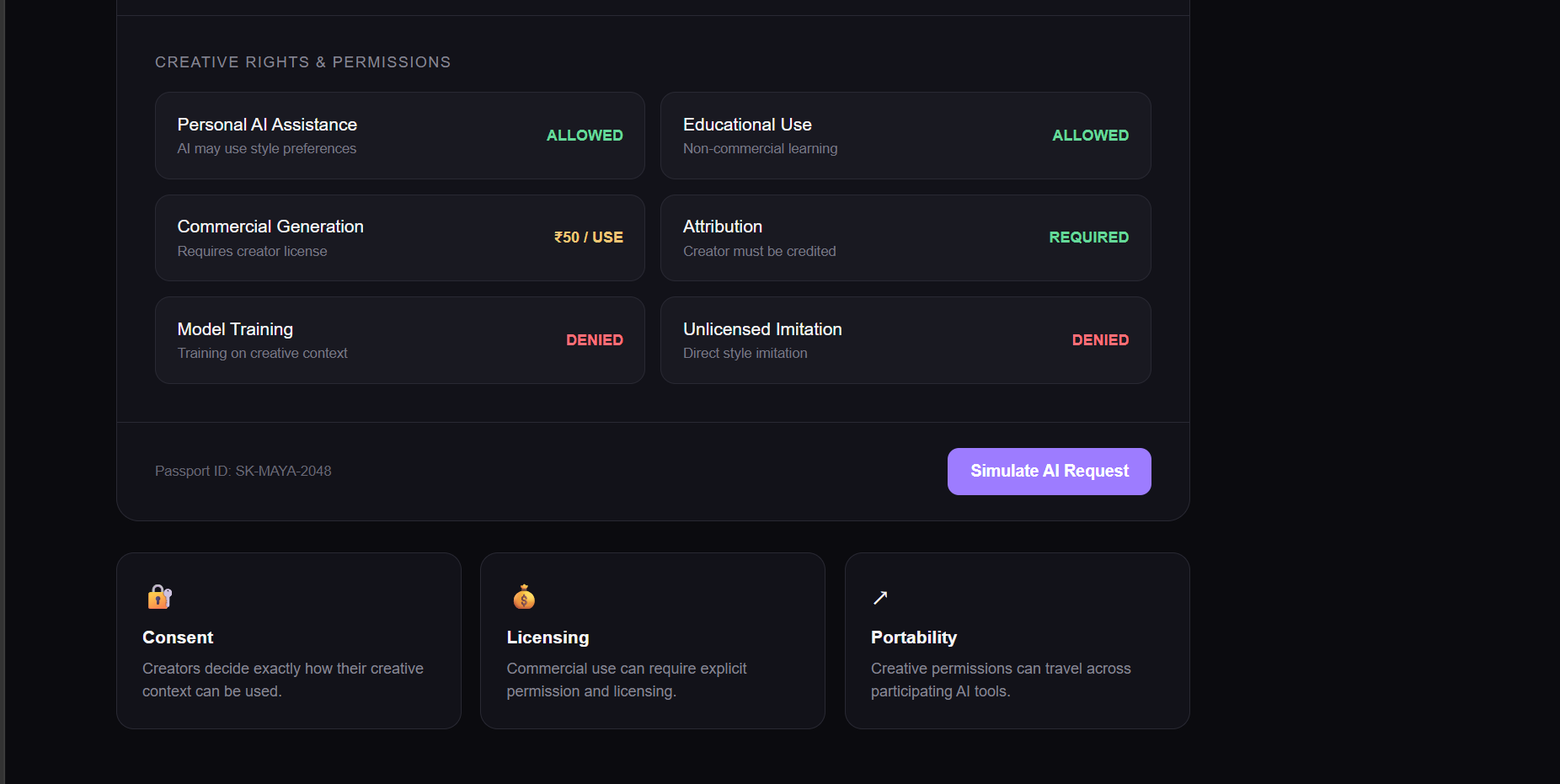
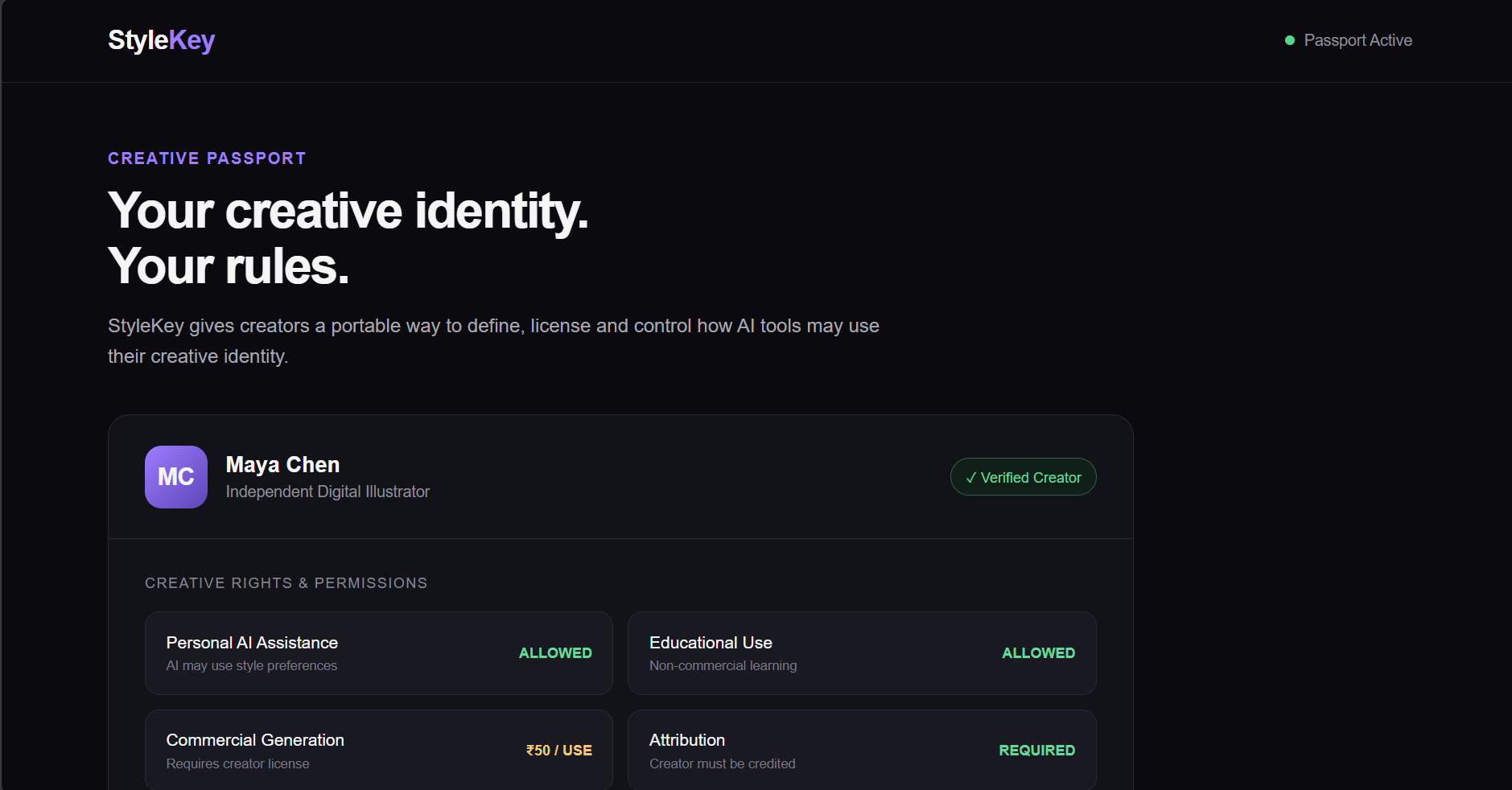
Creative Passport — Maya defines her creative identity and establishes the rules AI systems must follow.
Inspiration
Generative AI has made it easier than ever to create, remix, and transform creative work. But for creators, a new problem is emerging:
What happens when an AI system wants to use the creative identity behind their work?
A creator's visual style, color language, composition, techniques, and creative preferences can represent years of experience and experimentation. Today, permissions around this kind of creative context are often unclear, platform-specific, or difficult to communicate.
We wanted to explore a simple question:
What if a creator could carry their own permission rules with them, instead of having to trust every AI platform to define those rules for them?
That became StyleKey — a Creative Rights use case for AI Passport.
What it does
StyleKey is a portable creative passport that gives creators a structured way to control how participating AI systems use their creative context.
The creator defines their rules once, and an AI application requests the specific context it needs rather than receiving unrestricted access.
For example, a creator can define:
| Creative Permission | Creator Rule |
|---|---|
| Personal AI assistance | Allowed |
| Educational use | Allowed |
| Commercial generation | Licensed |
| Attribution | Required |
| Model training | Denied |
| Unlicensed imitation | Denied |
When an AI application requests access, the creator can evaluate:
What → Who → Why → How long → Under what conditions
The creator can then:
Allow → Define Conditions → License → Monitor → Revoke
For example, an AI application might request a creator's visual style for a commercial campaign. StyleKey can represent a scoped permission containing the requested creative context, purpose, duration, commercial conditions, attribution requirements, and model-training restrictions.
The creator remains the decision-maker.
Why AI Passport?
StyleKey uses the AI Passport idea as a portable permission layer.
Instead of rebuilding creator permissions separately inside every AI platform, the passport can carry the creator's approved context and permission rules across participating systems.
The passport becomes a:
Portable, creator-controlled source of permission.
How we built it
We deliberately built a working browser prototype rather than only presenting a concept.
The prototype uses:
- HTML
- CSS
- JavaScript
It demonstrates the complete permission lifecycle:
Creator Passport
       ↓
AI Access Request
       ↓
License Control
       ↓
License Activated
       ↓
Creator Revokes Access
       ↓
Access Revoked
The prototype includes:
1. Creative Passport The creator establishes their creative permissions.
2. AI Access Request An AI application requests specific creative context.
3. License Control The creator determines what can be used and under which conditions.
4. Active License The creator can see the currently active permission.
5. Revocation The creator can revoke the permission.
The prototype is publicly deployed so the complete workflow can be tested directly.
Challenges we ran into
The hardest part was not building the interface. It was deciding what a meaningful AI permission should contain.
Creative rights are not simply "allowed" or "denied."
A creator might allow an AI to use their style for education but not commercial advertising. They might allow generation but deny model training. They might allow access for 24 hours but not indefinitely.
We therefore designed permissions around multiple dimensions:
Context + Purpose + Application + Duration + Commercial Conditions + Attribution + Training
Another challenge was revocation.
We did not want to make the misleading claim that clicking "Revoke" can erase information an external system has already copied or processed.
Instead, StyleKey treats revocation as a governance boundary: participating systems should stop future authorized access once permission is revoked.
This distinction helped us keep the prototype realistic while still demonstrating the value of a permission layer.
Accomplishments that we're proud of
Our biggest accomplishment is turning an abstract idea about AI permissions into a working, publicly accessible prototype with a complete user journey.
A judge can actually experience the concept:
Define → Request → License → Activate → Revoke
We are particularly proud of making creator control the central interaction, rather than adding permissions as a secondary settings page.
We also designed the prototype around the three core concerns of the AI Passport challenge:
User Control
The creator decides what context an AI application receives, under what conditions, and whether access should continue.
Privacy & Risk
The design follows a minimum-access principle and separates permissions such as generation and model training.
Clear AI Passport Use
The passport represents the creator's portable permission state rather than simply acting as a profile or identity card.
Most importantly, we built something that can be experienced, not just described.
What we learned
We learned that access is not the same as permission.
An AI system may technically be capable of accessing a creator's context. That does not mean it should automatically be allowed to use that context for every purpose.
We also learned that portability is important.
If creators have to configure the same rules independently on every AI platform, they remain dependent on each platform's permission model.
A portable passport changes the relationship:
The creator defines the rules. Participating AI systems request access under those rules.
Finally, we learned that good permission design requires being honest about its limits. A governance layer cannot magically undo information that has already been copied, but it can provide a clear framework for controlling future authorized access.
What's next for StyleKey — Creative Passport
The current prototype demonstrates the permission experience. The next step would be turning that experience into interoperable infrastructure.
A production version could introduce:
- Cryptographically signed permissions so participating systems can verify authorization
- Portable creator credentials that can move across AI applications
- Selective disclosure so an AI receives only the approved creative context
- Verifiable licenses for commercial use
- Cross-platform permission verification
- AI-agent authorization
- Audit logs showing permission history
- Automated expiration
- License payment infrastructure
- Standardized creative-context schemas
- Revocation APIs for participating AI platforms
The long-term vision is simple:
A creator should not have to choose between sharing everything and sharing nothing.
They should be able to say:
Share this. With this AI. For this purpose. For this long. Under these conditions.
And when the permission ends:
Stop.
That is the future StyleKey is exploring.
Core Principle
Your creative identity should not be an all-or-nothing permission.
It should be yours to define, license, and revoke.

Log in or sign up for Devpost to join the conversation.