




Style Transform Based On GAN
Yuyang Wang, Zihan Miao, Chi Zhang yang609, zmiao4, czhan201
Introduction
We are implementing an existing paper called Generative Adversarial Networks for Image to Illustration Translation[1], which solved the problem that existing image-to-image style translation models cannot transfer both style and content at the same time. There are actually existing style transfer functions on some streaming websites and applications. Many live streaming software has a filter function on it. In fact, lots of these filter functions are based on GAN. But it is even more interesting to implement a style transfer model on our own. So we chose this paper.
Related Work
A generative adversarial network (GAN) is a class of machine learning frameworks designed by Ian Goodfellow and his colleagues in June 2014. Two neural networks contest with each other in a zero-sum game, where one agent's gain is another agent's loss. GANILLA, the paper we decided to implement, is a variation of GAN. Before GANILLA, there were also variation of GANs that focus on image-to-image style transfer. Such as CycleGAN and DualGAN. However, as mentioned before, these two variations failed to transfer both style and content at the same time.
Data
We decided to use the dataset provided by the author as our base dataset. Which consists of 9448 illustrations coming from 363 different books and 24 different artists.
We also decided to combine the dataset provided by the author with monet2photo dataset to produce our own results. Monet refers to Monet style painting while photo refers to real natural photos. This detest is designed for style transfer.
The monet training set includes 1072 images in the trainA folder, the test set includes 121 images in the testA folder, the photo training set includes 6287 images in the trainB folder, and the test set includes 751 images in the testB folder, where the images are all jpg files with size of 256x256.
Methodology
GAN is an unsupervised model. So we just need to feed the data into the model and let the generator contest with the discriminator. Model collapse is a major issue when training GAN models. When a model collapse happens, whatever the input is, the model produces the same result. Training of GAN is also highly unstable, the losses of generator and discriminator are quite bouncing. It is really important to find proper hyper parameters for the model.
Here are the steps a GAN takes:
●The generator takes in random numbers and returns an image.
●This generated image is fed into the discriminator alongside a stream of images taken from the actual, ground-truth dataset.
●The discriminator takes in both real and fake images and returns probabilities, a number between 0 and 1, with 1 representing a prediction of authenticity and 0 representing fake.
So we have a double feedback loop:
●The discriminator is in a feedback loop with the ground truth of the images, which we know.
●The generator is in a feedback loop with the discriminator.
When training the discriminator, we will hold the generator values constant; and when training the generator, we will hold the discriminator constant. Each should train against a static adversary.
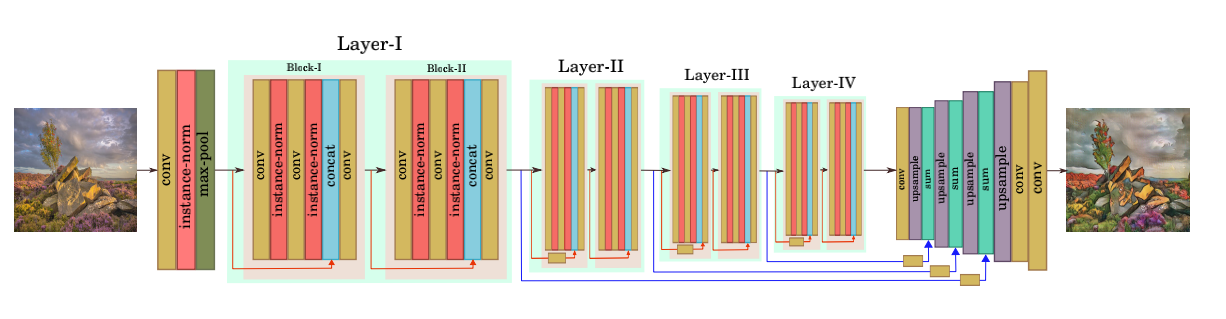
GANILLA designed a new generator network in such a way that it preserves the content and transfers the style at the same time. A high-level architectural description of our generator network, GANILLA, is presented in Figure 2 along with the current state-of-the-art models and our two ablation models. GANILLA utilizes low-level features to preserve content while transferring the style. This model consists of two stages (Figure 1): the downsampling stage and the upsampling stage. The downsampling stage is a modified ResNet-18 network with the following modififications: In order to integrate low-level features at the down sampling stage, we concatenate features from previous layers at each layer of down sampling. Since low-level layers incorporate information like morphological features, edge and shape, they ensure that transferred image has the substructure of the input content.
Figure 1: GANILLA generator network. The model uses concatenative skip connections for downsampling (from image up to Layer-IV). Then, the output of Layer-IV is sequentially upsampled while lower-level features from the downsampling stage are added to it via long, skip connections (blue arrows). The final output is a 3-channel stylized image.
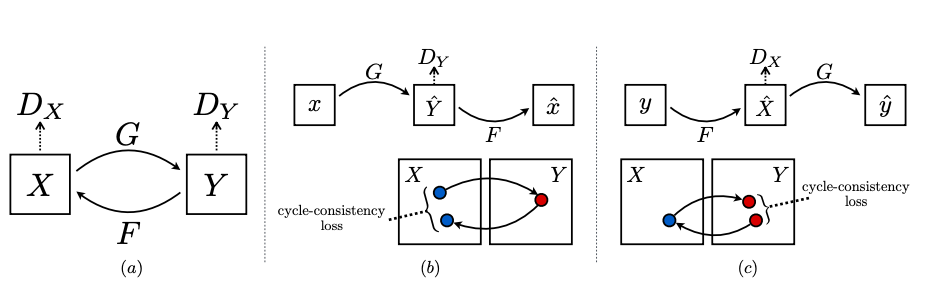
Figure 2: High-level architectural description of state-of-the-art models (CycleGAN, CartoonGAN, DualGAN), our model (GANILLA) and the two ablation models we experimented with. We follow the idea of cycle-consistency to train our GANILLA model. Specifically, there are two couples of generator-discriminator models. The first set(G) tries to map source images to the target domain, while the second set (F) takes input as the target domain images and tries to generate source images in a cyclic fashion.
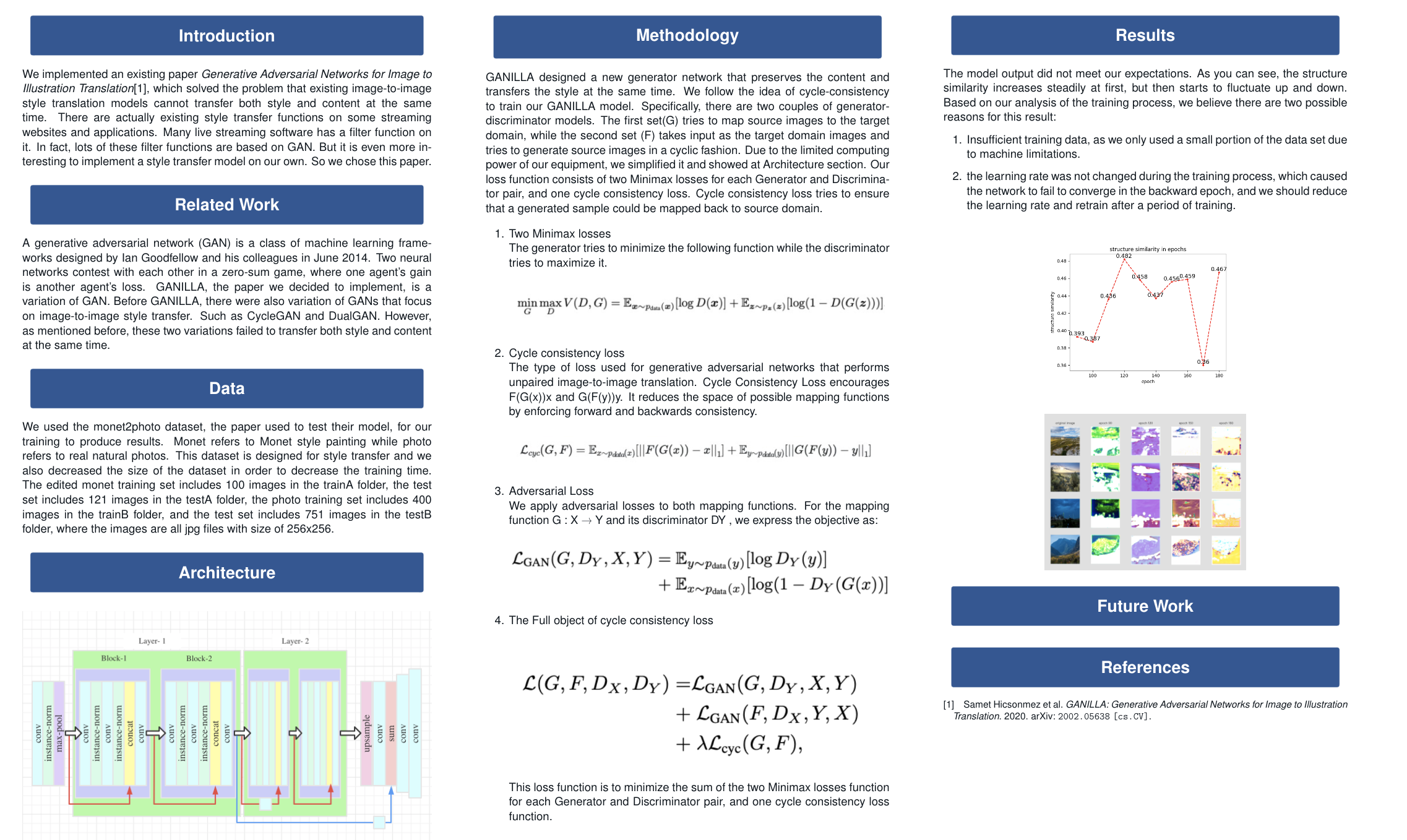
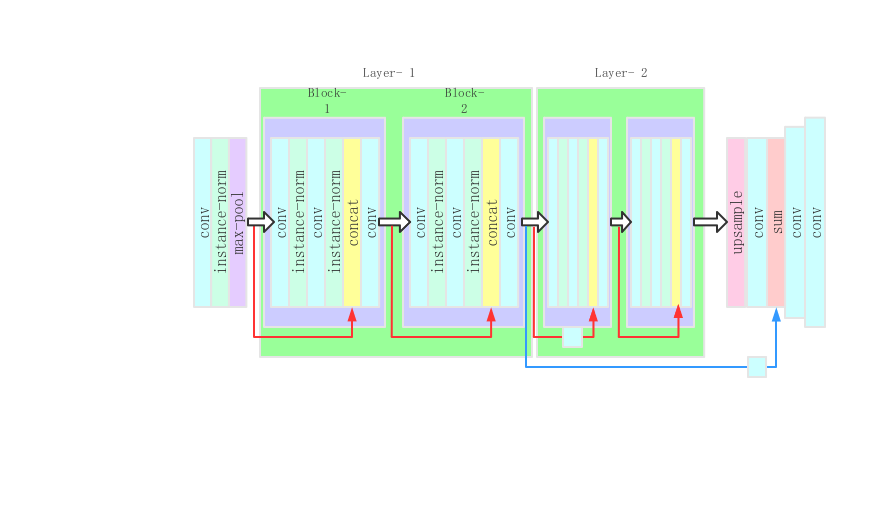
Due to the limited computing power of our equipment, we simplified the model to the following figure3:
Loss function: Our loss function consists of two Minimax losses[2] for each Generator and Discriminator pair, and one cycle consistency loss[3]. Cycle consistency loss tries to ensure that a generated sample could be mapped back to source domain. We use L1 distance for cycle consistency loss. When we give source domain images to generator F , we expect no change on them since they already correspond to source domain. A similar situation applies when we feed the generator G with target domain images. (1). Two Minimax losses: The generator tries to minimize the following function while the discriminator tries to maximize it:
In this function: D(x) is the discriminator's estimate of the probability that real data instance x is real. Ex is the expected value over all real data instances. G(z) is the generator's output when given noise z. D(G(z)) is the discriminator's estimate of the probability that a fake instance is real. Ez is the expected value over all random inputs to the generator (in effect, the expected value over all generated fake instances G(z)). The formula derives from the cross-entropy between the real and generated distributions. The generator can't directly affect the log(D(x)) term in the function, so, for the generator, minimizing the loss is equivalent to minimizing log(1 - D(G(z))). (2). Cycle consistency loss:
(a) The model contains two mapping functions G : X → Y and F : Y → X, and associated adversarial discriminators DY and DX. DY encourages G to translate X into outputs indistinguishable from domain Y , and vice versa for DX and F. To further regularize the mappings, we introduce two cycle consistency losses that capture the intuition that if we translate from one domain to the other and back again we should arrive at where we started: (b) forward cycle-consistency loss: x → G(x) → F(G(x)) ≈ x, and (c) backward cycle-consistency loss: y → F(y) → G(F(y)) ≈ y Cycle Consistency Loss is a type of loss used for generative adversarial networks that performs unpaired image-to-image translation. It was introduced with the CycleGAN architecture. For two domains X and Y, we want to learn a mapping G:X→Y and F:Y→X. We want to enforce the intuition that these mappings should be reverses of each other and that both mappings should be bijections. Cycle Consistency Loss encourages F(G(x))≈x and G(F(y))≈y. It reduces the space of possible mapping functions by enforcing forward and backwards consistency:
(3). Adversarial Loss We apply adversarial losses to both mapping functions. For the mapping function G : X → Y and its discriminator DY , we express the objective as:
where G tries to generate images G(x) that look similar to images from domain Y , while DY aims to distinguish between translated samples G(x) and real samples y. G aims to minimize this objective against an adversary D that tries to maximize it. We introduce a similar adversarial loss for the mapping function F : Y → X and its discriminator DX as well. (4) The Full object of cycle consistency loss:
where λ controls the relative importance of the two objectives. Our full objective function is to minimize the sum of the two Minimax losses function for each Generator and Discriminator pair, and one cycle consistency loss function.
Metrics
We decided to train the model on monet2photo dataset. As for evaluating the model. Because this is a generative model, which creates something not in the dataset. It is hard to find a mathematical way to evaluate the model. In order to solve the problem. Author of this paper proposed to train and use a style classifier to evaluate the model.
Base goal: implement the model with data provided by the author.
Target goal: implement the model with monet2photo dataset and produce reasonable results.
Stretch goal: implement the model with our own dataset and produce reasonable results.
Ethics
Our dataset is illustrations from children’s books. There are no concerns about how it was collected or labels. Children’s book illustrations contain highly abstract shapes and objects. It usually haven’t underlying historical or societal biases.
Results
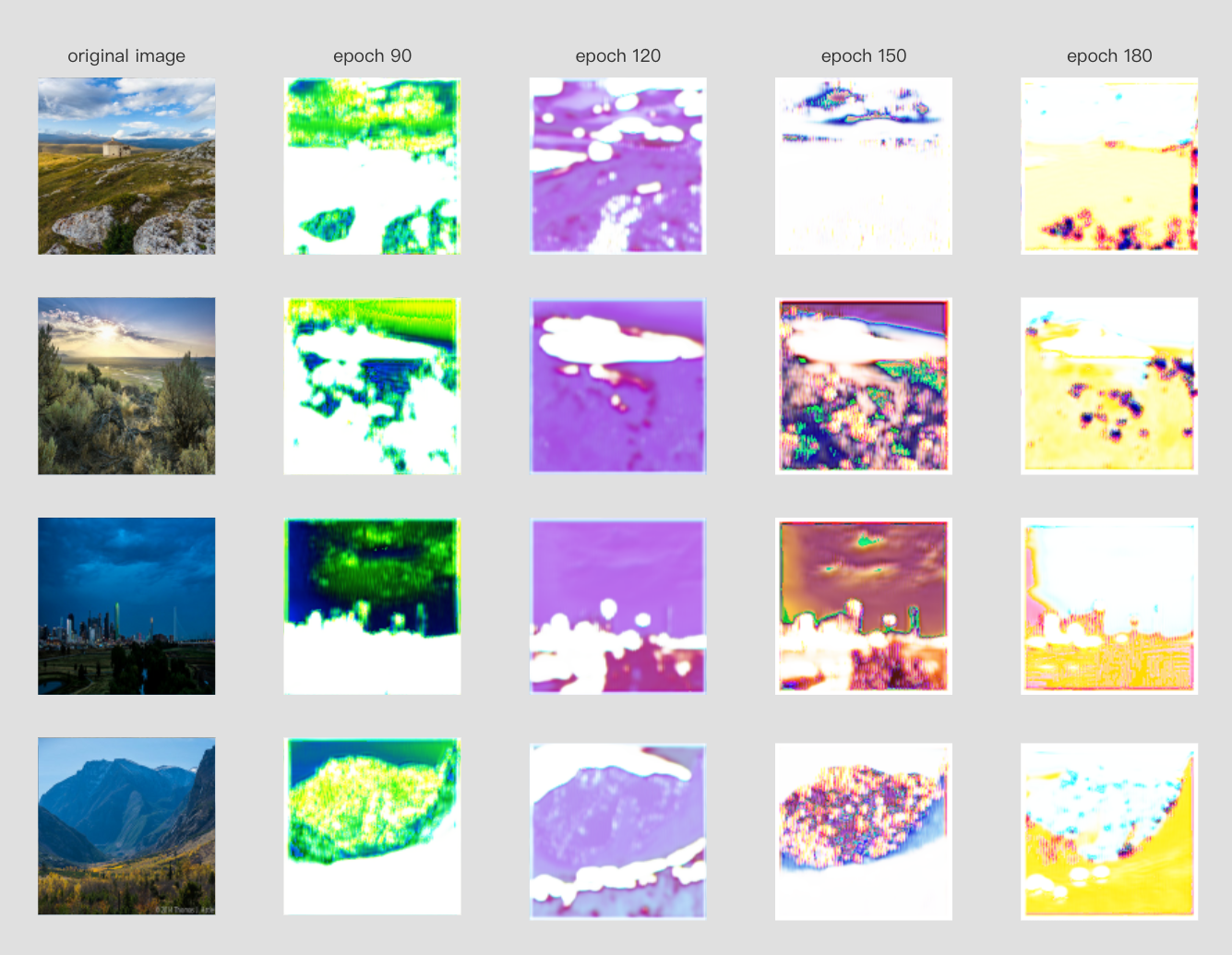
The model output did not meet our expectations. As you can see, the structure similarity increases steadily at first, but then starts to fluctuate up and down. Based on our analysis of the training process, we believe there are two possible reasons for this result: 1. Insufficient training data, as we only used a small portion of the data set due to machine limitations. 2. the learning rate was not changed during the training process, which caused the network to fail to converge in the backward epoch, and we should reduce the learning rate and retrain after a period of training.
Reference:
[1] Hicsonmez, S., Samet, N., Akbas, E. and Duygulu, P., 2020. GANILLA: Generative adversarial networks for image to illustration translation. Image and Vision Computing, 95, p.103886.
[2] I. Goodfellow, J. Pouget-Abadie, M. Mirza, B. Xu, D. Warde-Farley, S. Ozair, A. Courville, Y. Bengio, Generative adversarial nets, in: Advances in Neural Information Processing Systems, 2014, pp. 2672–2680.
[3] J.-Y. Zhu, T. Park, P. Isola, A. A. Efros, Unpaired image-to-image translation using cycle-consistent adversarial networks, IEEE International Conference on Computer Vision.
Division of labor
Yuyang Wang: Model construction, Parameter fine tune
Zihan Miao:Data preprocess, Parameter fine tune
Chi Zhang: Methodology reserach and transformation. Loss function research and transformation. Discriminator construction.
Github link
https://github.com/0wsdqr0/ganilla
presentation video
https://drive.google.com/file/d/1rJCRT9gCM7INorIIM2LwPrrAE1_kH-Kj/view?usp=sharing
poster
https://drive.google.com/file/d/1HQkA3VFLeGB1iUll-4ZscNsCiIiYl7lg/view?usp=sharing
second reflection
https://docs.google.com/document/d/1YrWbhrHdP4FLgJi3jV7mohnc2rNQbSQbPUpY4dyzSE0/edit?usp=sharing
final reflection
https://docs.google.com/document/d/1_wG9UTJapFsd27KuWGFIIT-NFwpt81wXr7OyyymsI-A/edit?usp=sharing
Built With
- python
- tensorflow


Log in or sign up for Devpost to join the conversation.