Inspiration
The anxiety surrounding AI replacing jobs is palpable, and will only become more palpable in the upcoming years. We wanted to flip the narrative from panic to preparation. We realized that the question "Will AI replace me?" is too broad. The real question is: "Which parts of my job will AI replace, and what can I do about it?" We were inspired to build a tool that acts not as a crystal ball of doom, but as a strategic compass for the future of work.
What it does
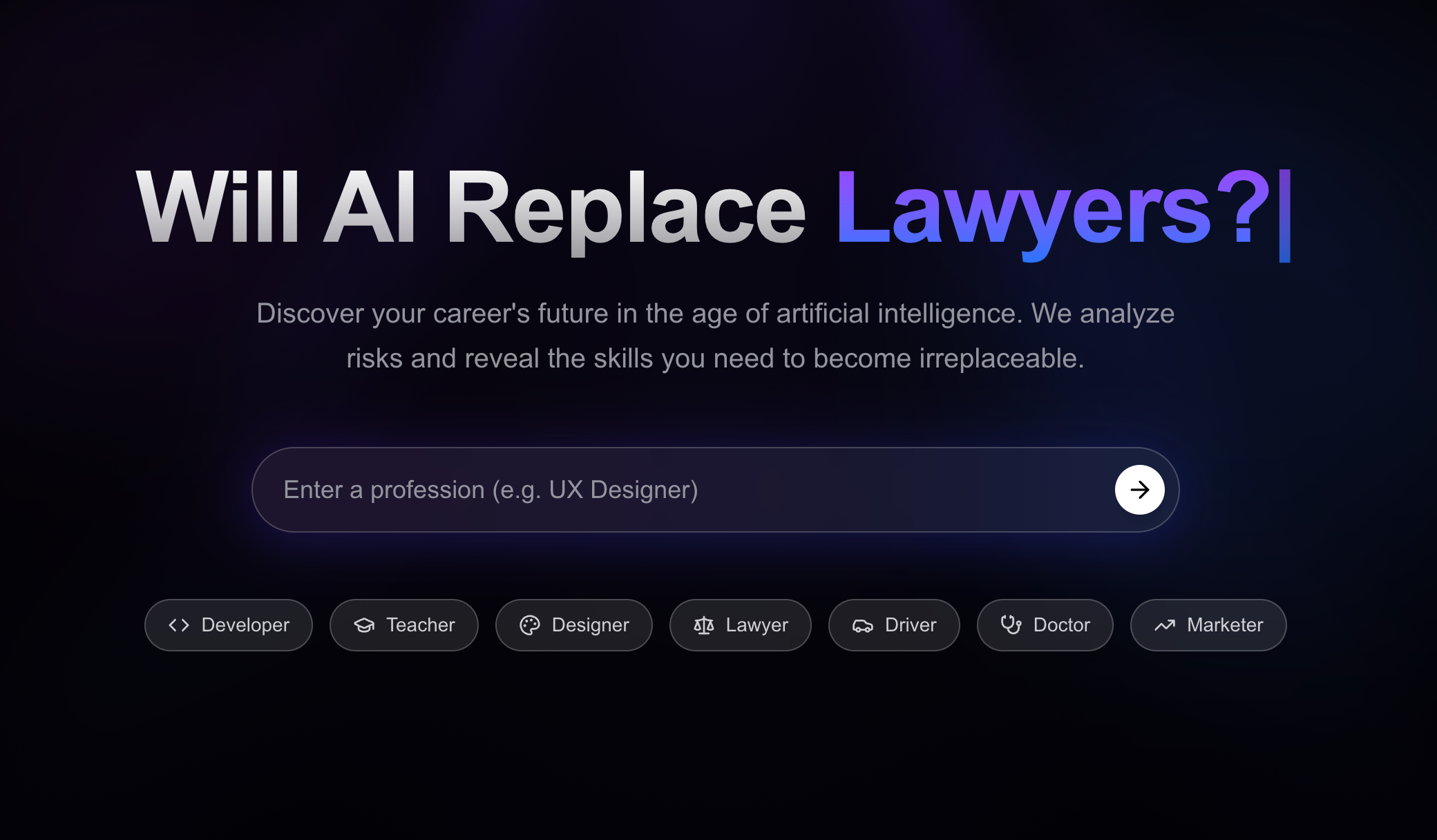
willaireplace.you is a career resilience engine.
- Analyzes: Users enter information about their profession.
- Decomposes: Our agentic workflow breaks the role down into its atomic tasks and skills. Also, it performs web searches to stay up-to-date with the latest SOTA AI capabilities.
- Evaluates: It assesses each task against the current and projected future capabilities of SOTA AI models.
- Strategizes: It calculates a granular "Automation Risk Score" and, most importantly, generates likely future scenarios and a personalized "Survival Strategy" roadmap of high-value, human-centric skills to learn to become irreplaceable.
How we built it
We built willaireplace.you with a focus on good agent performance, meaning it replies as fast as possible while maintaining high standard of answers.
- Backend: Python and FastAPI power the API. We used LangChain and LangGraph to orchestrate complex, multi-step agent workflows. OpenAI GPT-5.1 serves as the core intelligence for reasoning and task decomposition.
- Frontend: Next.js and React for a cutting-edge, reactive UI. We used Tailwind CSS for rapid styling and Framer Motion + OGL to create a cinematic, immersive experience.
Challenges we ran into
- Balancing "Doom" and "Hope": It was a challenge to design the UX so that high risk score didn't feel discouraging, but rather empowering. We iterated on the copy and visual feedback to focus on actionability.
- Agent Orchestration: Getting the agents to consistently break down jobs into meaningful, granular tasks (without hallucinating) required significant prompt engineering and strict validation loops in our LangGraph workflow.
- Latency vs. Experience: Multiple agents performing deep analyses takes time. We had to design the UI to keep the user engaged with fluid animations and pseudo-funny phrases (inspired by gemini-cli) while the backend crunched the numbers.
Accomplishments that we're proud of
- The "Wow" Factor: We achieved a visual aesthetic that feels genuinely premium.
- Granularity of Analysis: We're proud that the tool doesn't just give a generic "90% chance" but explains why specific tasks are at risk.
- Cutting-Edge Stack: Successfully deploying a project. You can check it out at willaireplace.you.
What we learned
- AI replaces tasks, not jobs: This nuance is key to understanding the future economy.
- CORS: This can be a real pain in the ass :)
What's next for willaireplace.you
- Resume Integration: Allowing users to upload their CV for a hyper-personalized gap analysis.
- Course Integration: Partnering with learning platforms to link directly to courses for the recommended skills.
- Enterprise Dashboard: A version for companies to analyze the AI-resilience of their entire workforce and plan training budgets accordingly.

Log in or sign up for Devpost to join the conversation.