-
-
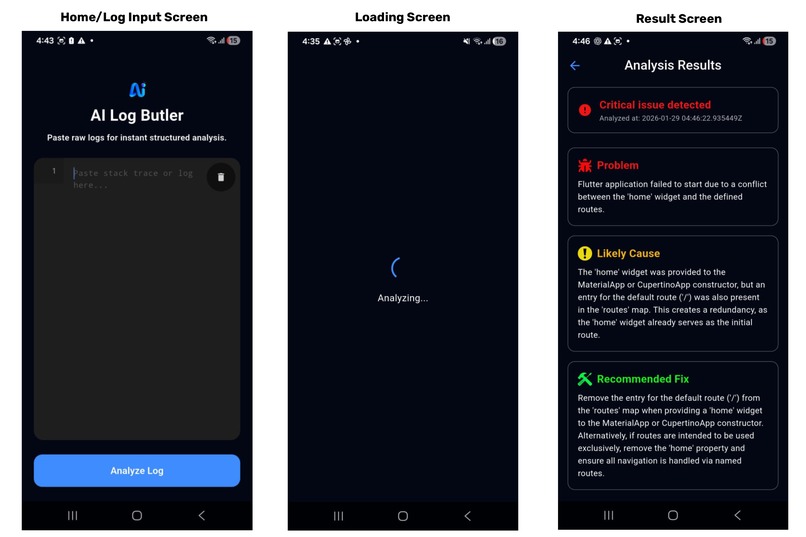
Flutter + Gemini app that turns raw application logs into clear error explanations, root causes, and actionable fixes.
Inspiration
Modern applications generate massive volumes of logs, but logs alone don’t explain problems. As a developer, I often found myself scrolling through raw logs, trying to guess:
- What actually went wrong?
- Is this critical or ignorable?
- What should I fix first?
Most existing tools either display raw logs without context or require heavy configuration and setup. I wanted something simple, intelligent, and immediately useful.
That’s how AI LogButler was born:
an AI-powered assistant that reads logs like an experienced engineer and turns them into clear, structured insights that developers can act on instantly.
What it does
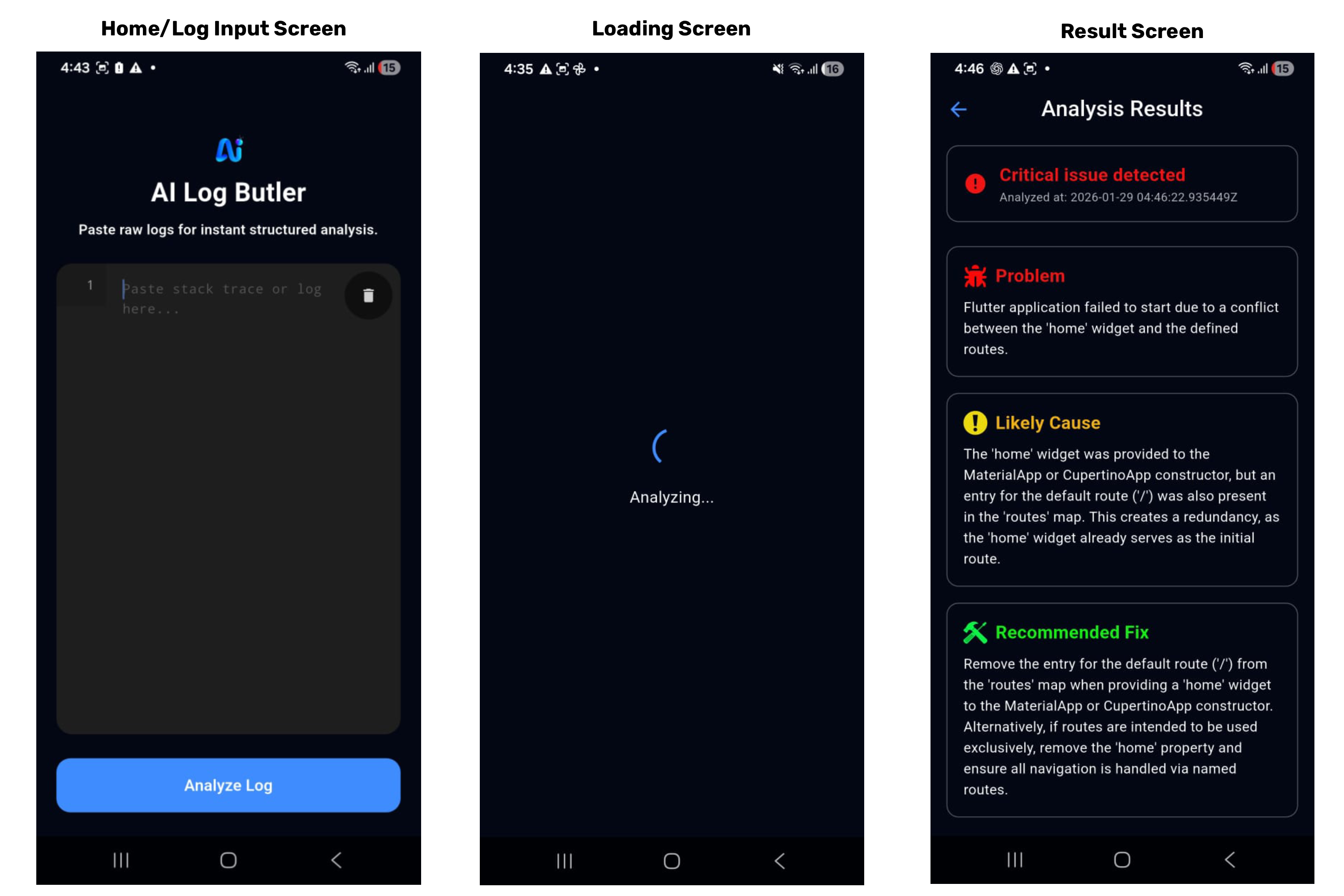
AI LogButler takes raw application logs and transforms them into structured, human-readable diagnostics.
For each log input, it:
- Identifies the core problem
- Determines the likely root cause
- Evaluates the severity level
- Suggests a concrete and actionable fix
- Optionally provides a relevant code example
- Detects the programming language or log type (e.g., Dart, Python, Database, Application..) to provide context-aware analysis.
Instead of forcing developers to interpret logs manually, AI LogButler delivers clear answers in seconds, allowing them to focus on fixing issues rather than deciphering errors.
How we built it
AI LogButler is built as a full-stack application using modern, developer-friendly technologies.
- Serverpod powers the backend, handling API endpoints, validation, and type-safe data models.
- Google Gemini is used as the AI engine to analyze logs and generate structured insights.
- Flutter is used for the frontend to deliver a clean, responsive, and intuitive user experience.
A strict JSON schema is enforced between the AI and the backend to ensure reliability and predictable outputs.
This guarantees that AI responses are not just intelligent, but also usable in a production-grade application.
Challenges we ran into
One of the main challenges was ensuring the reliability of AI-generated responses.
AI models sometimes return valid insights but in an unexpected or invalid format.
We had to implement validation, error handling, and fallback logic to avoid breaking the user experience.
Another challenge was balancing simplicity and usefulness:
- Too much information overwhelms developers
- Too little information reduces trust
we solved this by focusing on clarity, severity signaling, and actionable recommendations.
Accomplishments that we're proud of
Successfully integrating Serverpod with Gemini in a real-world use case
- Designing a strict AI response schema instead of relying on free-form text
- Building a clean, intuitive UI that highlights severity and priority
- Delivering a fully functional, end-to-end AI-assisted developer tool
Most importantly, we built something practical, not just a demo.
What we learned
This project taught us how critical structure is when working with AI systems.
We learned that:
- AI is most useful when its output is constrained and predictable
- Strong backend validation is essential for AI-powered applications
- Developer tools must prioritize clarity and actionability over raw data
We also gained hands-on experience building scalable backends with Serverpod and integrating AI into real workflows.
What's next for AI LogButler
Next, we plan to:
- Support real-time log streams
- Integrate with CI/CD pipelines
- Add team collaboration features
- Expand support for different log formats and platforms
Our goal is to evolve AI LogButler into a trusted AI assistant that developers rely on daily to maintain healthy, reliable systems.


Log in or sign up for Devpost to join the conversation.