-
-
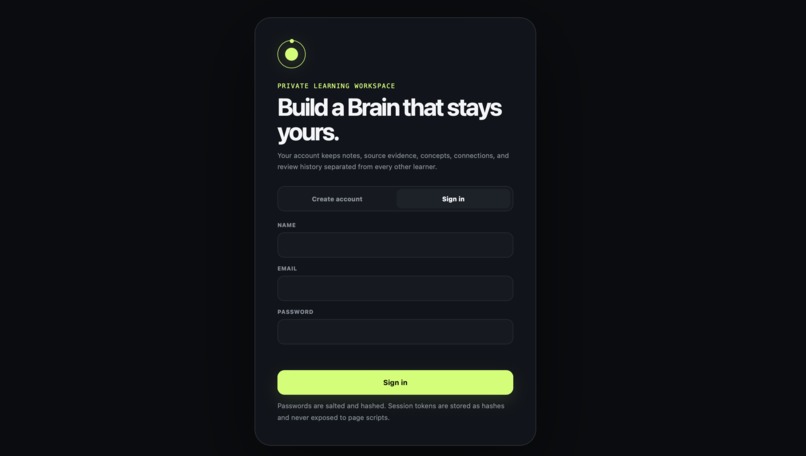
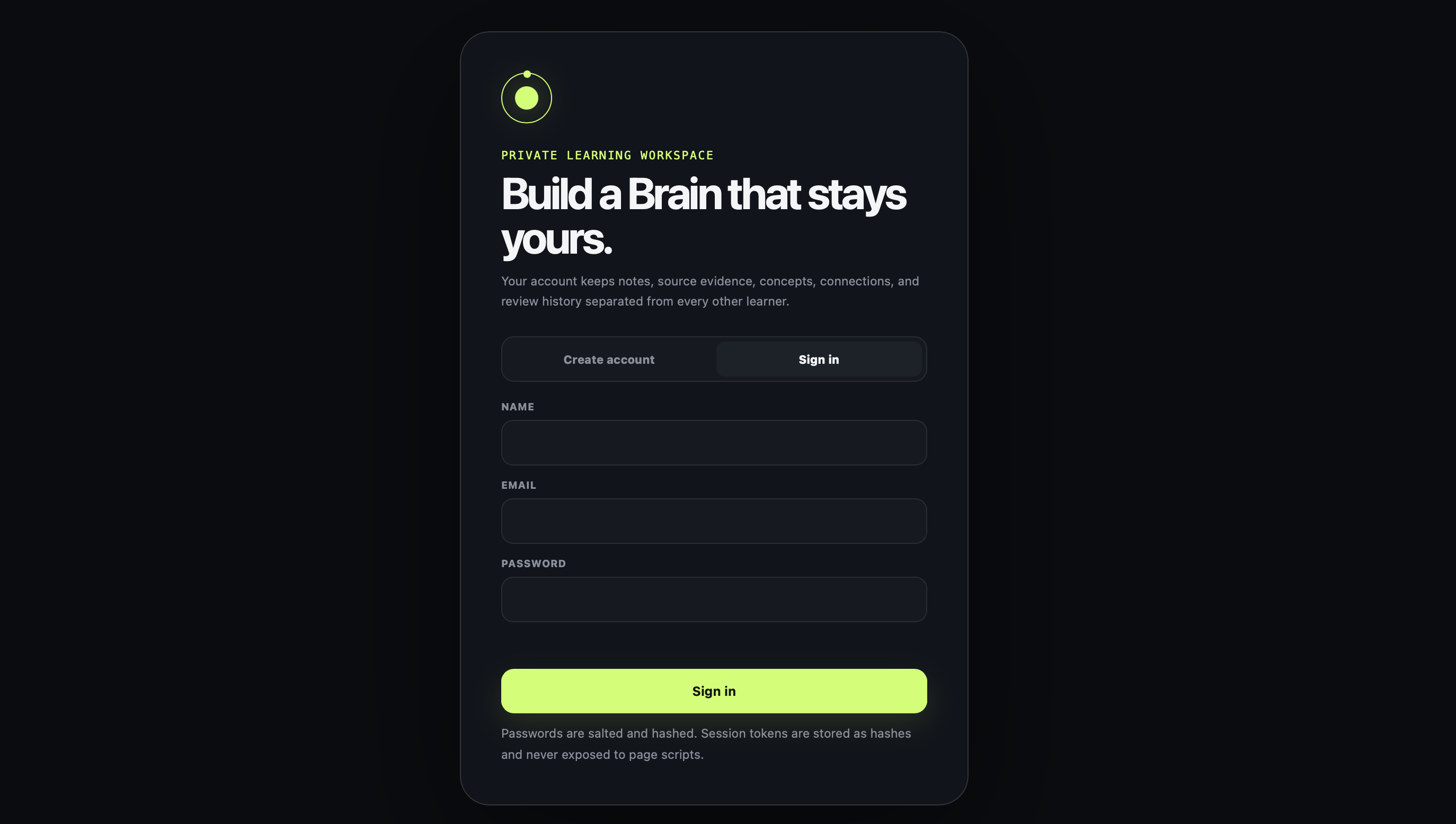
Welcome, please login/sign up
-
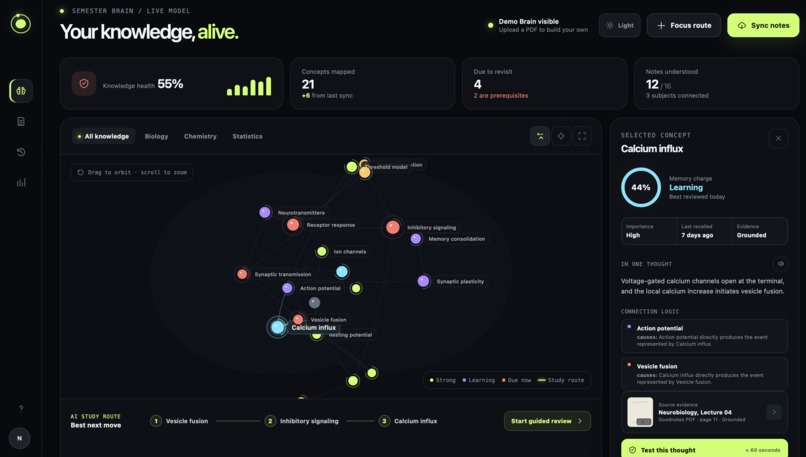
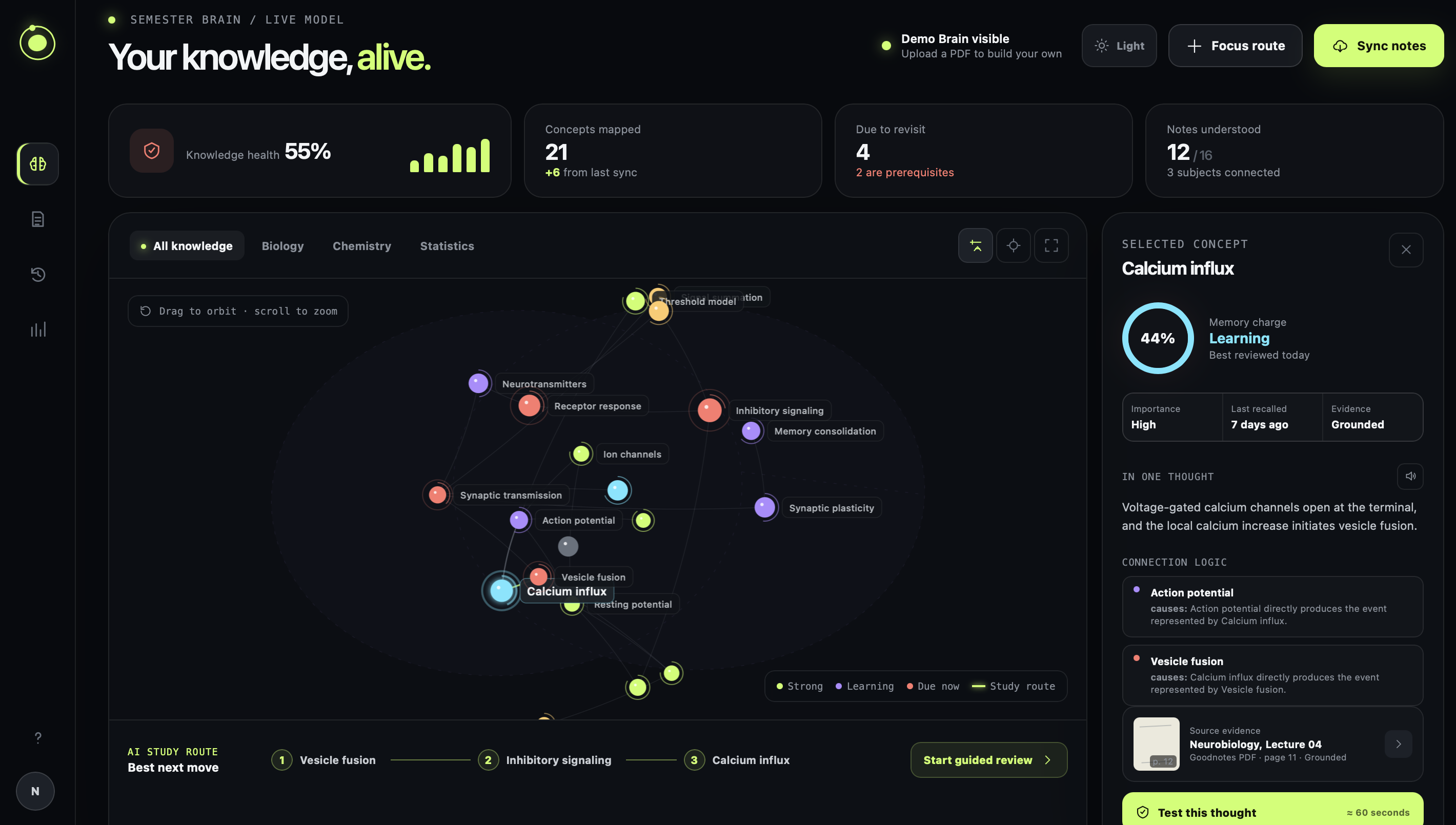
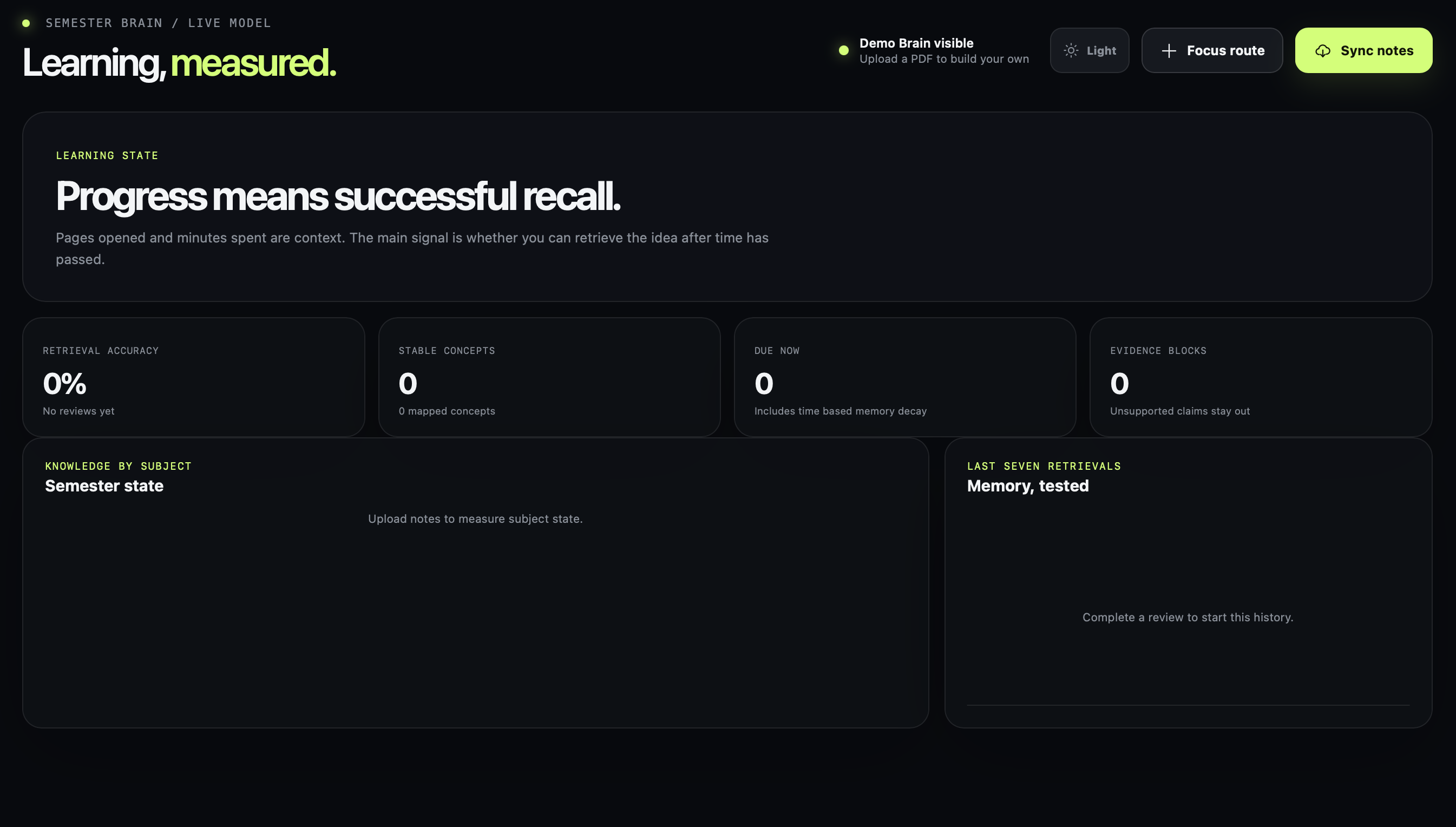
If Anki had access to goodnotes and steroids
-
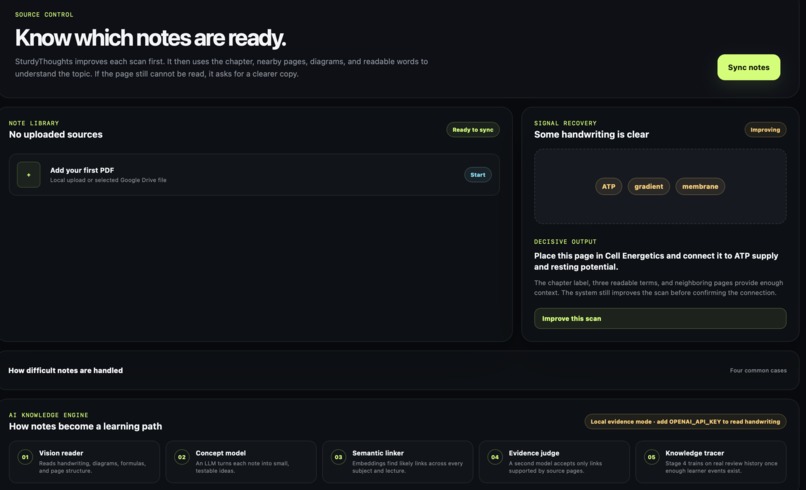
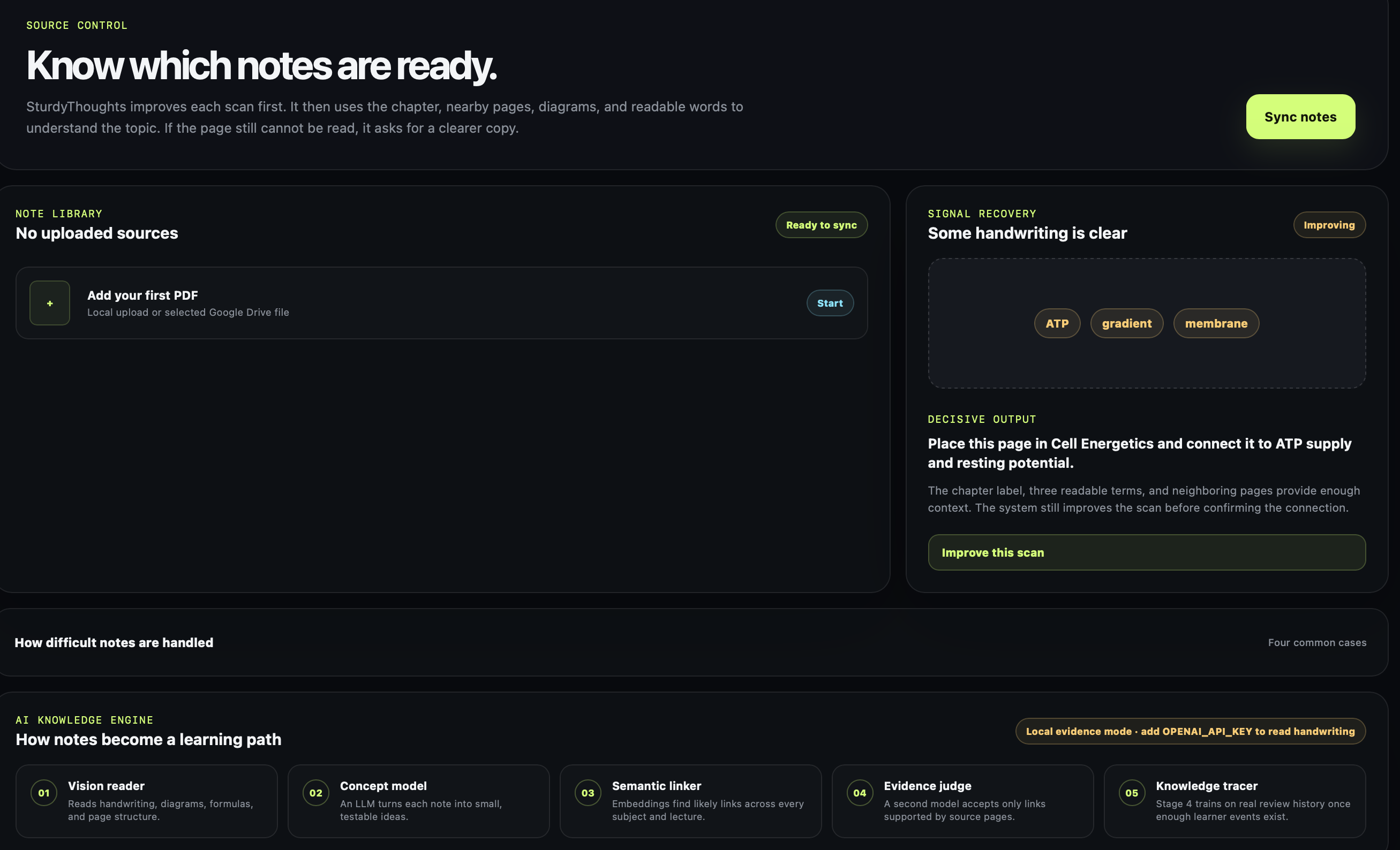
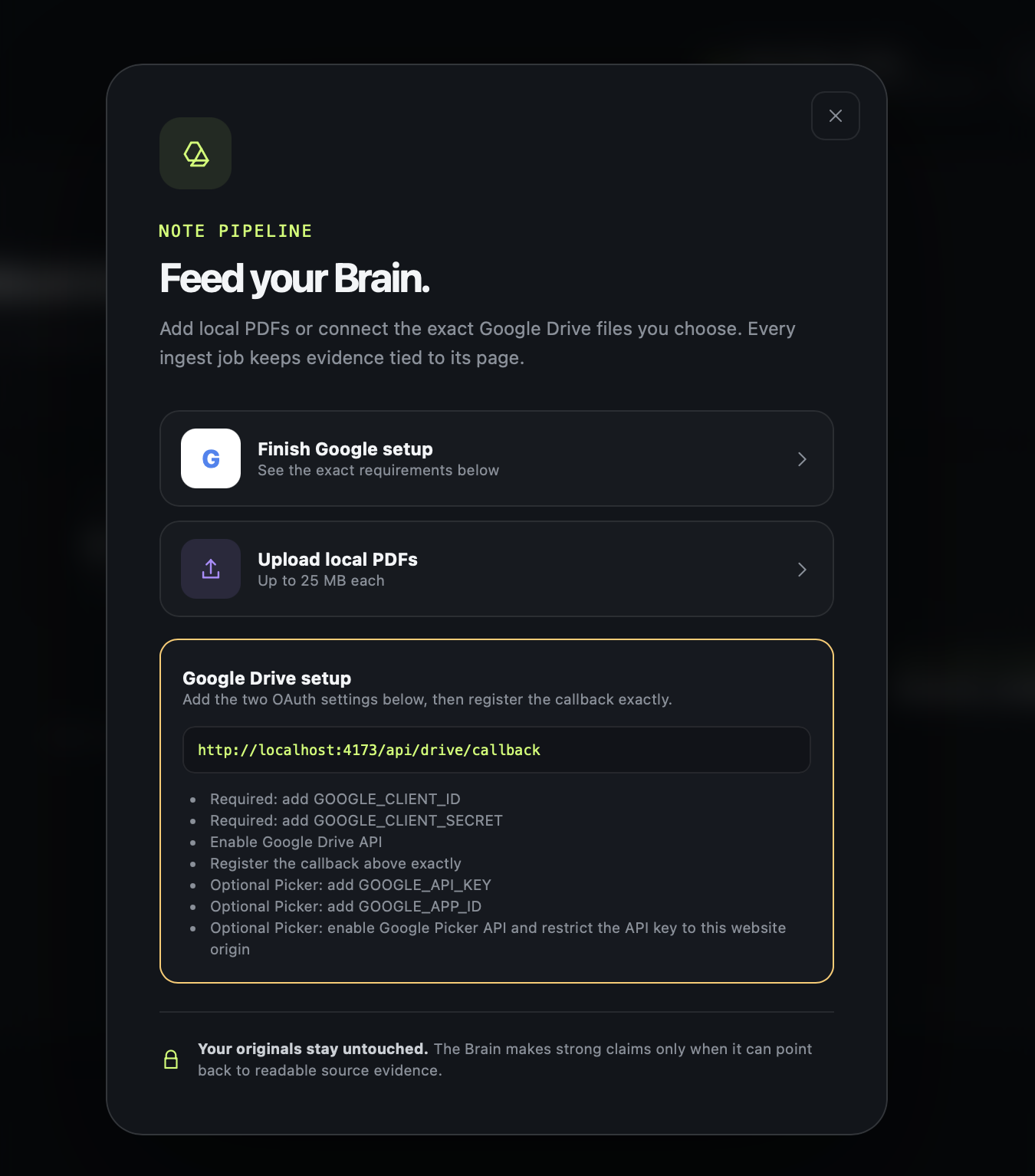
Keep track of all your notes
-
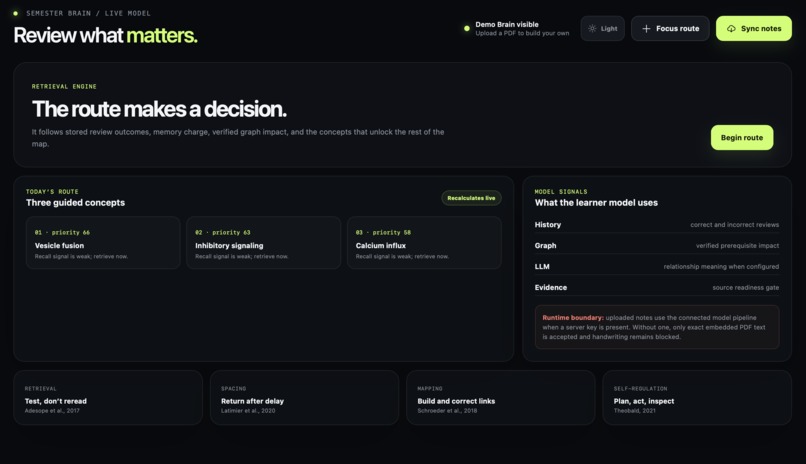
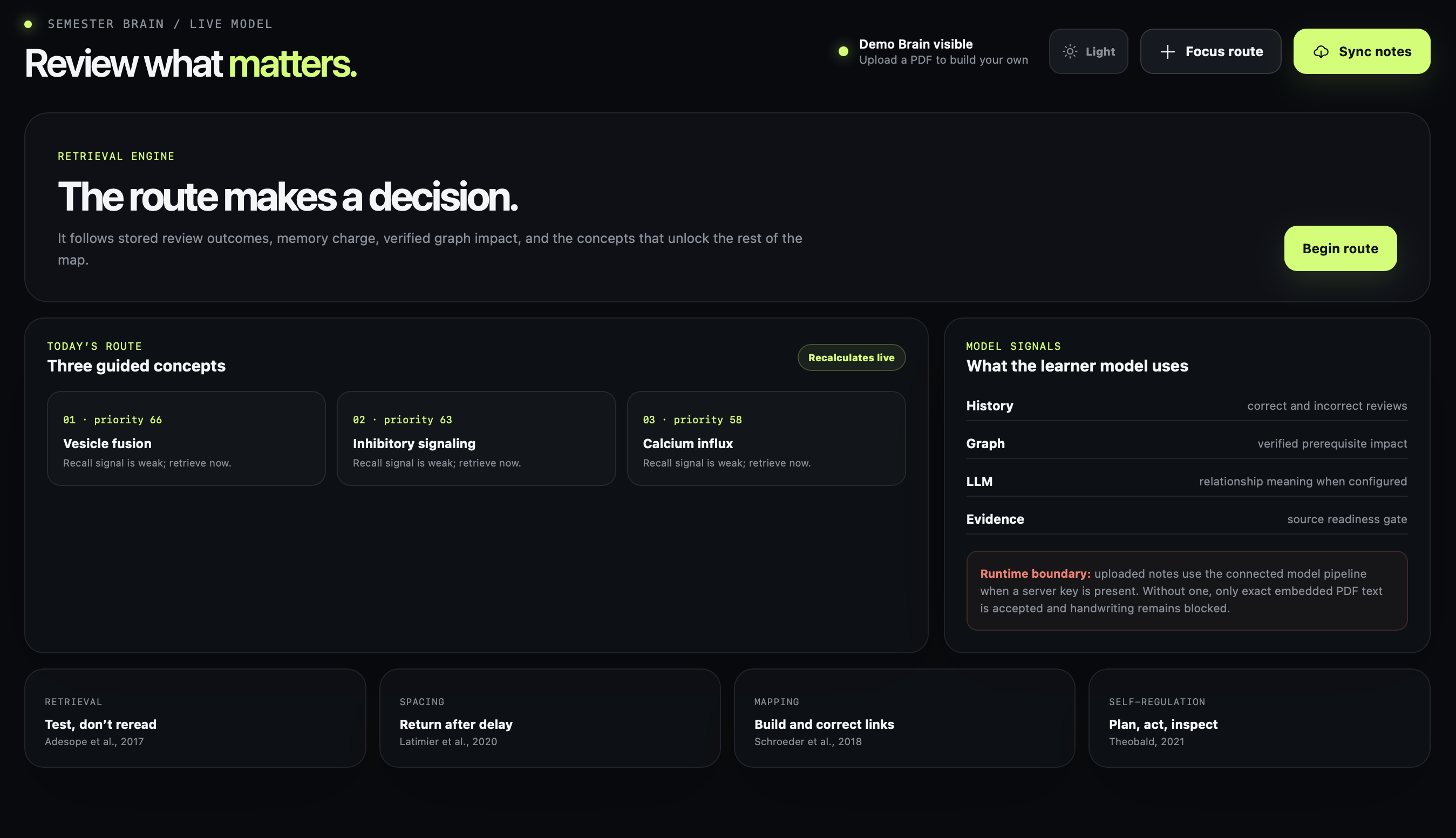
Prepare your routes of study
-
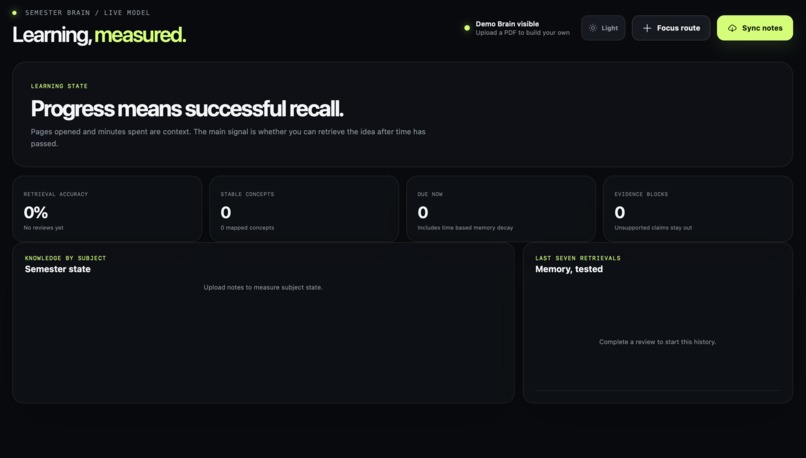
Progress meter, are you locked in
-
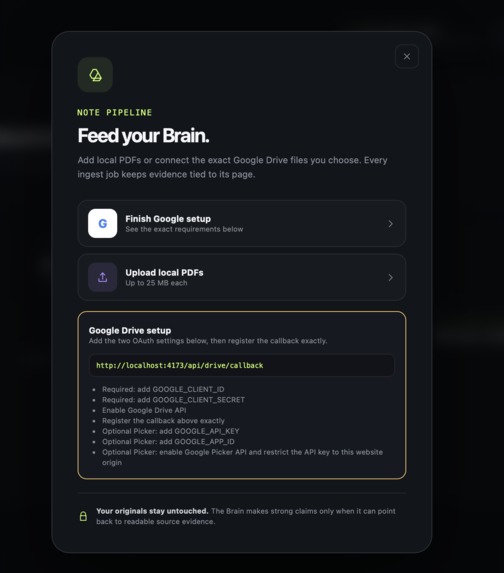
Syncnotes, possibility of syncing from Goodnotes with auto upload to drive
-
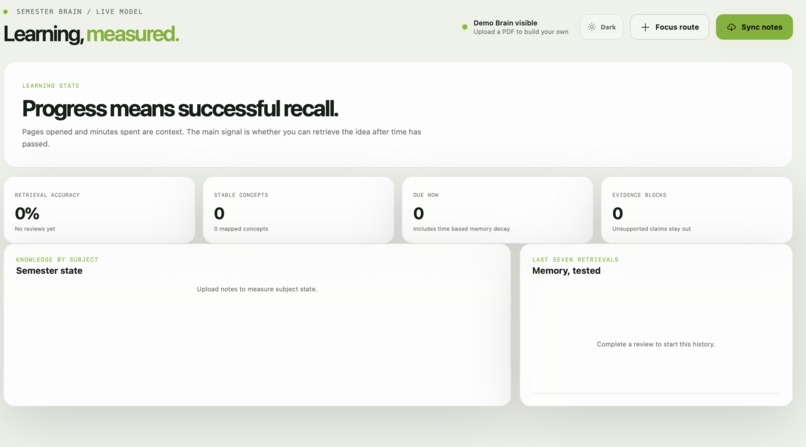
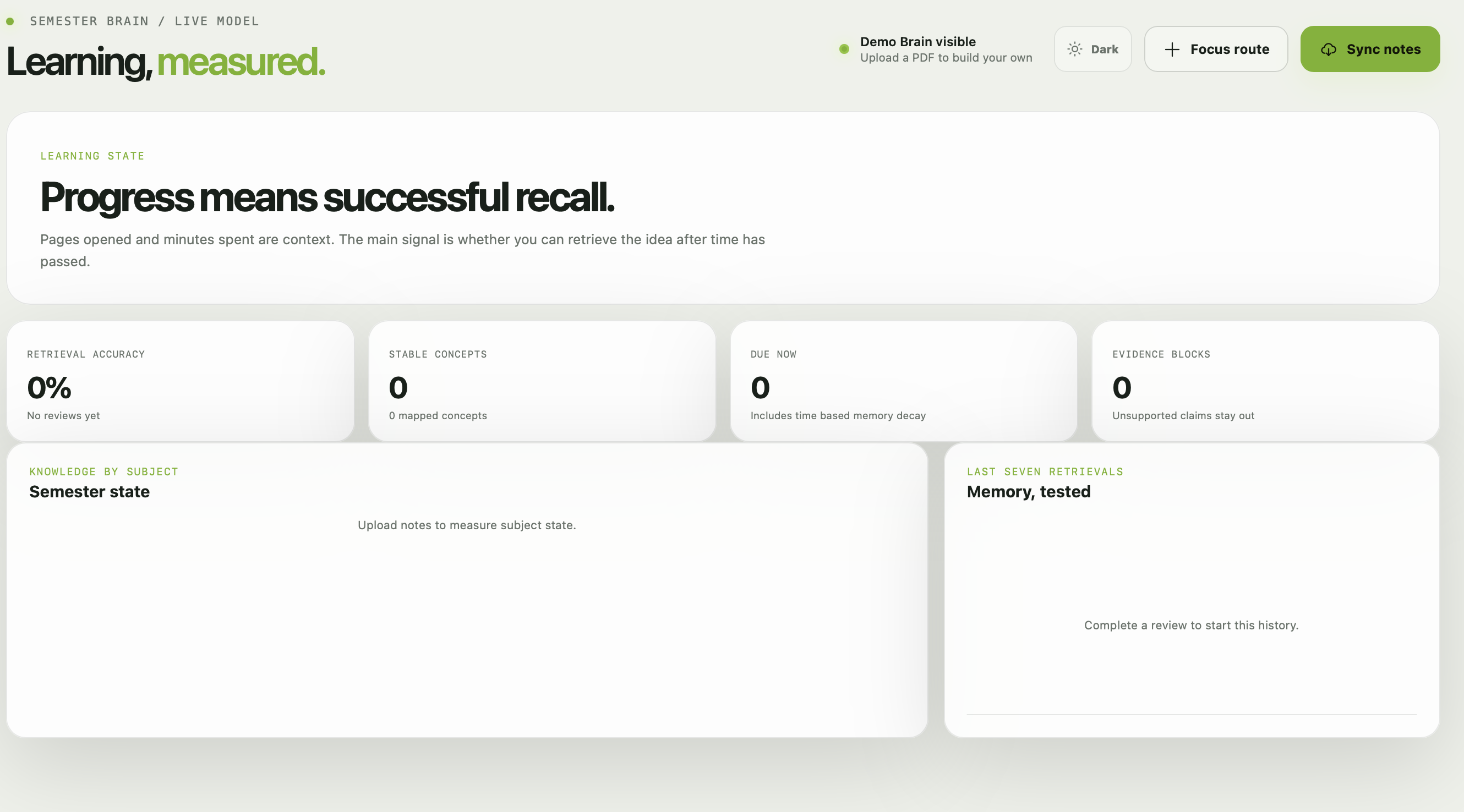
Light Mode :(
-
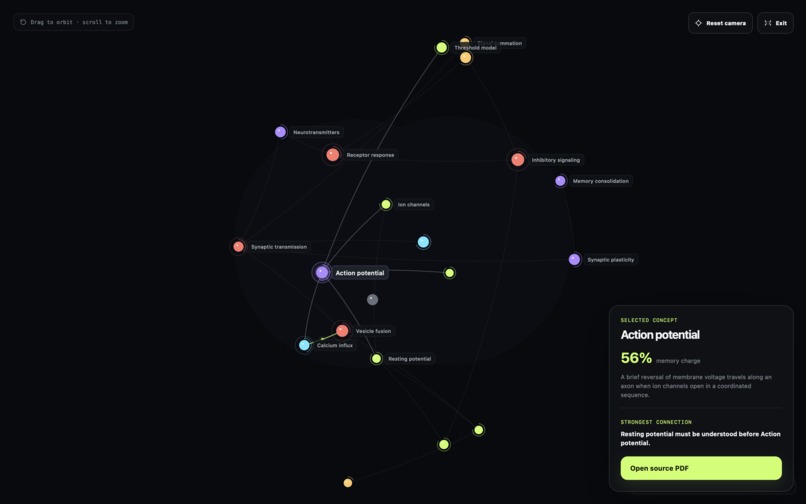
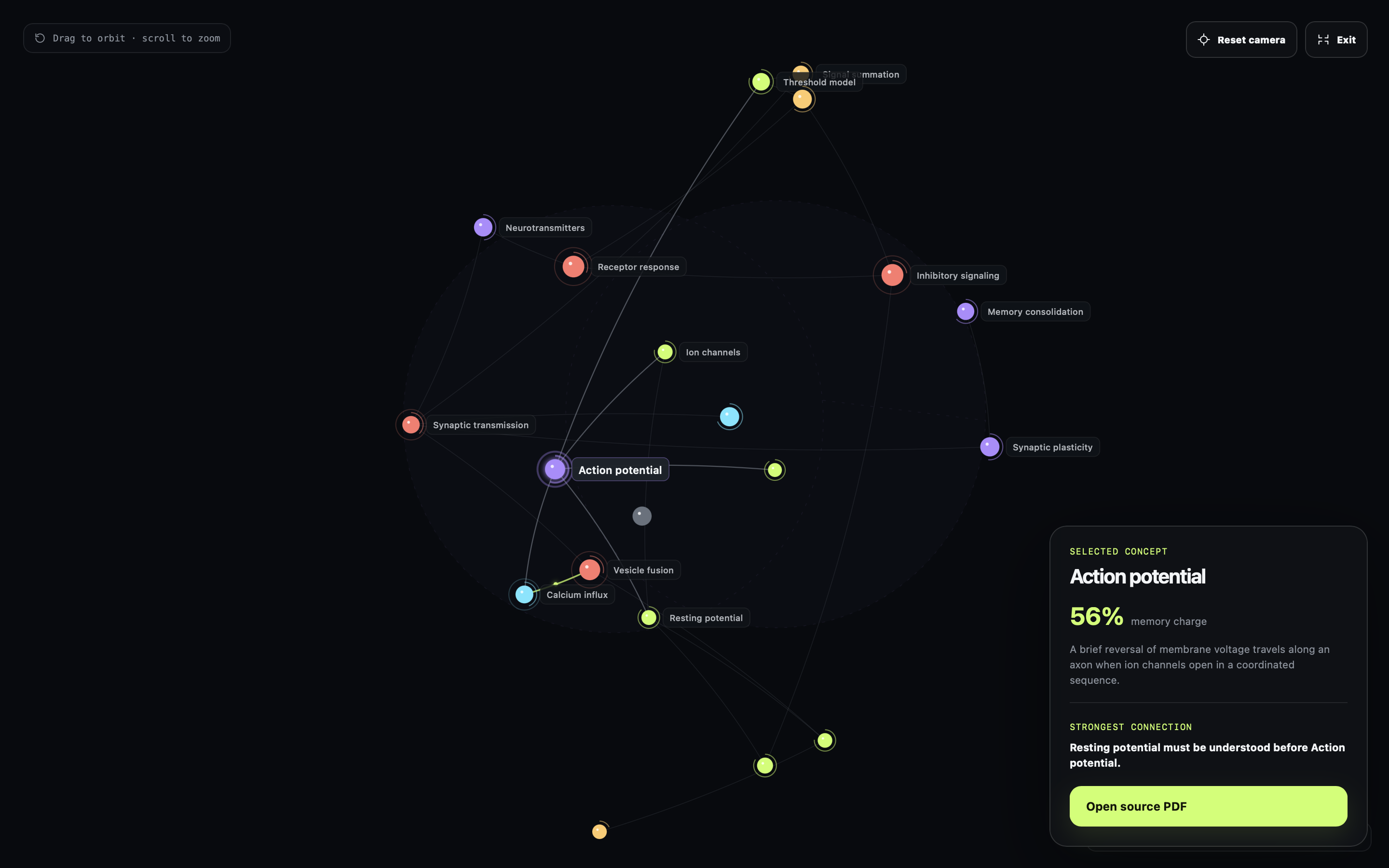
Full Screen: No distractions
## Inspiration
Our notes knew the syllabus. They did not know us.
At university, revision often becomes a guessing game. Reread everything and lose hours. Skip familiar chapters and risk discovering, during the exam, that familiar was not the same as remembered.
That feeling has a name. Research with college students found that most repeatedly read their material while relatively few test themselves, partly because rereading can create an illusion of competence [1].
We wanted AI to solve that exact problem. Not by writing more notes. Not by adding another chatbot. By turning the notes we already had into a living picture of what we knew, what was fading, and what deserved our attention next.
That matters beyond grades. Every hour saved from unnecessary revision is an hour returned to building, experimenting, and joining hackathons like this one.
SturdyThoughts helps us forget less, so we can build more.
## What it does
One PDF in. A living Brain out.
SturdyThoughts uses AI to transform lecture PDFs and handwritten pages into an interactive map of a student’s knowledge.
The journey is simple:
Read → Prove → Connect → Recall
AI reads the document page by page, including handwriting, formulas, diagrams, and difficult layouts. It extracts small, testable concepts and attaches each one to the exact page and evidence that produced it.
A separate AI pass checks the work. If the page does not support a concept, the concept does not enter the Brain. Every insight needs a receipt.
Embeddings then search across different notes for possible connections. Another AI judge decides whether each connection is meaningful and labels it as a prerequisite, cause, explanation, trigger, or supporting idea.
The result appears as a three dimensional Brain. Node size shows importance. Color shows learning state. A ring shows memory charge. A pulse means review is due. Bright connections form the next study route.
The student then practises retrieval instead of simply rereading. This choice is deliberate. Research shows that retrieval practice strengthens long term retention [2], spacing improves later recall [3], and concept maps can improve knowledge retention across many learning settings [4].
If an answer is wrong, SturdyThoughts opens the exact source page. The mistake becomes a doorway back to understanding. After every answer, the Brain updates and the route changes.
The notes do not just sit there. They think with you.
## How we built it
AI is not an extra feature inside SturdyThoughts. Remove it and the Brain goes blank.
We built the application with JavaScript, Node.js, HTML, CSS, SQLite, the OpenAI API, Google Drive, and the browser Canvas API.
The first AI stage interprets the source and returns concepts through a strict data schema. Every concept must contain a title, summary, subject, importance score, page number, and evidence fragment.
The second stage acts as an independent evidence judge. It rejects invented quotations, incorrect pages, broad claims, and ideas supported only by outside knowledge.
The third stage creates embeddings for accepted concepts. These vectors help find ideas that may be connected across lectures. Similarity is only a clue, never a conclusion.
The fourth stage judges those candidates using evidence from both source concepts. Only direct and explainable relationships enter the graph.
The learning engine then combines memory charge, retrieval performance, prerequisite impact, concept importance, and evidence quality to choose the next review route. This part is deliberately transparent. We use AI where interpretation is needed and clear scoring where the student deserves an understandable decision.
The interface turns that pipeline into an intuitive study experience. Students can orbit the Brain, zoom, filter by subject, inspect relationships, enter fullscreen mode, open original notes, complete reviews, and watch their knowledge state change.
We also built privacy into the foundation. Passwords use scrypt. Sessions use hashed tokens inside HttpOnly cookies. Google credentials are encrypted. Provider secrets remain on the server, and every student receives a separate private workspace.
This is not a prompt inside a pretty frame. It is a complete AI learning pipeline, from raw page to verified concept to personal review.
## Challenges we ran into
The hardest problem was simple to describe and difficult to solve:
AI can sound certain while being wrong.
In education, a polished mistake is still a mistake. We therefore separated extraction from verification and made the original note the final authority. Current research also warns that generative systems need structured, pedagogically grounded use rather than unrestricted answers [8].
Handwriting was another challenge. Real lecture notes are full of arrows, shorthand, formulas, margins, and diagrams that make sense to a student but confuse ordinary text extraction. Visual interpretation helped us read the page as a page rather than as a bag of words.
Connections created a different problem. Two ideas can rhyme without reasoning. Embeddings may detect similar language, but they cannot prove that one concept explains or enables another. That is why every proposed edge receives a second judgment using both pieces of evidence.
The Brain itself needed restraint. A three dimensional graph can quickly become a galaxy shaped screensaver. We made every visual choice answer a study question: What is weak? What is important? What depends on this? What comes next?
Finally, we resisted pretending that we already possessed years of student data. The current route adapts using real review activity and an inspectable scoring model. A learned forgetting model will come only after we have authentic, consented history to train and evaluate it properly.
## Accomplishments that we're proud of
We are proud that we built a working learning loop, not an AI party trick.
A student can create an account, import a real note, watch AI build a verified Brain, inspect the original evidence, answer a question, make a mistake, revisit the correct page, and see the route recalculate.
We are especially proud of the evidence chain. Every accepted thought knows where it came from. Unreadable pages are marked honestly. Unsupported claims are blocked. Citations are not decoration. They are doors back to the source.
We are also proud that the Brain earns its place. It turns a stack into a map, a map into a route, and a route into recall.
Our two minute demo can tell the whole story in five beats:
One note. One Brain. One question. One source. One smarter route.
## What we learned
The biggest lesson was that students do not need AI to produce more material. They need AI to make better decisions about the material they already have.
We learned that the strongest system is not always the one with the largest prompt. Giving AI separate jobs produced clearer results. One model reads. One verifies. One connects. The learning engine prioritizes. The student remains in control.
We also learned that good educational AI begins with good learning science. A systematic review found that knowledge graphs can support personalized learning, concept mapping, and content recommendation [5]. Another review found growing use of AI for personalized learning paths, particularly in higher education [6]. A recent meta analysis involving 5,849 learners found that AI supported personalized feedback had a moderate effect on learning outcomes and a strong effect on motivation [7].
Those findings did not become marketing claims. They became design decisions.
The best AI does not replace thinking. It points thinking toward the right target.
## What's next for SturdyThoughts
Next, we want the Brain to understand not only what a student remembers, but how that student remembers.
We plan to add exam dates, assignment deadlines, richer spacing schedules, mobile note capture, and deeper subject insights. As real review history grows, SturdyThoughts will learn individual forgetting patterns and build increasingly personal routes.
We also plan to evaluate SturdyThoughts with students in controlled studies. The research shaped the product, but the product must now earn its own evidence.
The long term goal is a personal learning system that quietly keeps an entire semester in order.
Less cramming. More connecting. Fewer blind spots. More bright ideas.
Research that shaped SturdyThoughts
[1] Jeffrey D. Karpicke, A. C. Butler, and H. Roediger III. 2009. Memory. Metacognitive strategies in student learning: Do students practise retrieval when they study on their own? (https://consensus.app/papers/metacognitive-strategies-in-student-learning-do-students-karpicke-butler/ece3a92a567351fe963d6cf6fdc63368/?utm_source=chatgpt) Citation count: 733. DOI: 10.1080/09658210802647009.
[2] H. Roediger and A. C. Butler. 2010. Trends in Cognitive Sciences. The critical role of retrieval practice in long term retention (https://consensus.app/papers/the-critical-role-of-retrieval-practice-in-longterm-roediger-butler/0207e35356b255738a4e6ae7e73e544d/?utm_source=chatgpt). Citation count: 1,671. DOI: 10.1016/j.tics.2010.09.003.
[3] N. Cepeda, H. Pashler, E. Vul, J. Wixted, and D. Rohrer. 2006. Psychological Bulletin. Distributed practice in verbal recall tasks: A review and quantitative synthesis (https://consensus.app/papers/distributed-practice-in-verbal-recall-tasks-a-review-and-cepeda-pashler/a804ac03928753dbaff03c4b92036866/?utm_source=chatgpt). Citation count: 1,760. DOI: 10.1037/0033-2909.132.3.354.
[4] J. Nesbit and Olusola O. Adesope. 2006. Review of Educational Research. Learning With Concept and Knowledge Maps: A Meta Analysis (https://consensus.app/papers/learning-with-concept-and-knowledge-maps-a-metaanalysis-nesbit-adesope/be2bc5f0b65059f5843d1a9011102744/?utm_source=chatgpt). Citation count: 982. DOI: 10.3102/00346543076003413.
[5] Bilal Abu Salih and Salihah Alotaibi. 2024. Heliyon. A systematic literature review of knowledge graph construction and application in education (https://consensus.app/papers/a-systematic-literature-review-of-knowledge-graph-abu-salih-alotaibi/4d69991c196d5d71a62484e7deae031a/?utm_source=chatgpt). Citation count: 137. DOI: 10.1016/j.heliyon.2024.e25383.
[6] K. Bayly Castaneda, M. S. Ramirez Montoya, Morita Alexander, P. Schrader, and I. Awidi. 2024. Frontiers in Education. Crafting personalized learning paths with AI for lifelong learning: a systematic literature review (https://consensus.app/papers/crafting-personalized-learning-paths-with-ai-for-lifelong-bayly-castaneda-ramirez-montoya/690b8a46a0ce5d338df3b5c675621c49/?utm_source=chatgpt). Citation count: 103. DOI: 10.3389/feduc.2024.1424386.
[7] Wenxuan Wang, Yiting Wang, Jiahua Chen, Xudong Wang, Hui Zhang, Chunli Guo, and Yan Peng. 2025. Journal of Educational Computing Research. The Effectiveness of AI Supported Personalized Feedback on Students’ Learning Outcomes and Motivation: A Meta Analysis (https://consensus.app/papers/the-effectiveness-of-aisupported-personalized-feedback-wang-wang/4fc12b394ab75f6884d57937b4ffc3a4/?utm_source=chatgpt). Citation count: 7. DOI: 10.1177/07356331251410020.
[8] A. A. Adejumo, S. Oyelere, I. Sanusi, and Jarkko Suhonen. 2026. Computers and Education: Artificial Intelligence. A systematic review of the impact of GenAI on learning performance, AI hallucinations, and problem solving in computer science education (https://consensus.app/papers/a-systematic-review-of-the-impact-of-genai-on-learning-adejumo-oyelere/29be57eca9b95b6ba13afa86c7810212/?utm_source=chatgpt).
Built With
- adaptive-learning
- canvas-api
- css3
- embeddings
- generative-ai
- google-drive-api
- google-oauth-2.0
- google-picker-api
- html5
- json-schema
- knowledge-graphs
- learning-analytics
- machine-learning
- multimodal-ai
- natural-language-processing
- node.js
- openai-api
- openai-responses-api
- pdf-parsing
- rest-api
- semantic-search
- sqlite
- vision-ai

Log in or sign up for Devpost to join the conversation.