-
-
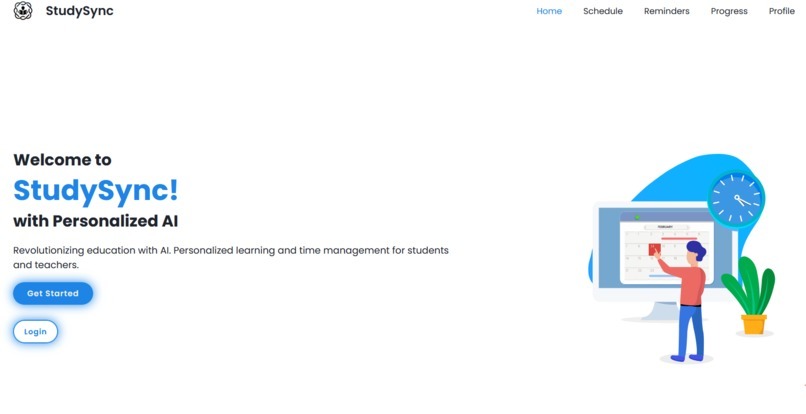
Front page
Inspiration
The idea for our app was sparked by a simple but common problem: the way we all tend to lose a lot of our precious time to our smartphones. My team and I wanted to tackle this issue head-on by creating a web application that utilizes artificial intelligence to help people manage their time more effectively.
The motivation behind our project was rooted in a shared desire to help individuals break free from the addictive grip of their mobile devices. In today's fast-paced world, it's easy to get caught up in endless scrolling and app-hopping, which often leads to reduced productivity and a sense of time slipping away.
Our app is our answer to this challenge. We aimed to develop a practical tool that could assist users in finding a better balance between screen time and the other important aspects of their lives. By using AI, our goal was to design a scheduling tool that could understand each user's unique preferences, goals, and responsibilities, and then craft a personalized daily plan accordingly.
Our primary inspiration was the genuine wish to make a positive impact on people's lives. We wanted to give users a tool that would enable them to be more intentional with their time, while also curbing the negative effects of excessive phone use. Our hope is that our app can be a catalyst for change, helping individuals regain control over their time and lead more fulfilling, balanced lives.
What it does
Our app leverages artificial intelligence to create personalized schedules for users. It helps individuals optimize their daily routines by taking into account their unique preferences, goals, and responsibilities. The ultimate goal is to assist users in managing their time more effectively and reducing excessive smartphone usage, allowing them to lead more balanced and fulfilling lives.
How we built it
Two of our teammates worked on the HTML and CSS, while the third focused on both the back and front end JavaScript.
Challenges we ran into
Programming our app was a journey filled with several technical challenges. One significant obstacle was integrating ChatGPT into our web application. Learning to use the AI model effectively, managing API requests, and ensuring that the generated responses were contextually relevant was a learning curve.
Setting up the backend server, the core of our app, was another complex task. It involved configuring servers, handling data, and managing the interaction between the front end (the part you see) and back end components (the part you don't see; for example, ChatGPT making a response). This was essential for ensuring a smooth user experience.
Adapting our app for various screen sizes and resolutions proved to be a crucial challenge. Initially, we developed our app on a wide screen monitor, which posed difficulties in ensuring that the user interface was responsive and worked seamlessly across different devices.
Optimizing user input was another technical hurdle. We had to figure out the right questions to ask users to obtain the information needed to create personalized schedules. This required fine-tuning the user experience and prompts used to elicit relevant responses from ChatGPT.
Crafting effective prompts was a creative and technical challenge. We had to experiment with different prompts to consistently elicit the desired responses from ChatGPT.
Despite these challenges, our team was determined and committed to overcoming them to develop an app that could genuinely benefit users in reclaiming their time and enhancing their daily productivity.
Accomplishments that we're proud of
We are proud of the fact that we managed to build a project using the ChatGPT API, because we didn't know anything about it before.
What we learned
One significant takeaway was improving communication with a backend developer. All three of us typically work on the front end, so collaborating effectively with a backend developer presented a new experience.
What's next for StudySync
In the development of a 2.0 version of our app, we envision several key enhancements that would further enrich the user experience. Firstly, we would seek to incorporate Spotify integration, allowing users to seamlessly pair their schedules with a personalized soundtrack. For instance, users could enjoy calming music during study sessions or energizing tunes for workout schedules. This feature would add a new dimension to time management and productivity.
A critical focus for our 2.0 version would be on improving response times. We understand that speed is of the essence in user interactions. Consequently, we would invest in optimizing ChatGPT's performance to ensure faster loading and response generation. This enhancement would significantly enhance the app's efficiency, making it more responsive to users' needs.
Furthermore, we aim to enhance the visual appeal of ChatGPT's responses. This could involve more refined formatting and better organization of information to present responses in a clear and aesthetically pleasing manner. The goal is to provide a more engaging and informative user experience that's not only functional but visually appealing.
These improvements collectively aim to empower users to better manage their time and enjoy an even more rewarding experience.

Log in or sign up for Devpost to join the conversation.