-
-
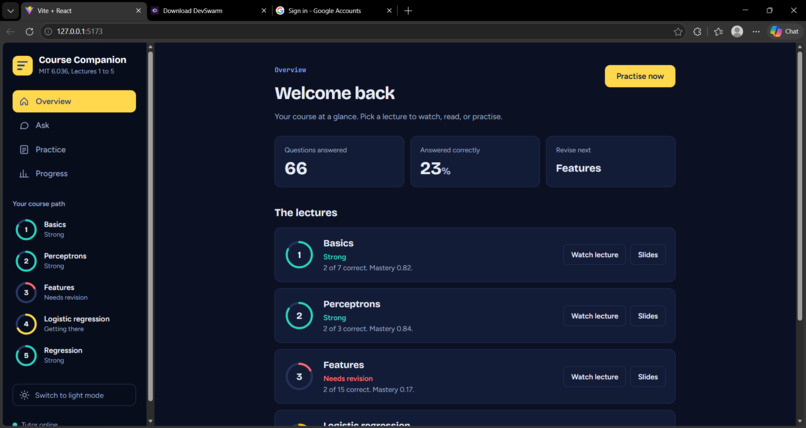
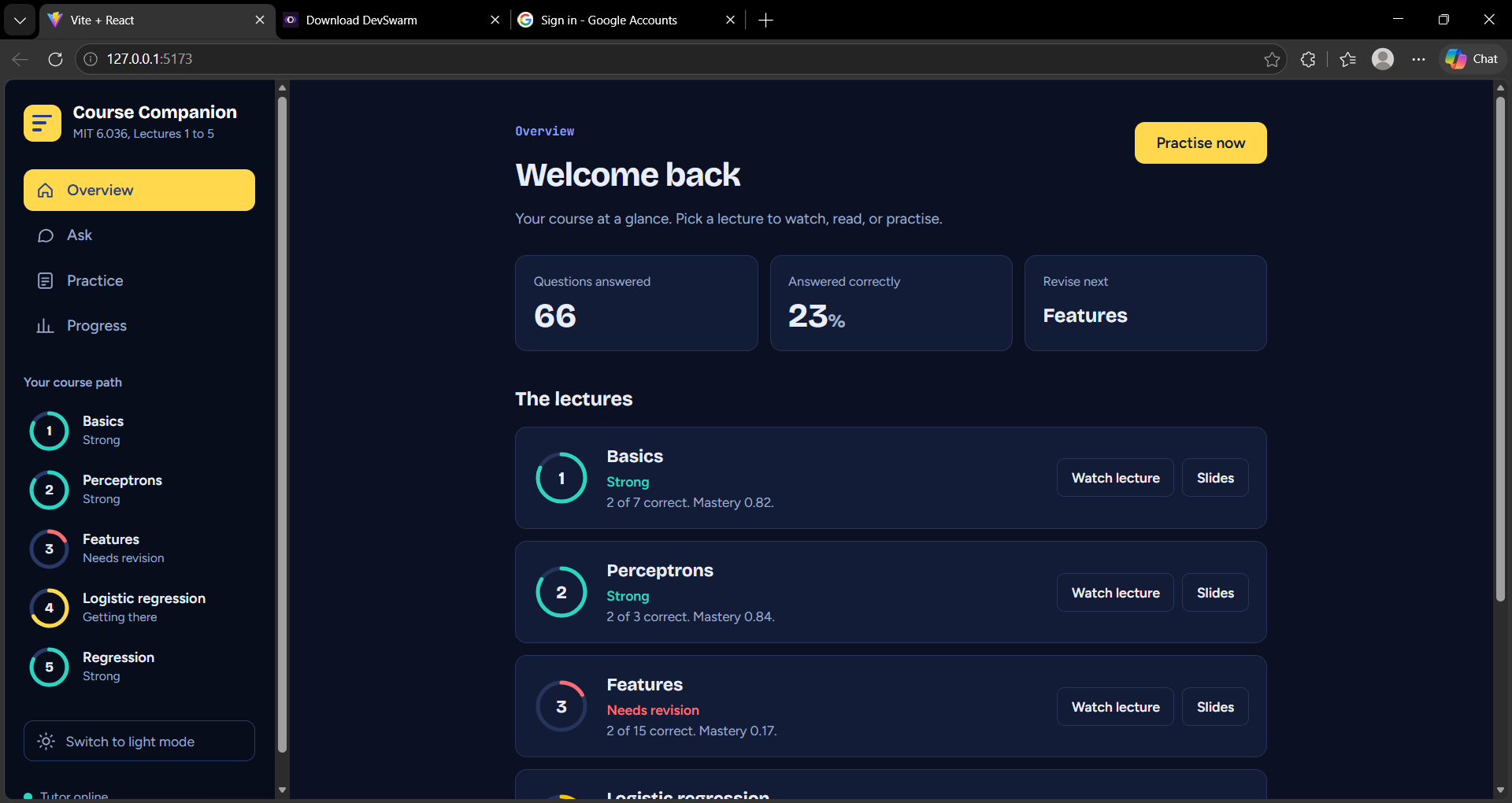
StudySync AI dashboard showing adaptive learner model and per-topic mastery tracking.
Inspiration
Students often study from lecture videos, textbooks, and slides scattered across different platforms. General AI chatbots give answers that aren't tied to the course material. We wanted to build a source-grounded companion that models the learner.
What it does
StudySync AI unifies lecture videos, slides, and textbooks into a multimodal knowledge base. It provides cited answers, declines unsupported queries, generates adaptive MCQ assessments with post-quiz reports, and maintains a per-topic learner model.
How we built it
We built a multimodal ingestion pipeline using Gemini for vision and text extraction. We used a RAG pipeline with vector search for source grounding, and an LLM-judge evaluation framework for faithfulness, relevancy, precision, and recall.
Challenges we ran into
Extracting information from diagrams and figures was challenging. Maintaining accurate source citations across timestamps and slide numbers required careful chunking and metadata tagging. Building the adaptive learner model with limited student data was also difficult.
Accomplishments that we're proud of
We achieved Faithfulness 1.0, Relevancy 1.0, Precision 0.75, and Recall 0.92 on our evaluation metrics. We also implemented a working refusal mechanism that correctly declines off-material queries.
What we learned
We learned how to build source-grounded RAG systems, how to evaluate them rigorously, and how to design adaptive assessment pipelines.
What's next
Textbook ingestion, short answer and numerical question types, RAGAS integration, and repetition rate tracking in simulations.
Built With
- fastapi
- gemini-api
- javascript
- langchain
- python
- rag
- react
- vector
