Inspiration
During midterms and finals, walking into campus libraries like the PCL or GDC feels like an impossible game of musical chairs. Worse than full libraries are "ghost seats"—desks hogged for hours by a single backpack or coffee cup while dozens of students wander around searching for a place to study.
At the same time, many students study difficult subjects alone, wanting a partner or study group but held back by the awkwardness of approaching strangers. We built Synapse to tackle both issues at once: eliminating ghost seats with IoT sensors and breaking social barriers using Meta AI study matching.
What it does
Synapse connects physical desk hardware with a live digital platform to optimize library seating and foster campus collaboration:
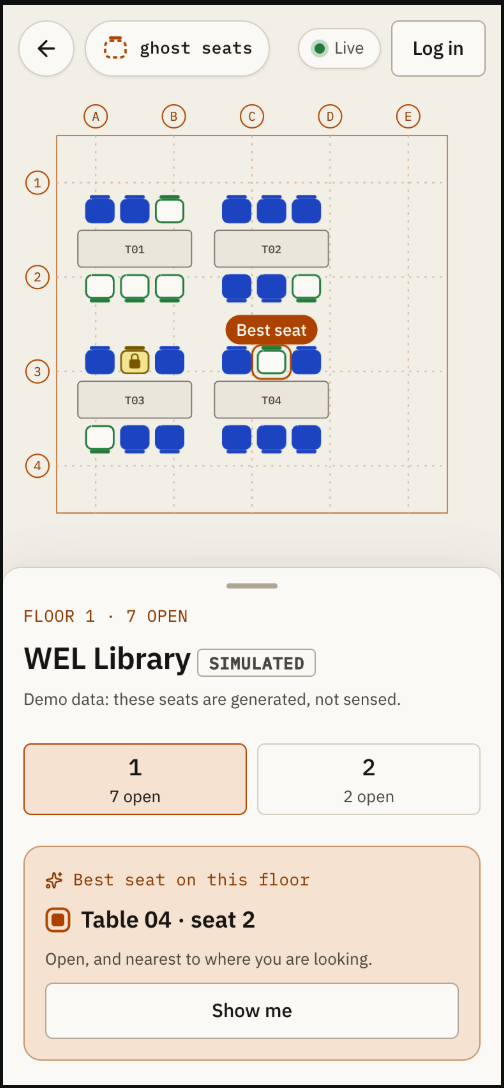
- Hardware Occupancy Sensing: Desk-mounted IR sensors detect actual human presence rather than stationary objects. Multi-color LEDs visually signal status right at the desk (Blue for Vacant, Light Green for Occupied).
- Live Seat Map: Students can browse real-time floorplans across campus buildings (PCL, GDC, Welch) to find open desks before walking over.
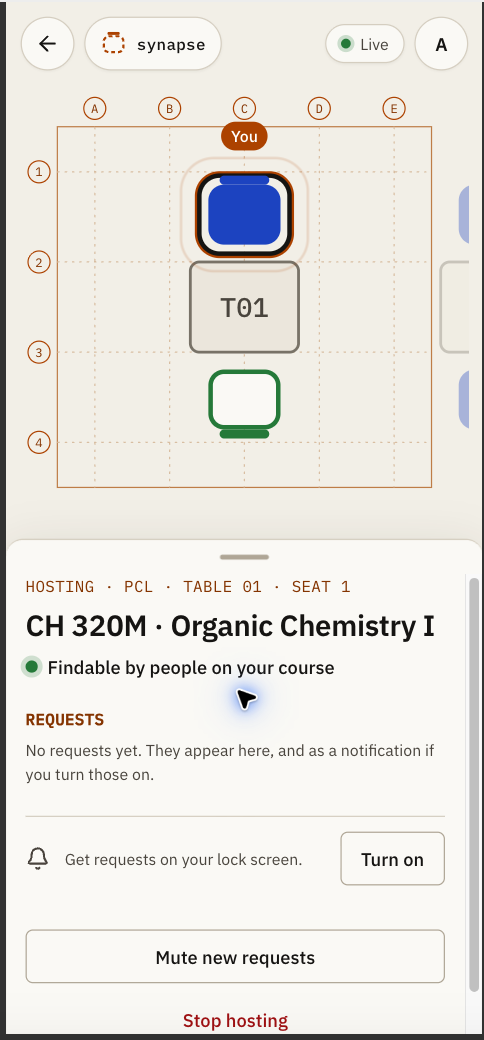
- Host Mode & Meta AI Matching: Students at open tables can toggle "Host Mode" with their current course (e.g., Linear Algebra). Other students can find them and use Meta Llama AI-generated icebreakers tailored to their shared topics to start studying together without the awkwardness.
- LED Beacon Finder: Once a study partner is selected, the physical desk LED pulses blue as a beacon, guiding the arriving student straight to their table.
- Usage Analytics: TimescaleDB tracks occupancy time-series data to provide campus planners with insights on peak study hours and average desk dwell time $T_{\text{avg}}$.
How we built it
- Hardware Layer: An Arduino microcontroller running C++ reads digital IR optical sensors and controls dual-color status LEDs.
- Serial Bridge Daemon: A Python bridge script (
arduino_bridge.py) reads USB serial telemetry at 115200 baud, authenticates via secure node tokens, and streams updates to the backend in real time. - Backend & Database: Built with FastAPI (Python) for REST endpoints, integrated with TimescaleDB on Tiger Data for hyper-table occupancy time-series tracking.
- AI Integration: Integrated Meta Llama to generate contextual, course-specific conversation starters and study plans based on matching student profiles.
- Frontend & PWA: Built with React and Vite, featuring an interactive SVG/CSS floorplan map, responsive glassmorphic UI, and 1.5-second live polling.
Challenges we ran into
- Hardware Jitter & Debouncing: Physical IR sensors often fluctuate when students shift in their seats or when ambient lighting changes. We implemented an algorithmic debounce window of $\Delta t_{\text{debounce}} \ge 1.0\text{ s}$ on the backend to eliminate ghost flickering on the live map and physical LEDs.
- Serial Port Synchronization: Handling high-speed serial streams on macOS without port locking or buffer delays required building an auto-reconnecting Python daemon with automatic buffer flush cycles.
- Social Usability vs. Privacy: Balancing open collaboration with student comfort. We solved this by making Host Mode strictly opt-in, ensuring students only share study subjects when they actively want company.
Accomplishments that we're proud of
- Community Impact: Built a practical tool that simultaneously solves physical space waste and combats campus loneliness through intelligent AI matching.
- End-to-End Hardware-Software Flow: Sitting down at a physical desk instantly turns the hardware LED green and updates the interactive web map with zero noticeable lag.
- Robust Architecture: Delivered a production-grade backend with over 150 automated tests and a standalone in-memory mode for rapid local evaluation.
- Community Impact: Built a practical tool that simultaneously solves physical space waste and combats campus loneliness through intelligent AI matching.
What we learned
- Designing embedded-to-cloud architectures that reliably push micro-telemetry from physical microcontrollers into modern web apps.
- Engineering effective prompts for micro-social interactions—directing Meta AI to generate approachable, friendly, and non-cringe student icebreakers.
- Managing hyper-table time-series schemas to efficiently query spatial density and desk turnover rates at scale.
What's next for StudySync
- Wireless IoT Upgrades: Transitioning from USB Arduinos to ultra-low-power ESP32 Wi-Fi / LoRaWAN modules powered by rechargeable LiPo batteries for frictionless campus-wide deployment.
- Smart Sensor Fusion: Pairing optical sensors with subtle pressure/weight sensors to differentiate human presence from objects with $99.9\%$ accuracy.
- Instant Match Notifications: Push notifications alerting students when an open seat or compatible study partner becomes available in their preferred library.
- Campus Facilities Dashboard: Predictive analytics enabling university administrators to dynamically optimize building hours, study lounge configurations, and HVAC efficiency.


Log in or sign up for Devpost to join the conversation.