
Inspiration
As a Purdue student, I’m sure you and many other students have come across the struggle of having to find a study spot. We’ve all been there: you walk into the library, circle the floors three times, peek into classrooms, and by the time you finally sit down, you’ve wasted ten minutes you could’ve been studying. To solve this problem, we decided to design an app that identifies open study areas.
What it does
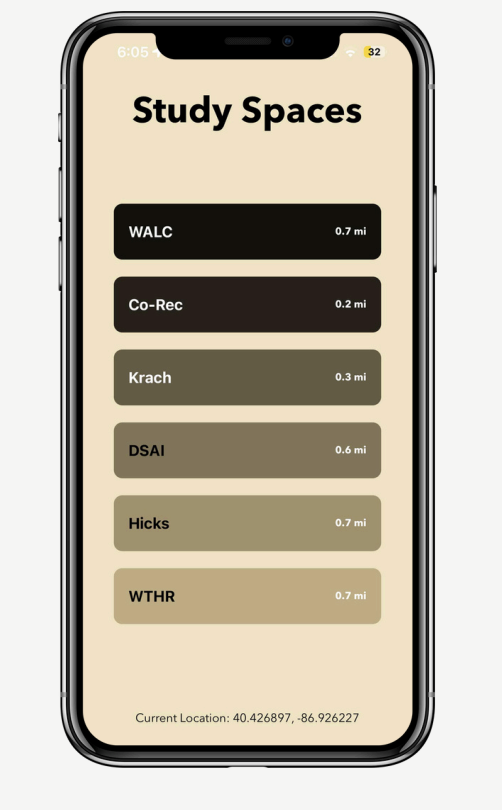
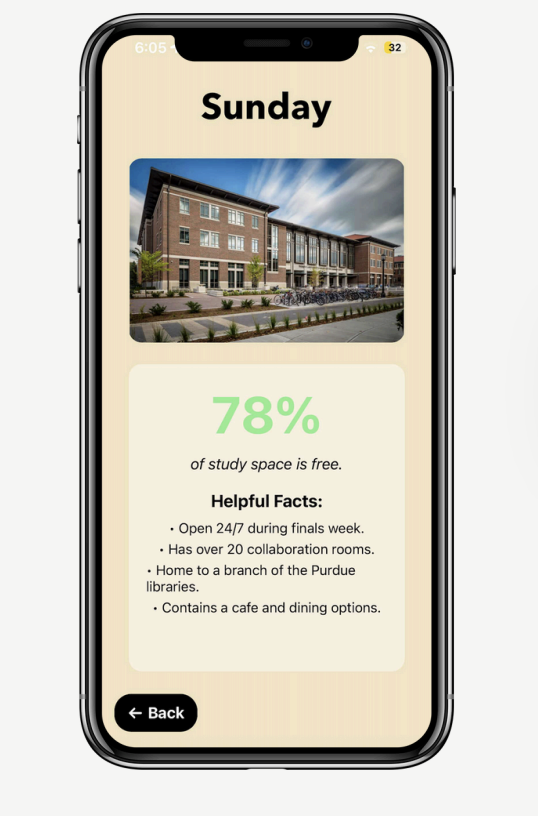
StudyScout is a real-time tracker designed to eliminate the frustration of searching for open spots. We use location data and occupancy tracking to update the app, showing students which libraries, classrooms, and study areas have available seats. When a student’s location falls within a specific boundary for a study area, they’re counted as “present”, which allows other users to see how many users are in that space. We then apply a scaling algorithm to predict the percentage of available capacity in each study area.
How we built it
We built StudyScout using React for the front-end. We used Firebase for our backend. We also used GitHub to collaborate efficiently as a team, and mostly Java for our code.
Challenges we ran into
- Developing code to determine whether a user is inside or outside a building
- Connecting the React frontend with Firebase and making sure the app updates occupancy in real-time
- Debugging the errors that our code had
Accomplishments that we're proud of
- Successfully creating a system that uses location data to detect when classrooms and study spaces are occupied
- Designed a scaling algorithm that takes into account the percentage of Purdue students using the app, so we can predict the occupancy at certain study spots
- Developing code that can determine whether a student is inside/outside using latitude/longitude boundaries
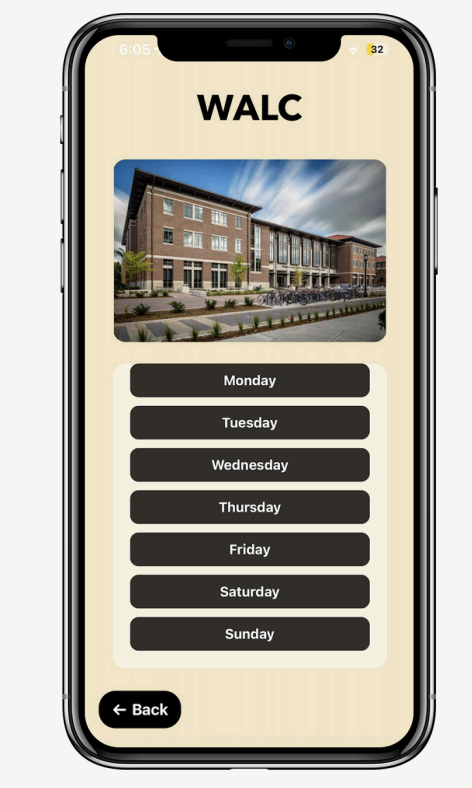
Building a user-friendly interface for the first time using React, where students can see certain statistics about study spots and study space occupancy
Successfully creating a system that uses location data to detect when classrooms and study spaces are occupied
Designed a scaling algorithm that takes into account the percentage of Purdue students using the app, - - so we can predict the occupancy at certain study spots
Developing code that can determine whether a student is inside/outside using latitude/longitude boundaries
Building a user-friendly interface for the first time using React, where students can see certain statistics about study spots and study space occupancy
What we learned
We discovered that detecting whether a student is inside or outside a building isn’t as simple as checking GPS coordinates. The boundaries have to be very specific. Through this project, we gained experience in full-stack development, geolocation logic, and coding collaboratively.
What's next for StudyScout
- Expanding coverage of Purdue buildings so the app can be a campus-wide tool
- Push alerts when a student’s favorite study spot has space available, or when a building is near capacity
- Allow users to self-report if a room is busy or empty to improve predictions along the GPA scaling
- Using heatmaps to show occupancy on a campus map with color coding for efficient decision-making for the user
- Make predictions room-specific, since different rooms or floors can have different occupancy levels

Log in or sign up for Devpost to join the conversation.