-
-
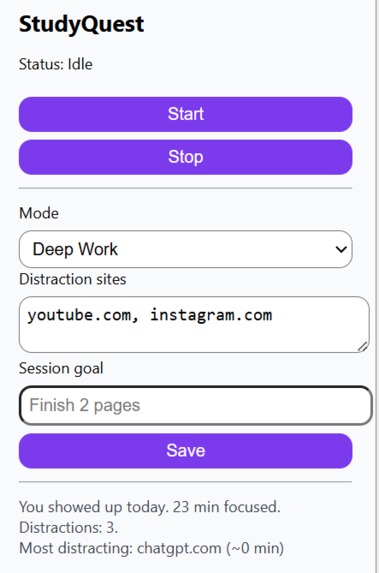
Output
Inspiration
The idea for StudyQuest came from a simple observation: most students don’t struggle because they don’t want to study — they struggle because distraction is everywhere.
While studying, it’s common to open a browser for one small task and end up drifting into social media, videos, or unrelated content. Existing solutions I tried either blocked websites aggressively or tracked time in dashboards. Instead of helping, they often created guilt, frustration, or were simply ignored.
I wanted to build something that respected how humans actually behave, rather than punishing them for it.
What I Built
StudyQuest is a privacy-first adaptive study companion that runs quietly in the background during focus sessions.
Instead of blocking distractions, it intervenes at the exact moment distraction happens, directly inside the distracting application. When a student opens a distracting site, StudyQuest gently appears and asks what they want to do next — return to study, snooze the reminder, or continue intentionally.
This keeps the student in control, while still increasing awareness at the right moment.
The agent adapts over time by observing repeated behavior. If certain distractions happen frequently, StudyQuest adjusts its intervention timing accordingly. This learning is simple, explainable, and entirely on-device — no personal data is collected or sent anywhere.
How I Built It
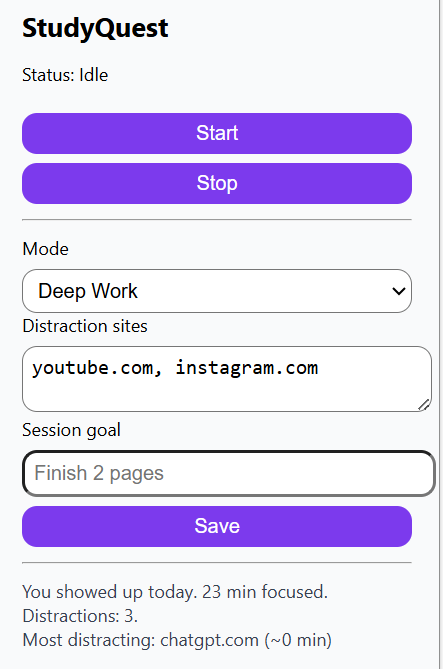
The project is implemented as a Chrome extension that acts as the real-world runtime for the agent:
A background service worker monitors active tabs during focus sessions
User-defined distraction sites trigger in-context interventions
A content script displays interactive overlays inside distracting pages
All state and learning logic runs locally using browser storage
The Airia platform is used to register and publish the agent as part of the hackathon, while the actual behavior is demonstrated through a live demo video. This separation allowed me to focus on building a realistic, working system rather than a simulated workflow.
What I Learned
This project taught me that AI agents don’t need to be chatbots.
An agent can be:
autonomous without being intrusive
adaptive without being opaque
intelligent without overclaiming machine learning
I also learned the importance of designing for human psychology, not just technical correctness. Small, well-timed interventions are often more effective than strict enforcement.
Challenges Faced
One of the main challenges was balancing usefulness with respect for user autonomy. It was tempting to make the agent more aggressive, but doing so would have recreated the same problems as existing tools.
Another challenge was working within platform constraints — understanding what needed to live inside the Airia ecosystem versus what should exist as a real-world implementation. This required careful alignment between the demo, the agent concept, and the submission requirements.
Conclusion
StudyQuest is not about forcing productivity. It is about supporting focus in a realistic, ethical, and human-centered way.
By intervening at the moment of distraction and keeping the student in control, StudyQuest demonstrates how AI agents can quietly assist rather than dominate — helping users follow through on intentions they already have.
Built With
- chrome
- css3
- extensions
- html
- javascript


Log in or sign up for Devpost to join the conversation.