-
-
Home
-
Source
-
Verification
-
Evidence
-
Architecture
StudyProof
Don’t just get an AI answer. Prove it.
Inspiration
AI has become a powerful study tool, but there is a problem that is easy to overlook: a confident answer is not necessarily a correct answer.
Students can ask an AI system a question, receive a polished response, and still have no simple way to tell which individual claims are supported by their own study material and which are questionable or incorrect.
That inspired StudyProof.
Instead of treating an AI answer as one block of text, StudyProof breaks it into individual claims and checks those claims against the student's source material. The goal is simple: help students understand why an answer should be trusted, reviewed, or rejected.
What StudyProof Does
StudyProof is an AI-assisted study answer verification tool.
A student can:
- Choose a study document.
- Enter a question and answer.
- Run verification.
- See the answer broken into individual claims.
- See each claim marked Supported, Review, or Unsupported.
- Open a claim to inspect the supporting or contradicting evidence.
- View the relevant passage from the original source.
For example, a photosynthesis answer might contain a claim that glucose is produced in the process, another claim about where the process occurs, and another claim about oxygen.
Instead of simply saying "correct" or "incorrect," StudyProof shows the student which claims are supported and what evidence led to that result.
How It Works
The application has four main screens:
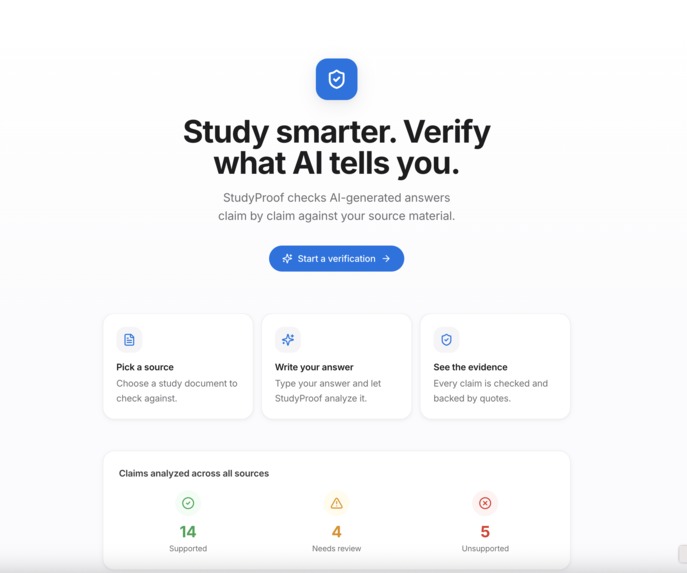
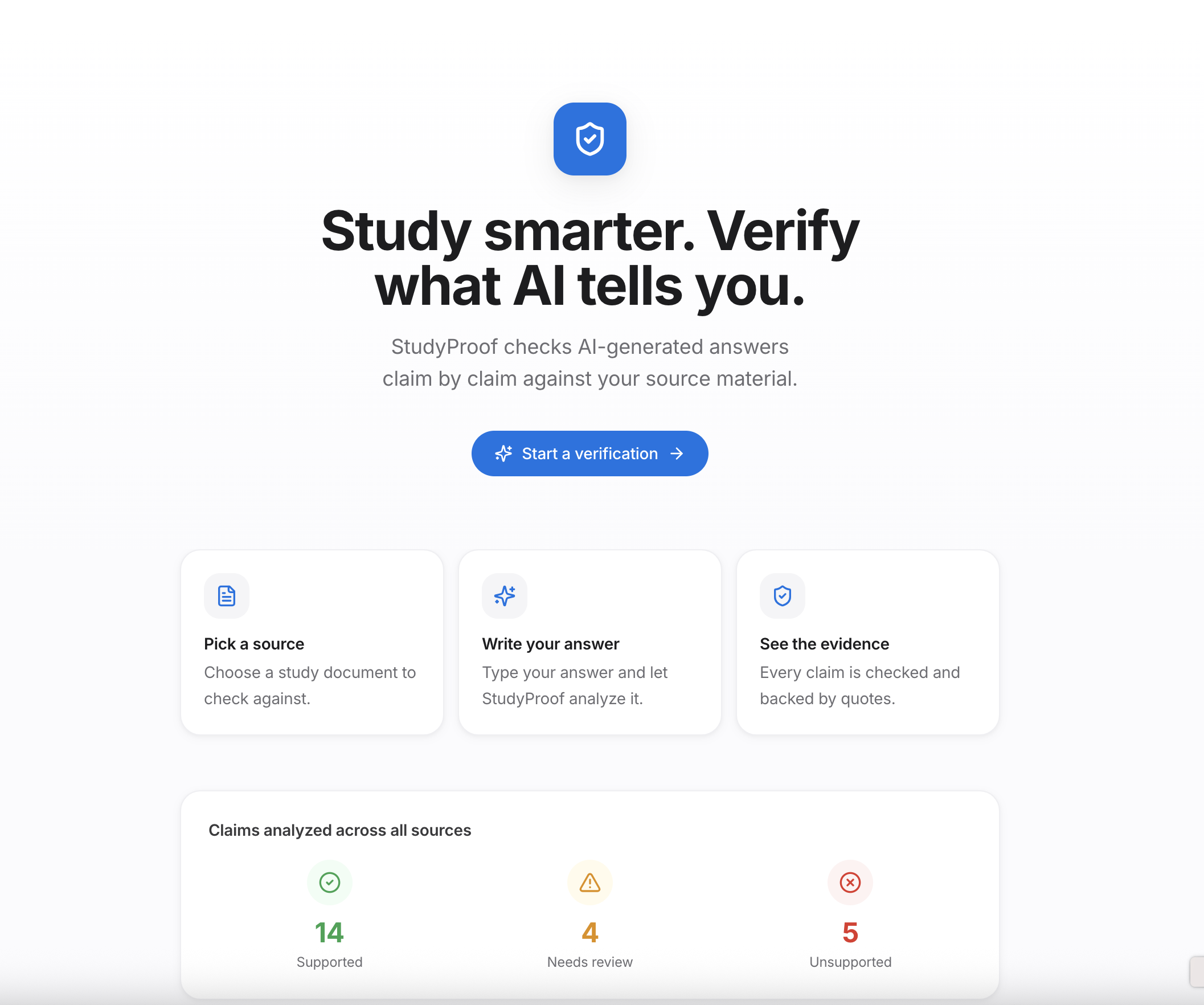
Home
The student starts a verification or chooses a built-in demo.
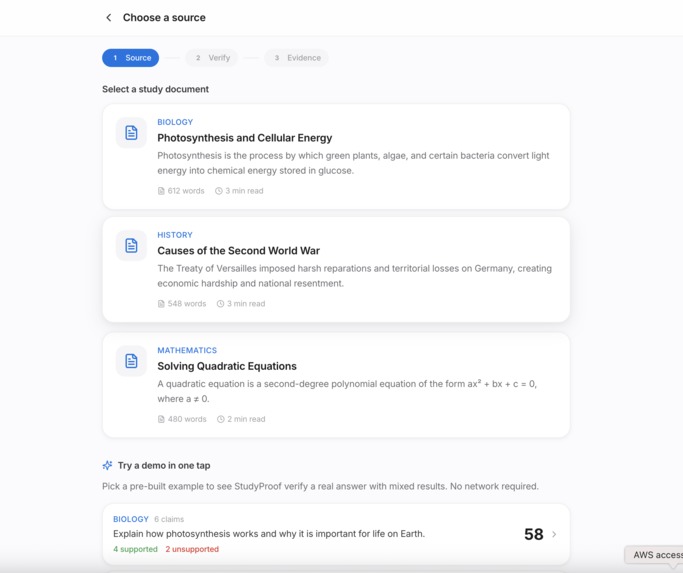
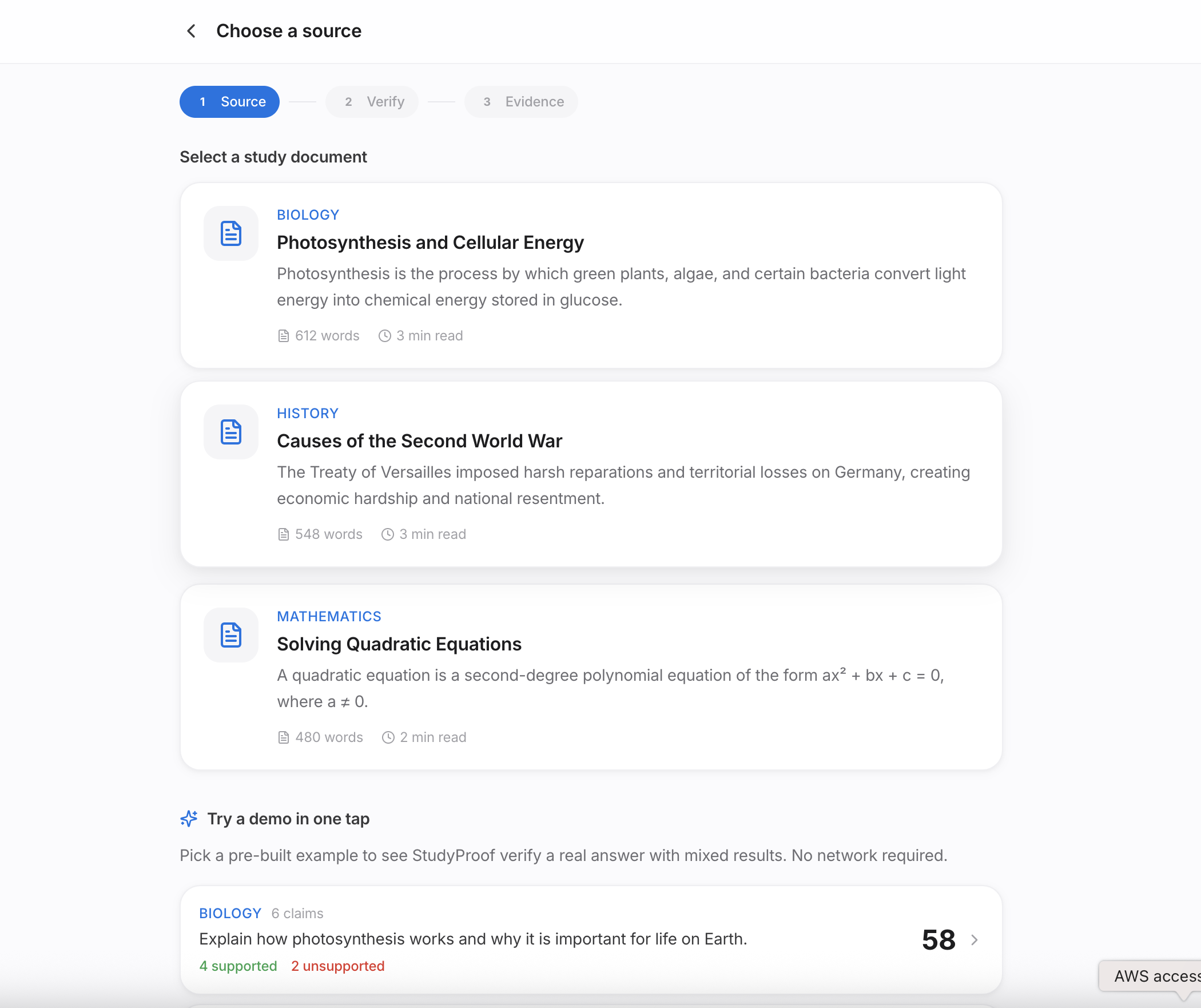
Source
The student selects study material and enters a question and answer.
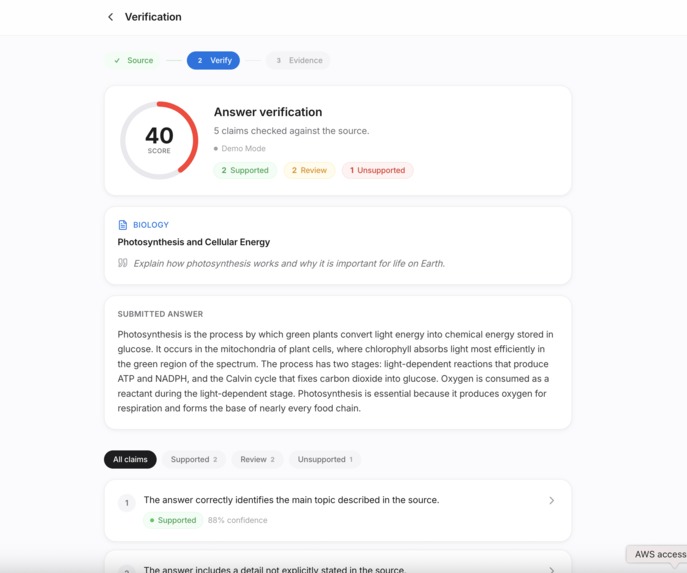
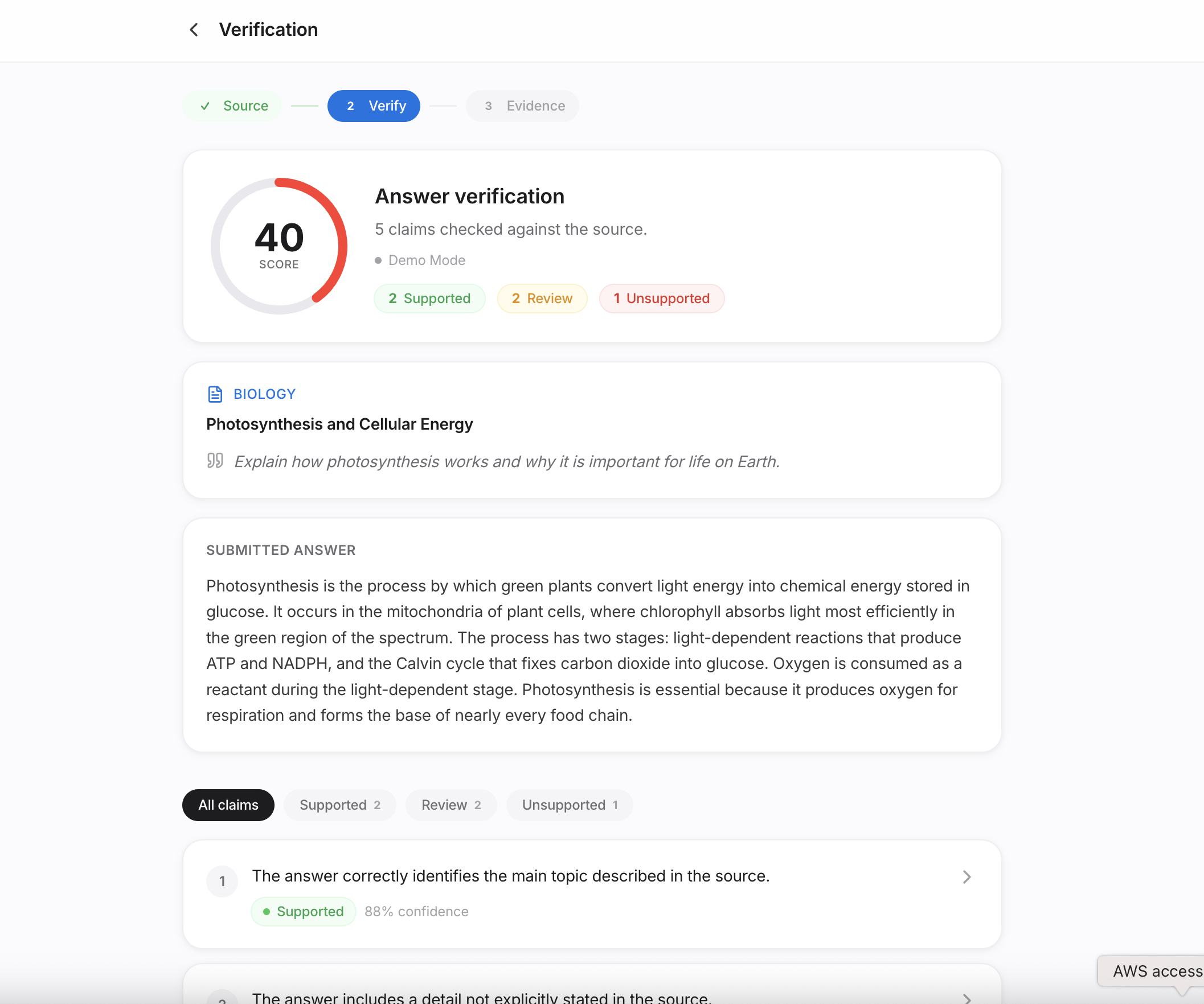
Verification
StudyProof presents the overall verification result and a claim-by-claim breakdown with confidence values and status filters.
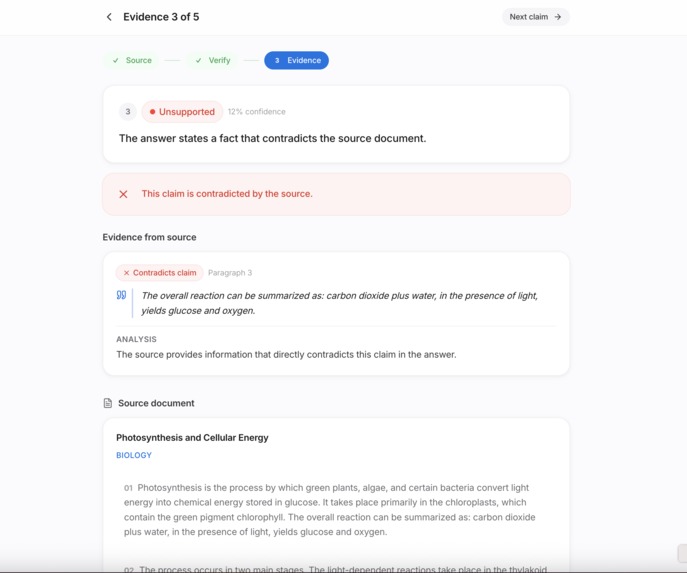
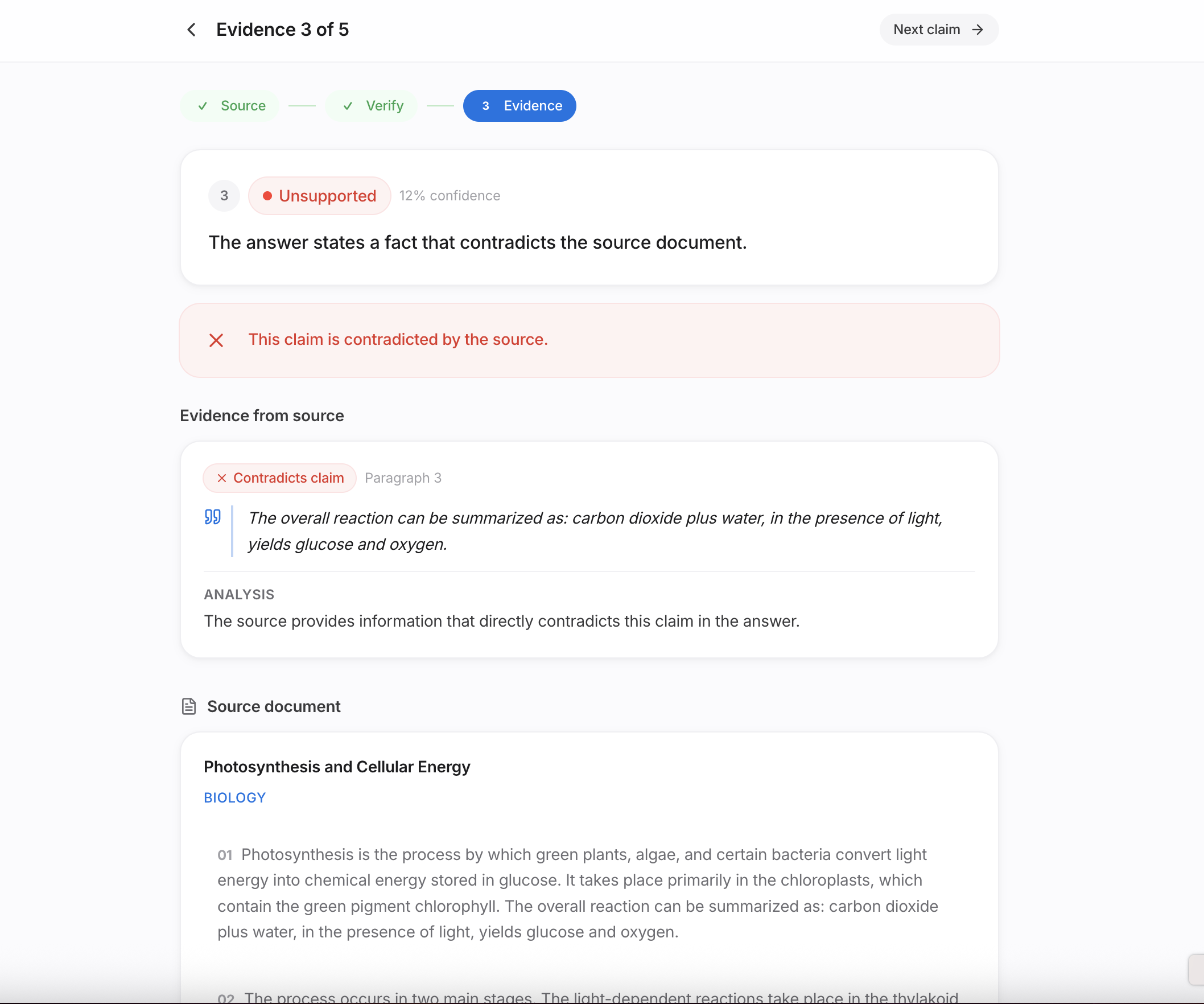
Evidence
Selecting a claim opens the underlying evidence, including source quotations, analysis, and the relevant part of the original document.
Technical Architecture
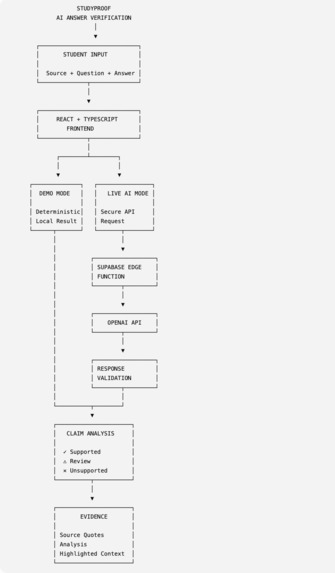
Architecture Explanation
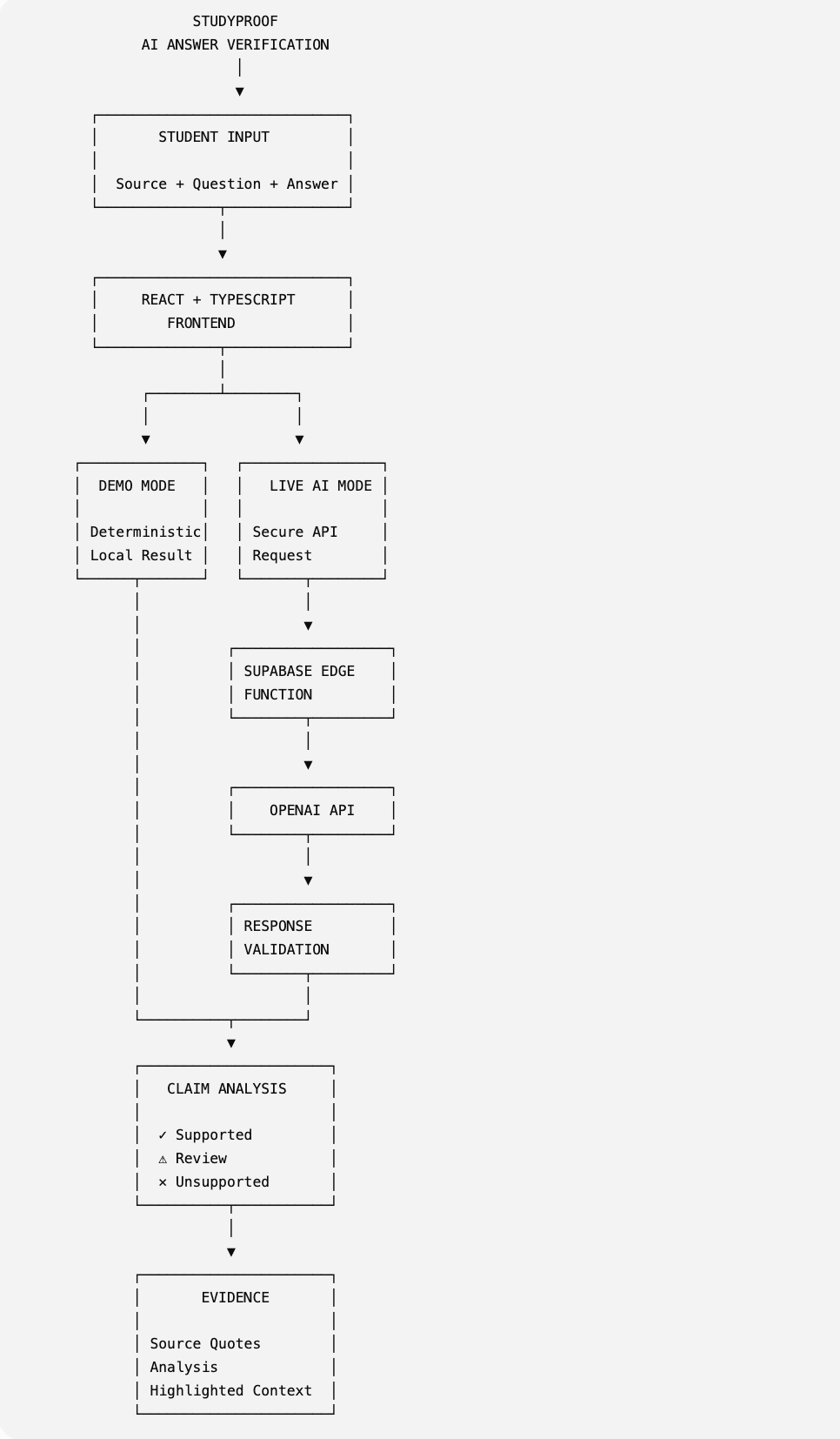
StudyProof uses a simple, secure architecture designed around evidence-first answer verification.
Student Input The student selects study material and provides a question and answer.
React + TypeScript Frontend The frontend handles the verification workflow, displays claim-level results, and provides the evidence interface.
Secure Supabase Edge Function For live verification, the frontend sends the request to a Supabase Edge Function. The OpenAI API key is kept server-side and is never exposed to the client.
OpenAI Verification The Edge Function sends the source material, question, and answer to OpenAI and requests a structured verification response.
Response Validation The server validates the returned structure and allowed verification states before the result reaches the interface. The frontend also performs runtime validation and constrains confidence and score values to valid ranges.
Claim-Level Results The answer is presented as individual claims with three possible states: Supported, Review, or Unsupported.
Evidence View Students can select a claim and inspect the corresponding source evidence, explanation, and highlighted source material.
StudyProof also includes a deterministic local demo path. This allows the full product experience to work without a network request or API dependency during demonstrations.
StudyProof was built with React and TypeScript and uses a secure server-side verification path for live AI analysis.
The main flow is:
Student Question + Answer + Source
              ↓
        Verification API
              ↓
     Supabase Edge Function
              ↓
          OpenAI API
              ↓
      Structured AI Response
              ↓
       Response Validation
              ↓
      Claim-Level Results
              ↓
        Evidence UI
The client uses a typed API layer that validates the returned structure before displaying it. Invalid statuses and malformed responses are rejected, while confidence and score values are constrained to the expected range.
The OpenAI API key is kept server-side inside the Edge Function rather than exposed to the browser.
Reliability and Demo Mode
One of the biggest lessons from building StudyProof was that an AI product should not depend on an AI request succeeding every time.
For that reason, StudyProof has two distinct paths.
Live AI verification uses the secure Edge Function and OpenAI.
Demo Mode uses deterministic, pre-built verification data locally. It requires no network request or OpenAI API call, which makes the core demonstration reproducible even when a service is unavailable.
This also lets us demonstrate the product's claim-level verification experience without pretending that a pre-built result is a live AI response.
Challenges
The hardest challenge was balancing AI flexibility with predictable application behaviour.
AI responses are not naturally guaranteed to follow the exact structure a frontend expects. A malformed response, unexpected status, or API failure should not be able to crash the experience.
We addressed that by adding validation on both sides of the API boundary and by creating a deterministic fallback path for the built-in demos.
Another challenge was making the interface communicate a fairly technical idea without overwhelming students. Instead of presenting raw model output, we designed the experience around a simple sequence:
Answer → Claims → Evidence → Verification
That structure became the core UX principle of the project.
What I Learned
Building StudyProof taught me that an AI application is not just about choosing a model.
The surrounding system matters just as much:
- validating model output before rendering it
- separating live AI behaviour from deterministic demo behaviour
- keeping secrets server-side
- designing useful failure states
- making evidence understandable to the user
- building a UI that explains the AI's result instead of simply displaying it
I also learned that reliability is part of the product design. A good AI demo should have a predictable path that still works when an external dependency does not.
Business Model
Business / Finance
StudyProof is designed as an education product with a simple student-first business model.
The core experience can be offered as a free entry point so students can verify a limited number of answers and understand the value of evidence-based AI study.
A future paid student tier could provide higher verification limits, saved verification history, larger document processing, and additional study workflows.
For schools and educational organisations, StudyProof could be offered through institutional licensing, giving educators and students access to verification tools across courses and study materials.
The main cost drivers are AI inference, document processing, and infrastructure. These costs can be managed through usage limits, efficient document processing, caching, and asynchronous verification workflows as the platform grows.
The initial goal is to prove the workflow and user value first, then scale the product around usage and institutional demand.
StudyProof could use a simple freemium model.
Free: limited monthly verifications and documents for students.
Student Plus: additional documents, verification volume, and saved verification history.
Schools: annual licensing for classroom use, teacher-created source packs, and usage insights.
The underlying value proposition is not simply "another AI tutor." It is helping students use AI while giving them a clearer way to examine the claims behind an answer.
Scalability
The current prototype is intentionally small, but its architecture is designed around independent verification jobs rather than a single hardcoded workflow.
A larger version could scale by:
- processing documents asynchronously
- indexing reusable source material
- caching document representations
- separating document processing from question verification
- storing verification history independently from the UI
- adding rate limits and usage tiers
Because claims are represented as structured data, the same verification workflow can support different subjects and many different source documents without changing the fundamental UX.
Why StudyProof?
Most study AI experiences focus on generating an answer.
StudyProof focuses on examining the answer.
The central idea is:
Don't ask students to trust AI blindly. Give them a way to check it.
StudyProof turns an AI answer into something a student can inspect claim by claim, evidence by evidence.
Built With
- ai
- api
- app
- css
- design
- edge
- edtech
- education
- functions
- generative
- javascript
- openai
- react
- responsive
- rest
- supabase
- tailwind
- typescript
- vite
- web


Log in or sign up for Devpost to join the conversation.