Inspiration## Inspiration
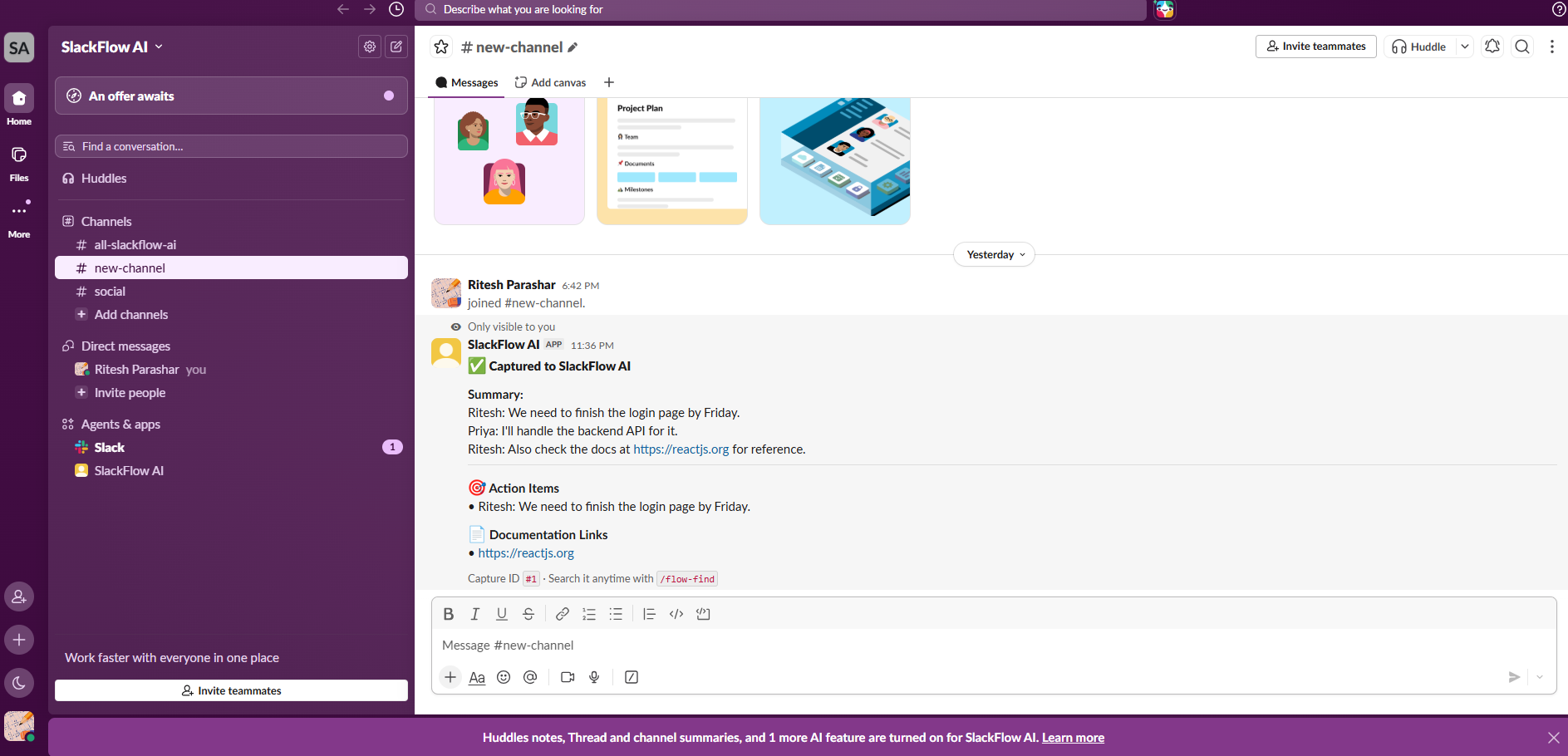
Every team's most valuable knowledge — decisions, action items, code snippets, deadlines — gets buried in endless Slack threads within days. We wanted a way to turn everyday conversations into a structured, searchable project workspace without anyone having to manually take notes.
What it does
SlackFlow AI is an AI-powered Slack assistant that:
- Uses
/captureto extract action items, decisions, documentation links, code snippets, and deadlines from any Slack thread (via permalink) or pasted conversation text, using an LLM. - Uses
/flow-findto search everything ever captured, with results shown in rich Block Kit modals. - Provides a live dashboard (
/flow-dashboardand the App Home tab) showing open action items, decisions logged, and upcoming deadlines. - Runs automated daily standups — posting a reminder, collecting Yesterday/Today/Blockers via a modal form, and posting an AI-generated digest that explicitly calls out blockers.
- Tracks action item status with interactive buttons (mark as done).
How we built it
- Backend: Python + Flask, using the Slack Bolt SDK for all Slack event/command/interactivity handling.
- Database: SQLite, with a schema covering workspaces, users, captures, action items, decisions, doc links, code snippets, deadlines, and standups.
- AI: OpenAI-compatible chat completions API for structured knowledge extraction and standup summarization, with a regex-based fallback extractor so the bot degrades gracefully instead of failing if the AI call errors out.
- UI: Slack Block Kit for all modals, dashboards, and interactive messages.
- Scheduling: APScheduler for daily standup reminders and digests.
Challenges we ran into
- Getting Slack permalink parsing right (decoding the timestamp format) to fetch full thread context via
conversations.replies. - Designing prompts that reliably return strict, parseable JSON from the LLM for extraction.
- Handling Slack's view/modal update flow correctly (ack vs. response_action) for a smooth search & capture experience.
Accomplishments that we're proud of
A fully working end-to-end pipeline — from a raw Slack thread to structured, searchable knowledge — with proper error handling, logging, and a fallback path so the bot never silently fails.
What we learned
Deep familiarity with the Slack Bolt SDK's event/command/view lifecycle, Block Kit UI design constraints, and prompt engineering for reliable structured extraction.
What's next for SlackFlow AI
- Postgres support for multi-workspace scale
- Slash command for editing/reassigning action items directly
- Smarter deadline reminders integrated with Slack's reminder API

Log in or sign up for Devpost to join the conversation.