-
-
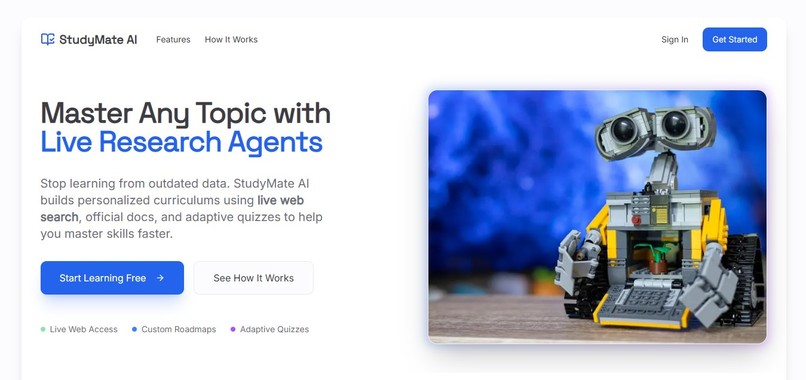
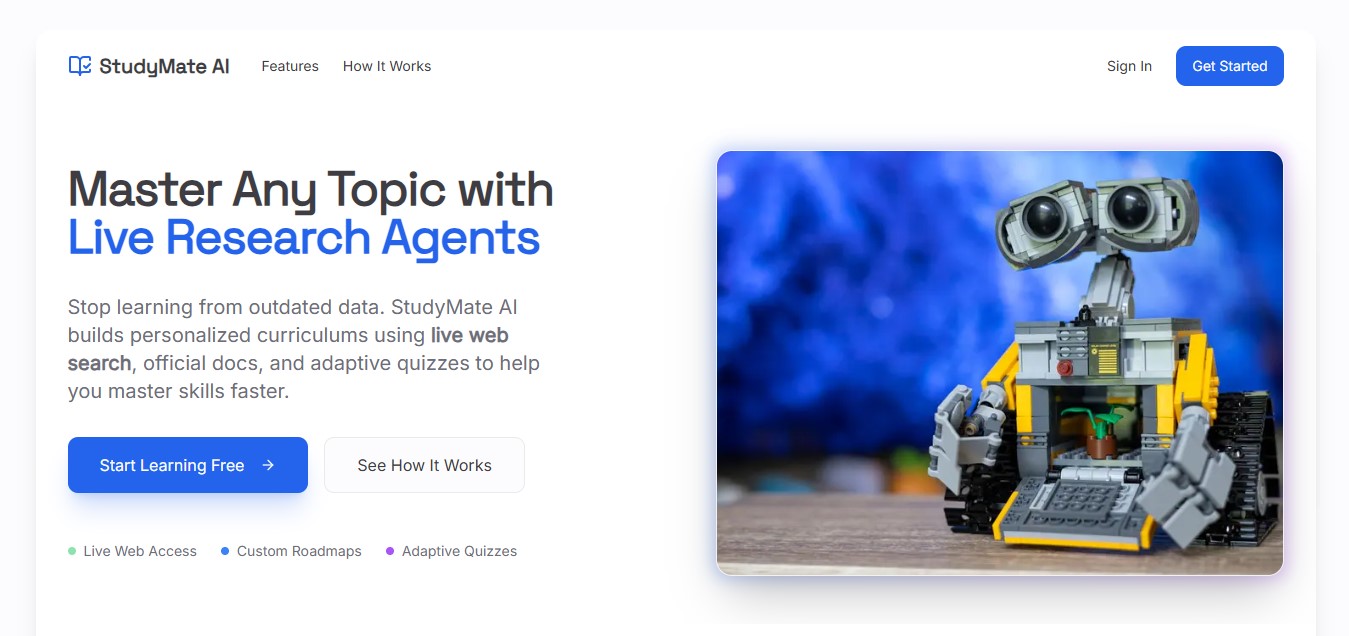
Landing Page
-
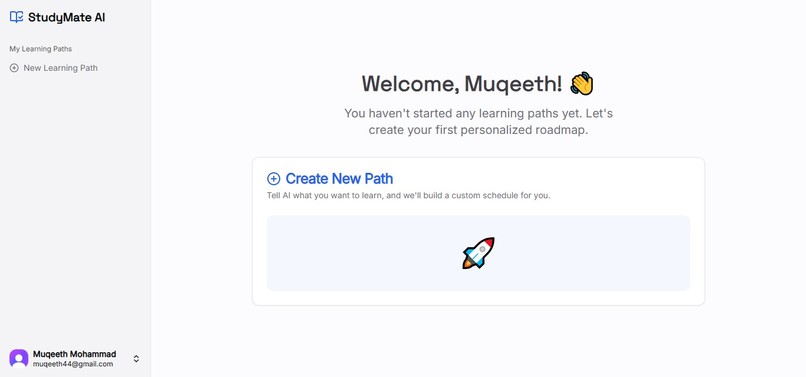
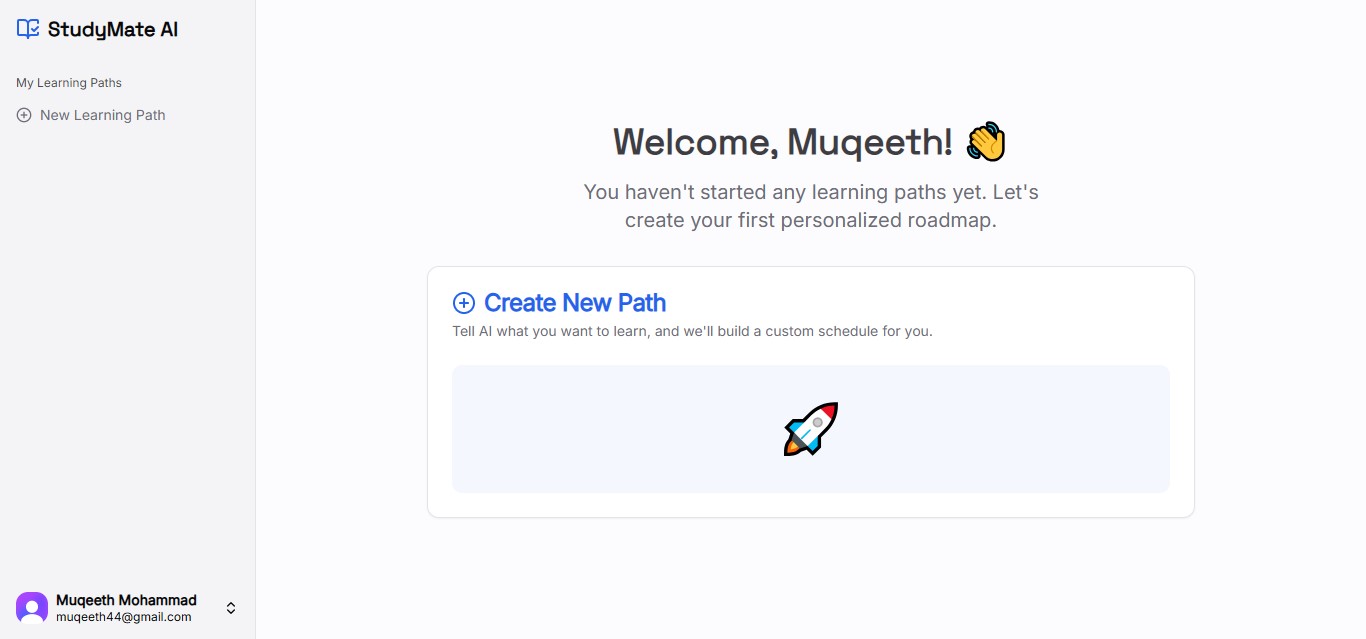
Learning Path Dashboard
-
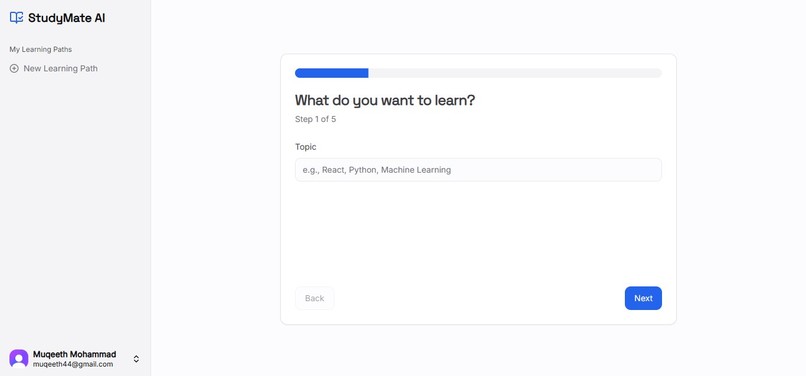
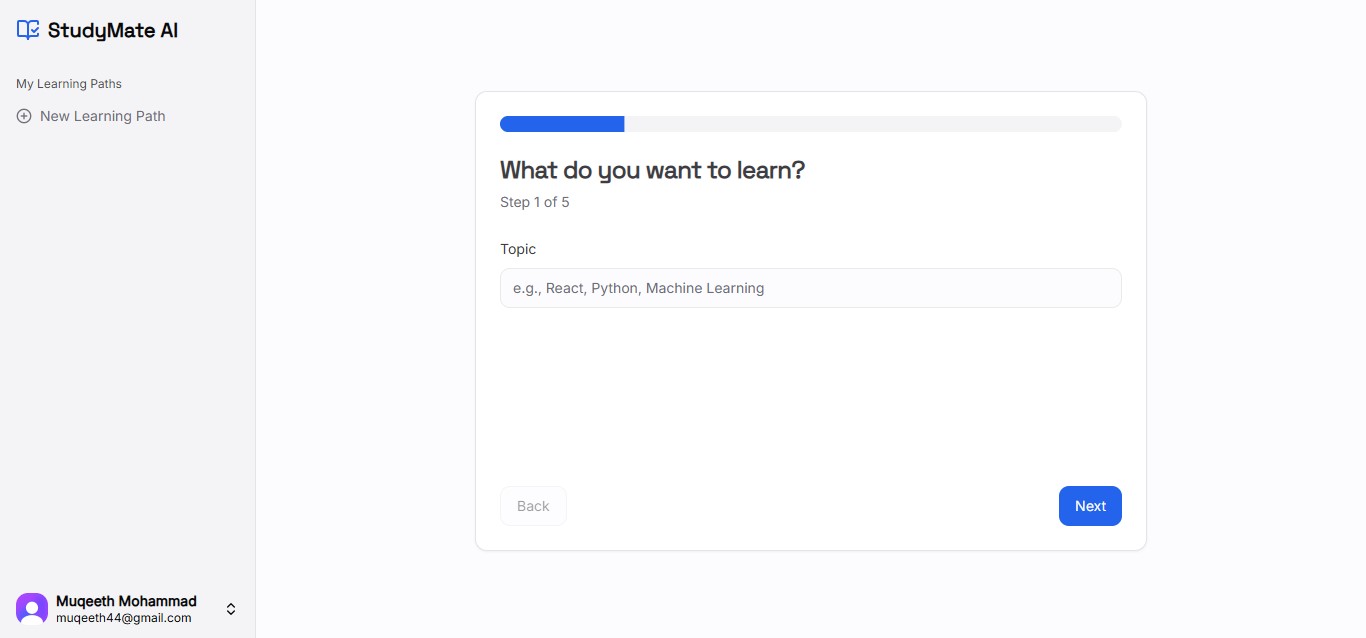
Learning Path Form
-
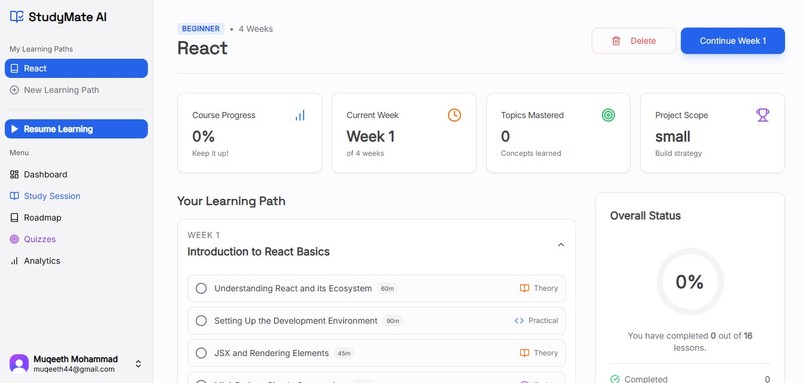
Course Dasboard
-
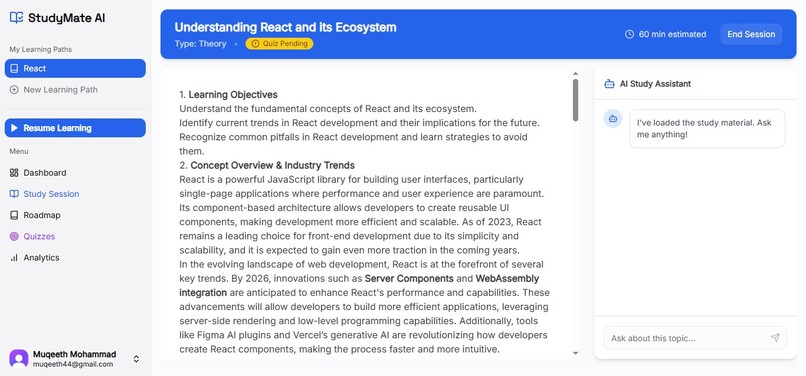
Study Session with StudyBuddy AI Chat
-
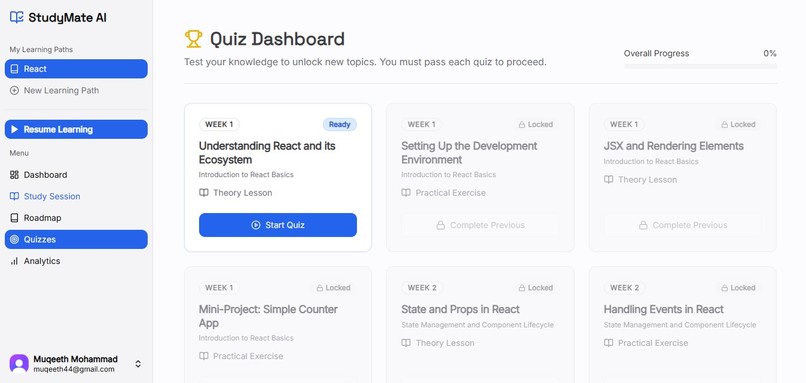
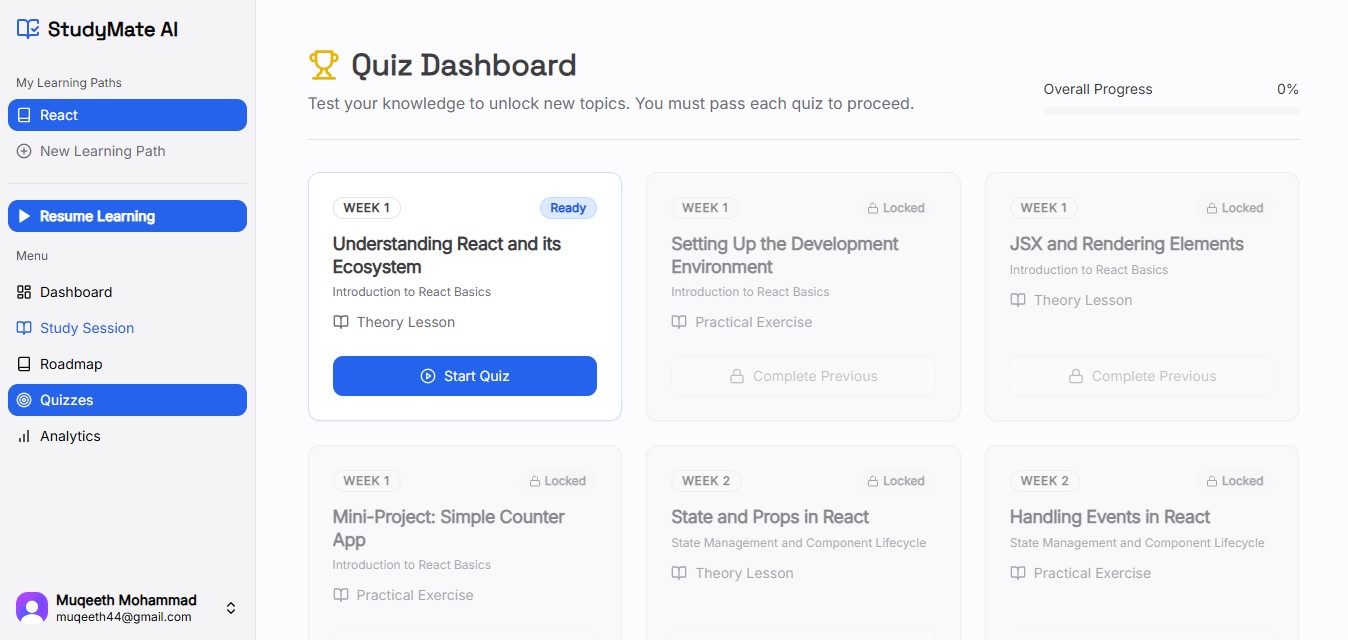
Quizzes Dashboard
-
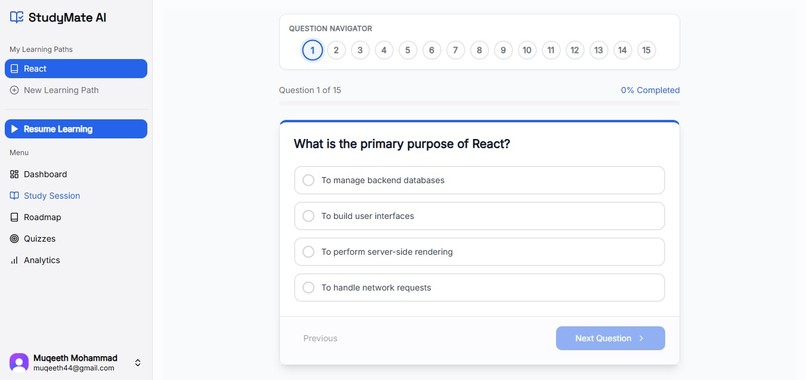
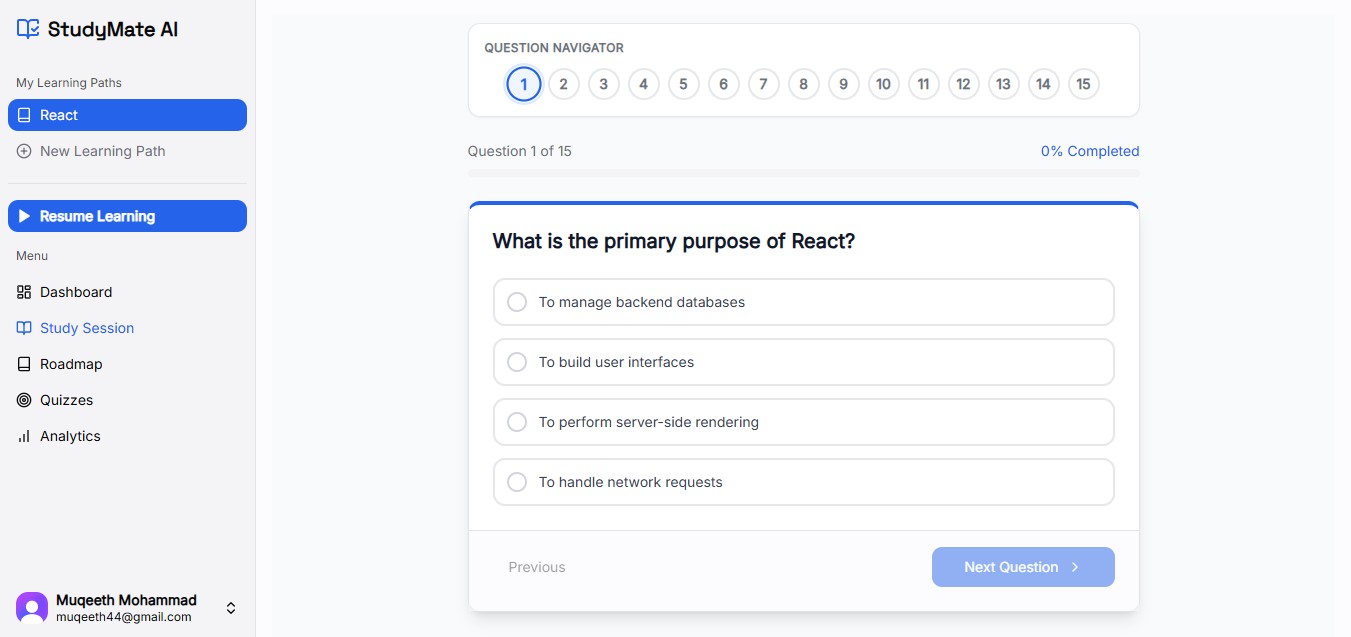
Quiz
-
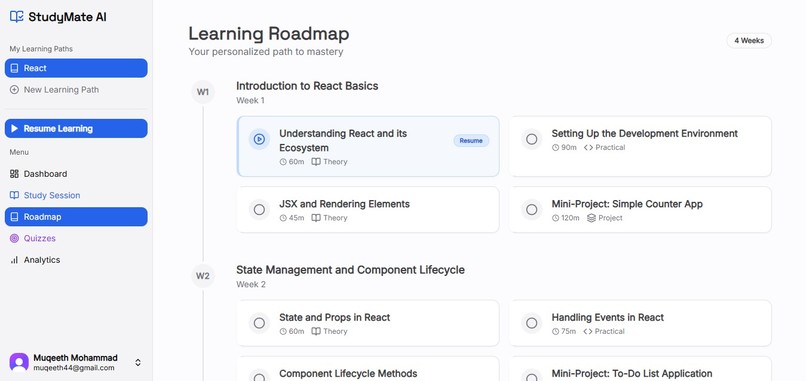
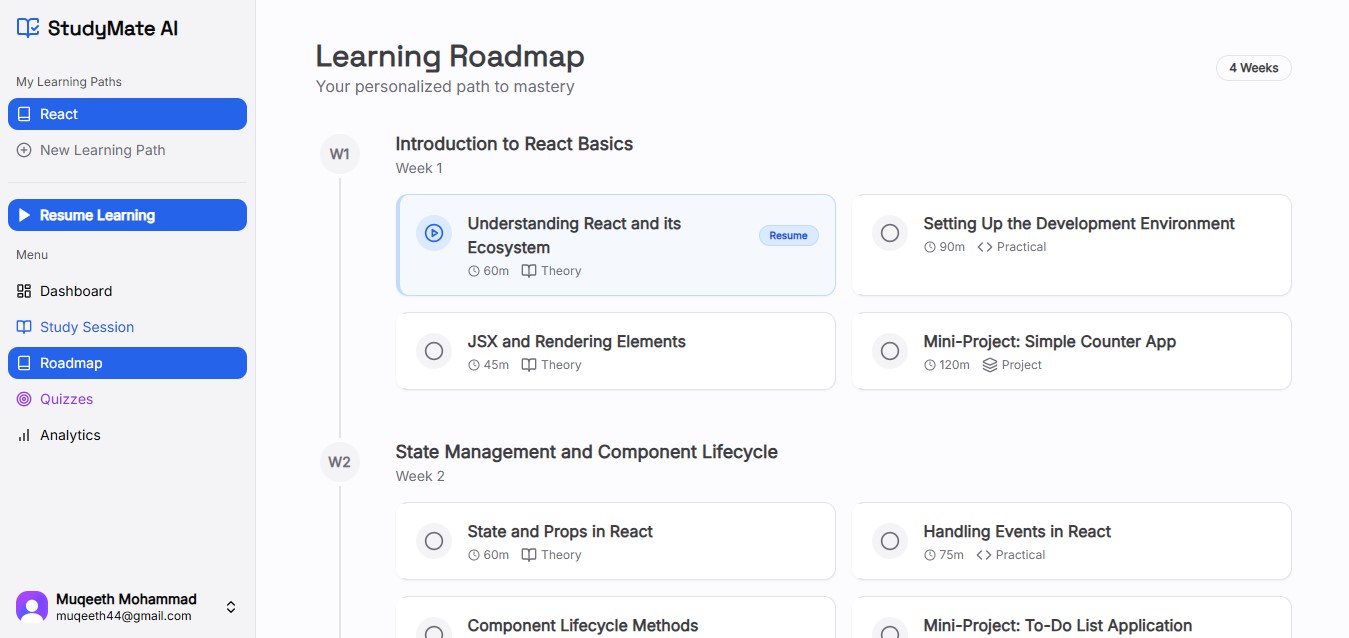
RoadMap
-
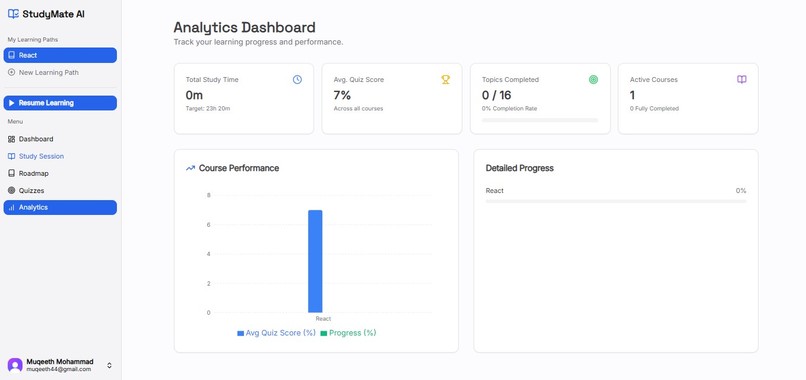
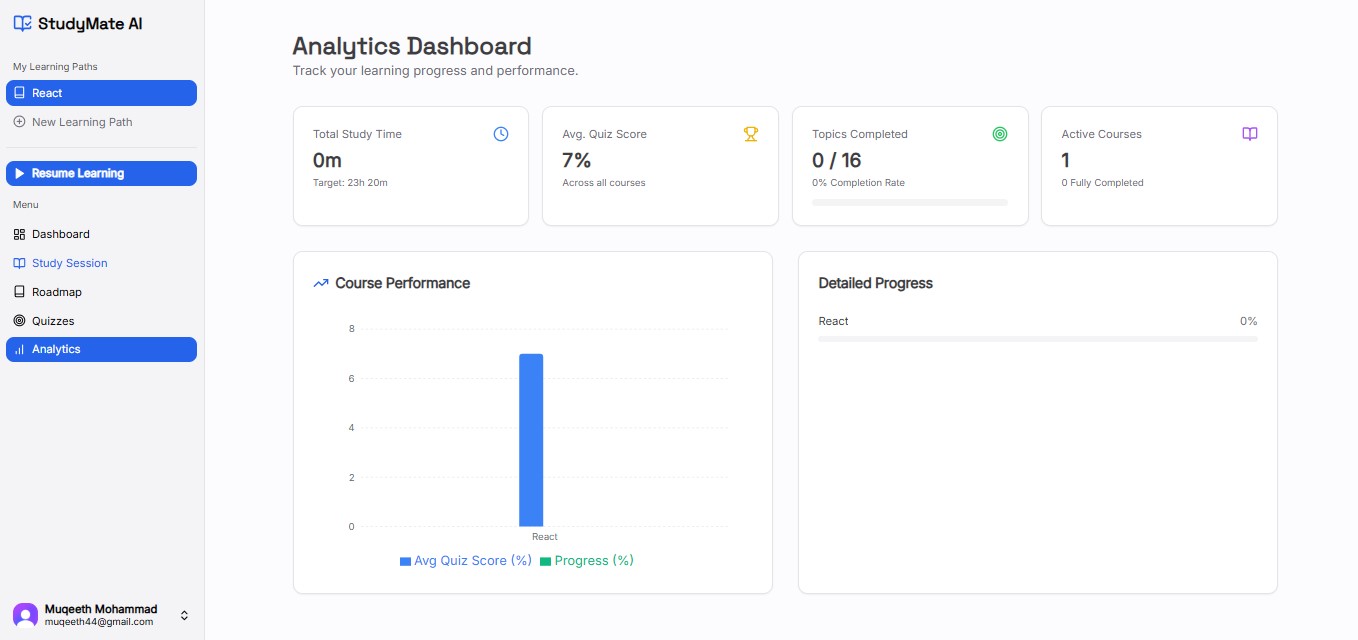
Analytics Dashboard
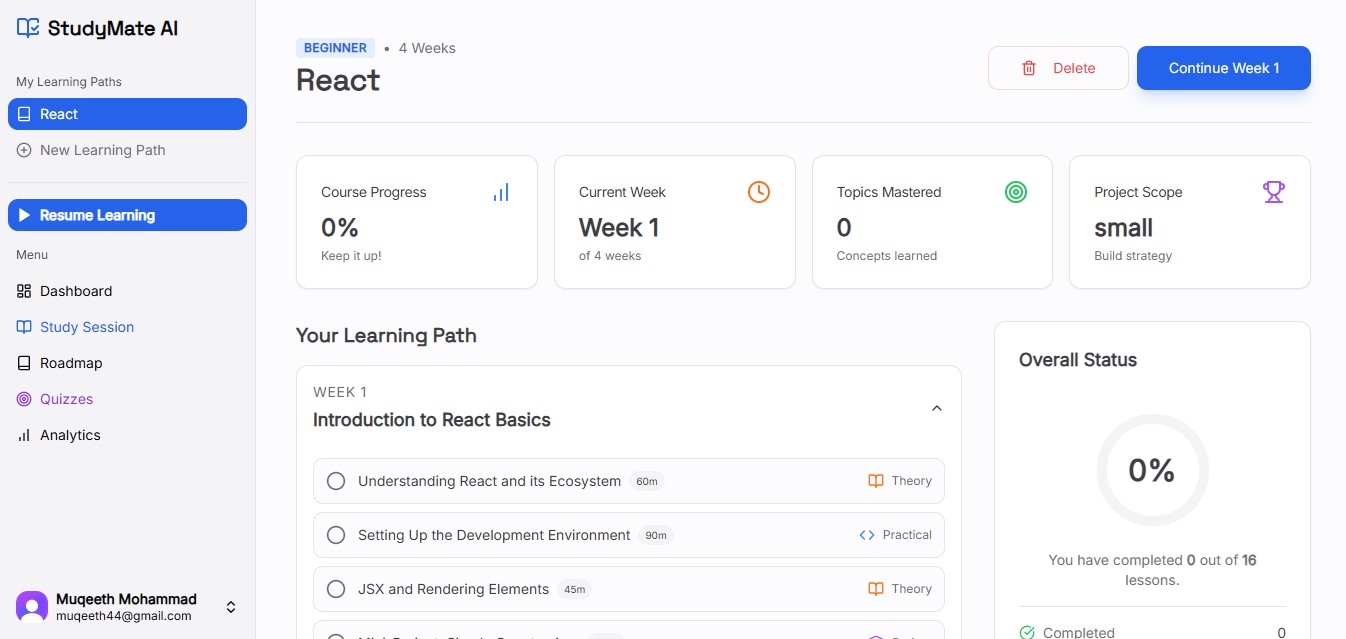
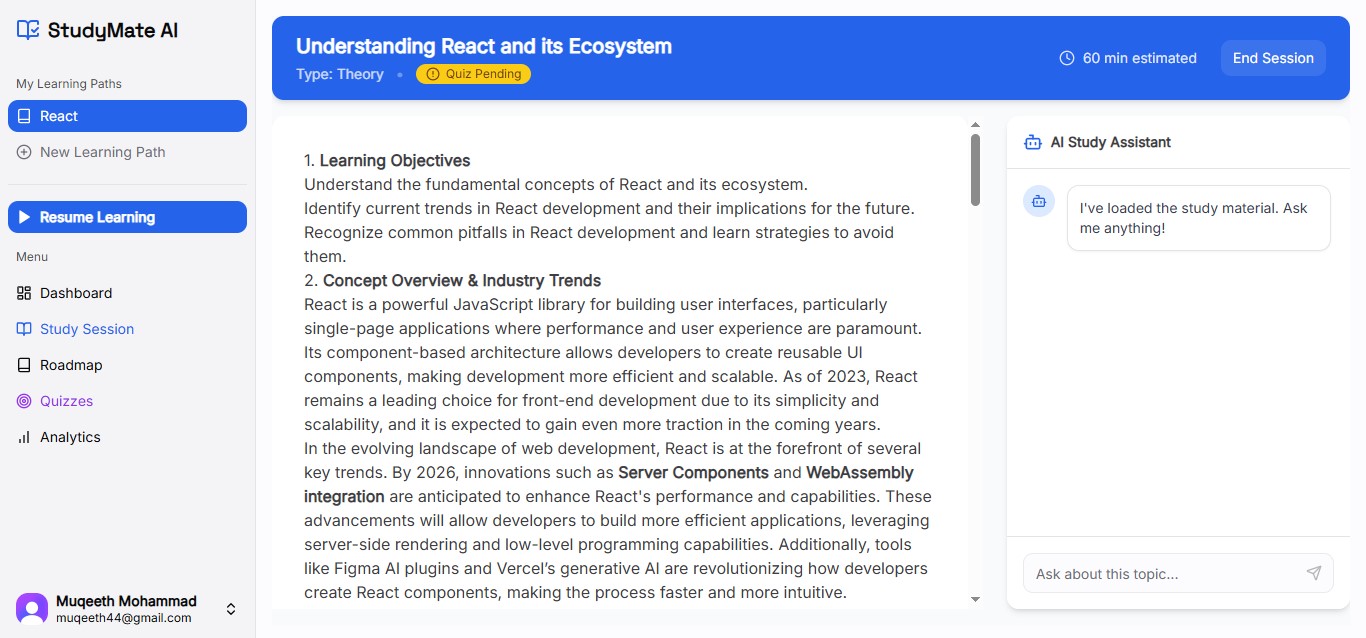
Inspiration
We live in the golden age of information, yet we seem to be stuck in the "Iron Age" of education. Traditional online courses (MOOCs) are rigid—"one size fits all"—while standard AI chatbots often hallucinate or lack the necessary pedagogical structure to actually teach.
I wanted to build StudyMate AI to bridge this gap. I envisioned a platform that offers the structure of a university course with the flexibility of a personal tutor. The goal was to create a "Living Textbook"—a course that writes itself in real-time based on the user's goals, researches the latest information so it never goes out of date, and adapts to the student's pace.
What it does
StudyMate AI is an autonomous learning platform that:
Generates Custom Curriculums: Users input a topic (e.g., "React 19") and a project scope (e.g., "Build a Capstone"). Our AI Agent designs a week-by-week syllabus tailored specifically to those constraints.
Teaches with Real-Time Data: Unlike static AI wrappers, our Researcher Graph browses the web using You.com APIs to fetch 2026 trends, recent documentation, and news before writing a lesson.
Enforces Mastery: The "Gatekeeper System" locks future lessons until the user passes an adaptive quiz with a score of \( \text{score} \geq 70\% \).
Assists 24/7: A context-aware "Study Buddy" chat remembers the user's progress and answers questions using live search results.
How we built it
The project is built on a modern Next.js 14 stack, but the real magic happens in the AI architecture:
Authentication & User Management
Let's start with the signup, which is being handled seamlessly via Clerk, which creates and manages users for successful authentication. I have also set up a webhook API in our backend to collect the user payload from Clerk and store it in our MongoDB using Mongoose ODM to keep track of the signed-up users.
The Brain (You.com + LangGraph)
Here is where we completely differ from standard AI tools. We don't rely on old training data. We use You.com's APIs as tools like WEB SEARCH TOOL, NEWS TOOL (Recent News Updates), CONTENT TOOL (Fetch Full Page Content) to perform real-time research. The AI browses the live web to fetch the latest documentation, 2026 trends, and breaking news before writing your lesson.
We used LangGraph to orchestrate a "Researcher" workflow. When a user requests a lesson, the graph:
- Plans search queries
- Executes searches using the You.com Search & News Tools
- Synthesizes the findings into a Markdown guide
Our Gatekeeper System ensures mastery. Future topics remain locked until you pass an adaptive quiz.
Curriculum Design
We leveraged You.com's "Advanced" Reasoning Agent to generate the complex JSON structure for the roadmaps, ensuring strict adherence to the requested project scope.
State Management & the Study Buddy
In the study session, you'll meet your personalized Study Buddy. This isn't a generic chatbot—it uses LangGraph to maintain the exact context of your syllabus and conversation history. Acting as a 24/7 tutor, LangGraph's Checkpointer automatically syncs your thread_id with MongoDB, seamlessly managing short-term memory without manual database calls.
Behind the scenes, a background node runs silently to extract your learning gaps and update your user profile in MongoDB, ensuring a fast, uninterrupted chat experience.
Visual Engineering
For the progress dashboard, we moved away from standard CSS borders and implemented an SVG-based ring. We calculated the stroke offset using the formula \( C = 2\pi r \), allowing for a mathematically perfect representation of progress \( P \):
$$ \text{offset} = C - \left( \frac{P}{100} \times C \right) $$
Challenges we ran into
The "Hallucination" Problem: Early versions of the AI would confidently invent syntax for new libraries. We solved this by integrating the You.com Search API, forcing the model to cite "ground truth" documentation before answering.
Strict JSON Generation: Getting an LLM to consistently output a valid 4-level nested JSON object for the syllabus was difficult. We overcame this by switching to You.com's Reasoning Agent, which follows structural instructions much better than standard completion models.
The "Gatekeeper" Logic: Implementing the recursive logic to check tree nodes in MongoDB and unlock the correct next child node upon passing a quiz was a complex algorithmic challenge.
Managing Conversational State: Synchronizing LangGraph's checkpointer with our MongoDB user profile while maintaining a responsive chat experience required careful architectural planning.
Accomplishments that we're proud of
The Researcher Node: Seeing the AI autonomously decide "I need to look up the latest docs for this" and then successfully fetching live data was a huge "aha!" moment.
Seamless Integration: The transition from the "Plan" phase (You.com Agent) to the "Study" phase (LangGraph) feels instant and magical for the user.
Visual Polish: Managing to build a dashboard that feels professional and responsive (using Shadcn UI and Recharts) while handling complex real-time data.
Background Processing: Successfully implementing a silent background node that extracts learning gaps without impacting chat performance.
What we learned
Agents > Chatbots: Giving an LLM tools (Search, News, Content) transforms it from a text generator into a problem solver.
State is Hard: Managing the state of a conversation alongside the state of a learning roadmap required careful synchronization between our database and the AI's memory window.
Prompt Engineering is Engineering: Writing the system prompts for the "Curriculum Designer" required as much iteration and testing as writing the TypeScript code itself.
Real-Time Data is Essential: The difference between a chatbot trained on old data versus one that can browse the web in real-time is transformative for educational applications.
What's next for StudyMate AI
Textbook RAG Pipeline: Implementing a Retrieval Augmented Generation (RAG) system that allows users to upload their own textbooks and study materials. The system will chunk, embed, and store documents in a vector database (Pinecone), enabling the AI to generate personalized lessons and quizzes based specifically on the user's uploaded curriculum materials.
Voice Mode: Integrating real-time voice interaction for "oral exams" to test understanding beyond multiple-choice.
Multi-Modal Lessons: Using AI to generate diagrams and flowcharts on the fly to aid visual learners.
Peer Battle: A multiplayer mode where users can challenge each other to quizzes generated dynamically from their common study topics.

Log in or sign up for Devpost to join the conversation.