Inspiration
Students rarely struggle because they have too little study material. They struggle because their material is scattered across PDFs, notes, recorded lectures, and YouTube videos—and knowing what to study next is often harder than finding something to read.
StudyMate AI was built around a simple question: What if your study material could become a workspace for understanding, practice, and revision?
Our aim is to help students move beyond repeatedly reading notes and start checking what they understand, identifying gaps, and taking a useful next step.
What it does
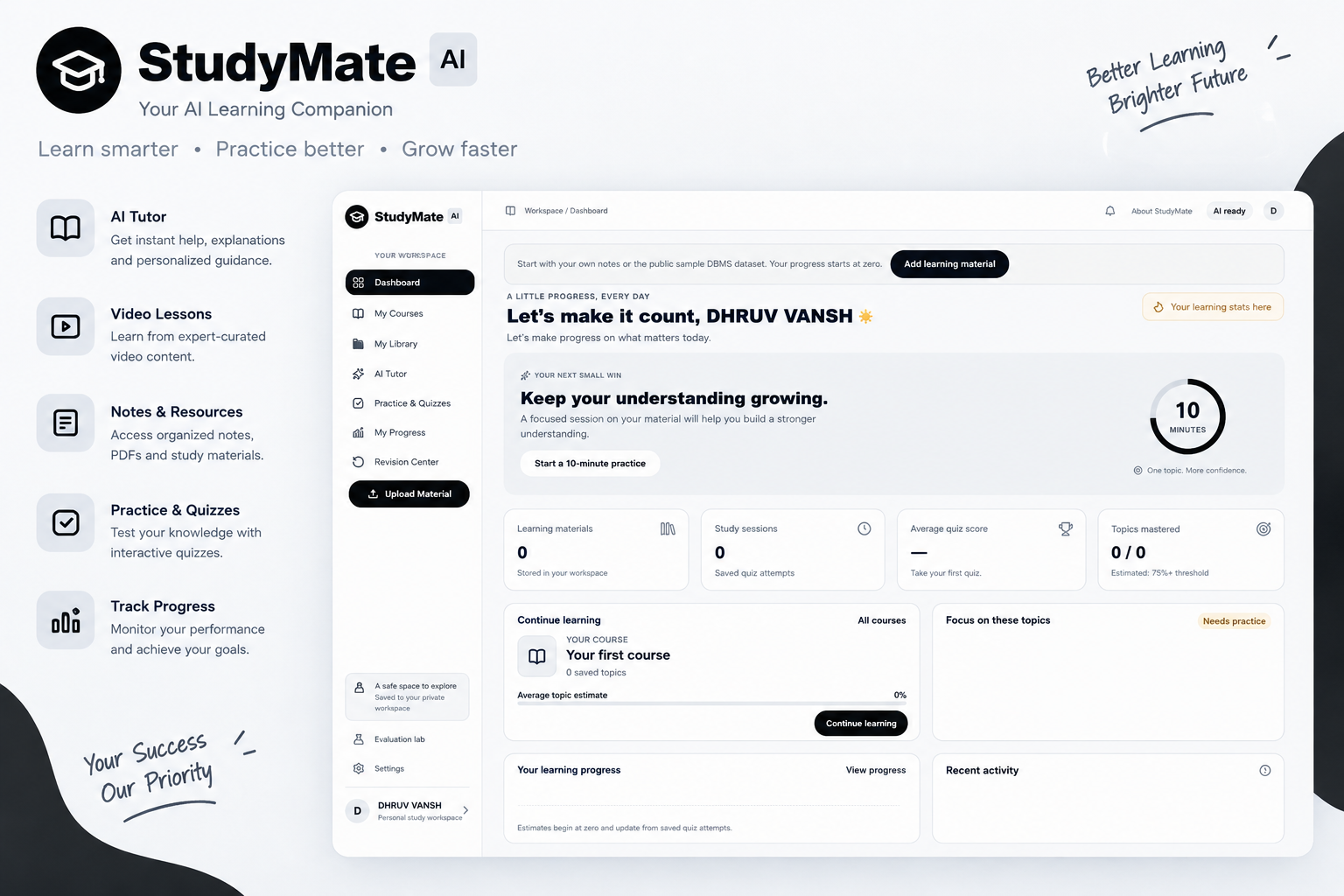
StudyMate AI brings the learning journey into one personal workspace:
- Organize courses and materials: Keep notes, PDFs, and learning resources together by subject.
- Study documents and video lessons: Extract readable document text and work with uploaded videos or public YouTube lessons. Video extraction requires configured AI access; students can also provide a transcript.
- Ask a source-grounded AI tutor: Get explanations based on selected study material, with source references that students can open and inspect.
- Practice with quizzes: Use the prepared DBMS question bank or generate questions from study material when Gemini is configured.
- Review answers and progress: Receive server-checked results, revisit explanations, and track topic estimates across saved attempts.
- Revise with purpose: Use flashcards, review records, and suggested practice areas to guide the next study session.
Personal accounts keep each student's materials and learning records separate. Progress remains available after refreshing or returning to the application.
How we built it
The local application uses React, TypeScript, and Vite for the interface, with Tailwind CSS, reusable UI components, Lucide icons, and Recharts supporting the experience.
A Python FastAPI backend handles accounts, uploads, document processing, tutoring requests, quiz submission, and saved learning activity. SQLite stores structured records, while uploaded originals remain in private file storage.
Authentication uses Argon2id password hashing and server-side sessions. Protected operations check ownership before accessing a student's records.
For document learning, pdfplumber extracts PDF text. Keyword-based retrieval selects relevant passages from permitted materials before sending a question to Google Gemini. Returned source quotes are checked against the available text. Provider credentials stay on the server.
AI features clearly report when configuration is missing. The prepared DBMS practice workflow remains available without an AI key.
Challenges we faced
The central challenge was connecting a polished interface to reliable, persistent behavior. Uploads needed genuine processing states, quizzes needed server-side grading, and saved records needed consistent ownership checks.
Another challenge was making AI output inspectable. A fluent explanation can still be wrong, so source references and explicit limitations are essential. Checking that a quote exists is useful, but it does not independently prove every generated claim.
Portable setup also required attention: teammates need both frontend dependencies and the Python backend environment before starting the complete application.
Accomplishments we are proud of
StudyMate AI connects material → explanation → practice → feedback → revision in a single learning workflow.
The project includes real document processing, personal accounts, saved learning records, source-linked study tools, and a public DBMS sample dataset. It also distinguishes prepared content, configured AI features, and unavailable functionality instead of presenting simulated results as live services.
What we learned
Building StudyMate AI reinforced that a useful educational tool needs more than answer generation. Clear sources, understandable feedback, reliable persistence, and honest failure states are equally important.
We also learned to treat progress estimates as guidance—not proof of mastery—and to make room for students to inspect answers and challenge automated grading.
What's next
Our next priorities are OCR for scanned notes, stronger semantic retrieval, better handling of short-answer paraphrases, and independent evaluation of generated questions and explanations.
We also plan to improve account recovery, accessibility, and testing with real student workflows.
The goal is simple: help students turn the material they already have into understanding they can build on.


Log in or sign up for Devpost to join the conversation.