-
-
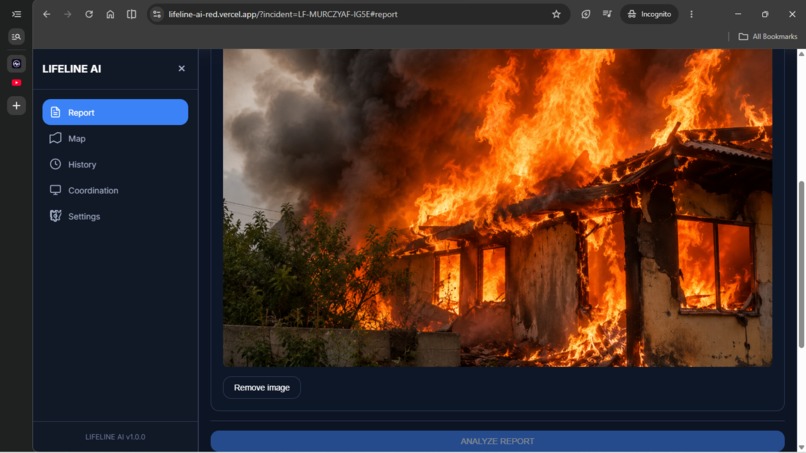
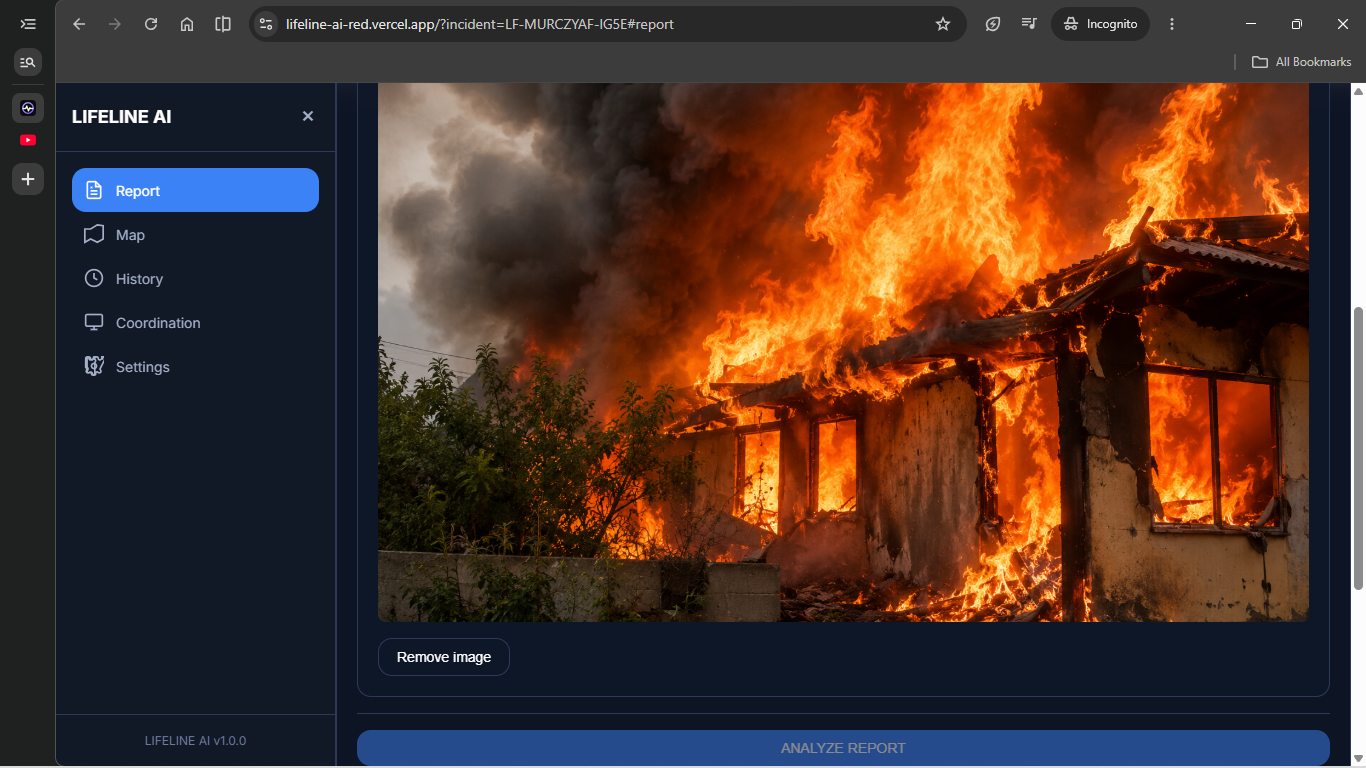
Report
-
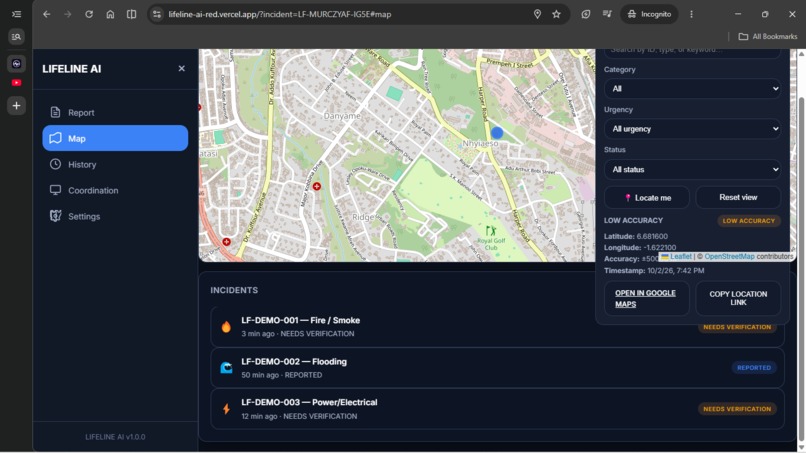
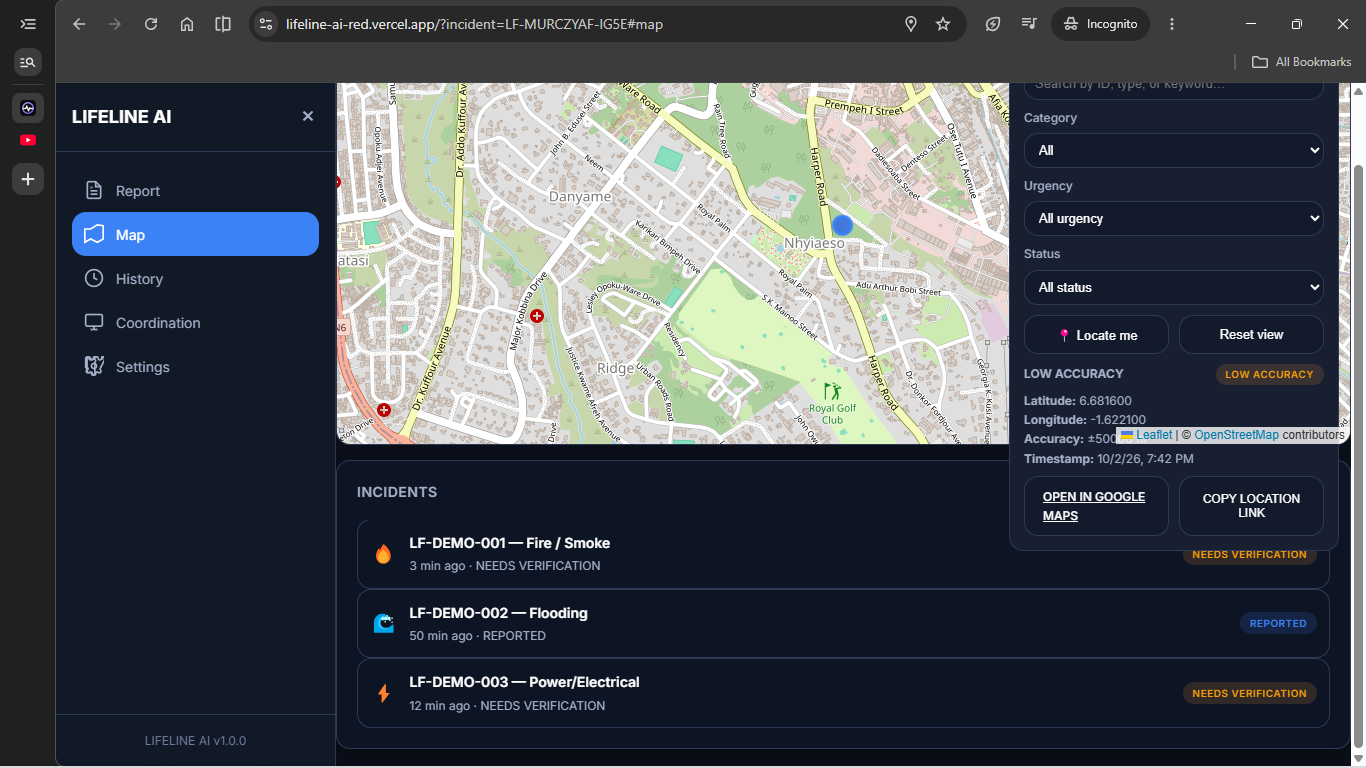
Live Location
-
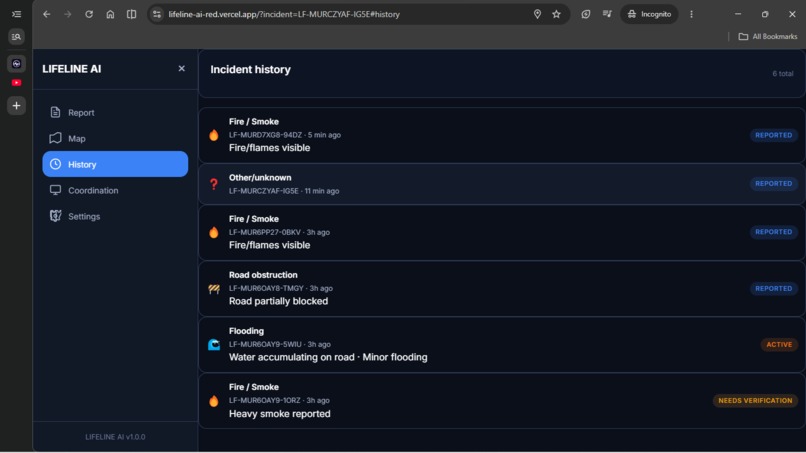
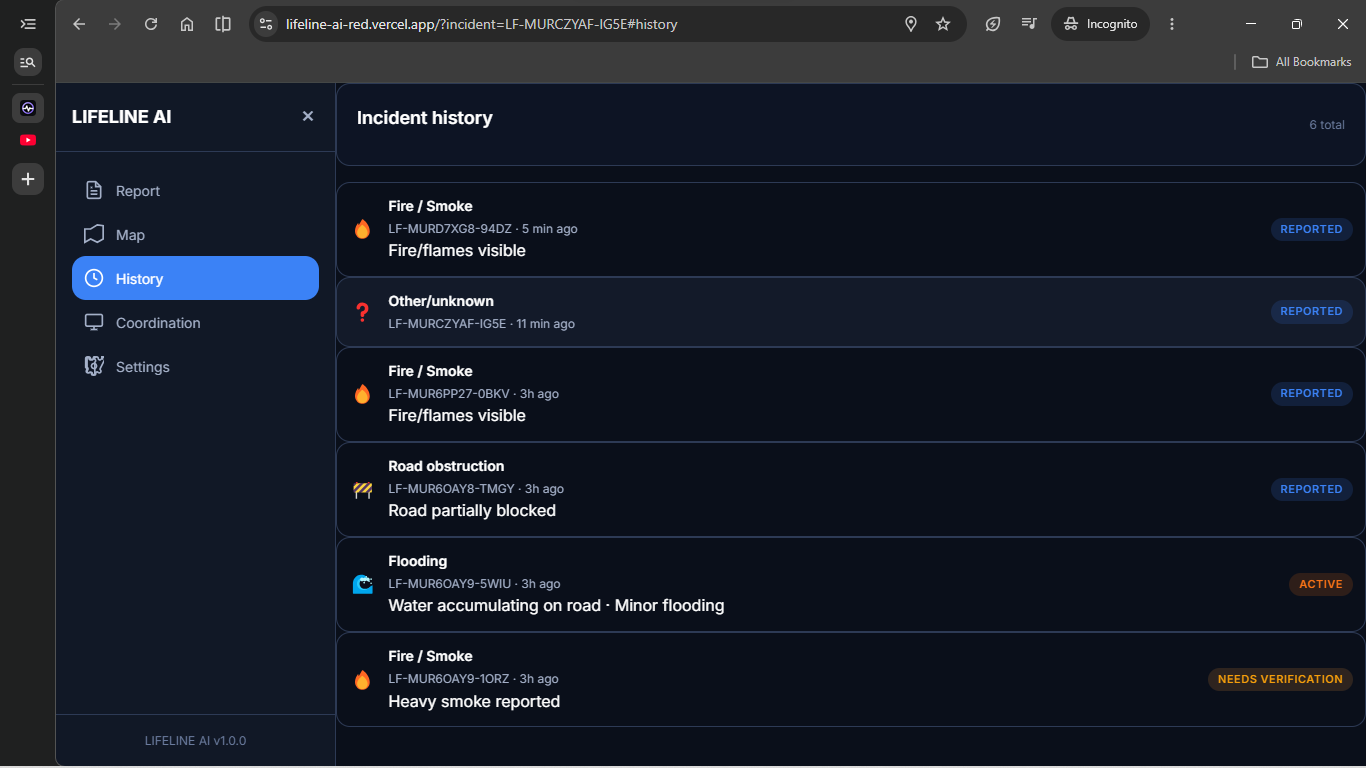
History
Inspiration
In a community incident, the hardest part is often not noticing that something is wrong—it is turning incomplete information into useful, actionable information quickly. A person may know that there is smoke, flooding, a blocked road, or another hazard, but not know exactly what information responders need, who should be contacted, or how to communicate the situation clearly.
We built LIFELINE AI around a simple idea: turn chaos into coordinated action.
Instead of treating an incident report as just a message, LIFELINE transforms reports into structured incident intelligence, adds approved location information, explains its reasoning at a high level, and helps route the information toward the appropriate configured response channel.
What it does
LIFELINE AI is a multimodal, location-aware, offline-first incident intelligence platform.
Users can report an incident through:
- Text
- Voice
- Images
- Location
The system analyzes the report and produces a structured incident brief containing:
- Incident category
- Urgency level
- Key observations
- Missing information
- Location and accuracy
- Recommended response category
- Incident status
- Verification state
LIFELINE can identify related reports and cluster potentially connected incidents, helping coordinators understand whether several reports may describe the same event.
Its Smart Escalation system uses the incident classification and a configurable contact directory to determine which response category should receive the report.
Before high-consequence communication occurs, the user reviews and confirms exactly what will be shared.
When location permission is granted, LIFELINE captures the user's current coordinates, records their accuracy and timestamp, and generates a shareable map link. That location link can become part of the approved incident package sent through configured communication channels.
The platform also supports an offline-first workflow, allowing reports to be created and queued when connectivity is unavailable rather than falsely claiming that they were delivered.
How we built it
We designed LIFELINE as a layered system rather than making an AI model responsible for the entire response process.
The architecture separates:
Input → AI analysis → deterministic safety validation → incident intelligence → location → escalation → human confirmation → communication → coordination
For AI analysis, we designed a provider abstraction that can use Groq when configured, while maintaining a local rules-based fallback for situations where an AI provider is unavailable.
The fallback can still identify categories, urgency signals, locations, missing information, timestamps, and other structured fields. It is explicitly labeled as LOCAL FALLBACK rather than pretending to be cloud AI.
For location, we use the browser's Geolocation API with explicit user permission. Every location record includes latitude, longitude, accuracy, and timestamp.
For mapping and incident visualization, we use a map-based interface with incident markers, status states, and coordination views.
For offline functionality, we use browser storage and a synchronization queue so reports can survive temporary connectivity loss.
The communication layer is provider-independent and supports configured channels such as:
- Phone links
- SMS
- Webhooks
- Future organizational integrations
The application is packaged as a Progressive Web App with responsive interfaces designed for mobile incident reporting and desktop coordination.
Challenges we ran into
One of the biggest challenges was designing an AI system for a situation where being confidently wrong can be worse than being uncertain.
We therefore avoided making the language model the sole decision-maker for escalation. AI classification is combined with deterministic validation and explicit human confirmation.
Another challenge was location handling.
We wanted location to be genuinely useful without silently collecting or sharing it. The system therefore asks for permission, records location accuracy and timestamp, clearly identifies the location source, and lets users continue without location.
Communication was another challenge. Simply displaying "Emergency team contacted" would create a dangerous illusion of reliability. LIFELINE instead separates requested, sent, delivered, failed, and unavailable states and only reports what the communication layer can actually verify.
We also had to design for poor connectivity. An incident reporting system that only works with a perfect internet connection is not useful in many real-world situations, so offline queueing became a core part of the architecture rather than an afterthought.
Accomplishments that we're proud of
We're proud that LIFELINE is more than an AI chatbot.
It combines:
- Multimodal incident reporting
- Structured AI analysis
- Explainable classifications
- Deterministic safety rules
- Current-location capture
- Automatic map-link generation
- Smart escalation
- Human confirmation
- Configurable response contacts
- Incident clustering
- Community incident feeds
- Coordination dashboards
- Offline-first reporting
- Synchronization queues
- Audit logging
- Provider-independent AI architecture
We're especially proud of the current-location workflow. Once the user explicitly grants permission, LIFELINE can turn their current coordinates into a usable map link and include it in the approved incident package.
We also designed the product around transparency: users can see what the system detected, what is unknown, why an incident was flagged, what information will be shared, and what happened to the communication request.
What we learned
We learned that building AI for high-consequence environments requires more than improving the model.
The surrounding system matters just as much.
A useful incident platform needs clear uncertainty handling, permissions, human oversight, reliable state management, privacy controls, offline behavior, and honest communication about what actually happened.
We also learned that multimodal AI becomes significantly more useful when its output is converted into a structured format that other parts of the system can understand.
Most importantly, we learned to design AI as a decision-support layer, not as an unquestionable authority.
What's next for LIFELINE AI
The next step is expanding LIFELINE from a prototype into a platform that can integrate with real community organizations and response workflows.
Future development could include:
- More AI providers and stronger local models
- Better multimodal image and audio analysis
- Secure organization accounts and role-based access
- Verified responder organizations
- Real-time incident collaboration
- More advanced incident clustering
- Geospatial risk analysis
- Community-level analytics
- Secure responder integrations
- More robust offline synchronization
- SMS-based reporting for limited-connectivity environments
- Additional language support
- Privacy-preserving location controls
- Stronger testing and reliability monitoring
The long-term vision is a system where a community report can move from raw observation → structured understanding → verified information → coordinated response while keeping humans in control of consequential decisions.
LIFE

Log in or sign up for Devpost to join the conversation.