-
-
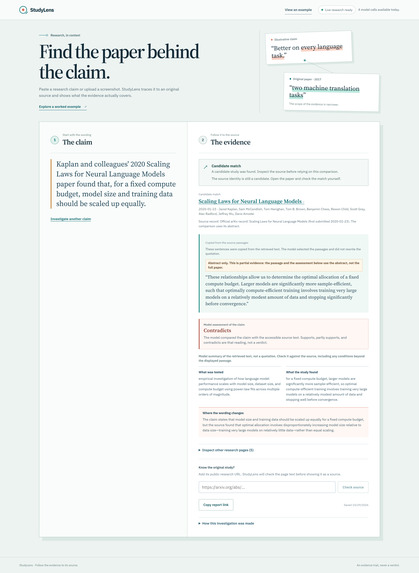
Hosted Kaplan report: copied abstract, model assessment, and wording gap.
Inspiration
A research claim often reaches us through a post, headline, or screenshot. Finding the original paper is harder than finding a page that repeats the claim. During development, StudyLens found a later paper that stated a claim almost word for word. Its quotation check passed, even though it was the wrong paper. That failure became the central problem to solve.
StudyLens gives readers an inspectable path from a claim to a candidate study, a passage copied from accessible source text, and a clearly labeled model assessment. It is built for public research claims with retrievable sources. It does not issue a universal truth score or medical advice.
What it does
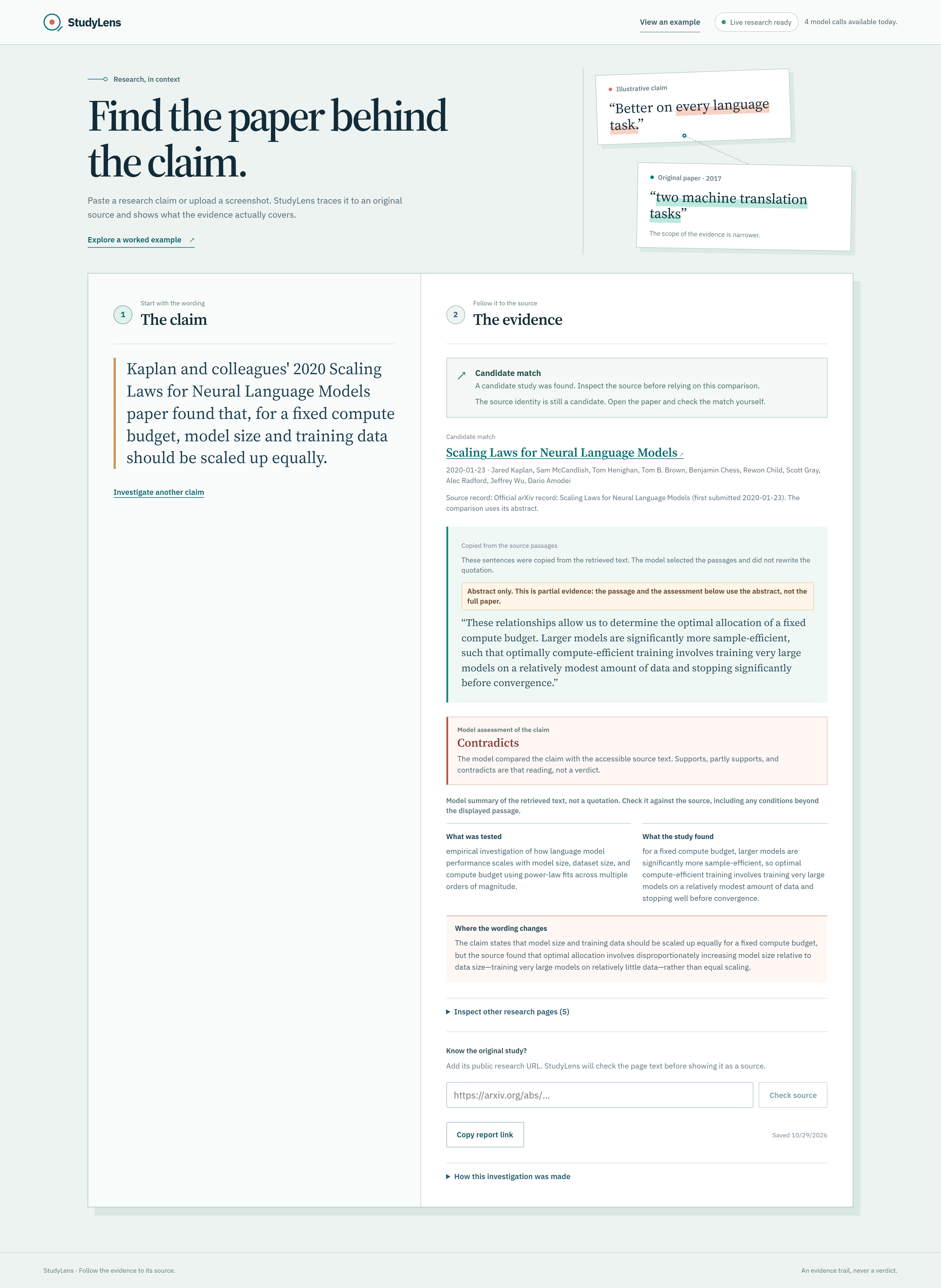
Paste a claim or upload a screenshot. NVIDIA Nemotron extracts a checkable claim and search phrase, which the reader can edit before research starts. Tavily finds candidate research pages. For arXiv papers, StudyLens checks official metadata, including title, authors, date, and abstract. It can follow a small number of explicit arXiv citations when a later paper points back to an earlier one.
Nemotron selects a candidate with a recorded reason. Another Nemotron model compares the claim with the accessible source text and selects passage IDs. The server copies those passages directly from the retrieved text, so the displayed quotation is not a model transcription. The report labels abstract-only evidence, presents “supports,” “partly supports,” or “contradicts” as a model assessment, and lets the reader inspect other candidates or correct the source. If a defensible source is not found, it says “source not confirmed.”
Reports have shareable URLs. A source correction preserves the previous automated match in the report history.
How I built it
The frontend uses React and TypeScript; the API uses FastAPI. One Render service hosts the site and API, and Neon PostgreSQL stores reports and provider-attempt records.
All runtime model inference uses NVIDIA Nemotron through Nebius Token Factory: Nemotron 3.5 Lightning for extraction and candidate selection, Nemotron Super for source comparison, and Nemotron 3.5 Super VL for screenshots. Tavily Search finds candidate pages; Tavily Extract retrieves accessible text where supported. The official arXiv API supplies paper metadata and abstracts.
The API reserves a database-backed request slot before each paid provider attempt, including attempts that fail or time out. These are request ceilings, not a dollar-level billing cap.
Challenges and accomplishments
The hardest problem was source identity. A later paper can quote or restate a finding and pass a verbatim quotation check. Adding official metadata, bounded citation following, and author/date exclusions helped StudyLens recover the Kaplan et al. 2020 paper in a case where an earlier run chose Hoffmann et al. 2022.
The second problem was asking a model to write the evidence quotation. A Super response failed the verbatim check. Switching to numbered passages let the model choose relevant text while the server performed the copying. The model still interprets the passage, so the interface labels its summary and relation as assessments rather than established facts.
A hosted live investigation found the Kaplan paper, quoted its abstract, and assessed a claim about equal scaling as “contradicts.” A local browser run tested screenshot extraction and source correction. An invented study returned “source not confirmed.” These are working demonstrations, not a measured accuracy or adoption result. A nine-case evaluation set exists, but the full live evaluation and human review remain open.
What I learned and feedback on Token Factory
Token Factory made it practical to route different tasks to different NVIDIA models in one application. Lightning handled short extraction and selection tasks; Super gave the harder source comparison a stronger route; Super VL read a real screenshot. On one Kaplan diagnostic, Lightning’s relation label conflicted with its own explanation, while a later Super comparison labeled the abstract “contradicts.” This is one observed case, not a model benchmark. I did not test Nemotron 3 Ultra or Nano.
The most useful product improvement would be an account-credit figure available to the application so a public demo could stop before an unexpected charge. StudyLens currently enforces its own attempt ceilings, but those cannot see account billing or usage of the same key elsewhere. I did not use Nebius Serverless Endpoints or Jobs; Token Factory served every model call.
Try it and what's next
Open the public demo. Render Free may take time to wake. The worked example and hosted Kaplan report open without a new provider call. The corrected report shows source history.
Next I want to run and review the full evaluation set, improve incomplete wording-gap explanations, measure actual dollar cost, and gather feedback from readers. The public deployment currently has tight shared limits on new provider calls.
Built With
- arxiv
- fastapi
- nebius
- nemotron
- postgresql
- react
- tavily
- typescript

Log in or sign up for Devpost to join the conversation.