🧠 Inspiration
StudyFlow started from a very relatable problem: planning study time sounds simple, but in real life it’s chaotic.
Between classes, meetings, deadlines, and random life events, it’s surprisingly hard to look at a calendar and confidently decide when to study — and for how long. Most tools either ignore your real schedule or stack unrealistic back-to-back sessions that look productive but aren’t sustainable.
We wanted to build something smarter — a system that actually respects your real calendar and creates a study plan that feels doable, not overwhelming.
⚙️ What it does
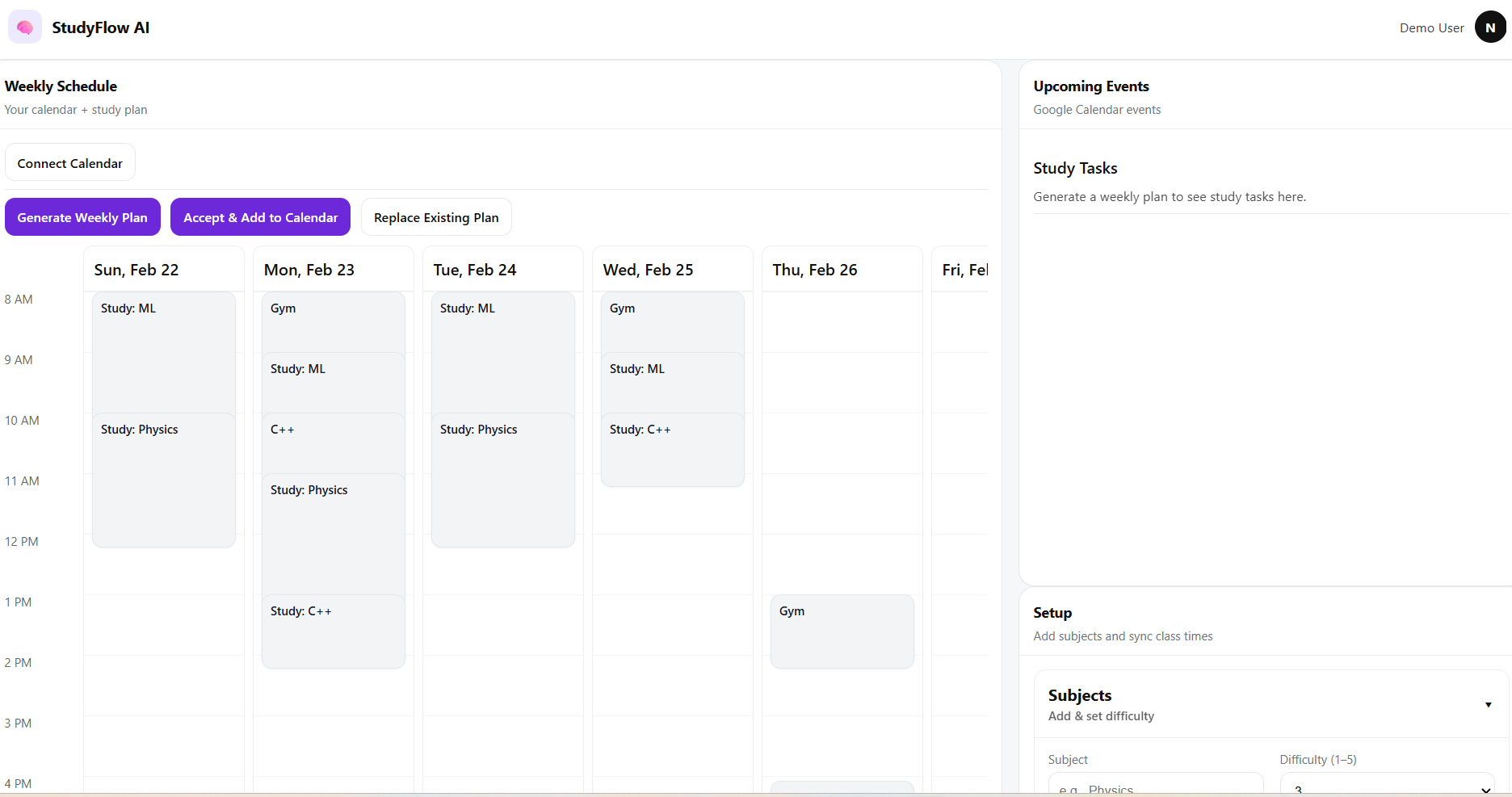
StudyFlow connects to your Google Calendar and automatically generates a realistic 7-day study plan.
It:
Reads your existing calendar events
Understands subject difficulty
Uses AI to decide how much time each subject needs
Finds real free time in your schedule
Places study sessions into those time slots
Prevents burnout by enforcing spacing and daily limits
You can preview the plan before committing it, and once approved, the study blocks are added directly to your calendar.
It turns messy availability into structured focus time.
🛠 How we built it
We built StudyFlow in layers.
First, we integrated Google OAuth and the Calendar API so we could read upcoming events and insert new study sessions safely.
Next, we created an AI allocation layer. Each subject has a difficulty level, which translates into baseline study hours. A GPT-based optimizer then assigns priority scores and target minutes, adjusting how study time should be distributed across the week.
After that, we built a constraint-safe scheduling engine from scratch. This was key. The scheduler:
Finds real free time between events
Enforces a study window (8 AM – 10 PM)
Caps sessions at 2 hours
Limits total daily study time
Prevents back-to-back sessions
Distributes sessions across the week
The AI decides how much to study. The scheduler decides when it’s realistically possible.
Finally, we added a preview-and-commit workflow so users always approve changes before anything is written to their calendar.
🧗 Challenges we ran into
One of the biggest challenges was balancing AI flexibility with real-world constraints.
If you let AI schedule everything freely, it tends to cluster sessions or create unrealistic blocks. If you rely only on rigid rules, the system becomes too mechanical and unintelligent.
Finding the right separation between “smart allocation” and “hard constraints” took multiple iterations.
Another challenge was preventing back-to-back sessions and ensuring the plan felt human. We had to deliberately build in spacing rules and buffer logic to make the schedule sustainable.
Integrating Google Calendar safely (without duplicating or overwriting events incorrectly) was also more complex than expected.
🏆 Accomplishments that we're proud of
We’re proud that StudyFlow doesn’t just generate a schedule — it generates a realistic one.
It respects real calendar constraints
It prevents overload
It separates AI reasoning from deterministic scheduling
It requires explicit user approval before committing changes
The system feels grounded. It doesn’t hallucinate time.
That balance between intelligence and practicality is something we’re especially proud of.
📚 What we learned
We learned that AI works best when paired with structure.
Letting AI make high-level decisions (like priority and time allocation) while enforcing hard constraints in code creates a much more reliable system.
We also learned that small details — like enforcing 30-minute breaks — dramatically change how “human” a schedule feels.
And we learned that calendar integration adds real-world complexity that you can’t simulate with dummy data.
🚀 What's next for StudyFlow
There’s a lot of room to grow.
Next steps could include:
Performance-based adaptive difficulty (adjusting study time based on completion rates)
Exam countdown prioritization
Multi-week planning
Automatic re-optimization if the calendar changes
Energy-aware scheduling (morning vs evening productivity)
Progress tracking and study streak analytics
StudyFlow started as a way to make planning less stressful. The goal now is to make it smarter, more adaptive, and even more aligned with how people actually study.
Built With
- express.js
- google-cloud-apis
- javascript
- node.js
- open-ai
- react

Log in or sign up for Devpost to join the conversation.