Inspiration
Financial institutions are increasingly adopting tokenized assets, but small businesses are often left behind. Many businesses rely on invoices and receivables for cash flow, yet these assets remain difficult to track, finance, and settle in a transparent and privacy-preserving manner. We were inspired by Canton Network's vision of private, interoperable financial markets and wanted to demonstrate how everyday business receivables could become tokenized assets managed through a modern financial workflow.
What it does
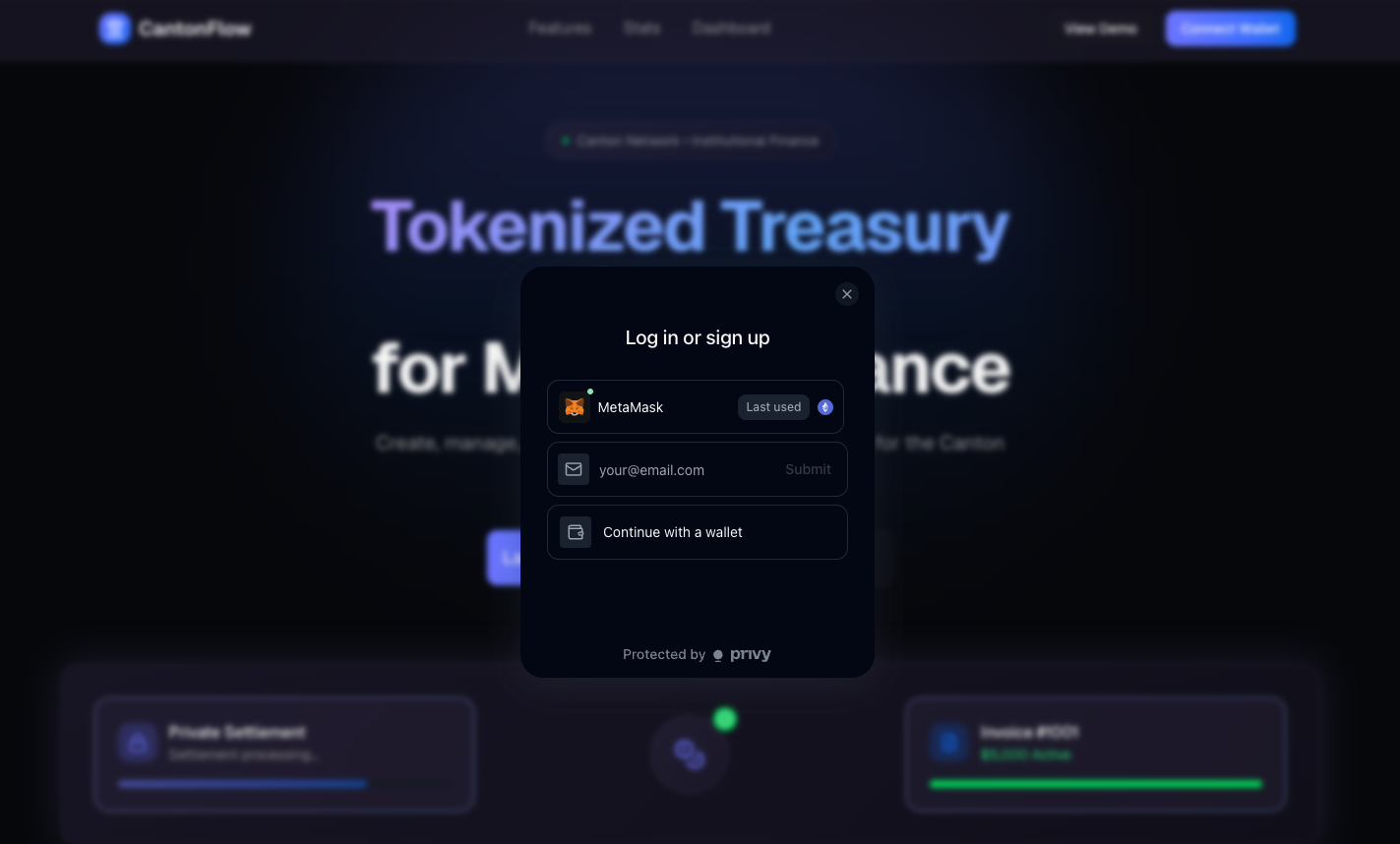
CantonFlow Receivables allows businesses to create, manage, and track tokenized invoice assets through a simple web dashboard. Users can create invoice-based assets, monitor their status, and view settlement activity through an institutional-style interface.
The platform demonstrates how receivables can be represented as digital financial assets and managed through a workflow designed for privacy-preserving financial infrastructure. Assets progress through stages such as creation, tokenization, and settlement while maintaining an audit-ready record of activity.
How we built it
We built CantonFlow Receivables using:
Next.js and TypeScript for the frontend Tailwind CSS for the user interface Privy for authentication and wallet connectivity Daml smart contracts to model receivable assets Canton-compatible local ledger infrastructure through Daml Sandbox React-based dashboards for asset and settlement management
The application includes:
Landing page Asset creation workflow Asset dashboard Settlement tracking dashboard Daml contract representing a tokenized receivable asset Challenges we ran into
The biggest challenge was learning the Canton development stack. Unlike traditional EVM chains where developers interact directly with smart contracts through RPC endpoints, Canton applications rely on Daml smart contracts and ledger APIs.
We also encountered challenges configuring the Daml environment, managing local ledger services, handling authentication requirements for the JSON API, and understanding the relationship between Daml contracts, the ledger, and application-layer services.
Accomplishments that we're proud of
Successfully set up and deployed a Daml-based project. Built a complete treasury and receivables management interface. Modeled invoice receivables as tokenized financial assets. Connected a modern Next.js frontend with Canton-oriented infrastructure. Demonstrated a realistic institutional finance use case aligned with Canton Network's vision of privacy-preserving financial markets. What we learned
Through this project we learned:
Fundamentals of Daml smart contract development. How Canton differs from traditional public blockchain architectures. The role of privacy and synchronization in institutional finance. How tokenized assets can be represented as programmable contracts. How modern web applications can integrate with enterprise blockchain infrastructure. What's next for CantonFlow Receivables
Future development includes:
Full integration with Canton ledger APIs. Real-time settlement execution on Canton. Tokenized invoice financing and factoring workflows. Private counterparty management. Stablecoin settlement support. Multi-party approval workflows. Institutional compliance and audit reporting. Deployment to a production Canton Network environment.
What's next for CantonFlow Receivables
CantonFlow Receivables currently demonstrates how invoice receivables can be represented as tokenized financial assets using Daml smart contracts and a Canton-compatible ledger environment. While the prototype validates the core concept, several enhancements are planned for future development.
Our next milestone is full integration between the Next.js application and the Canton ledger APIs, allowing assets created through the web interface to be automatically issued as Daml contracts without requiring manual interaction through the ledger tools.
We also plan to implement real-time settlement workflows, enabling counterparties to approve, transfer, and settle receivable assets directly on the ledger. This would allow businesses to track the complete lifecycle of an invoice from issuance through payment.
Additional roadmap items include:
Tokenized invoice financing and factoring markets Private counterparty onboarding and identity management Stablecoin-based settlement rails Multi-party approval and compliance workflows Role-based permissions for issuers, investors, auditors, and counterparties Automated maturity and payment tracking Institutional reporting and audit dashboards Integration with production Canton Network infrastructure
In the long term, we envision CantonFlow Receivables becoming a privacy-preserving platform where businesses can tokenize receivables, access liquidity, and manage financial assets using the interoperability, synchronization, and privacy guarantees provided by the Canton Network.
Built With
- canton-network
- metamask
- next.js
- privy

Log in or sign up for Devpost to join the conversation.