-
-
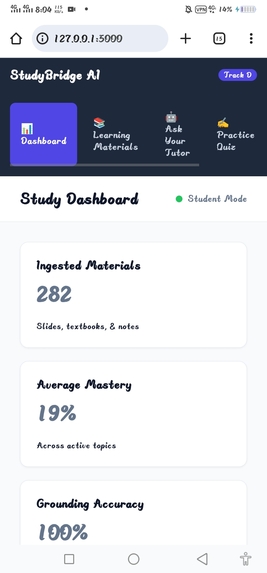
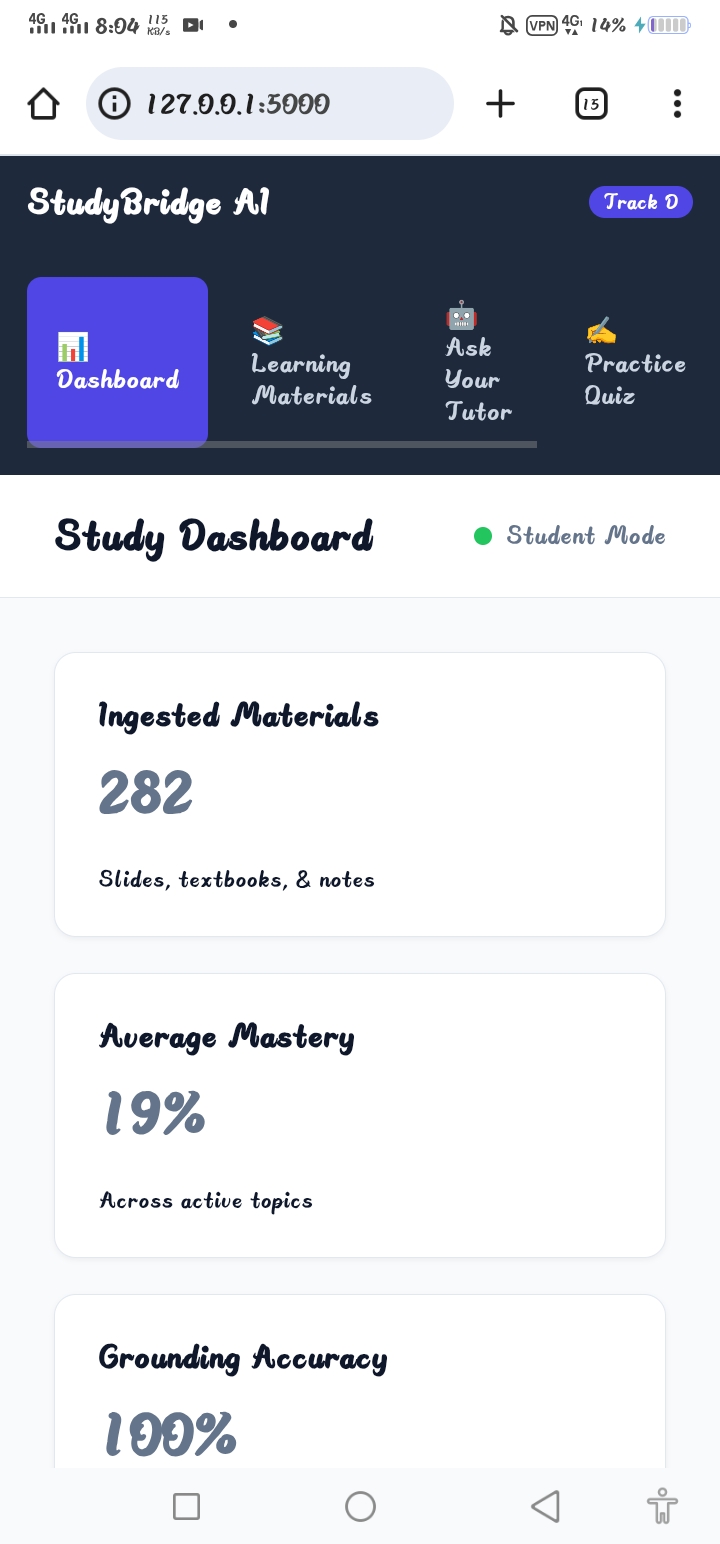
Dashboard
-
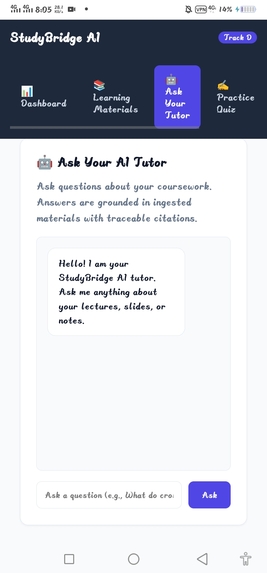
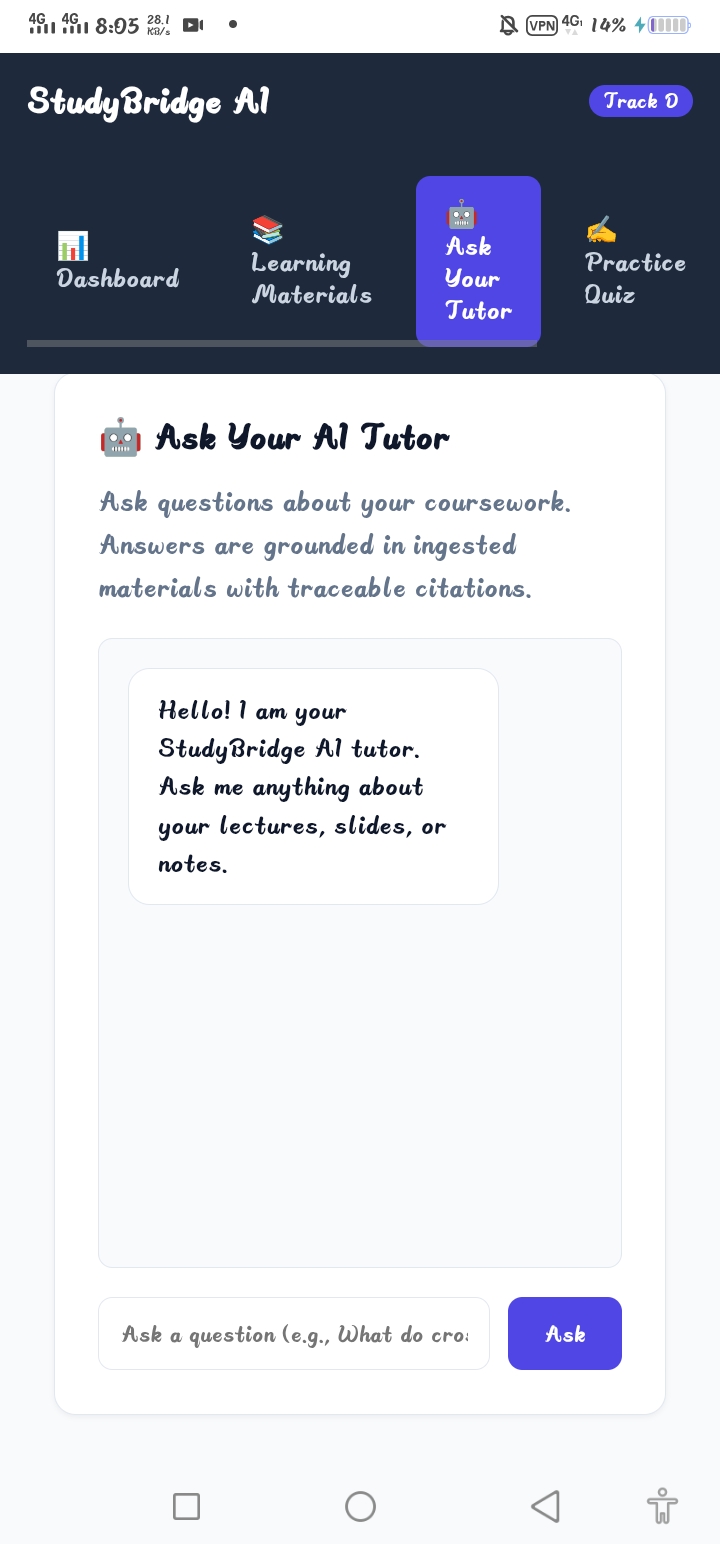
source-grounded tutoring response.
-
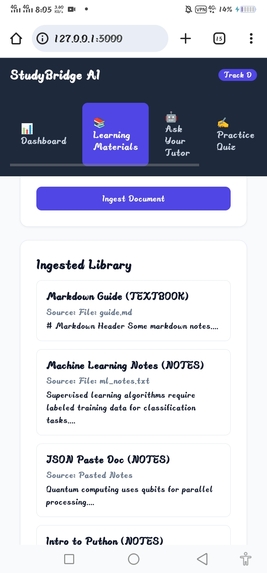
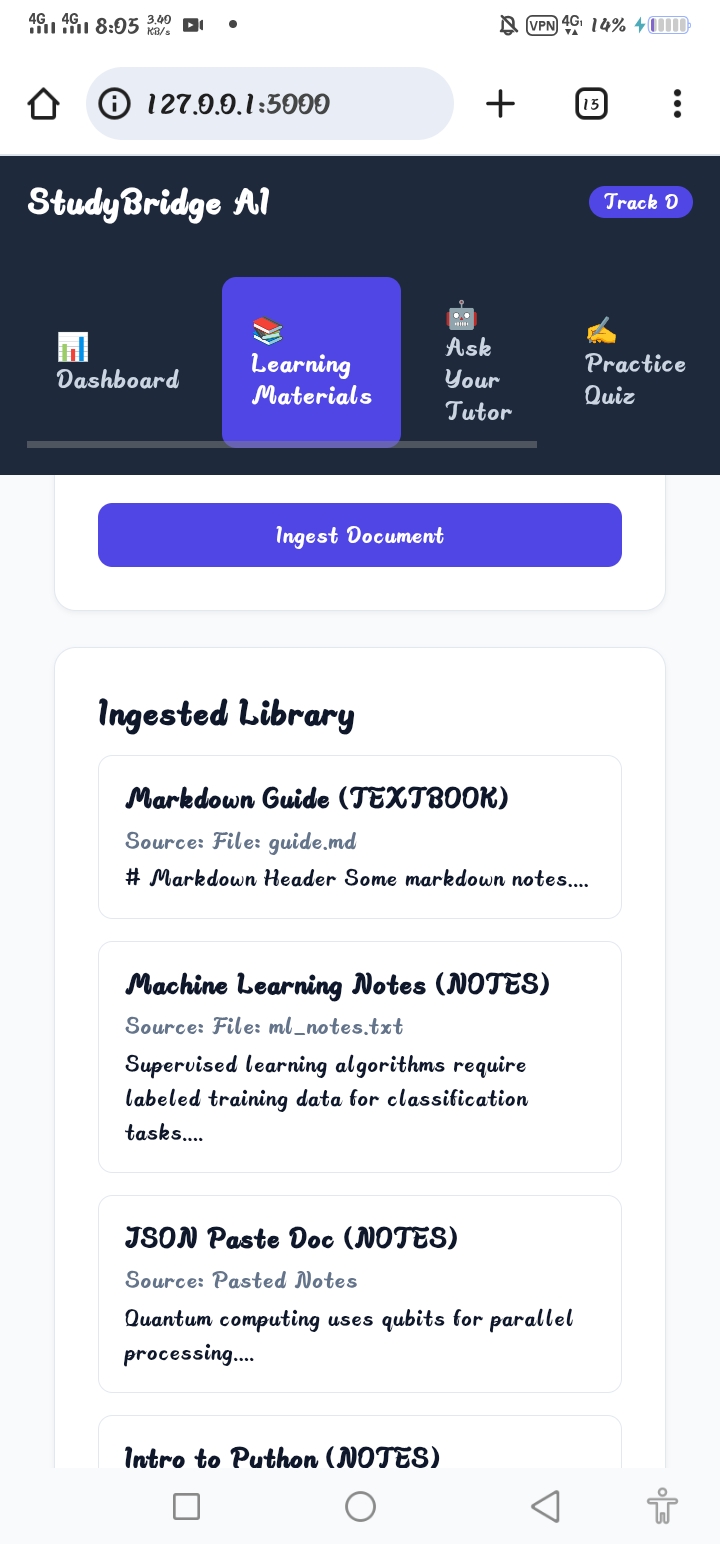
Uploaded study materials.
-
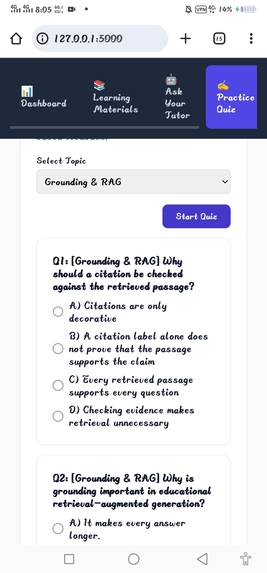
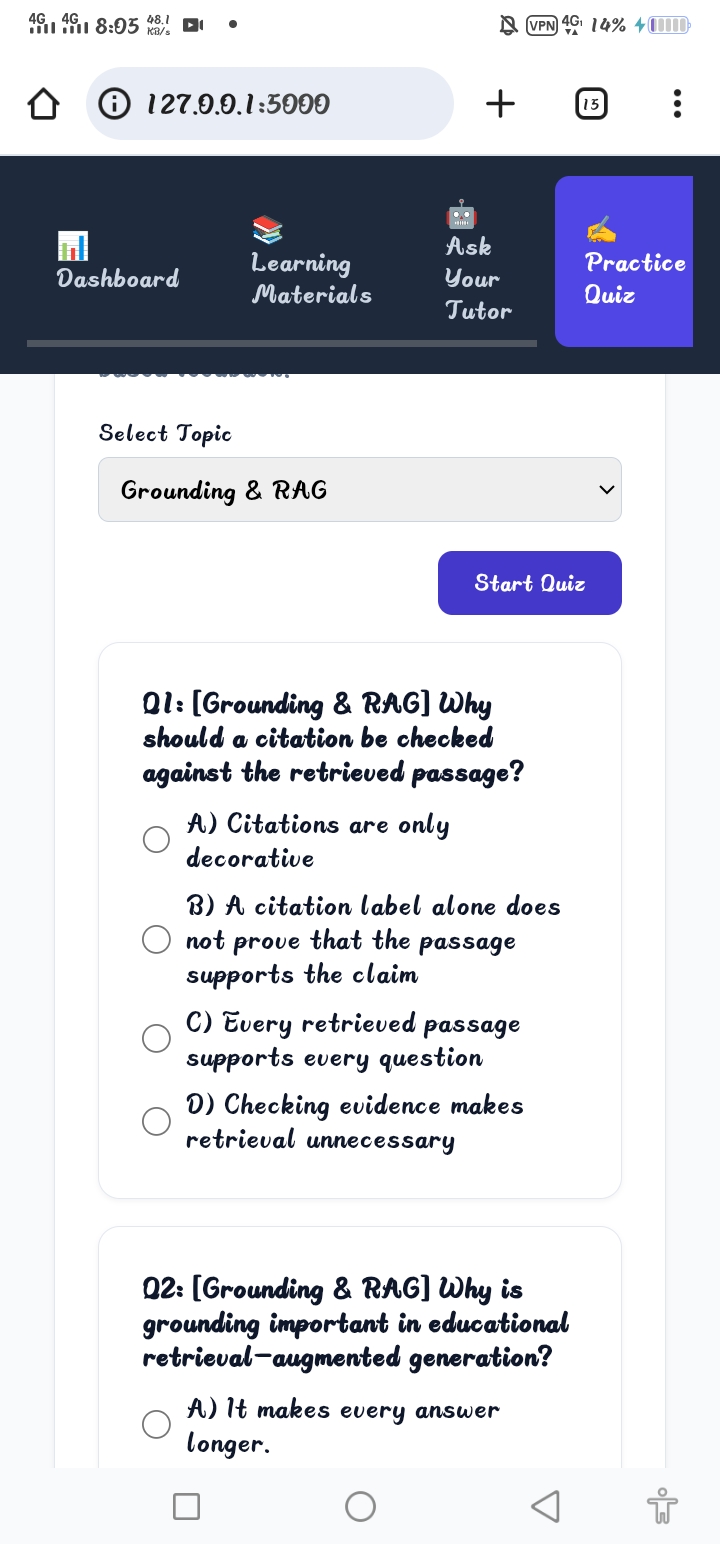
quiz and its feedback.
Inspiration
Students often have lecture notes, textbooks, and other study materials but struggle to turn them into effective, personalized learning experiences. Finding reliable answers, identifying weak topics, and knowing what to study next can be difficult, especially for students with limited access to expensive tutoring tools or reliable internet connections.
StudyBridge AI was created to help bridge that gap. The goal was to build a practical tutoring application that helps students learn from their own study materials, receive answers linked to available sources, practise with quizzes, and track their progress without depending on a hosted AI service for its core local functionality.
What it does
StudyBridge AI is a privacy-first, mobile-friendly tutoring and adaptive learning web application.
Its main features include:
- Study material ingestion: Upload supported text, Markdown, and text-extractable PDF documents to create a local study knowledge base.
- Source-grounded tutoring: Ask questions about uploaded materials and receive answers based on relevant retrieved text, with source information where available.
- Unsupported-question handling: When the application cannot find sufficient supporting material, it can decline to provide an unsupported answer rather than presenting an ungrounded response as verified.
- Adaptive quizzes: Practise with multiple-choice questions, including topic-specific quizzes that help learners focus their revision.
- Personalized progress tracking: Track estimated mastery by topic and receive recommendations based on recorded learning activity.
- Local evaluation: Run automated tests and small evaluation scenarios to check core functionality, grounding behaviour, assessment validation, and personalization logic.
- Mobile-friendly interface: Use the application through a responsive web interface designed to work on smaller screens.
How we built it
StudyBridge AI was built with Python and Flask for the application backend, HTML and CSS for the interface, and JavaScript for browser-side interactions. It uses local document processing, lexical retrieval, structured assessment data, and a lightweight learner model.
The retrieval system matches questions against extracted study material and uses available source metadata to support traceability. It is a lightweight lexical approach rather than a semantic embedding-based retrieval system.
The learner model updates estimated topic mastery using an exponential moving average. Quiz selection supports topic filtering, prioritizes weaker areas, and considers previous question exposure to reduce unnecessary repetition.
The project also includes automated tests, evaluation scripts, architecture documentation, and a submission audit. The latest local test run completed with 68 tests passing.
Challenges we faced
One of the biggest challenges was developing and testing the application entirely on an Android phone using Termux, rather than relying on a conventional desktop development environment. Limited resources and unreliable connectivity made it important to keep the architecture lightweight and avoid unnecessary dependencies.
Another challenge was balancing helpful tutoring with trustworthy answers. StudyBridge AI therefore distinguishes between supported and unsupported questions, while its documentation identifies the limitations of lexical retrieval and source attribution.
We also had to make the assessment and learner-progress logic predictable enough to test. Automated tests helped verify input validation, document handling, question selection, scoring, progress updates, and evaluation behaviour.
What we learned
Building StudyBridge AI reinforced the importance of designing around real constraints, testing core behaviour systematically, and being transparent about what an educational application can and cannot do.
We learned that personalization should be measurable, source-grounded answers should be traceable, and evaluation results should be reported with their limitations. A passing test suite is useful evidence of software reliability, but it does not by itself demonstrate improved learning outcomes.
What's next
Future improvements include semantic retrieval, richer extraction from scanned documents and diagrams, video transcription, additional question formats, stronger source-grounded quiz generation, and broader independent evaluation with more learning materials and simulated learner profiles.
Our goal is to evolve StudyBridge AI into a more capable and accessible learning companion while keeping privacy, transparency, and practical usability at the centre of its design.
Built With
- adaptive
- ai
- android
- css
- education
- flask
- html
- javascript
- language
- machine-learning
- natural
- personalized
- privacy
- processing
- python
- sqlite

Log in or sign up for Devpost to join the conversation.