-
-
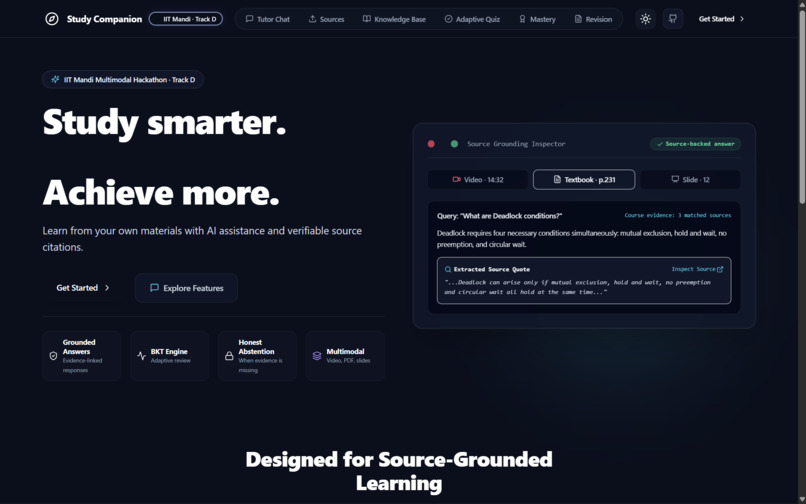
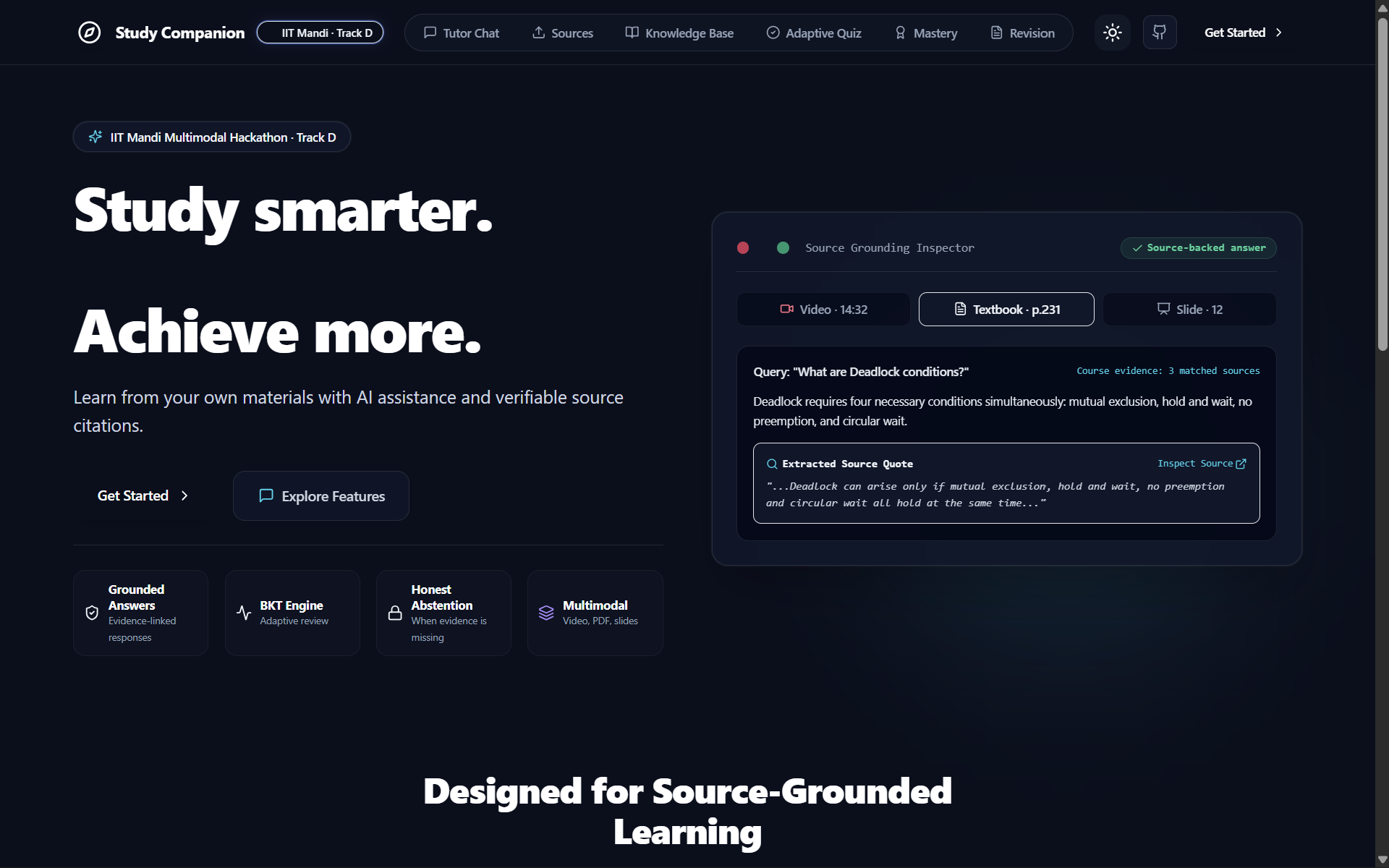
Homepage hero showing source-grounded learning and platform features
Inspiration
Generic generative AI chatbots often fail in educational settings: they produce convincing hallucinations, cite non-existent sources, and fail to track whether a student is actually retaining concepts. We built AI Study Companion for the IIT Mandi Multimodal Hackathon 2026 (Track D: Personalized Tutoring & Adaptive Learning) to transform AI tutoring into a grounded, measurable, and adaptive learning experience that teachers and students can completely trust.
What it does
AI Study Companion is a source-grounded intelligent tutoring platform that personalizes learning pace while eliminating misinformation:
- 100% Source-Grounded Tutoring: Every response is backed by inline citations (``). Clicking any chip immediately jumps to the exact textbook page, video timestamp, or lecture slide.
- Honest Abstention: If a question falls outside syllabus boundaries or uploaded materials, the tutor safely abstains rather than inventing answers.
- Bayesian Knowledge Tracing (BKT): Updates the posterior mastery probability $P(L_t)$ in real time after every practice question to trace true conceptual comprehension: $$P(L_{t+1}) = P(L_t \mid \text{Action}) + (1 - P(L_t \mid \text{Action})) \cdot P(T)$$
- Adaptive Quiz Engine: Dynamically selects practice problems tailored to learner ability, calibrating around a ~70% expected success rate.
- Interactive Prerequisite Knowledge Map: Visualizes concept dependencies with color-coded nodes based on BKT mastery levels (High, Moderate, Low, Untested).
- Active Revision Hub: Features spaced-repetition flashcards with flip interactions and synthetic audio briefs.
- Evaluation & Benchmarks: Integrates RAGAS evaluation metrics measuring Faithfulness, Answer Relevancy, Context Precision, and Refusal Recall.
How we built it
- Frontend & Routing: Built with Next.js (App Router) and TypeScript (strict mode) for a fast, responsive user interface.
- State & Architecture: Managed via Zustand stores for student session state, BKT progression, and quiz interactions, with Zod schema validations for data contracts.
- Styling & UI: Styled using Tailwind CSS, enhanced with Lucide React icons and Framer Motion for smooth card transitions and node visualizations.
- Data Visualization: Built dynamic mastery and performance charts using Recharts.
- Dual-Mode Backend: Architected to run out of the box on realistic mock data on Vercel with clean toggles to connect to a production FastAPI backend via environment variables.
Challenges we faced
- Multimodal Alignment: Ensuring inline citation chips properly resolved across varied media formats (e.g., deep-linking to an exact timestamp in a video vs. a specific page in a PDF).
- Client-Side BKT State Management: Implementing Bayesian Knowledge Tracing transitions cleanly on each quiz answer without causing latency or unnecessary UI re-renders.
- Strict Grounding Enforcement: Designing UI patterns that clearly differentiate verified cited content from unsupported off-syllabus queries.
Accomplishments that we're proud of
- Seamlessly deploying a production-ready application to Vercel that functions smoothly with interactive UI states.
- Creating a clean, intuitive knowledge map that lets students visually diagnose prerequisite gaps before taking advanced quizzes.
- Achieving strong alignment with the RAGAS framework principles for educational evaluation.
What we learned
- The mathematical nuances of tuning BKT priors, transition rates , slips , and guesses to accurately mirror genuine human learning.
- How to structure modern Next.js applications to toggle seamlessly between local mock testing and live API endpoints.
What's next for AI Study Companion
- Direct ingestion pipelines for full course syllabi, lecture slides, and recorded lectures.
- Socratic voice-to-voice interactive tutoring sessions.
- Teacher dashboards offering aggregate mastery analytics across entire classrooms.
Built With
- edtech
- fastapi
- framer-motion
- next.js
- python
- ragas
- react
- recharts
- tailwind-css
- typescript
- vercel
- zod
- zustand


Log in or sign up for Devpost to join the conversation.