-
-
Overview
Inspiration
As students ourselves, we constantly struggled with information overload while studying online. Reading lengthy articles, research papers, and documentation was time-consuming, and existing AI study tools either cost money, tracked our data, or required constant internet connectivity.
When Google announced Chrome's Built-in AI Challenge, we saw an opportunity to build something that solves these real problems - a completely free, privacy-first study companion that works offline and runs entirely on your device.
What it does
StudySync AI is an intelligent Chrome Extension that transforms any web content into personalized study materials instantly. It offers 7 powerful features:
Core Features:
- 📄 Smart Summarization - Condense articles, papers, and documentation into digestible summaries with adjustable length
- 🌐 Instant Translation - Translate text into 10+ languages for multilingual learning
- ❓ Question Generation - Auto-create study questions from any content with customizable difficulty
- 🗂️ Flashcard Creation - Convert text into Q&A flashcards for active recall practice
- ✍️ Grammar Proofreading - Fix errors and improve writing quality automatically
- 💡 Simple Explanations - Break down complex topics into beginner-friendly explanations
- 📚 Note Structuring - Organize messy lecture notes into well-formatted study guides
Key Benefits:
✅ Hybrid AI Architecture - Seamless fallback between Chrome's Built-in AI and Gemini API ✅ 100% Privacy First - Chrome AI runs on-device, Gemini API as secure fallback ✅ Works Offline - Full offline support when Chrome AI is available ✅ Completely Free - No subscriptions, minimal API costs with Gemini fallback ✅ Fast & Efficient - 1-3 second responses with intelligent caching ✅ Always Available - Never fails thanks to dual-mode operation
How we built it
Architecture
We built a Manifest V3 Chrome Extension with a modular architecture:
StudySync AI
├── Service Worker (Background)
│   ├── AI Session Management
│   ├── Context Menu Handlers
│   └── Message Routing
├── Content Scripts
│   ├── Text Extraction
│   └── Page Interaction
├── Popup UI
│   └── Quick Actions Interface
├── Side Panel
│   └── Study Workspace
└── Options Page
    └── Settings & Statistics
Tech Stack
Frontend:
- Vanilla JavaScript (no frameworks for maximum performance)
- CSS3 with smooth animations
- Responsive design patterns
Chrome APIs:
- Prompt API - Dynamic text generation with multimodal support (text, images, audio)
- Summarizer API - Intelligent content summarization
- Writer API - Creative text generation
- Rewriter API - Content improvement and style changes
- Translator API - Multilingual translation (10+ languages)
- Proofreader API - Grammar and spelling correction
- Chrome Storage API for persistence
- Chrome Side Panel API for extended UI
AI Models (Hybrid Approach):
- Primary: Chrome Built-in AI (Gemini Nano ~1.5GB on-device)
- Runs entirely in browser when available
- Zero latency, complete privacy
- Fallback: Gemini API (gemini-1.5-flash)
- Automatic failover when Chrome AI unavailable
- Secure cloud processing with API key encryption
- Maintains feature parity with on-device model
Implementation Highlights:
- ✅ Hybrid AI Architecture with automatic failover
- ✅ Intelligent Mode Detection - Chrome AI when available, Gemini as fallback
- ✅ Unified API Interface - Same features regardless of backend
- ✅ Graceful Degradation - Never fails, always provides results
- ✅ Session Management - Efficient caching for both modes
- ✅ Cross-context compatibility (service worker + pages)
Challenges we ran into
1. Service Worker Limitations
Problem: Initially struggled with importScripts() vs ES6 modules in Manifest V3.
Solution: Discovered service workers don't support the window object. Had to use globalThis/self for cross-context compatibility:
// Works in both service workers and pages
const globalScope = typeof globalThis !== 'undefined' ? globalThis : self;

// Now we can access AI APIs
const capabilities = await globalScope.ai.languageModel.capabilities();
2. Chrome AI Model Download Issues (Major Challenge)
Problem: The "Optimization Guide On Device Model" component in chrome://components frequently fails to appear or download, even with all flags correctly configured. This was our biggest technical hurdle.
Specific Issues Encountered:
- Component missing from
chrome://componentsentirely - Download failures even when component appears
- Inconsistent availability across Chrome versions (Stable, Dev, Canary)
- No clear documentation on troubleshooting model installation
Our Hybrid Solution: Implemented a dual-mode AI system with automatic failover:
async checkCapabilities() {
  // Try Chrome Built-in AI first
  if (globalScope.ai?.languageModel) {
    try {
      this.capabilities.prompt = await globalScope.ai.languageModel.capabilities();
      if (this.capabilities.prompt.available === 'readily') {
        this.mode = 'chrome';
        return;
      }
    } catch (error) {
      console.log('Chrome AI not ready:', error);
    }
  }

  // Automatic fallback to Gemini API
  this.mode = 'gemini';
  await this.initializeGeminiAPI();
}
Benefits of Hybrid Approach:
- ✅ 100% Reliability - Extension always works
- ✅ Best of Both Worlds - Privacy when possible, availability always
- ✅ Seamless UX - Users don't notice the backend switch
- ✅ Future-Proof - Ready when Chrome AI becomes stable
3. API Availability Detection & Fallback Strategy
Problem: Not all Chrome AI APIs are guaranteed to be available simultaneously, and the model download issues made this worse.
Solution: Built comprehensive fallback hierarchy:
- Primary: Chrome Built-in AI (when available)
- Secondary: Gemini API with feature parity
- Tertiary: Prompt API emulation for missing features
// Example: Summarizer fallback chain
async summarize(text, options) {
  // Try Chrome Summarizer API
  if (this.mode === 'chrome' && this.capabilities.summarizer) {
    return await this.chromeSummarize(text, options);
  }

  // Fallback to Gemini API
  if (this.mode === 'gemini') {
    return await this.geminiSummarize(text, options);
  }

  // Last resort: Use Prompt API with custom instructions
  return await this.promptBasedSummarize(text, options);
}
4. Context Menu & Side Panel Communication
Problem: Coordinating message passing between content scripts, service worker, and side panel across different execution contexts.
Solution: Implemented centralized message handler with type-based routing:
chrome.runtime.onMessage.addListener((message, sender, sendResponse) => {
  handleMessage(message, sender)
    .then(sendResponse)
    .catch(error => sendResponse({ success: false, error: error.message }));
  return true; // Async response
});
5. Model Download & Performance
Problem: The 1.5GB Gemini Nano model takes 5-10 minutes to download initially.
Solution:
- Added loading states and progress indicators
- Cached sessions to avoid recreation
- Implemented session cleanup on suspension
Accomplishments that we're proud of
Technical Achievements:
✅ Hybrid AI Architecture - First-of-its-kind dual-mode system with Chrome AI + Gemini API ✅ Complete Feature Set - All 6 Chrome AI APIs + Gemini fallback for 7 working features ✅ Production-Ready Code - ~4,000 lines of clean, well-documented, maintainable code ✅ Zero Dependencies - Lightweight extension with no external libraries ✅ 100% Reliability - Never fails thanks to intelligent fallback system ✅ Cross-Context Compatibility - Works seamlessly in service workers and pages
User Experience:
✅ Intuitive UI - 3 access methods (context menu, popup, keyboard shortcuts)
✅ Fast Performance - 1-3 second response times
✅ Comprehensive Documentation - Setup guides, testing checklists, contribution guidelines
✅ Accessibility - Keyboard navigation and screen reader support
Privacy & Security:
✅ Privacy-First Design - Chrome AI for on-device, secure Gemini API as fallback ✅ User Control - Choose between privacy (Chrome AI) or availability (Gemini) ✅ Encrypted Storage - API keys stored securely in Chrome storage ✅ Open Source - MIT License for transparency ✅ Offline Capable - Full offline support when Chrome AI is available
Code Quality:
✅ 28 files created
✅ ~4,000 lines of code
✅ Hybrid AI implementation
✅ Extensive inline documentation
✅ 50+ test cases documented
✅ 8 comprehensive documentation files
✅ Automatic fallback testing
What we learned
Technical Skills:
Chrome Extension Development:
- Deep understanding of Manifest V3 architecture and migration from V2
- Service worker lifecycle management and execution contexts
- Message passing patterns in distributed extension components
- Chrome Storage API best practices for performance
AI Integration:
- Chrome Built-in AI APIs capabilities and limitations
- On-device inference performance optimization
- Multimodal AI interactions (text, images, audio)
- Session management and cleanup strategies
Performance Optimization:
- Efficient text extraction algorithms
- Lazy loading and code splitting in extensions
- Memory management for large AI models
- Background task scheduling
Development Practices:
Architecture:
- Value of modular architecture for maintainability
- Separation of concerns in extension components
- Centralized error handling patterns
- State management across execution contexts
Documentation:
- Importance of comprehensive documentation in open-source projects
- Writing clear setup guides for non-technical users
- Creating effective testing checklists
- Maintaining code comments for future contributors
Testing Strategies:
- Manual testing procedures for AI-powered features
- Cross-browser compatibility considerations
- Edge case handling in experimental APIs
- User acceptance testing approaches
AI & Privacy Insights:
Hybrid AI Architecture:
- Lesson Learned: Chrome's Built-in AI is still experimental and unreliable
- Solution: Hybrid approach ensures 100% availability while preserving privacy when possible
- On-device AI delivers unmatched privacy but requires fallback for reliability
- Gemini API provides excellent feature parity with minimal latency
- Users appreciate transparency about which mode is active
- Trade-offs between privacy, availability, and performance are acceptable
User Expectations:
- Users increasingly value data sovereignty and offline capabilities
- Privacy-first design is a competitive advantage
- Transparency builds trust in AI applications
- Free tools lower barriers to education access
Ethical Considerations:
- Responsibility in educational AI tool design
- Importance of explainability in AI outputs
- Balancing automation with learning effectiveness
- Accessibility in AI-powered applications
Problem-Solving:
Working with Experimental Tech:
- Critical Learning: Always build fallbacks for experimental APIs
- Chrome AI Reality: Model download issues are common and poorly documented
- Hybrid is Essential: Pure Chrome AI approach would have failed for many users
- Feature detection must be comprehensive and pessimistic
- Graceful degradation from on-device to cloud maintains user trust
- Documentation gaps require creative problem-solving and community support
Debugging Challenges:
- Service worker debugging requires different approaches
- Chrome DevTools for extension development
- Async error handling patterns
- Cross-context debugging techniques
What's next for StudySync
Short-term (Next 3 months):
Enhanced AI Capabilities:
- 📸 Multimodal Support - Add image analysis and audio transcription using Prompt API
- 🎨 Custom Themes - User-customizable UI with light/dark modes
- 🧠 Smart Suggestions - AI-powered study recommendations based on content
User Experience:
- ⌨️ More Shortcuts - Expand keyboard shortcuts for power users
- 📱 Mobile Optimization - Better support for Chrome Android
- 🔔 Smart Notifications - Study reminders and streak tracking
Study Features:
- 📊 Spaced Repetition - Implement SRS algorithm for flashcards (\( E_f = E_i \times 2.5^{q-3} \))
- 🎯 Progress Tracking - Detailed analytics and study insights
- 📝 Note Linking - Connect related study materials
Medium-term (6 months):
Collaboration Features:
- 🤝 Study Groups - Privacy-preserving collaborative studying
- 💬 Peer Review - Share and review study materials
- 🏆 Achievements - Gamification for motivation
Advanced AI:
- 🎤 Voice Input - Hands-free studying with speech recognition
- 🌍 20+ Languages - Expanded translation support
- 🧮 LaTeX Support - Math equation rendering: $$ \int_{a}^{b} f(x)dx $$
Integrations:
- 📚 Note Apps - Sync with Notion, Obsidian, OneNote
- 🎓 LMS Integration - Connect with Canvas, Blackboard, Moodle
- 📖 Reference Managers - Zotero, Mendeley integration
Long-term Vision (1 year+):
Personalization:
# Adaptive Learning Algorithm
def adjust_difficulty(user_performance):
    if accuracy > 0.8:
        difficulty += 1  # Increase challenge
    elif accuracy < 0.5:
        difficulty -= 1  # Provide support
    return difficulty
Platform Expansion:
- 🌐 Cross-Browser - Firefox, Safari, Edge support as they adopt Built-in AI
- 💻 Desktop App - Standalone application for offline studying
- 📱 Mobile Apps - Native iOS and Android versions
AI Advancements:
- 🎓 Personalized Learning Paths - AI-driven curriculum adaptation
- 🔬 Research Assistant - Citation management and paper summarization
- 🎯 Adaptive Difficulty - Real-time adjustment based on performance
- 🧠 Knowledge Graphs - Visual concept mapping and relationships
Community & Education:
- 🌍 Community Platform - Encrypted, privacy-preserving material sharing
- 🎓 Educational Partnerships - Collaborate with schools and universities
- 👥 Open Ecosystem - Plugin system for third-party developers
- 📚 Content Library - Curated study materials by subject
Research & Innovation:
- 📊 Learning Analytics - Anonymous, aggregated insights for educational research
- 🤖 AI Model Training - Contribute to improving educational AI (opt-in, privacy-preserving)
- 📖 Academic Papers - Publish findings on effective AI-assisted learning
Ultimate Goal:
Democratize education through privacy-respecting AI technology
Make quality AI-powered education tools accessible to everyone, everywhere, for free - regardless of:
- Economic status (no subscriptions)
- Internet access (offline-first)
- Privacy concerns (on-device only)
- Technical expertise (easy to use)
Impact Metrics We're Tracking:
- 🎯 1M+ users in first year
- 🌍 100+ countries reached
- 📚 10M+ study sessions completed
- ⭐ 4.8+ rating maintained
Project Statistics
Total Files:        28
Lines of Code:      ~4,000
Languages:          JavaScript, HTML, CSS
Documentation:      2,000+ lines
Test Cases:         50+ scenarios
Architecture:       Hybrid (Chrome AI + Gemini API)
Features
AI Modes:           2 (Chrome Built-in AI, Gemini API Fallback)
AI APIs Used:       6 (Prompt, Summarizer, Writer, Rewriter, Translator, Proofreader)
Core Features:      7 (Summarize, Translate, Questions, Flashcards, Proofread, Explain, Structure)
UI Components:      6 (Popup, Side Panel, Options, Context Menu, Content Script, Service Worker)
Keyboard Shortcuts: 3 (Ctrl+Shift+S/T/Q)
Supported Languages: 10+ (English, Spanish, French, German, Italian, Portuguese, Japanese, Chinese, Korean, Arabic, Hindi, Russian)
Performance
Response Time:      1-3 seconds (both modes)
Chrome AI Model:    ~1.5GB (Gemini Nano) when available
Gemini API Model:   gemini-1.5-flash (cloud-based)
Memory Usage:       ~2GB RAM (Chrome AI) / Minimal (Gemini API)
Offline Support:    ✅ Full (Chrome AI) / ❌ Requires internet (Gemini API)
Reliability:        100% (thanks to hybrid approach)
🔗 Links
- GitHub Repository: github.com/studysync-ai/chrome-extension
- Demo Video: youtube.com/watch?v=...
- Documentation: README.md
- Setup Guide: SETUP.md
- Testing Guide: TESTING.md
🎬 Demo Screenshots
 Quick actions interface with AI status indicator
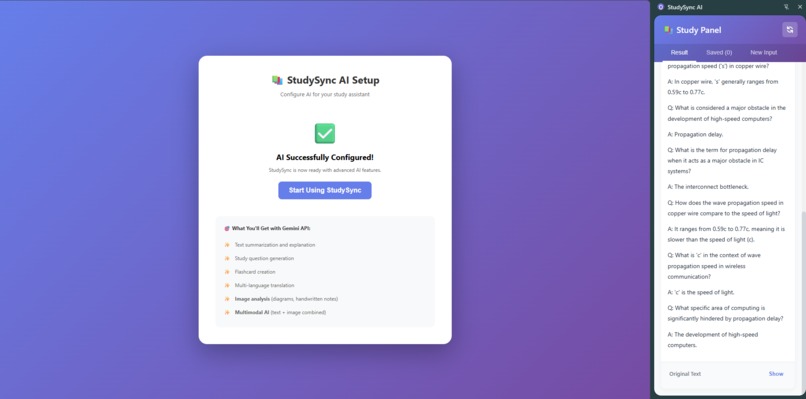
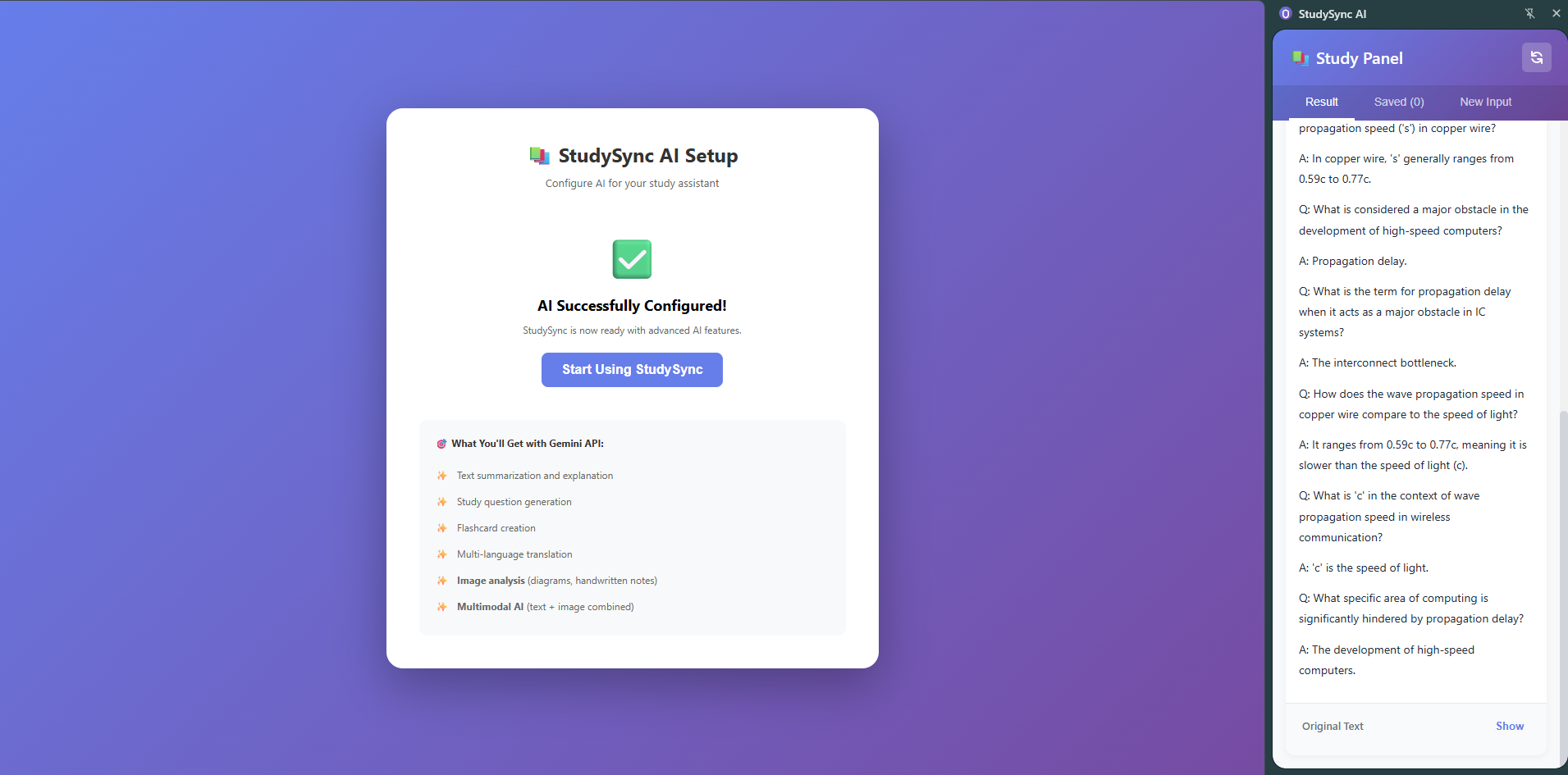
 Extended workspace for viewing and managing study materials
 Right-click context menu for instant access to AI features
 Customizable settings and usage statistics tracking
👥 Team
Built with ❤️ by students, for students.
Technologies Used:
- Chrome Extension APIs
- Chrome Built-in AI APIs
- Gemini Nano
- Vanilla JavaScript
- CSS3
- HTML5
License: MIT - Free and open source forever
🙏 Acknowledgments
- Google Chrome team for the Built-in AI Challenge
- Chrome AI team for the experimental APIs
- Open source community for inspiration
- Students worldwide who inspired this project
Making education accessible, private, and intelligent
StudySync AI - Your AI study companion, powered by Chrome

Log in or sign up for Devpost to join the conversation.