-
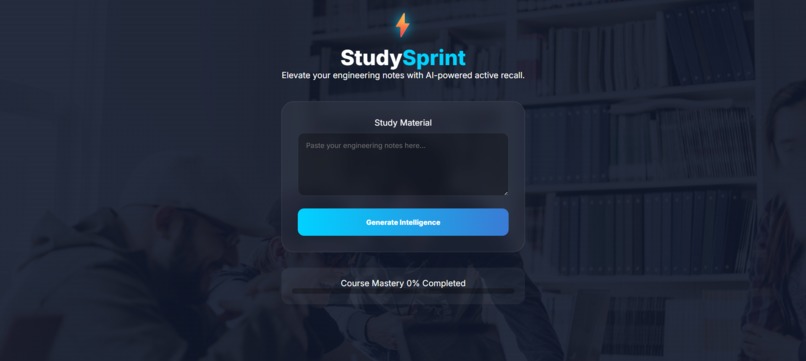
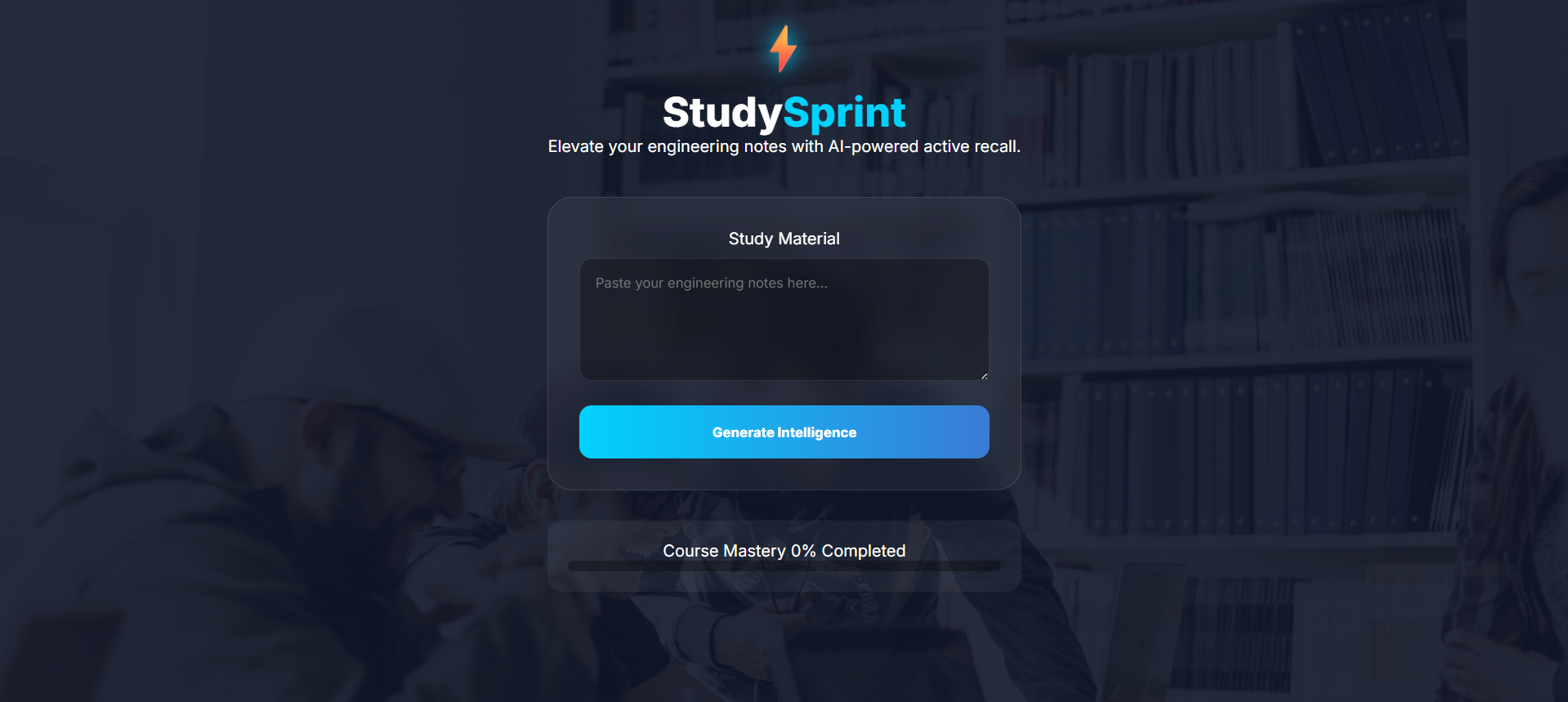
THIS IS MY USER INTERFACE
Inspiration As students at Chandigarh University, we noticed a recurring pattern: the "Pre-Exam Panic." With hundreds of pages of lecture notes and limited time before MSTs, students often default to passive reading—which is the least effective way to learn. We wanted to build a tool that forces Active Recall (the gold standard of learning science) but removes the friction of creating study materials manually.
What it does Study Sprint is an AI-powered academic pilot. It takes any text—from engineering formulas to history notes—and uses Gemini 3 Flash to synthesize them into interactive flashcards.
It identifies "Exam-Critical" concepts.
It tracks user mastery through a real-time progress bar.
It gamifies the experience with visual rewards (Confetti) once a unit is mastered.
It provides a distraction-free, Glassmorphism-based UI for deep focus.
How we built it The project is built using a modern web stack and cutting-edge AI:
Intelligence: Google Gemini 3 Flash API for PhD-level reasoning and rapid content generation.
Frontend: A custom-coded HTML5/CSS3 interface featuring Glassmorphism, smooth 3D card-flip animations, and CSS Keyframe animations.
Logic: Vanilla JavaScript for state management (mastery tracking) and API integration.
Libraries: canvas-confetti for the celebration logic and Google Fonts for typography.
Challenges we ran into One of the biggest hurdles was Prompt Engineering. We didn't want the AI to just summarize; we needed it to think like a CU Professor. It took several iterations to ensure Gemini returned a clean JSON array without extra text so the web app wouldn't crash. We also had to manage "Event Bubbling" in JavaScript to ensure that clicking the "Mastery" button didn't accidentally flip the card back and forth.
Accomplishments that we're proud of Zero-Friction UX: We created a system where a student can go from "Overwhelmed" to "Studying" in under 10 seconds.
Visual Polish: Building a professional-grade Dark Mode UI that feels like a premium SaaS product.
Speed: Leveraging the Flash model to ensure that even complex engineering notes are processed in near real-time.
What we learned We learned the power of Context-Window management and how to use AI for specific utility rather than just general chat. Personally, we grew our skills in Asynchronous JavaScript and learned how to design interfaces that stay responsive while waiting for heavy AI computations.
What's next for Study Sprint CUIMS Integration: Directly fetching notes from the university student portal.
Multi-Format Support: Allowing students to upload PDFs, PPTs, or even photos of handwritten notebook pages.
Social Learning: A "Squad Mode" where hostel-mates can compete to see who masters a unit first.
Hinglish Support: Using Gemini’s multilingual capabilities to explain complex physics or math concepts in easy-to-understand local dialects.

Log in or sign up for Devpost to join the conversation.