-
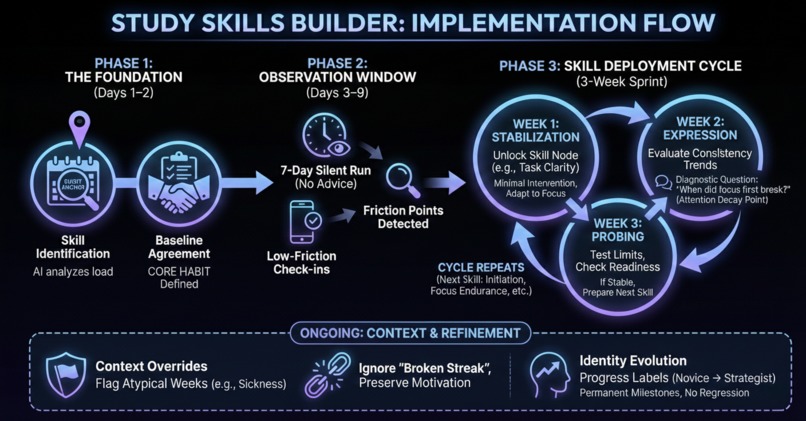
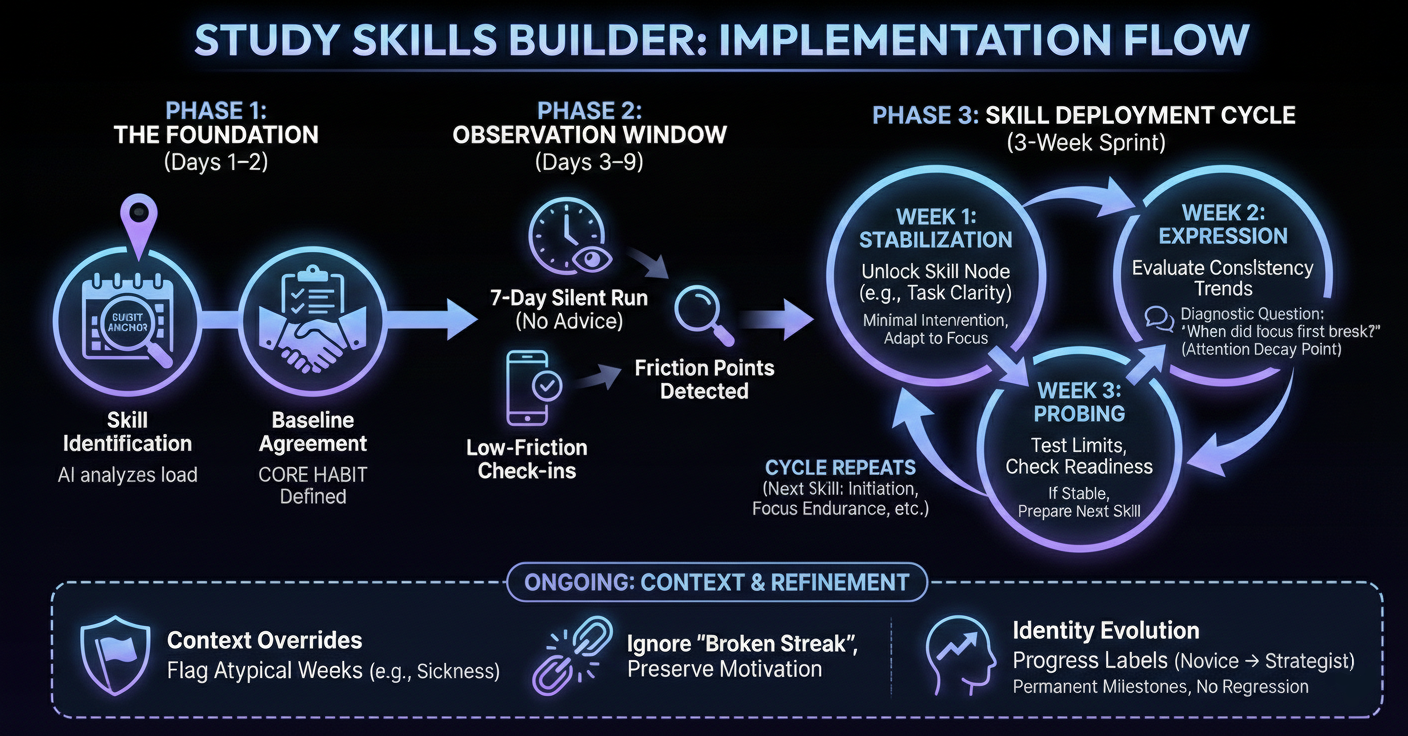
Implementation Flow
Inspiration
We noticed that most productivity apps have a huge flaw: they assume you already know how to study. They give you a place to list 50 tasks, but they don't help when you’re sitting there stuck with starting paralysis.
We wanted to treat studying like a gym routine. You don't just walk in and lift 200kg, but you build the skill first. We wanted to move away from habit trackers that make you feel guilty for missing a day and instead build a trainer that helps you get better at the actual process of focusing.
What it does
It’s basically a Skill Tree for the student's brain. Instead of just checking boxes, you level up through four tiers/leves: Task Clarity, Initiation, Focus Endurance, and Cognitive Recovery.
The Observation Phase: For the first 7 days, the AI doesn't give any advice. It just watches how you actually work to see where the real friction is.
Focus Decay: Instead of just timing how long you sit at a desk, the AI asks, “When did you actually stop paying attention?” This helps identify real cognitive limits.
Life Happens: If you get sick or have a brutal exam week, you can tell the AI. It won’t reset streaks or judge you, it just simply adjusts the data.
How we built it
The “brain” of the platform is powered by Groq, which handles the complex logic behind our behavioral engine.
Claude Code Course: To handle the harder programming and complex back-end architecture, we applied everything learned from a Claude Code course. This helped stabilize and optimize the heavy-duty coding side of the project.
The 3-Week Cycle: Each skill runs on a 3-week loop. Week 1 is adaptation, Week 2 looks for consistency patterns, and Week 3 tests readiness to level up.
AI-Assisted Design: We also used AI to help us draft the Markdown documentation and fine-tune the logic within the System Prompt. This really helped us organize the project's "brain" and documentation much faster than doing it all from scratch.
Low Friction: Daily check-ins take under one minute. If tracking feels like work, people won’t stick with it.
Hosting with Railway: We used Railway to host our server. It was a lifesaver because it handled all the deployment and back-end management automatically, making sure the platform stayed live and stable without us having to worry about complex server setup.
Challenges we ran into
Finding the Right API: We needed something fast, reliable, and affordable for a hackathon project. Groq ended up being the perfect fit for running our AI features.
The Psychology Side: Designing a skill system that feels helpful -not annoying- was harder than expected. We did research to make sure the Skill Tree made psychological sense and could improve with feedback.
Noisy Data: People aren’t robots. Teaching the AI to tell the difference between procrastination and real-life emergencies was a major challenge.
Accomplishments that we're proud of
Solid Prompting: We were concerned the AI might drift into therapist mode or give generic life advice, but our prompt engineering worked. It stays firmly in the role of a study trainer with clear boundaries.
The Decay Metric: Our focus tracking is far more useful than a standard timer, and it gives genuinely actionable insight.
Shame-Free UX: The system never treats a bad day as failure, just as data to learn from.
What we learned
The biggest problem isn’t the work itself, it’s the skills around the work. If you fix how you start, the what gets done much more easily. We also learned that AI tools must be flexible; because the moment a system feels rigid, users abandon it during their first busy week.
What's next for Study Skills Builder - مطوّر مهارات الدراسة
Psychological Deep Dive: We want to improve the psychological side of the plan by implementing proven frameworks from resources like Atomic Habits. This will make sure the system is backed by the best habit and skill formation science to ensure it actually works long-term.
Making It an App: Bringing the platform to iOS and Android so it’s always available for quick Focus Rescues.
Smart Phone Usage Integration: we want to add a feature that looks at your phone usage data (with your permission, of course). The goal isn't to judge for being on your phone, but to help the AI find your "quiet windows", those times during the day when you naturally stay off your device, so it can suggest those as the best, low-distraction times for you to study.
Front-End Polish: We want to refine the UI and make the Skill Tree feel even more game-like as users level up. Using AI to personalize the entire experience, including adapting the UI based on user stress levels.
Built With
- claude-code
- github
- groq
- postgresql
- prisma
- railway


Log in or sign up for Devpost to join the conversation.