-
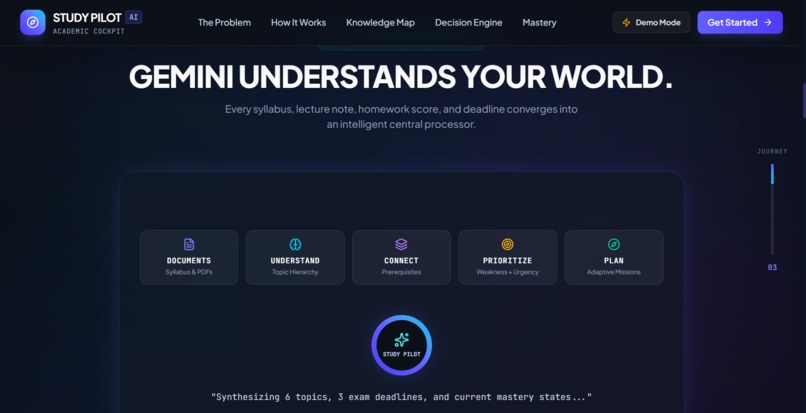
Adaptive Learning → demonstrates that Study Pilot actually learns from the student's performance
-
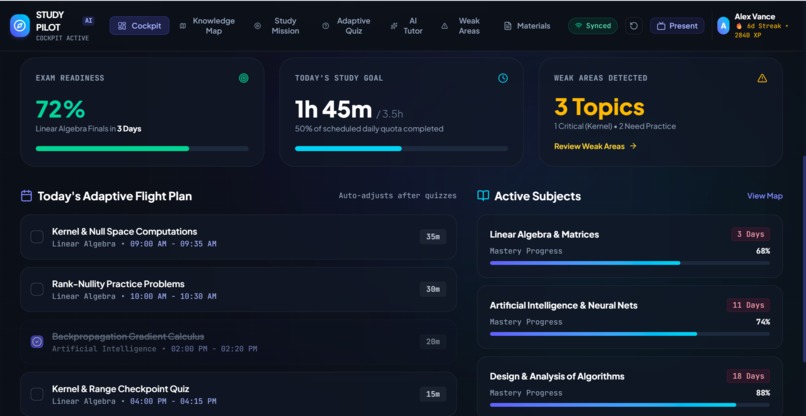
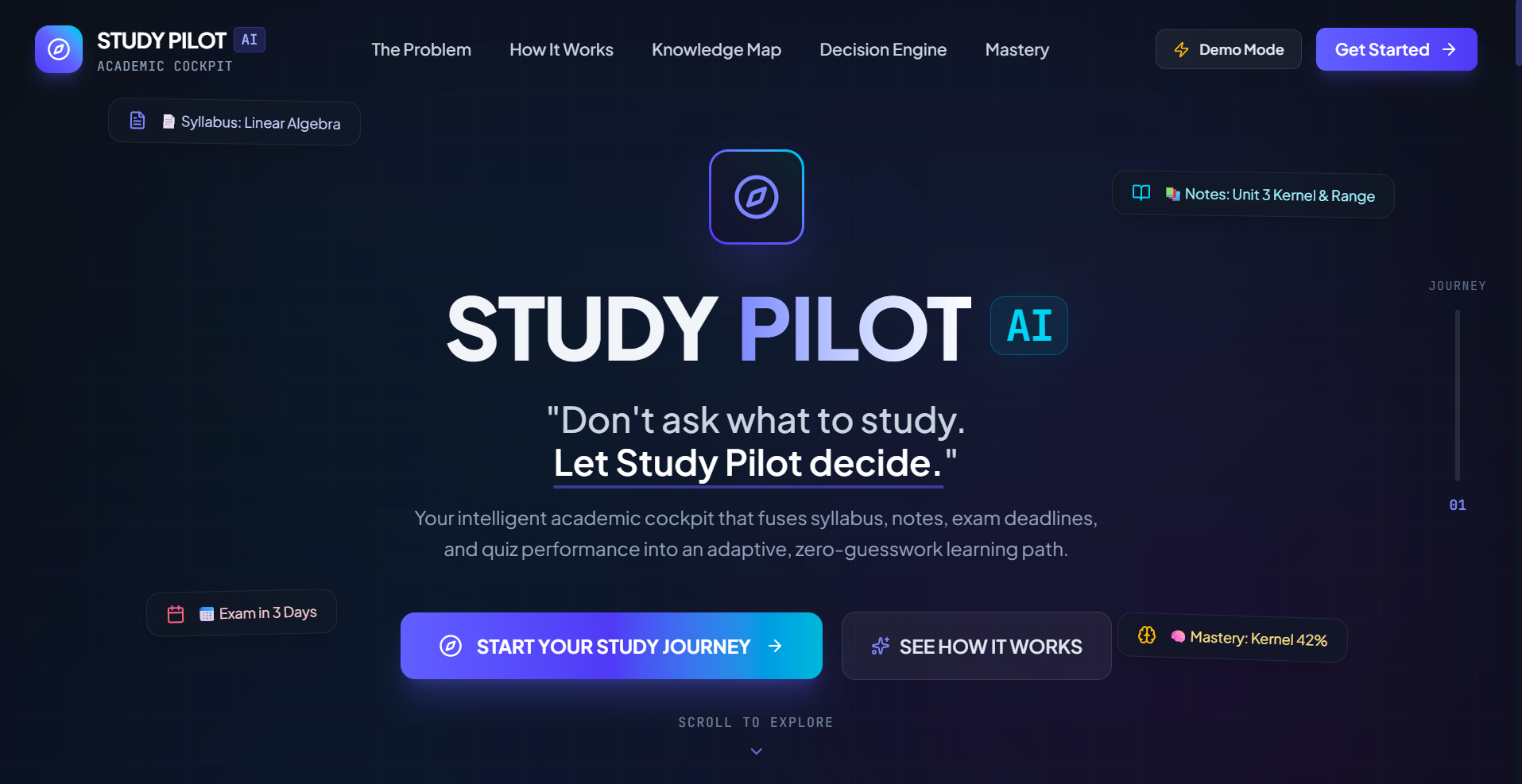
Example how it look likes after login
-
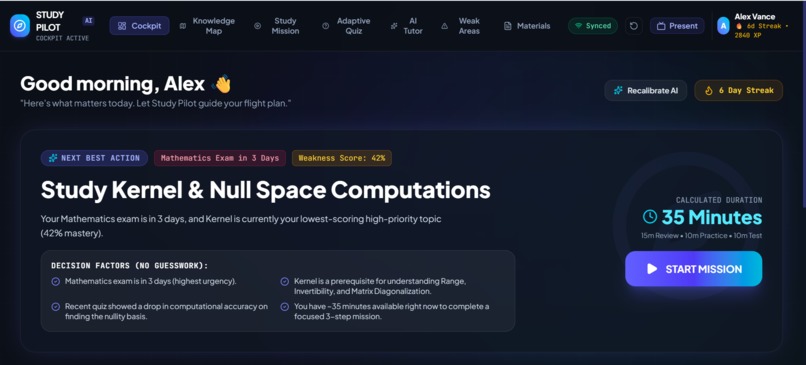
Login and use your self freely
-
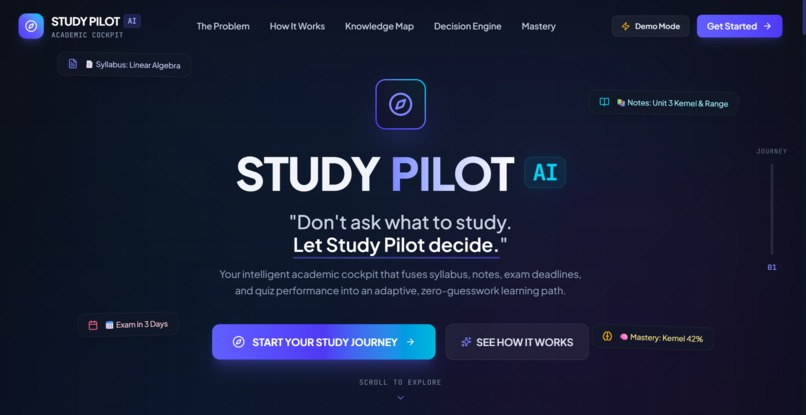
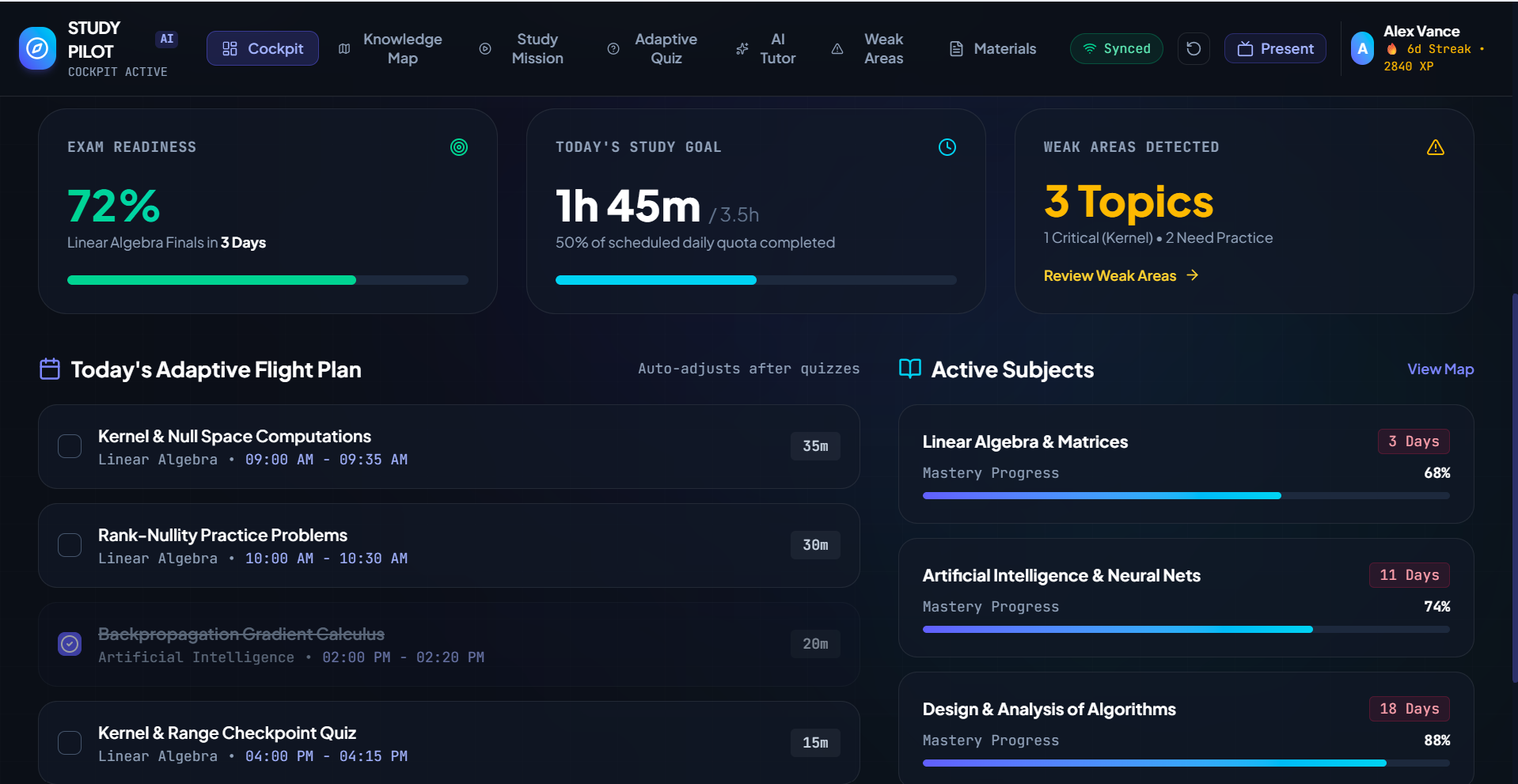
Dashboard → shows the complete product
-
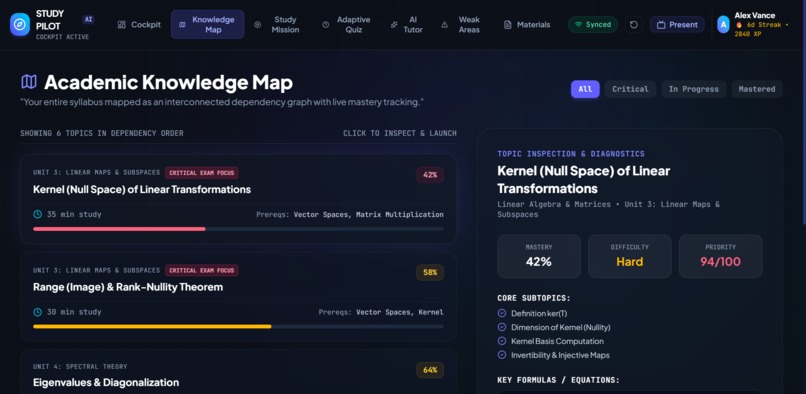
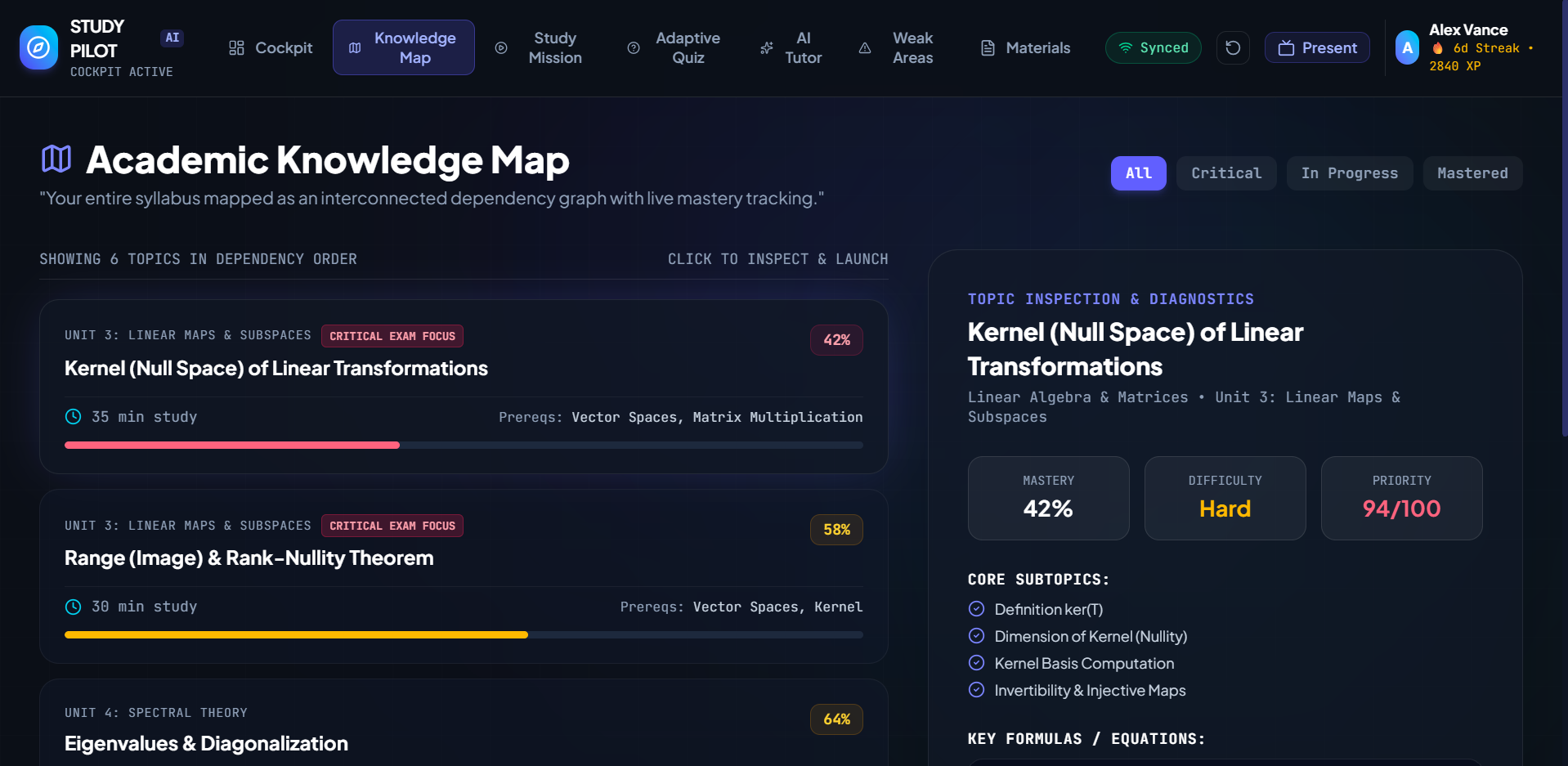
AI Built Knowledge map for us
Inspiration
Students rarely struggle because they have no study material. More often, they struggle because they have too much information and no clear idea what to do next.
Syllabi, PDFs, notes, assignments, exam dates, and quiz results are scattered across different places. A traditional study planner can create a schedule, and a chatbot can answer questions, but neither truly understands the student's complete academic situation.
That led us to one simple question:
What if an AI could act as a student's academic copilot and decide what they should focus on next?
This idea became Study Pilot AI — an intelligent academic copilot where the student is the pilot and AI helps navigate the journey toward exam readiness.
Our goal was not to build another AI chatbot. We wanted to build a system where AI understands, reasons about, recommends, teaches, evaluates, and adapts.
What it does
Study Pilot AI transforms a student's academic information into a personalized learning journey.
Students can provide:
- Syllabus and study materials
- PDFs and notes
- Exam dates
- Academic goals
- Available study time
- Current confidence levels
- Quiz and learning performance
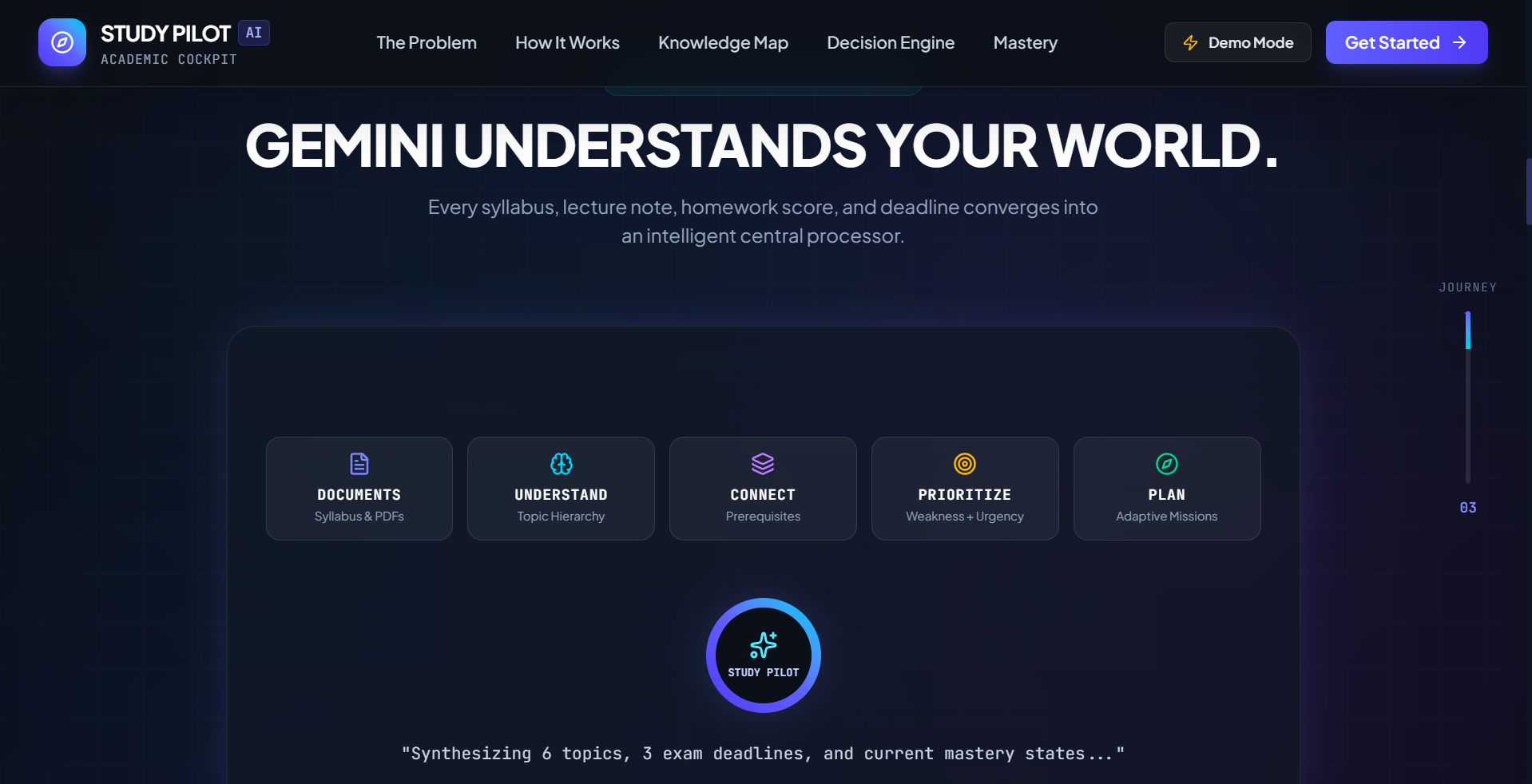
Study Pilot uses Gemini to understand this information and build an intelligent academic context.
Academic Material Analysis
Instead of simply summarizing uploaded documents, Study Pilot extracts:
- Units and chapters
- Topics and subtopics
- Important concepts
- Difficulty
- Prerequisites
- Estimated learning time
- Potentially important areas
It then organizes these concepts into an interactive Knowledge Map.
Personalized Study Planning
Study Pilot considers exam deadlines, topic importance, mastery, weaknesses, and available study time to generate a personalized study plan.
"What Should I Do Now?"
This is the core feature of Study Pilot.
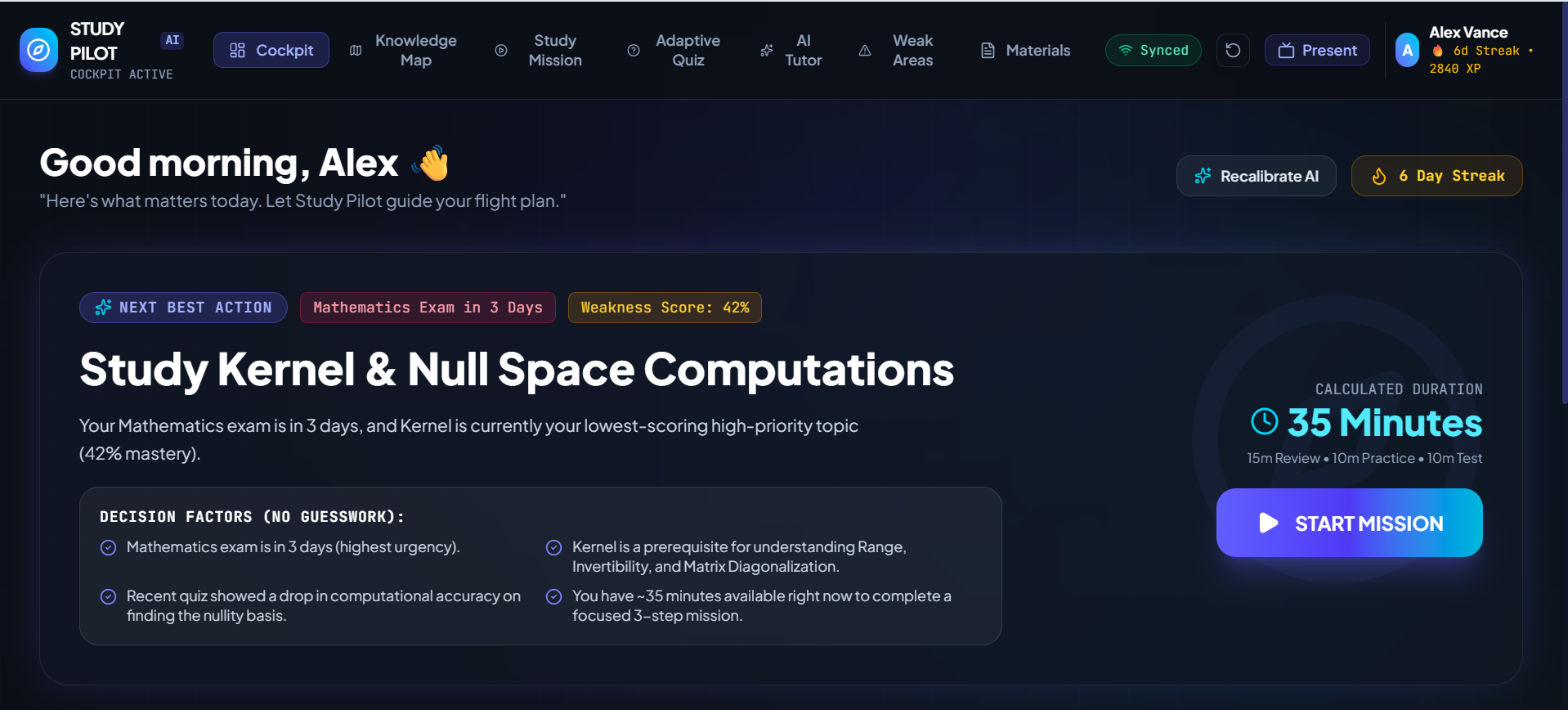
Instead of asking students to decide what to study, Study Pilot analyzes their current academic state and recommends their single highest-value next action.
For example:
Study Kernel & Range — 35 minutes
The recommendation is based on factors such as exam urgency, current mastery, topic importance, previous performance, and available time.
👨🏫 AI Tutor
Students can ask Study Pilot to:
- Explain concepts
- Give examples
- Simplify difficult topics
- Generate exam-level problems
- Explain mistakes
- Create quick revisions
The explanation can adapt to different modes such as beginner, exam-focused, deep understanding, visual learning, or quick revision.
Adaptive Quizzes
Gemini generates quizzes based on the student's topic, difficulty level, learning material, and previous performance.
After the quiz, Study Pilot analyzes the student's answers to identify patterns such as:
- Conceptual misunderstanding
- Calculation mistakes
- Misinterpretation
- Knowledge gaps
Adaptive Learning Loop
The most important part is that the system does not stop after generating a plan.
It continuously follows:
Learn → Practice → Test → Analyze → Adapt
If a student performs poorly on a topic, Study Pilot can increase its priority and adjust the recommended learning path.
This transforms the application from a static planner into an adaptive learning system.
How we built it
Study Pilot AI was built as a modern AI-powered web application with Gemini at the center of its intelligence layer.
Technology
- React + TypeScript for the frontend
- ** Vite** for development and bundling
- Tailwind CSS for the responsive interface
- Node.js + Express for the backend
- Google Gemini API for AI capabilities
- Structured JSON outputs for predictable AI-generated application data
We designed the application around several dedicated AI services, including:
- Academic Analysis
- Study Plan Generation
- Next Best Action
- AI Tutoring
- Quiz Generation
- Quiz Evaluation
- Weakness Analysis
Rather than using one generic prompt for everything, each major capability has a specific AI workflow.
Gemini Integration
Gemini is deeply integrated into the core product.
It is used to understand academic documents, identify topics, generate personalized learning plans, provide contextual tutoring, create assessments, analyze performance, and help determine the student's next best learning action.
For structured application data, we use structured outputs so Gemini responses can be safely transformed into application objects such as topics, study missions, quizzes, recommendations, and weakness reports.
We also designed the system so that deterministic calculations, such as quiz scoring and mastery updates, are handled by application logic rather than relying entirely on AI-generated numbers.
Challenges we ran into
Making AI genuinely useful
One of our biggest challenges was avoiding the common pattern of simply adding a chatbot to an existing application.
We wanted Gemini to be responsible for meaningful decisions inside Study Pilot.
This required designing AI workflows where the model receives the right academic context and produces information that directly affects the student's experience.
Turning unstructured material into structured knowledge
Academic PDFs and notes contain information in many different forms.
We needed to transform that information into a usable knowledge structure containing topics, relationships, priorities, difficulty, and learning requirements.
Creating adaptive recommendations
A study plan should not remain static.
If a student performs poorly on a topic, the application needs to recognize that change and adapt the next recommendation.
Designing this feedback loop required combining AI analysis with deterministic application logic.
Building within hackathon constraints
With limited development time, we had to prioritize the features that demonstrated the strongest value.
Instead of trying to build an enormous education platform, we focused on one central experience:
Understand the student → decide what matters → recommend the next action → evaluate progress → adapt.
Accomplishments that we're proud of
We are especially proud that Study Pilot AI goes beyond being an AI-powered chatbot.
Gemini is part of the decision-making system
The application uses Gemini across multiple stages of the learning journey instead of using it as a single isolated feature.
We built the "Next Best Action" concept
The idea that a student shouldn't have to constantly decide what to study is at the heart of Study Pilot.
The application attempts to answer:
"Given everything I know about you, what is the most valuable thing you can do right now?"
We created an adaptive learning loop
Study Pilot connects learning, assessment, analysis, and planning into one continuous cycle.
We transformed academic information into a knowledge map
Instead of presenting documents as static files, Study Pilot turns them into a structured representation of the student's learning journey.
We focused on product experience
We designed Study Pilot to feel like a real AI product rather than a basic hackathon dashboard, with a polished interface, interactive visualizations, responsive design, and a storytelling-oriented experience.
What we learned
Building Study Pilot taught us that using AI effectively is much more than generating text.
We learned how important it is to:
- Design AI around a real user problem
- Give models the right context
- Use structured outputs for application workflows
- Combine AI reasoning with deterministic software logic
- Validate AI-generated data
- Design adaptive feedback loops
- Handle AI uncertainty and failures gracefully
- Optimize API usage
- Build interfaces that make AI decisions understandable to users
Most importantly, we learned that the best AI applications don't simply answer questions.
They can help users make better decisions.
What's next for Study Pilot AI
Study Pilot AI is only the beginning.
Future versions could include:
Mobile application
A mobile companion that allows students to access their study missions, quizzes, and AI tutor anywhere.
Voice-based Study Pilot
Students could simply ask:
"I have one hour before class. What should I study?"
and interact with their academic copilot through voice.
Deeper learning analytics
Track long-term performance and identify patterns in how individual students learn.
More advanced personalization
Study Pilot could learn which explanation styles, question types, and study strategies work best for each student.
More academic sources
Integration with additional educational resources could allow Study Pilot to build a richer academic context.
Collaborative learning
Students could create shared study rooms, collaborate on material, and use AI to facilitate group preparation.
Long-term academic planning
Instead of optimizing only for the next exam, Study Pilot could eventually help students plan entire semesters, courses, projects, and academic goals.
Our ultimate vision is simple:
Study Pilot should become the intelligent navigation system for a student's entire academic journey.
The student chooses the destination.
Study Pilot helps navigate the way.
Built With
- adaptive-learning
- ai-tutor
- express.js
- gemini
- generative-ai
- google-gemini-api
- node.js
- react
- tailwind-css
- typescript
- vite


Log in or sign up for Devpost to join the conversation.