-

Study Kit From Notes - the course material on the NAS becomes a revision kit
-
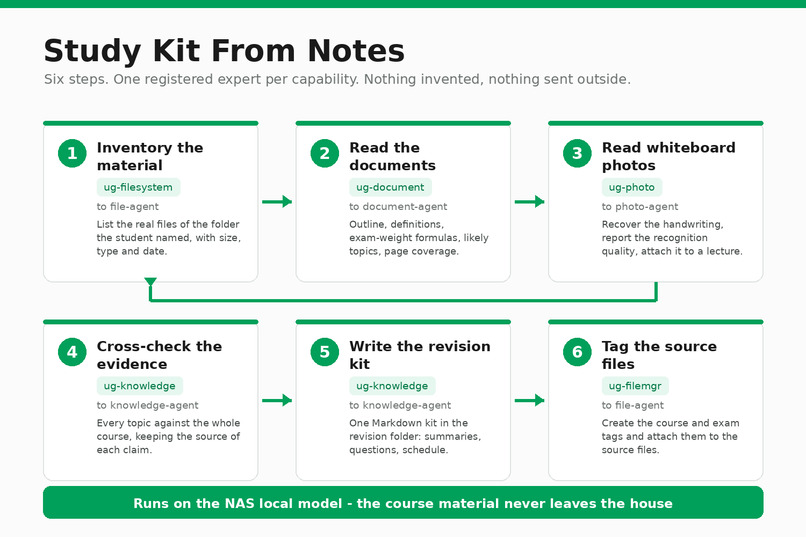
The six-step orchestration: every step is delegated to the registered expert that owns the capability
-
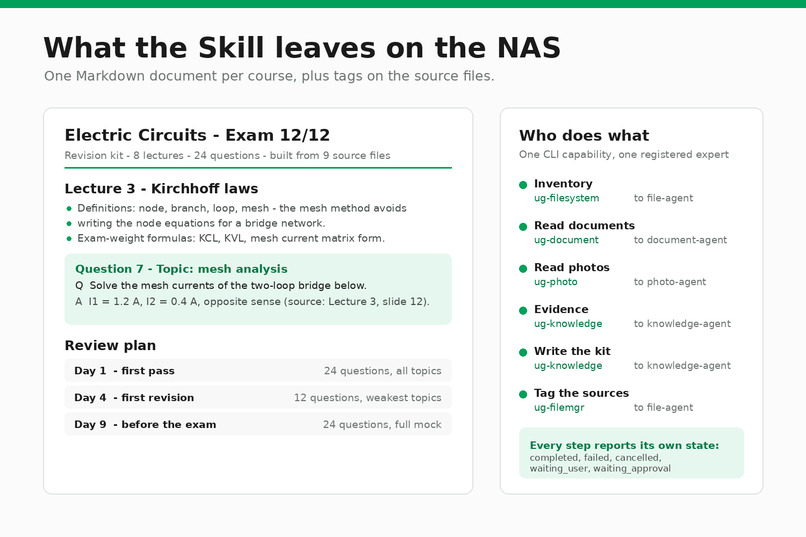
What the Skill writes on the NAS: summaries, a question bank with model answers, and the spaced-repetition plan


What it is
Study Kit From Notes is an AI Skill for the UGREEN AI NAS that turns the lecture material of a course into a single revision kit: a structured summary per lecture, an exam-style question bank with model answers, a spaced-repetition schedule, and the course and exam tags applied back to the source files.
The material is the stuff a student already keeps on the NAS: slide PDFs, handwritten notes, photos of the whiteboard. The problem is not storage, it is revision. The files sit in folders, in three formats, none of it shaped for the exam, so revision means rereading everything, and the whiteboard photos are effectively invisible because nobody reads them again. This is not a hypothetical problem: it is the entrant's own informatics course, with the exam two or three weeks away.
How it works
The Skill is an orchestration document. It performs no NAS operation itself: each step is delegated to the single registered expert that owns that capability, and every downstream step receives the real results of the upstream step.
Inventory - the file expert lists the real files of the scope the student named, with size, type and modification time.
Read - the document expert turns each file into a structured outline, the definitions and formulas that carry exam weight, the likely examination topics, and the page coverage.
Read the photos - the photo expert recovers the text of the whiteboard and handwritten notes, with the recognition quality, and attaches it to the lecture it belongs to.
Cross-check - the knowledge expert collects the evidence for every topic across the whole course, keeping the source document of each claim.
Write the kit - the knowledge expert saves one Markdown revision kit in the revision folder of the course: summary per lecture, question bank, and the schedule built on the real exam date.
Tag - the file expert creates the course tag and the exam tag and attaches them to the source files of the course.
Every step reports its own state. Empty results, unreadable files and partial reads are reported as they are, never replaced by invented content, and a question enters the bank only when the answer and its source lecture were both confirmed.
Why it is different
A chat assistant answers one question and forgets the course, which is the entrant's own first attempt: asking a chatbot to explain a data structure and getting a clean answer that had nothing to do with the slides on the NAS. A note application still needs the summary written by hand. Cloud study tools need the material uploaded off the home network and cannot read the whiteboard photos that live on the NAS. This Skill starts from the NAS as the single source of truth, works on photos as well as PDFs, and ends with a durable artefact on the device instead of a chat history. It runs on the local model of the NAS, so the material never leaves the house.
Status
The Skill package, the output template and the validation plan are complete, and the package passes the official static checker against the official capability catalogue with zero errors and zero warnings. The runs on real hardware are pending, because NAS access is granted only to the finalists of round two. The validation plan defines two core test cases and one edge case, all on synthetic and anonymised material.
What I learned
The hard part was not writing the workflow, it was respecting the capability contract: every CLI capability belongs to exactly one registered expert, so the Skill never performs a NAS operation itself and every downstream step consumes the real result of the upstream one. Writing the completion and failure handling before the happy path removed most of the risk: empty results, partial reads and the approval states are explicit, so the Skill reports what it really has instead of inventing the rest.
Challenges
Handling photos as well as PDFs was the first one: the photo capability returns a recognition quality, so the Skill reports a confidence instead of guessing, and a question without a confirmed source lecture is dropped rather than published. The second one is that round one has no NAS: the validation plan with two core cases and one edge case, all on synthetic material, was therefore written first and will be executed on the assigned testing day.
AI tools used
The Skill package and this proposal were prepared with the help of an AI coding assistant (Arena.ai Agent Mode), which was used for drafting the orchestration document and for the static validation of the package against the official capability catalogue. The entrant set the problem, the target user, the workflow, the scope limits, the test plan and the final wording, and reviewed, revised and approved the submitted material. At runtime the Skill uses the local AI model of the NAS, not any third-party model.
Third-party components
None embedded. The submitted package contains only Markdown: SKILL.md and three reference files, with no library, no binary, no executable and no manifest, and the Skill calls no external API. The only third-party material used is the UGREEN Skill Developer Package (uliya-skill-kit 0.7.3), the UGREEN public capability catalogue (version 2.0.0) and the Uliya Skill Development Standard, all of which belong to UGREEN.
Built With
- markdown
- ugos
- ugreen-ai-nas
- uliya


Log in or sign up for Devpost to join the conversation.