-
-
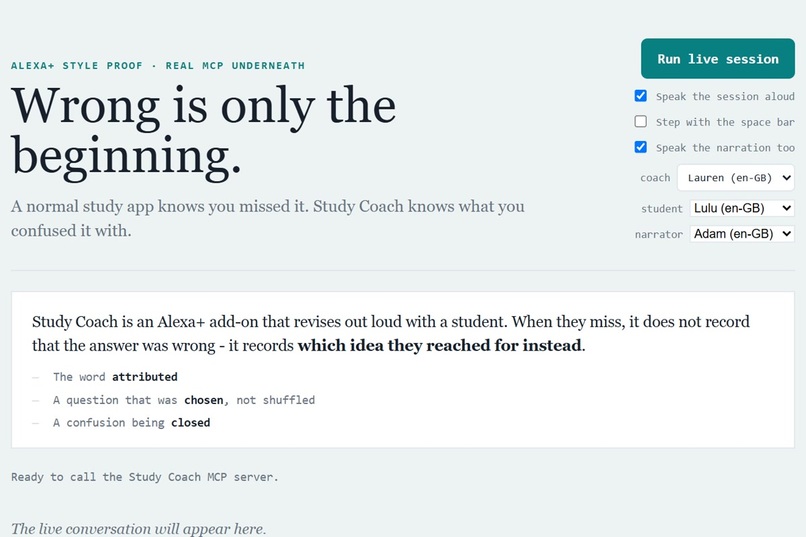
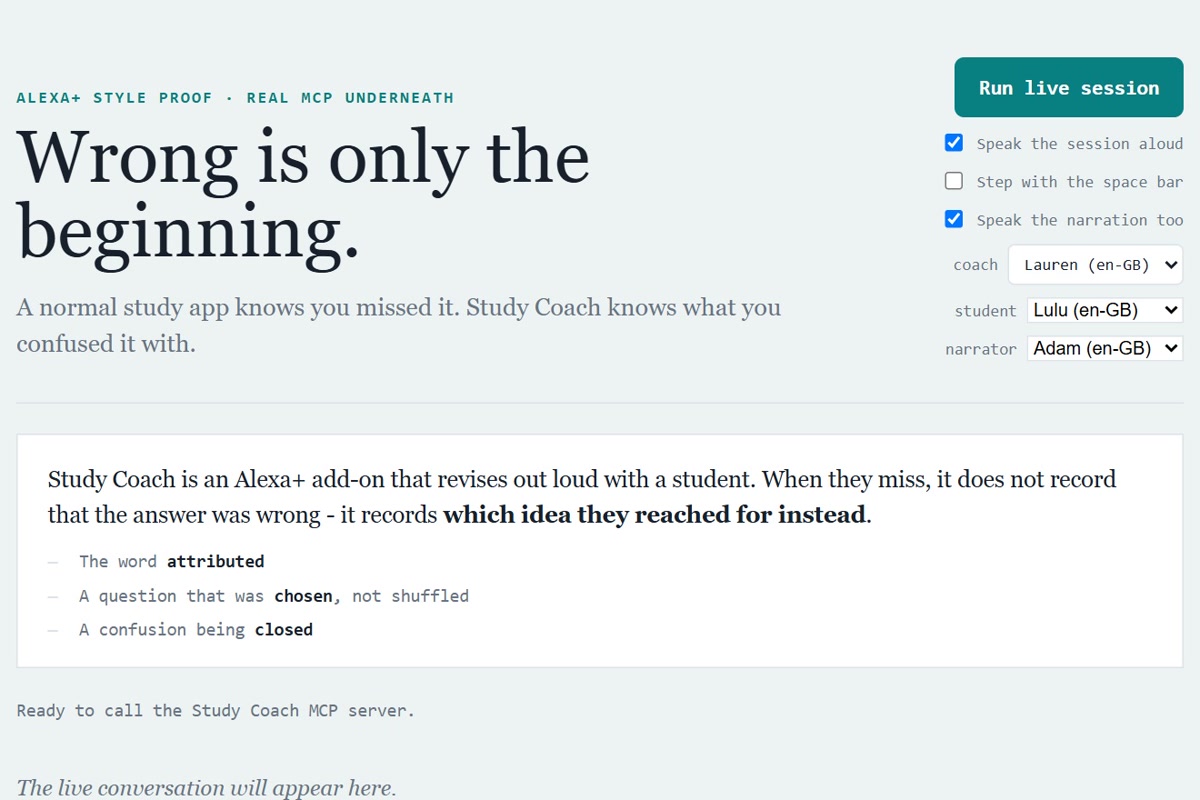
Marking an answer records one bit: wrong. Keeping which idea the student reached for instead is what everything else here is built on.
-
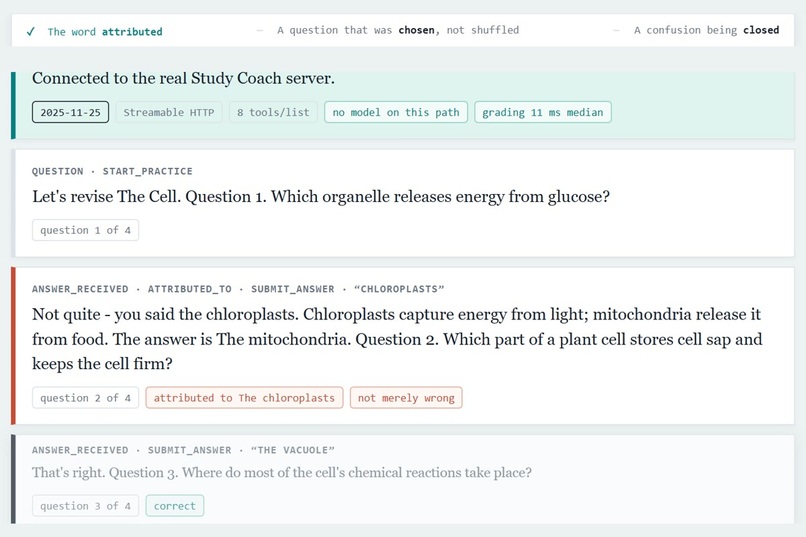
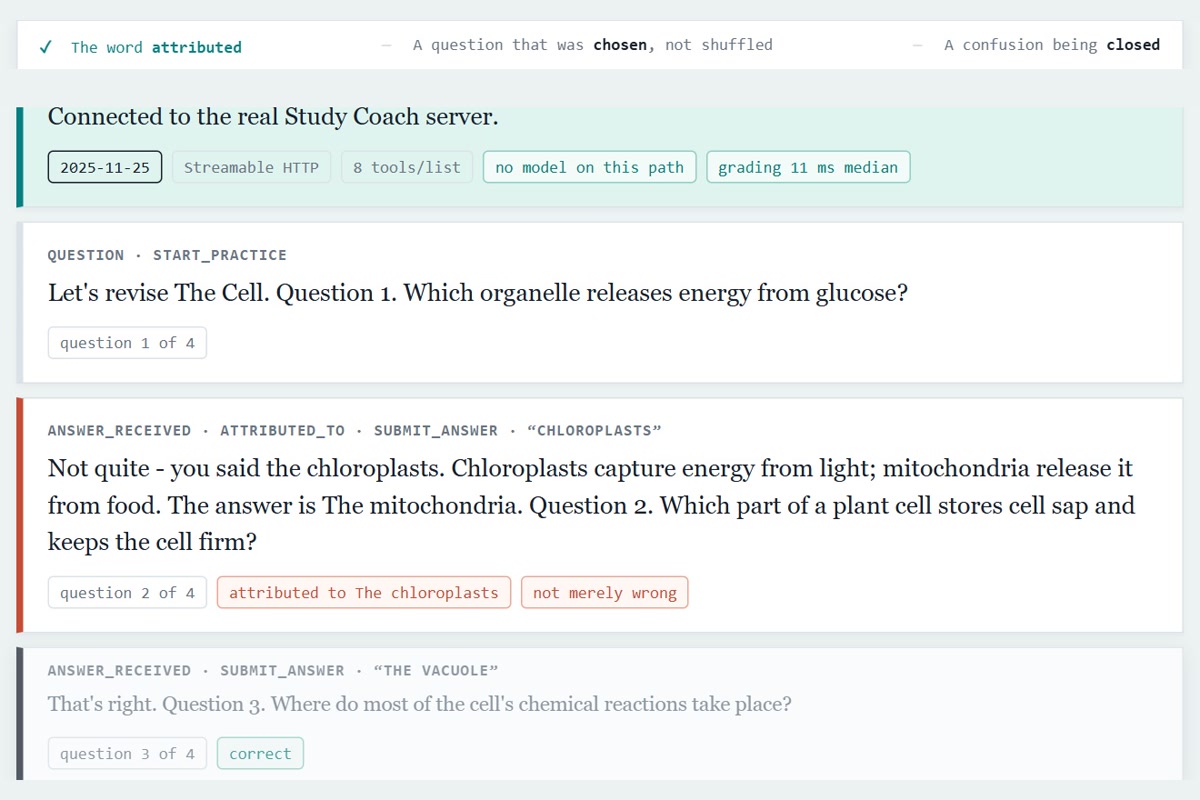
Not a mock-up. MCP spec 2025-11-25 over Streamable HTTP, eight tools, no model in the answer path, grading at 11 ms median.
-
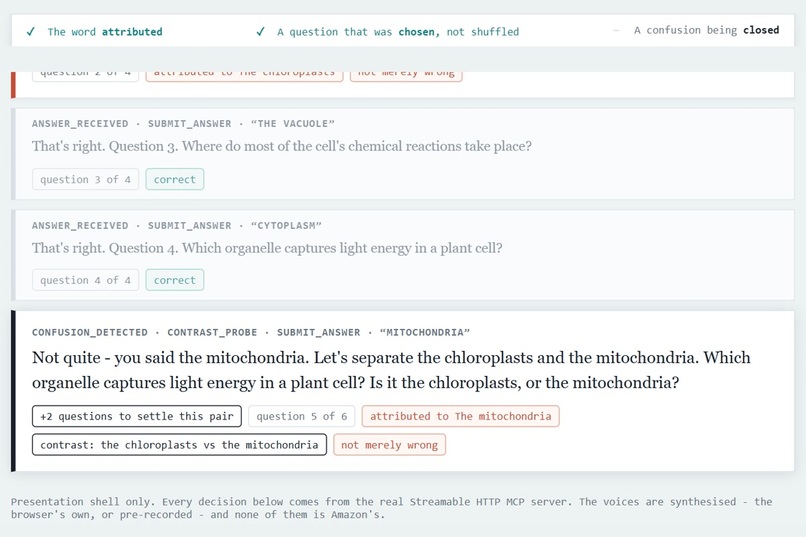
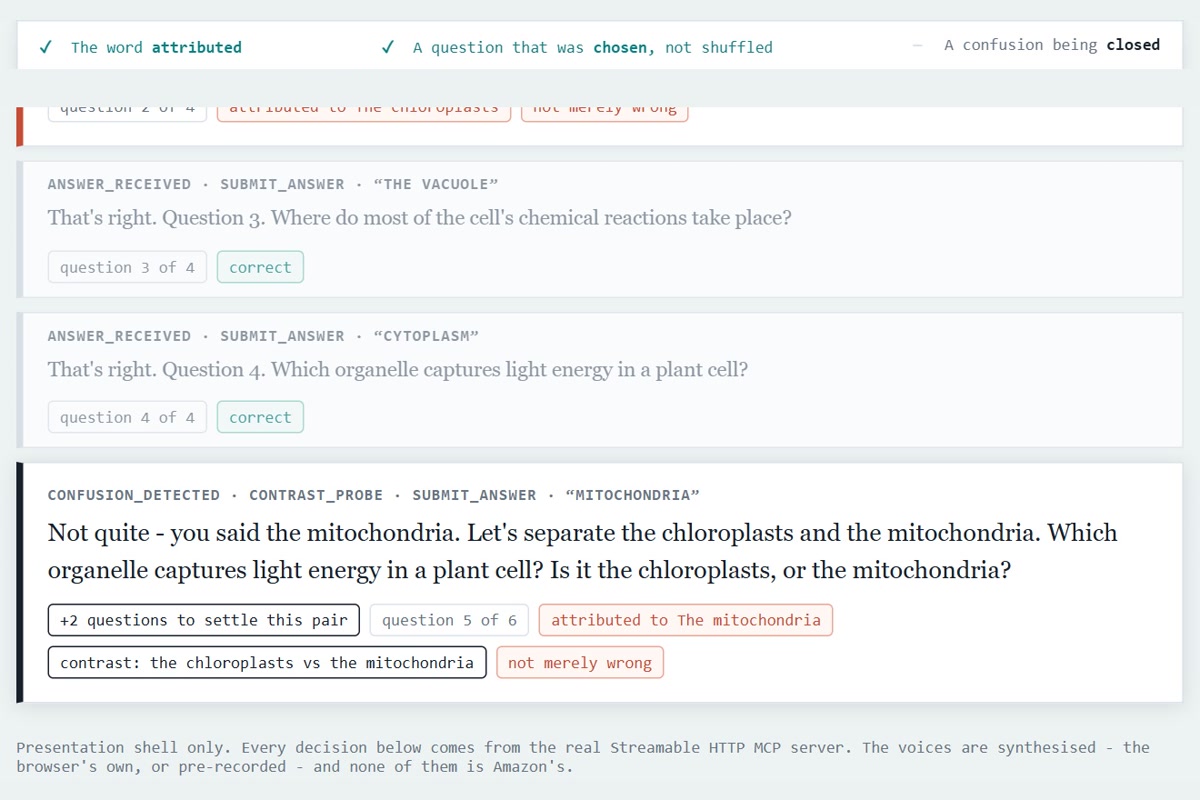
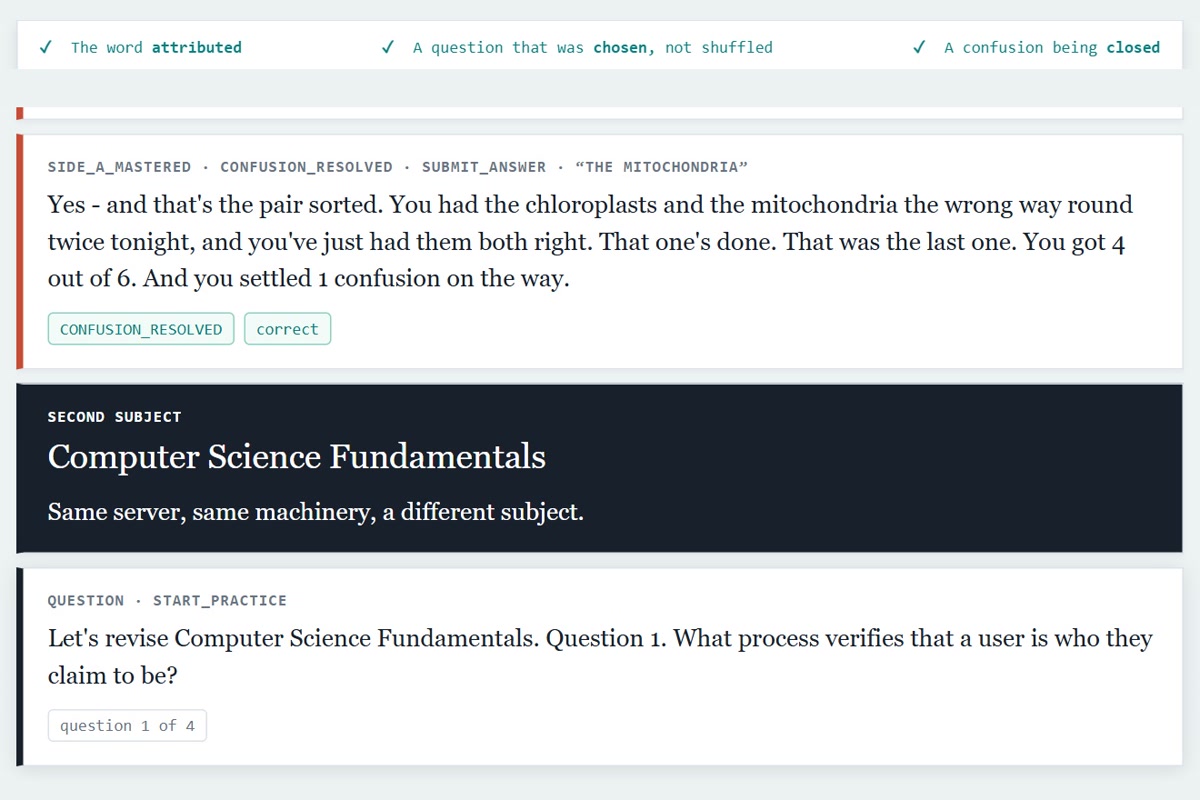
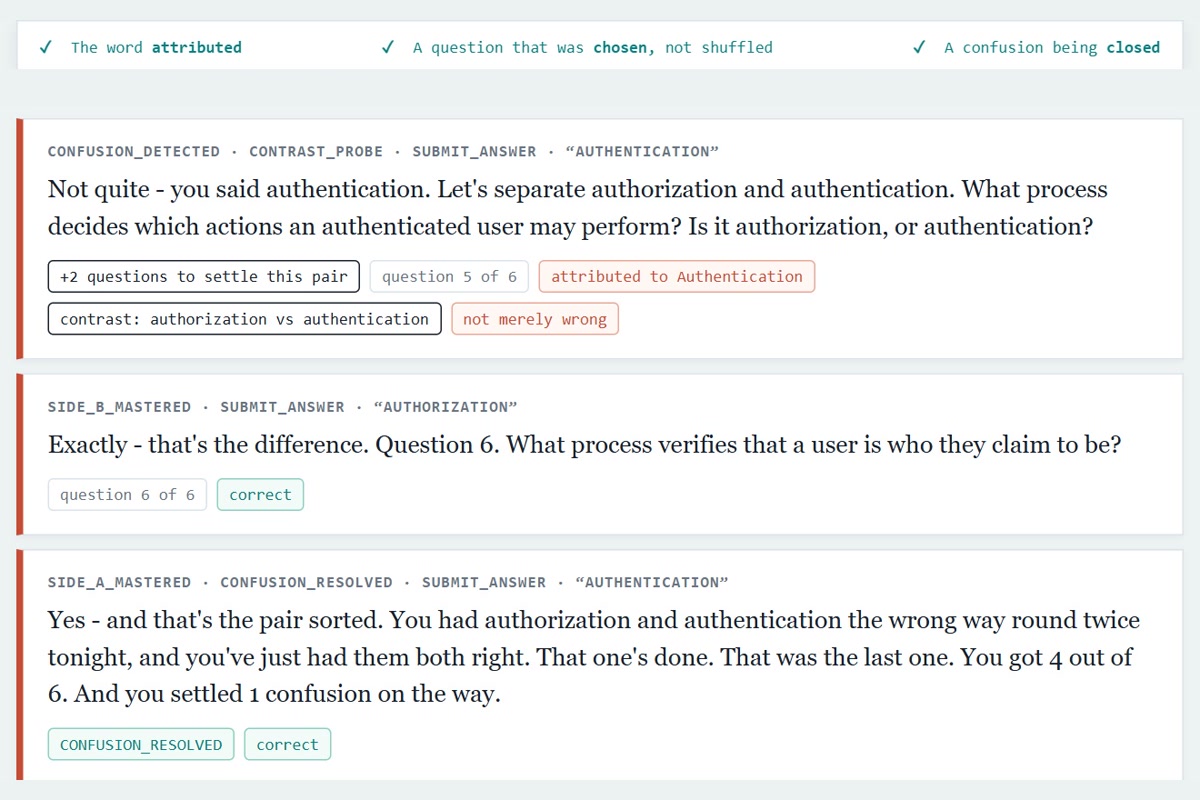
The answer is not scored but attributed: said the mitochondria, meant the chloroplasts. The contrast question is then chosen, not shuffled.
-
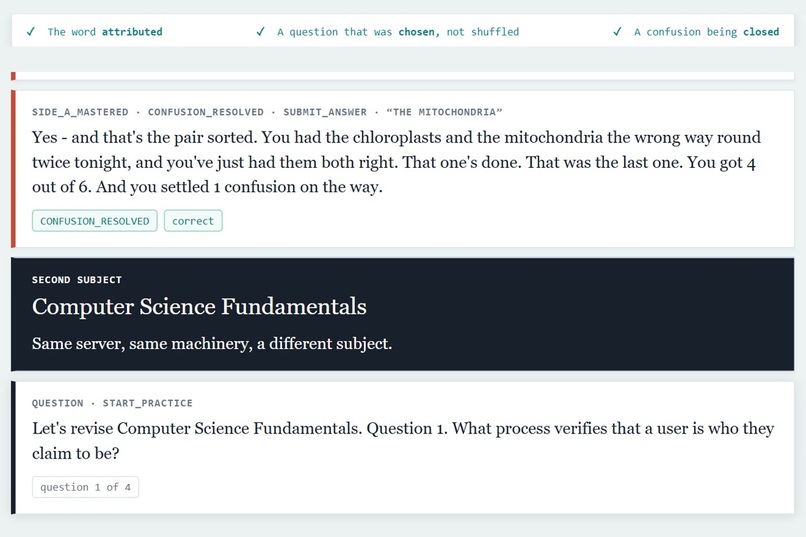
Right from both sides, so the pair is retired - the one piece of good news a revision session can honestly deliver.
-
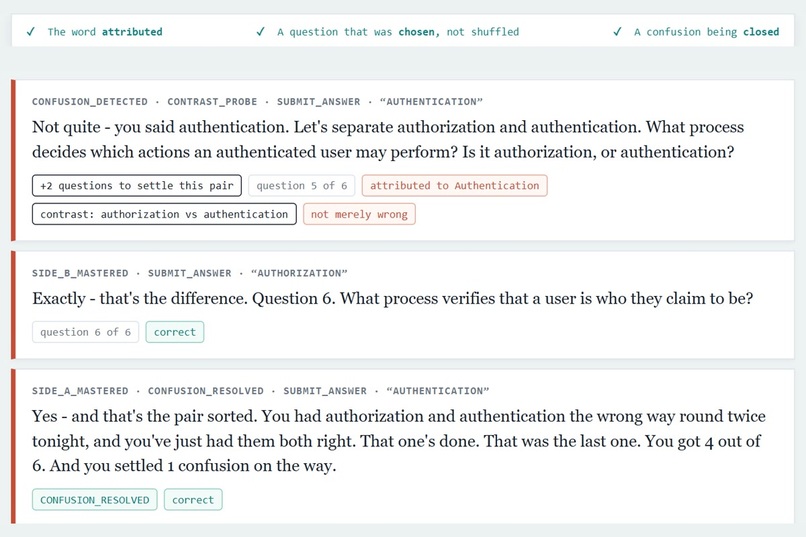
Same server, same machinery, a different subject: authorization against authentication, settled the same way, with no new code.
Inspiration
A revision app marks an answer right or wrong, and throws away the only interesting thing it knows. When a child says chloroplasts and the answer was mitochondria, "wrong" is one bit. Which wrong thing they said is the whole diagnosis, and no flashcard app keeps it.
Keep it, and a revision session can say things it otherwise cannot:
"Not quite — you said the chloroplasts. Chloroplasts capture energy from light; mitochondria release it from food."
…and then, two questions later:
"You had the chloroplasts and the mitochondria the wrong way round twice tonight, and you've just had them both right. That one's done."
That second sentence is why the project exists. It is the one piece of good news a revision session can honestly deliver, and marking cannot produce it.
What it does
Study Coach is an Alexa+ add-on that revises with a student out loud. Three things fall out of knowing which idea they reached for:
- It names the confusion. Two misses on the same pair are not two unlucky mistakes; they are one misconception seen from both sides.
- It goes looking for the other side. After the first miss, the mirrored question is scheduled deliberately — whether a confusion is real should not be left to the shuffle.
- It closes. Getting the contrast right is recognition. Getting the mirrored question right too is the distinction actually holding.
Built on top of that:
- It remembers. An unsettled confusion is carried into next week's session and re-probed; a settled one is retired. Session state is written during the session, so a child who puts the speaker down halfway keeps their evening.
- It reports the pattern, not the score.
tutor_reportfor a parent, andclass_reportfor a teacher: "Nine students have practised The Cell. One confusion stands out: osmosis and diffusion, seven students. Six of them go the same way: asked about osmosis, they answer diffusion. Three have since settled it." The useful sentence is the second-to-last. Not "they confuse these two" but which half of the distinction is missing — and no marking scheme produces it. - On a screen it shows what voice cannot. The MCP Apps extension (SEP-2133,
io.modelcontextprotocol/ui) renders a card that does not transcribe the conversation. It holds the two confused concepts side by side, and the moment the pair is finally told apart. Voice says that once and it is gone. The extension is additive: every tool still returns full spoken text, so a speaker with no display loses only the picture.
It reads how the answer arrived — and stops exactly where the law does
A tutor pushes when it is all going in too easily and backs off when the student is losing heart. That needs a signal about how an answer arrived. It would be convenient to read tone of voice, and we cannot: nothing in the Alexa+ MCP tool contract carries audio, prosody or affect, and the server never hears the student.
So the signal is split. The server reads hesitation markers, time-to-answer with
Alexa's own speaking time subtracted, and the run of right and wrong. And
submit_answer takes an optional manner argument that asks Alexa+ — which
did hear the student — for what the student did: "long pause before
answering", "asked to stop", "answered instantly".
manner carries observable behaviour and never an emotion label. The server
matches it against an allowlist of behavioural phrases, so an emotion word handed
over willingly matches nothing: it is not detected and refused, it is simply
inert. Fourteen emotion labels produced an adjustment identical to passing
nothing at all.
That is a legal line, not a stylistic one. Article 5(1)(f) of the EU AI Act prohibits AI systems that infer a person's emotions in education, in force since 2 February 2025, with only medical and safety exceptions. A revision coach sits squarely in that domain. Reading what a student did is not inferring what they felt, and keeping the two apart is what lets the feature exist at all.
How we built it
The core decision: grading is attribution, not similarity. The obvious way to mark a spoken answer is to accept it when it is similar enough to the expected one. We measured that this cannot work. Speech recognition mangles words phonetically, so a correct answer arrives distorted while a genuinely different answer is spelled almost identically:
"new clee us"against nucleus — letter similarity 0.667 — must be correct"nucleus"against nucleolus — letter similarity 0.875 — must be wrong
The wrong pair scores higher than the right one. On the content this repo ships, the lowest legitimate speech distortion scores 0.800 and the highest wrong answer that must be rejected scores 0.857. The classes overlap, so no threshold separates them.
So the grader never asks "is this close enough?". It asks "of every answer that
appears anywhere in this study set, which one did the student say?" —
nearest-neighbour attribution over a known, closed candidate set, deciding
between the best right answer and the best wrong one. nucleolus stops being a
near-miss and becomes its own candidate. That one decision is what produces the
diagnosis: you cannot name a misconception unless grading tells you which concept
was reached for, and a threshold never can.
Zero model calls in the answer path. The Alexa+ MCP quickstart requires a round trip under 500 ms. A language model call costs 200–800 ms on its own, so it cannot live there. It does not need to: Alexa+ supplies the conversation and the reasoning, and what it cannot do reliably is decide whether a mangled utterance was the right answer.
- grading, median — 11.3 ms
- grading, p99 — 49.6 ms, 10% of the platform budget
- MCP round trip, median / worst — 14–20 ms / 169–239 ms
- model calls while the student is waiting — 0
Reproduce it with harness/bench_grading.py: 10,400 calls against the full
thirteen-card set, each on an utterance the grader has not seen before. That last
part is the methodology, because warming a cache on the student's own words would
report a grader that never does any work — an earlier version of this table was
measured that way and read three times faster than the truth. These figures are
from an otherwise idle laptop, and that qualifier is load-bearing: running the
presentation shell alongside the server moves p99 to 119.3 ms and the worst round
trip to 912 ms.
A model is used — offline. tools/build_study_set.py turns a worksheet into
a study set built around the confusions, with both halves of every pair
present. tools/verify_study_set.py then checks the model's work with the real
grading.grade that serves live traffic, including the assertion the whole
product rests on: saying card A's answer to card B's question must still be
attributed to A.
The server. Self-hosted MCP on spec 2025-11-25 over Streamable HTTP
(mcp==2.1.1, uvicorn), fronted by an OAuth 2.1 resource server of our own:
bearer validation, audience and scope checks, Origin validation against DNS
rebinding, 401 on unauthenticated requests, and both
/.well-known/oauth-authorization-server and RFC 9728
/.well-known/oauth-protected-resource, because the quickstart conflates the
two. Eight tools, two of them UI-bound.
The video is built by the repository, not by a screen recorder. preview/
runs the presentation shell against the real server, tools/record_demo.mjs
drives it in headless Chrome and writes a still each time something visibly
changes — with the page stamping its own change times, because timing a frame by
when the recorder noticed put every card three seconds behind its own line — and
tools/mux_demo.py lays 43 pre-rendered speech clips back at the exact
millisecond each one played. Both halves came off the same clock, so nothing is
stretched or nudged.
Challenges we ran into
The honest list is FRICTION.md in the repository: fifteen numbered items with
reproductions, each written down when it cost us something rather than
reconstructed afterwards. The short version:
- The
alexa-aiCLI is not on public npm. It lives in a private AWS CodeArtifact repository behind an IAM role we could not be granted, so the documented path to a deployed add-on was closed from the first command. The submission requirements do not require a deployed add-on, which is the only reason this project exists at all. - The toolkit and the MCP specification disagree in places, most sharply on which well-known document is the "Protected Resource Metadata" one. We serve both.
- The MCP Apps extension is young enough that the thing we most wanted to know — what a real Alexa+ device does with a card it does not recognise — is not written down anywhere we could find.
The hardest engineering problem was none of those. In a real speech render, the pauses inside a sentence measure 0.40–0.46 s and the pauses between sentences 0.46–0.57 s. Overlapping classes, no threshold between them — which is exactly the shape of the problem this product exists to solve. It got the same answer: stop classifying the gaps and attribute instead. Cut finely, then group the pieces by what each line's character count says it should weigh.
Accomplishments that we're proud of
Not a feature. It is that the repository contains the measurements that make our own claims smaller.
LIMITATIONS.md opens with the case where grading against the content we
actually ship does worse than the number in the test file, explains why, and
says the fix is content-side rather than a threshold. The class report's own
section states that it is aggregate in the code and not in the system: a
teacher who runs it twice, thirty-five minutes apart with one child practising in
between, reads the identity off the deltas. We wrote that above the good news
rather than underneath it.
For a product whose users are children, that is the part we would want a judge to check first.
What we learned
Everything measurable here was verified automatically — and four defects in the finished demo were found by a human watching it: a verdict that read as agreement, a question whose subject was never named, a card that appeared before its line was spoken, and a clip that said "That's right" twice.
We could verify placement and timing. We could not verify meaning. For anything that will be listened to rather than executed, that gap is the thing to plan for.
What's next for Study Coach
Content coverage is the honest bottleneck. The diagnosis is only as good as the closed candidate set, and a set that omits the wrong answers students actually give is silently useless rather than visibly broken — it attributes the answer to the nearest card anyway and usually marks it correct.
Then a real deployment behind Cognito — the server is already a resource server,
so that is configuration rather than construction — and the class_report timing
leak, which needs k-anonymity over a fixed window rather than counting on call.
What this submission does not claim
- No child has used it. The class report is demonstrated against generated profiles, and the demo video's learner answers are scripted so the run repeats. Every verdict, question, diagnosis and report in the video came back from the real server; the voices are synthesised and none of them is Amazon's.
- It is not deployed in Alexa+. It is a server on the track's specification, runnable by anyone who clones it.
- The latency figures are from one idle laptop, and the section that gives them also gives the numbers under load.
Built With
- alexa
- claude
- ffmpeg
- javascript
- jellyfish
- jwt
- mcp
- mcp-apps
- model-context-protocol
- oauth2
- puppeteer
- pydantic
- python
- streamable-http
- uvicorn

Log in or sign up for Devpost to join the conversation.