-
-
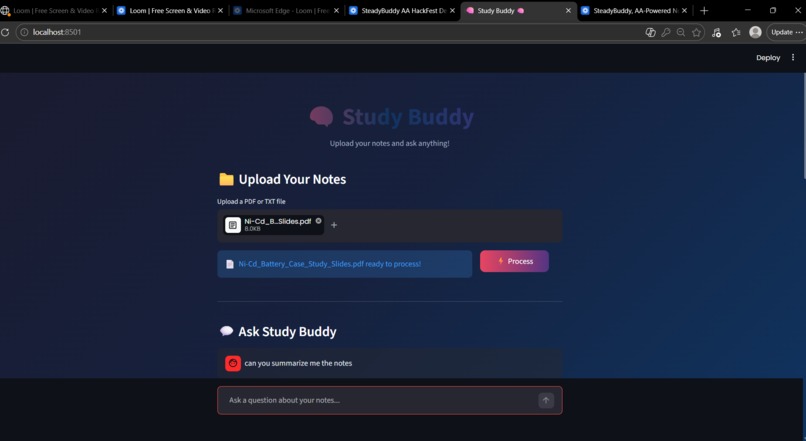
project home page
Inspiration
Studying from scattered PDFs and lecture notes is slow — you know the answer is somewhere in your notes, but finding it means re-reading pages you've already read twice. We wanted a tool that could actually "read" your notes with you and answer questions instantly, instead of making you dig through them yourself. (Replace this with your real story — what moment made you want to build this?)
What it does
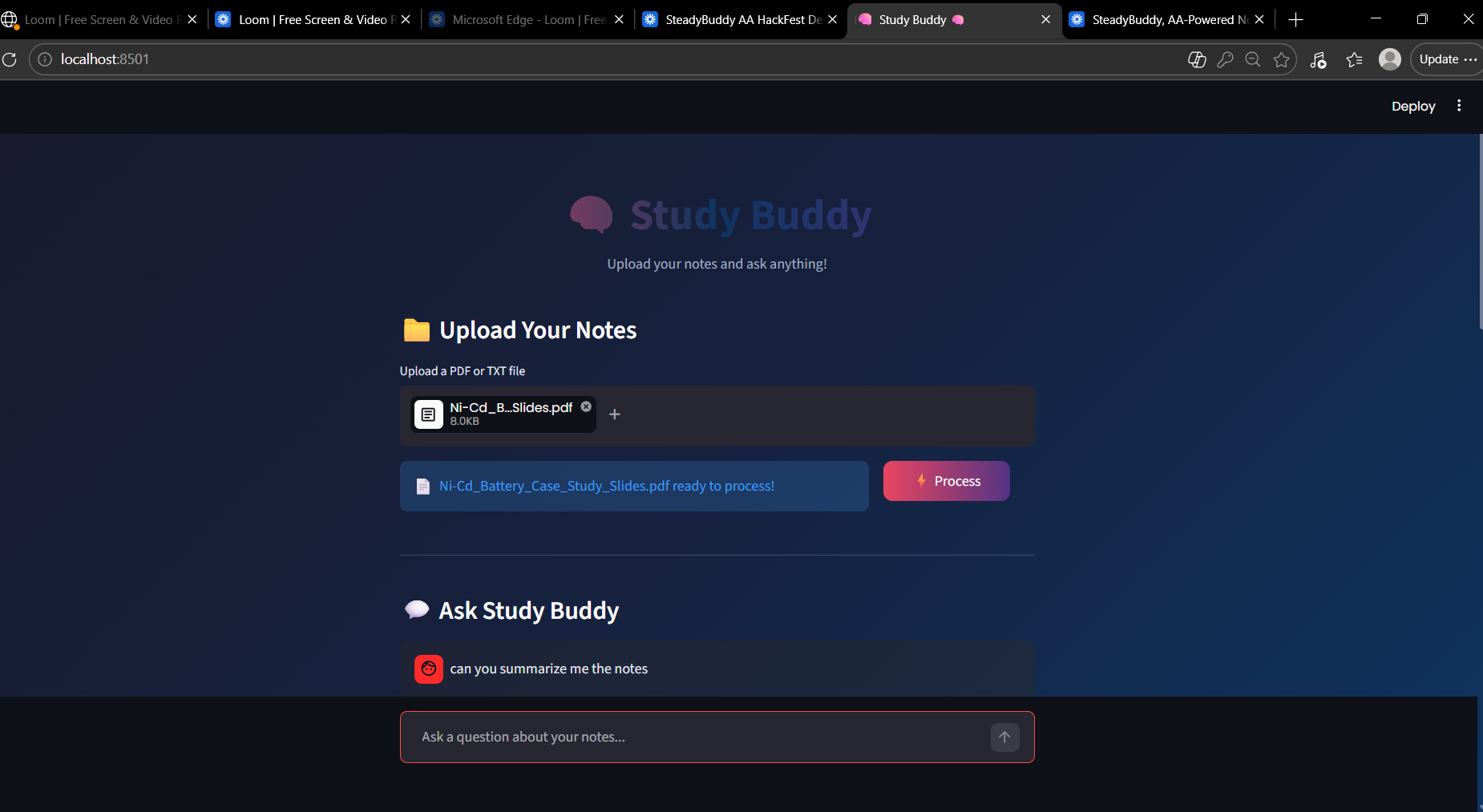
Study Buddy lets you upload your lecture notes or study materials (PDF or TXT), then ask it anything about them in plain language. Behind the scenes, it retrieves the most relevant chunks of your notes and uses Groq's LLaMA3 model to generate a clear, grounded answer — so you're never getting a generic response, just one based on what you actually uploaded.
How we built it Streamlit powers the front end — a clean, colorful chat interface for uploading files and asking questions. Snowflake stores the processed note "chunks" so they can be quickly searched and retrieved. Groq's LLaMA3 handles the actual question-answering, chosen for its speed and free tier, which mattered a lot during a time-boxed hackathon. We built a lightweight RAG (Retrieval-Augmented Generation) pipeline: notes are chunked and stored in Snowflake, then the most relevant chunks are pulled at query time and passed to LLaMA3 along with the user's question. A simple auth system lets users sign up and log in, so each person's uploaded notes stay theirs. Challenges we ran into
(Fill in your real ones — a few common ones for this kind of stack:)
Getting chunking granular enough that retrieval pulled genuinely relevant passages instead of noise. Managing Snowflake connection setup and credentials within a hackathon time limit. Balancing response speed vs. answer quality when tuning how much retrieved context to send to the LLM. Accomplishments that we're proud of
Getting a full end-to-end RAG pipeline — upload, store, retrieve, and answer — working reliably within a hackathon timeframe, with real user accounts rather than a single shared demo session.
What we learned
(e.g., how RAG pipelines work in practice, Snowflake basics, prompt design for grounded answers, working with Groq's API)
What's next for Study Buddy Support for more file types (slides, Word docs) Smarter chunking (e.g., by topic/section instead of fixed size) Citation of which part of the notes an answer came from Study aids beyond Q&A — quiz generation, flashcards, summaries

Log in or sign up for Devpost to join the conversation.