-
-
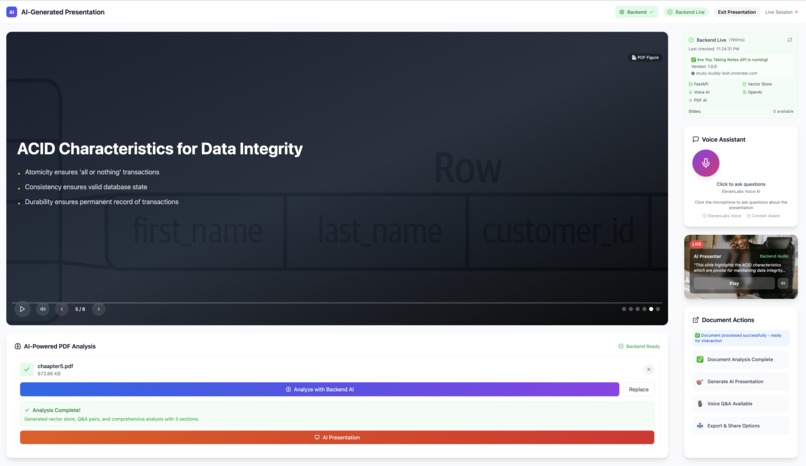
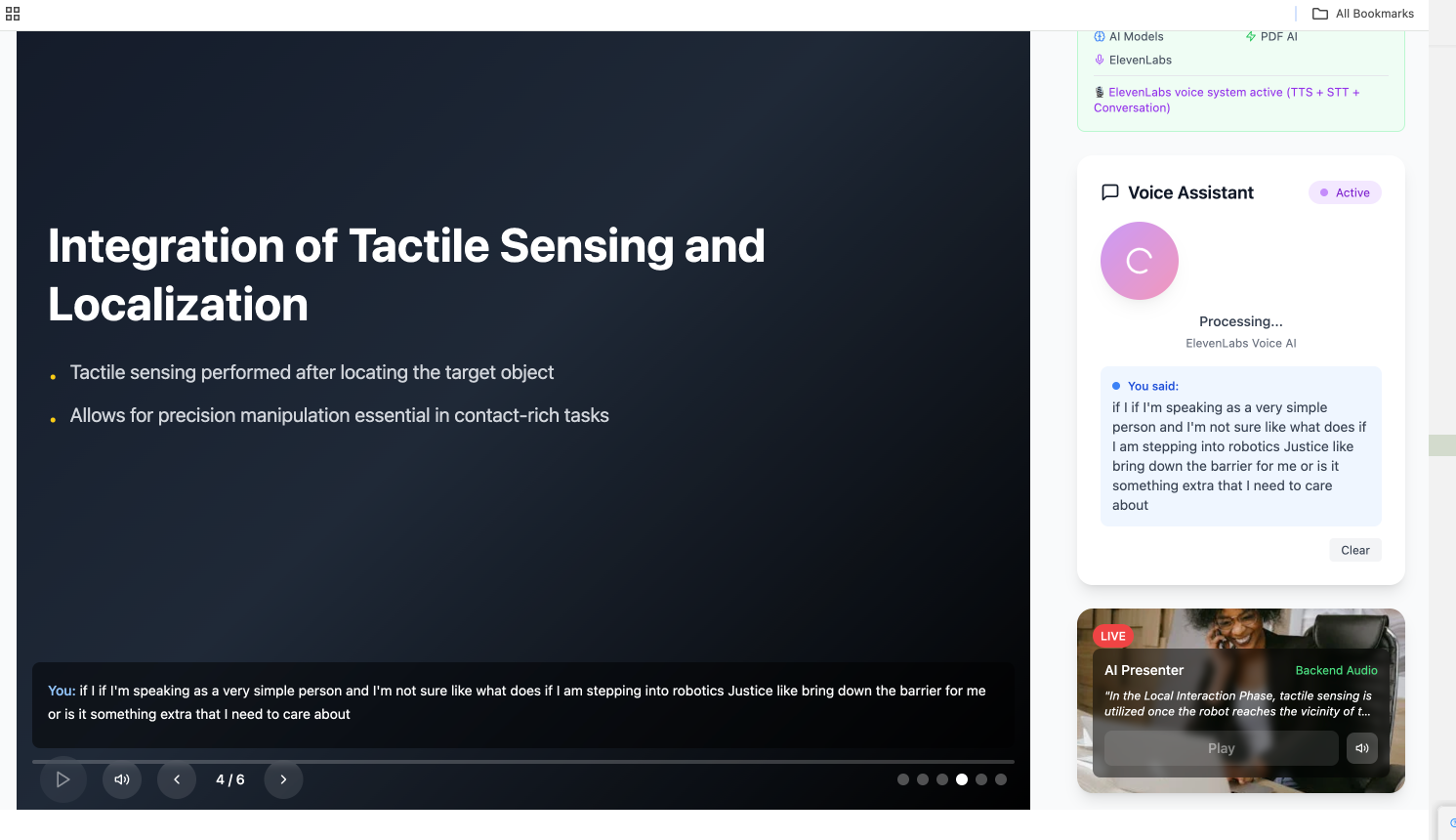
ScreenShot of the website
-
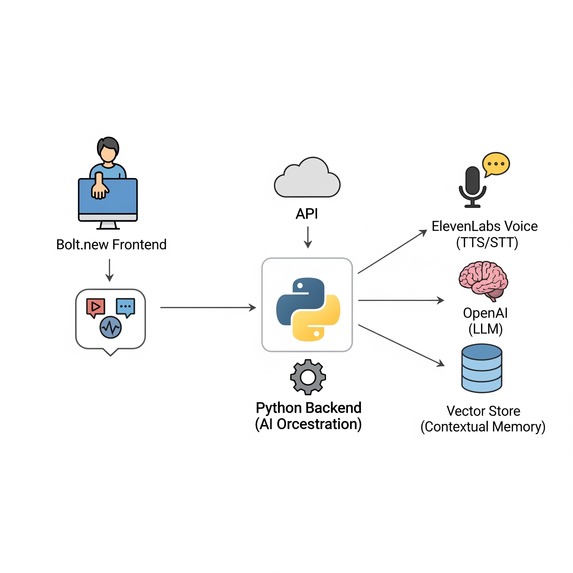
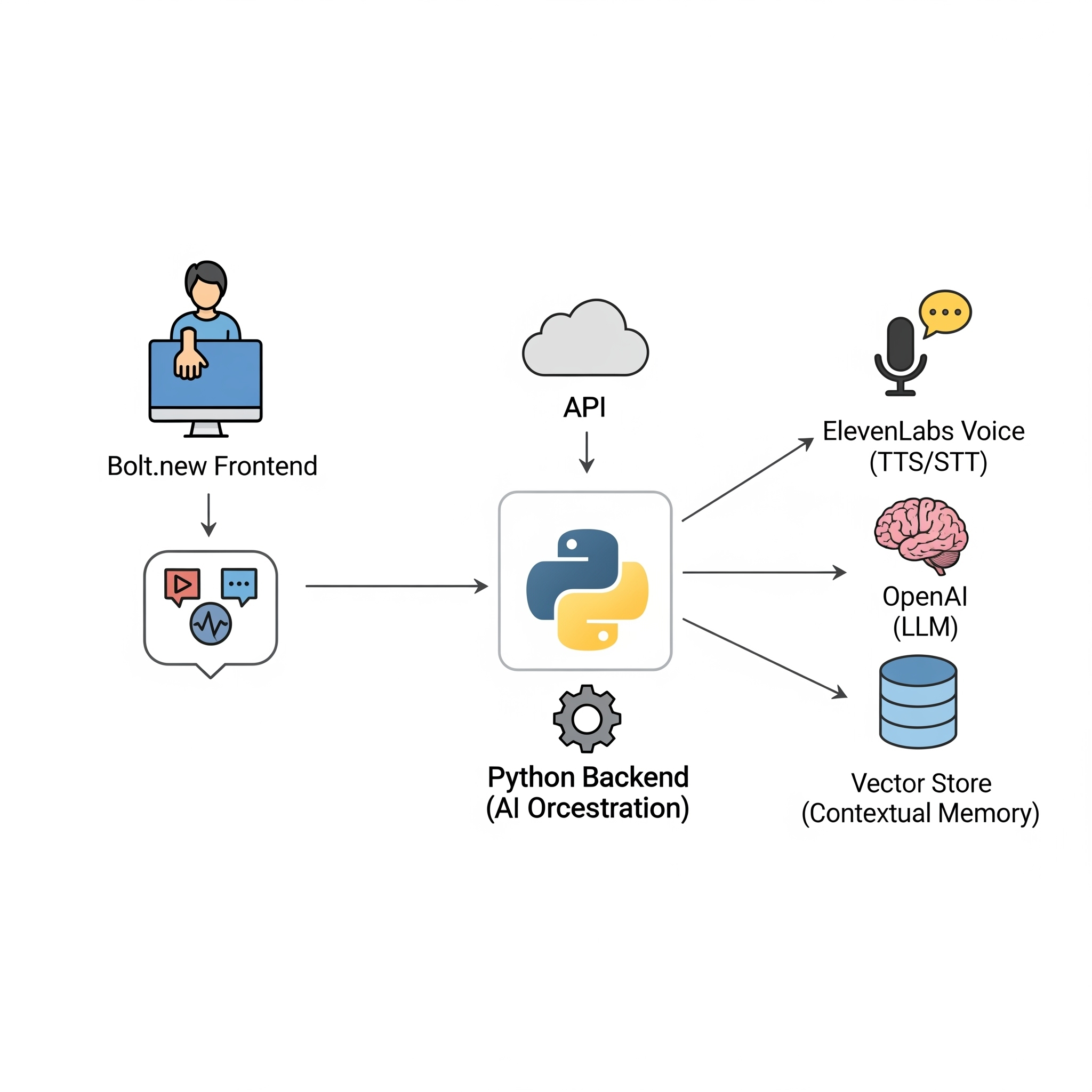
Architecture
-
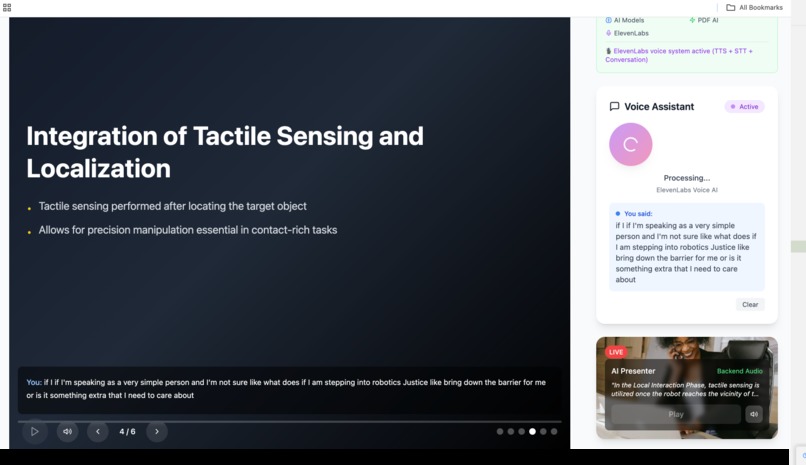
Processed screen
My Hackathon Journey: Study Buddy - Transforming Learning with AI
Inspiration
Study Buddy solves a common problem: transforming dense academic PDFs into engaging, visual presentations with AI narration. My inspiration: democratize learning by turning static documents into dynamic, interactive experiences. I even drew layout inspiration from a webinar image a day prior, demonstrating a clear vision for an intuitive design. The Bolt Hackathon provided the perfect stage to showcase this, leveraging Bolt.new for a powerful user experience.
Architecture
👤 USER → 🎨 BOLT.NEW FRONTEND → 🔌 API → 🤖 PYTHON BACKEND (AI Orchestration)
                                      ↓
                                    🎙️ ELEVENLABS VOICE (TTS/STT)
                                      ↓
                                    🧠 OPENAI (LLM)
                                      ↓
                                    📊 VECTOR STORE (Contextual Memory)
(Self-correction on diagram: Updated arrows for better clarity on data flow - assuming Vector Store provides context to OpenAI, and ElevenLabs is integrated with the backend which uses OpenAI.)
What I Built & How I Built It
My core achievement is Study Buddy, an application that converts academic PDFs into interactive, AI-narrated presentations with integrated Q&A.
Rapid Frontend with Bolt.new: All user-facing development started and flourished in Bolt.new. Its rapid capabilities allowed me to swiftly build the entire interactive presentation UI, complete with responsive design, audio controls, and seamless slide navigation—a testament to Bolt.new's modern React framework. Crucially, I developed a Demo Mode entirely within Bolt.new. This enabled rapid testing and iteration, allowing users to experience the full presentation flow with simulated data even without the backend, highlighting Bolt.new's standalone power.
Strategic Backend for AI Orchestration: I encountered a significant challenge when trying to monitor and orchestrate complex, multi-agent AI workflows. Operations like processing 100MB+ PDFs, orchestrating sophisticated AI for deep research and content generation (for slides and voice via OpenAI's Response API), and generating audio files are computationally intensive and outside Bolt.new's immediate native scope. This necessitated a minimal Python backend, specifically designed for these demanding AI tasks and leveraging asynchronous processing for efficiency.
The ElevenLabs Integration Breakthrough
Voice That Elevated Learning: Integrating ElevenLabs was a game-changer, transforming Study Buddy from a visual tool into a truly complete learning experience. The quality of voice synthesis was astounding, turning academic text into natural, engaging narration that made complex topics accessible.
Comprehensive Voice System: I built a comprehensive voice system utilizing ElevenLabs for:
- Text-to-Speech (TTS): Converting all slide content to natural, high-quality narration.
- Speech-to-Text (STT): Enabling real-time voice questions from users.
- Interactive Conversation: Facilitating real-time, context-aware Q&A sessions.
- Optimized Layout: Ensuring a balanced 50/50 image-text presentation, preventing visual distortion.
The ElevenLabs API integration was remarkably smooth, and its voice quality significantly exceeded expectations, transforming static content into dynamic, engaging educational experiences.
Deployment Experience
Seamless Render.com Integration: Deploying the Python backend to Render.com was exceptionally smooth. Render handled automatic builds directly from my GitHub repository. Cold start issues were minimal, and the integration between my Bolt.new frontend and the Render backend functioned flawlessly. The Bolt.new frontend's ability to automatically detect backend availability and gracefully fall back to demo mode further ensured a consistently functional user experience.
Challenges I Faced
As a solo developer, several challenges refined my approach:
- Balancing Bolt.new's Primary Role with AI Needs: Clearly defining the boundary between Bolt.new's strengths (the entire UX) and the justified need for an external backend for resource-intensive AI orchestration.
- Testing Complex AI Orchestration: Monitoring and debugging interactions within the multi-agent AI pipeline was difficult due to its interconnected and asynchronous nature, requiring extensive integrated debugging.
- Optimizing AI Performance: Ensuring a responsive user experience despite potentially 30+ second AI operations demanded careful asynchronous processing and robust error handling in the Python backend, with clear feedback on the Bolt.new frontend.
- Streamlining Voice System Architecture: Initially explored multiple voice providers but strategically streamlined to an ElevenLabs-first approach for superior quality and consistency across all voice features.
Key Achievements
✅ Rapid Frontend Development: Complete React UI with Bolt.new in hours, not days.
✅ Strategic Backend Integration: Python FastAPI for AI-intensive operations.
✅ ElevenLabs Voice Excellence: Natural TTS, STT, and conversational capabilities.
✅ Graceful Degradation: Demo mode ensures continuous functionality.
✅ Seamless Deployment: Render.com integration with automatic builds.
✅ Optimized Presentation Layout: Balanced visual experience.
What Made This Special
Study Buddy is a prime example of leveraging Bolt.new for an exceptional user experience, strategically complemented by an external Python backend for advanced AI capabilities. The synergy between Bolt.new's rapid development, ElevenLabs' cutting-edge voice technology, and Render's deployment simplicity allowed me to create a production-ready application that transforms how people interact with academic content.
The real magic: A student can now upload a research paper and within minutes have an engaging, narrated presentation with interactive voice Q&A all built in record time, showcasing how the right tools (Bolt.new + ElevenLabs + Render) can compress months of development into days, empowering solo developers to build truly impactful applications.
Built With
- bolt.new
- elevenlabs
- fastapi
- openai
- python
- render


Log in or sign up for Devpost to join the conversation.