Inspiration
Many students struggle to access real chemistry laboratories due to cost, safety concerns, or lack of equipment. Traditional virtual labs are often static, scripted, and do not allow true experimentation. We wanted to create an intelligent AI-powered laboratory where students can freely explore chemistry concepts just like in a real lab—without risk, chemicals, or expensive hardware.
The goal was to build a system where students can learn by doing, making mistakes, asking questions, and receiving instant guidance from an AI lab assistant.
What it does
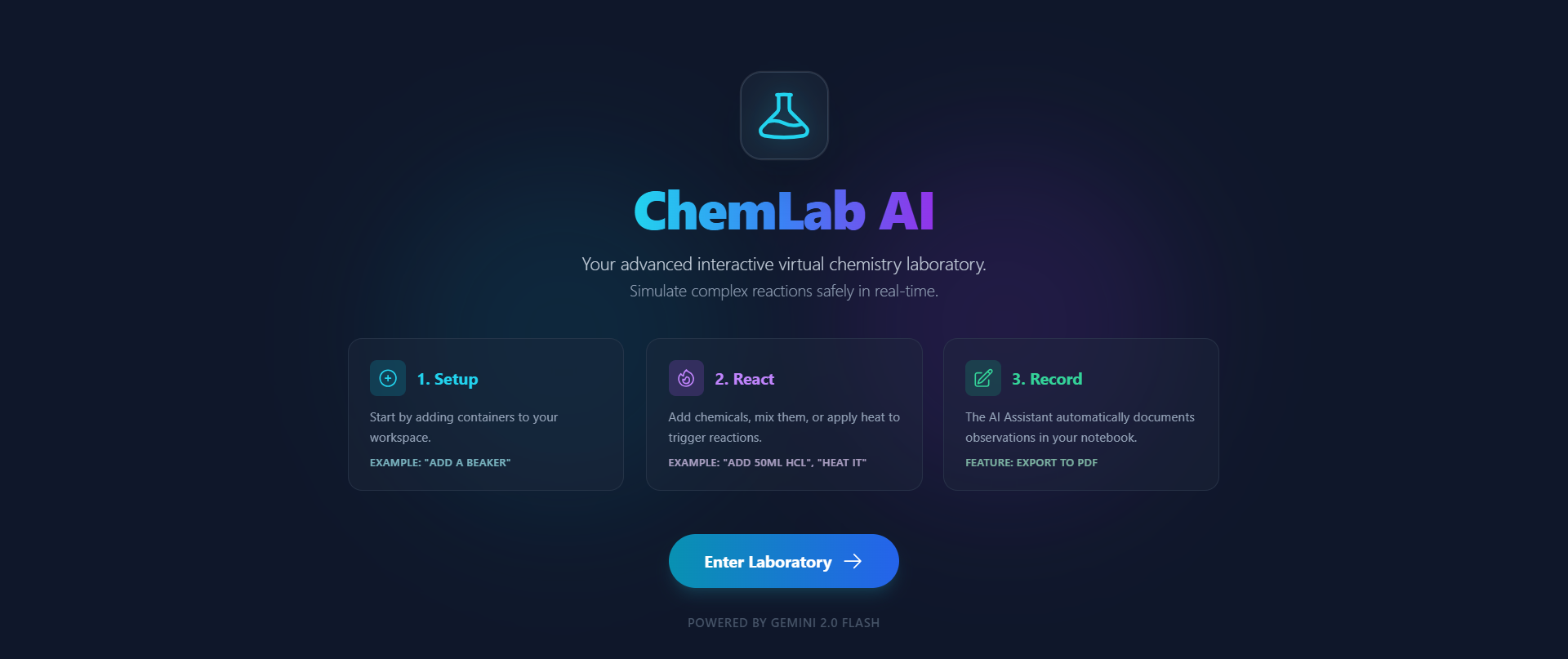
Chemi Lab Stimulate is an interactive virtual chemistry laboratory powered by the Gemini 3 API.
It allows users to:
- Create virtual containers such as beakers, flasks, and test tubes
- Add chemicals and perform reactions
- Transfer liquids between containers
- Use lab tools like pipettes, burettes, and droppers
- Heat, mix, filter, and process substances
- Keep a structured scientific notebook
- Ask an AI lab assistant questions at any time
The system tracks every action performed and generates realistic observations, balanced chemical equations, and experiment results in real time.
Students can perform multiple experiments in a single session, review their work, and even submit their lab notebook for AI correction and feedback.
How we built it
The project was built using:
- Google Gemini 3 API as the core intelligence engine
- A web-based user interface built with React
- Structured prompts to control AI behavior
- State management to track containers, chemicals, and actions
- A notebook system to mimic real lab reporting
Gemini 3 handles:
- Understanding user actions
- Simulating chemical reactions
- Generating explanations
- Correcting student notebooks
- Acting as an interactive lab assistant
All experiment logic and reasoning are powered entirely by Gemini, making the system flexible and highly intelligent.
Challenges we ran into
Several challenges appeared during development:
- Ensuring Gemini maintained persistent memory of containers and chemicals
- Preventing the AI from resetting the lab unexpectedly
- Designing structured prompts so responses stayed consistent
- Making the notebook system accumulate data instead of overwriting it
- Handling UI limitations such as selecting containers instead of typing
- Managing API quota limits while testing
Getting Gemini to behave like a true simulator instead of a normal chatbot required many iterations of prompt engineering and interface design.
Accomplishments that we're proud of
We are proud that we successfully created:
- A fully functional AI-driven chemistry lab without hardcoded reactions
- A system that behaves like a real continuous experiment environment
- Automatic generation of balanced equations and observations
- A smart notebook that can be graded and corrected
- An AI lab assistant that can explain chemistry concepts on demand
- A project built entirely around Gemini 3 capabilities
Most importantly, we built a tool that can genuinely help students learn chemistry in a safe and engaging way.
What we learned
Through this project we learned:
- How powerful Gemini 3 is for reasoning-based simulations
- The importance of structured prompt engineering
- Techniques for maintaining long-term AI context
- How to integrate AI models with real user interfaces
- Designing educational tools that feel natural and interactive
We also gained a deeper understanding of how AI can be used beyond chatbots—to simulate complex real-world environments.
What's next for Chemi Lab Stimulate
In the future we plan to expand the project with:
- Visual animations for reactions
- More advanced chemistry topics (organic, electrochemistry, kinetics)
- Pre-built experiment templates
- Teacher mode with automatic grading
- Multiplayer collaborative labs
- Voice interaction with the lab assistant
- Offline saving and export of lab reports
Ultimately, we aim to turn Chemi Lab Stimulate into a complete AI-powered virtual chemistry learning platform for schools and universities.
