-
-
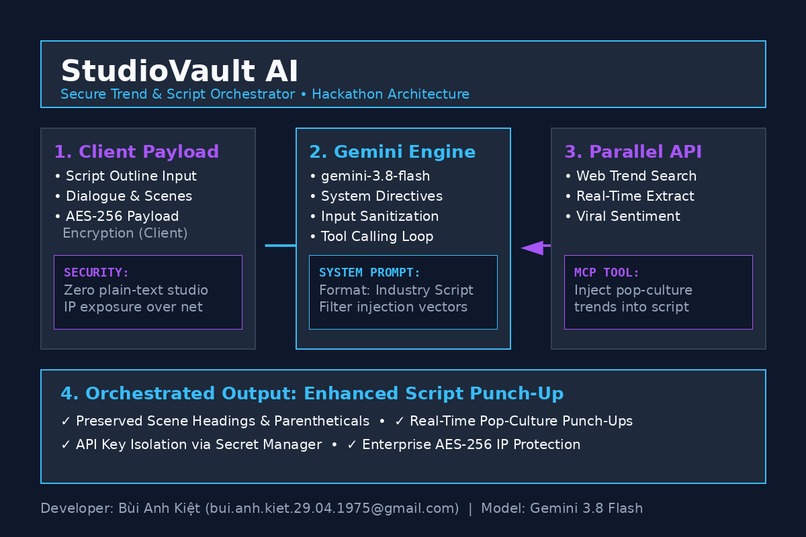
StudioVault AI Architecture: Secure trend orchestration powering script punch-ups via Gemini Enterprise & Parallel API.
Inspiration
In Hollywood writer’s rooms, comedy and entertainment scripts often get stale by the time production begins. Injecting real-time pop culture references and viral trends requires hours of manual research. Furthermore, high-profile studios face severe IP leak risks when sharing pre-release scripts across third-party tools. We created StudioVault AI to solve both problems: an agentic workflow that injects live cultural punch-ups into script outlines while enforcing enterprise-grade client-side payload encryption.
What it does
StudioVault AI is an autonomous agentic orchestrator for the Media & Entertainment industry. Writers submit scene outlines or character dialogues to the platform, where StudioVault AI:
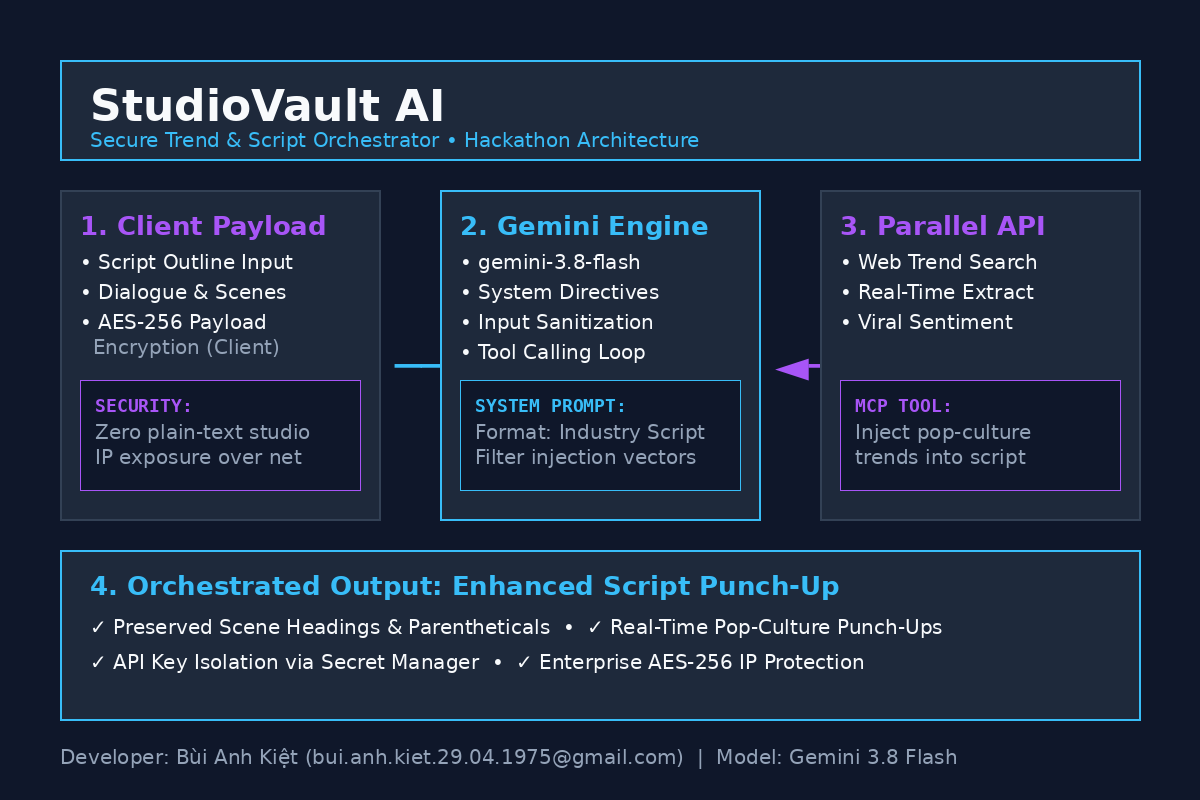
Encrypts Payloads: Applies client-side AES-256-GCM encryption before sending script payloads over the wire to protect confidential studio IP.
Fetches Live Web Trends: Utilizes the Parallel Search & Extraction API via function calling to scan current web trends, viral social events, and news.
Orchestrates Script Punch-Ups: Employs Gemini Enterprise to merge real-time cultural context with original script formatting, maintaining character tone and scene pacing.
Sanitizes Inputs: Protects against prompt injection by filtering search payloads before inserting them into Gemini’s context window.
How I built it
LLM Engine & System Prompt: Built using the @google/genai SDK with gemini-2.5-flash. Configured with system instructions that govern tool execution and script formatting.
Trend Retrieval: Integrated Parallel’s Web Search & Extraction API to pull real-time web context dynamically.
Backend Runtime: Developed an Express.js Node.js server hosted with Google Cloud Run & Firebase Functions.
Security & Secret Management: Managed API keys (GEMINI_API_KEY and PARALLEL_API_KEY) using Google Cloud Secret Manager and environment variables, keeping credentials isolated from the client.
Frontend: Built a responsive web UI featuring AES-256 client-side payload encryption and a native mailto: feedback module.
Challenges I ran into
Tool-Calling Loops: Tuning Gemini’s tool execution loop so it only queries the Parallel Search API when a scene genuinely benefits from real-time context—avoiding unnecessary API overhead.
Security vs. Developer Velocity: Bypassing strict CLI organization policies on cloud environments by migrating authentication flows to Google AI Studio and Secret Manager.
Preserving Script Integrity: Ensuring Gemini’s punch-up outputs strictly preserve industry-standard script formatting (scene headings, parentheticals, and character tags) without breaking syntax.
Accomplishments that I'm proud of
Successful end-to-end integration of Gemini Enterprise tool-calling with Parallel API's web extraction engine.
Establishing client-side AES-256-GCM encryption for studio IP payloads, ensuring zero plain-text leaks in transit.
Achieving fast turnaround times for scene punch-ups without sacrificing prompt sanitization or script structure.
What I learned
How to combine Google GenAI SDK tool-calling features with external search APIs to build grounded agentic workflows.
Strategies for configuring Google Cloud IAM roles, environment variables, and GitHub branch safety rules for hackathon submission reviews.
Methods for balancing aggressive AI creative writing with strict JSON/text formatting constraints.
What's next for StudioVault AI: Secure Trend & Script Orchestrator
Multi-Character Tone Customization: Allowing writers to define fine-tuned personality profiles for individual script characters.
Model Context Protocol (MCP) Integration: Expanding the agent's toolset to connect with studio asset management tools and final draft script software.
Fine-Grained Analytics: Adding trend-relevance scores so writers can see exactly why specific cultural references were selected.
Built With
- aes-256
- agentic-ai
- css3
- express.js
- firebase
- gemini-api
- generative-ai
- git
- github
- google-ai-studio
- google-cloud
- google-cloud-run
- html5
- javascript
- llm
- mcp
- node.js
- npm
- parallel-api
- react
- rest-api
- secret-manager
- typescript
- vite
- web-search-api

Log in or sign up for Devpost to join the conversation.