-
StudioVault AI
-
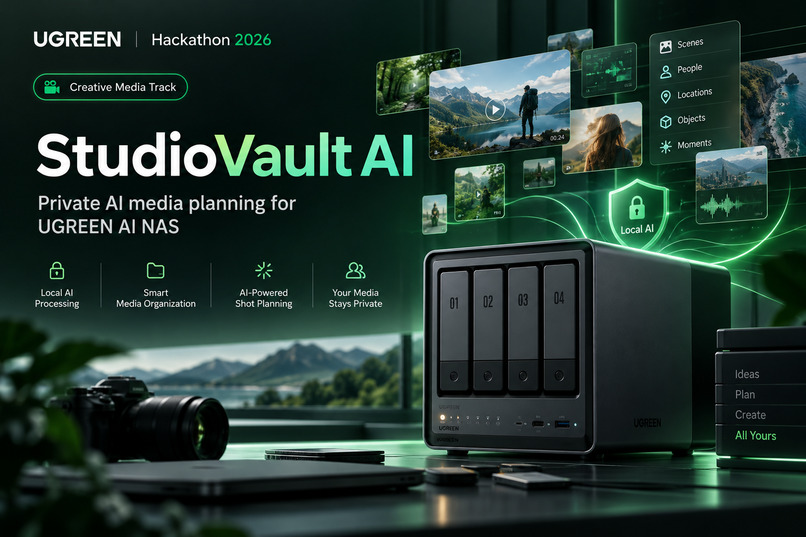
StudioVault AI Intro
-
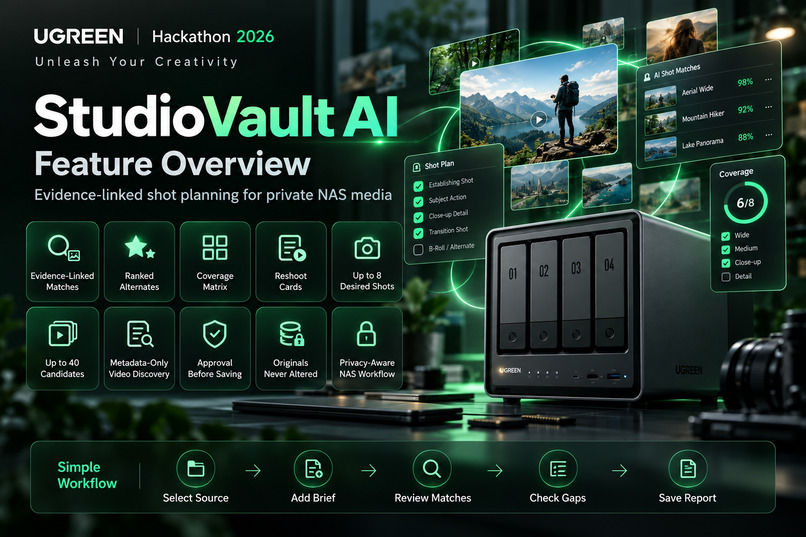
StudioVault AI Features
Inspiration
As a technology developer and content creator, I know how time-consuming it can be to organize footage, find the right shots, and plan a compelling video. Creators often accumulate hundreds of photos and videos across projects, yet finding the right material can take longer than planning the story itself.
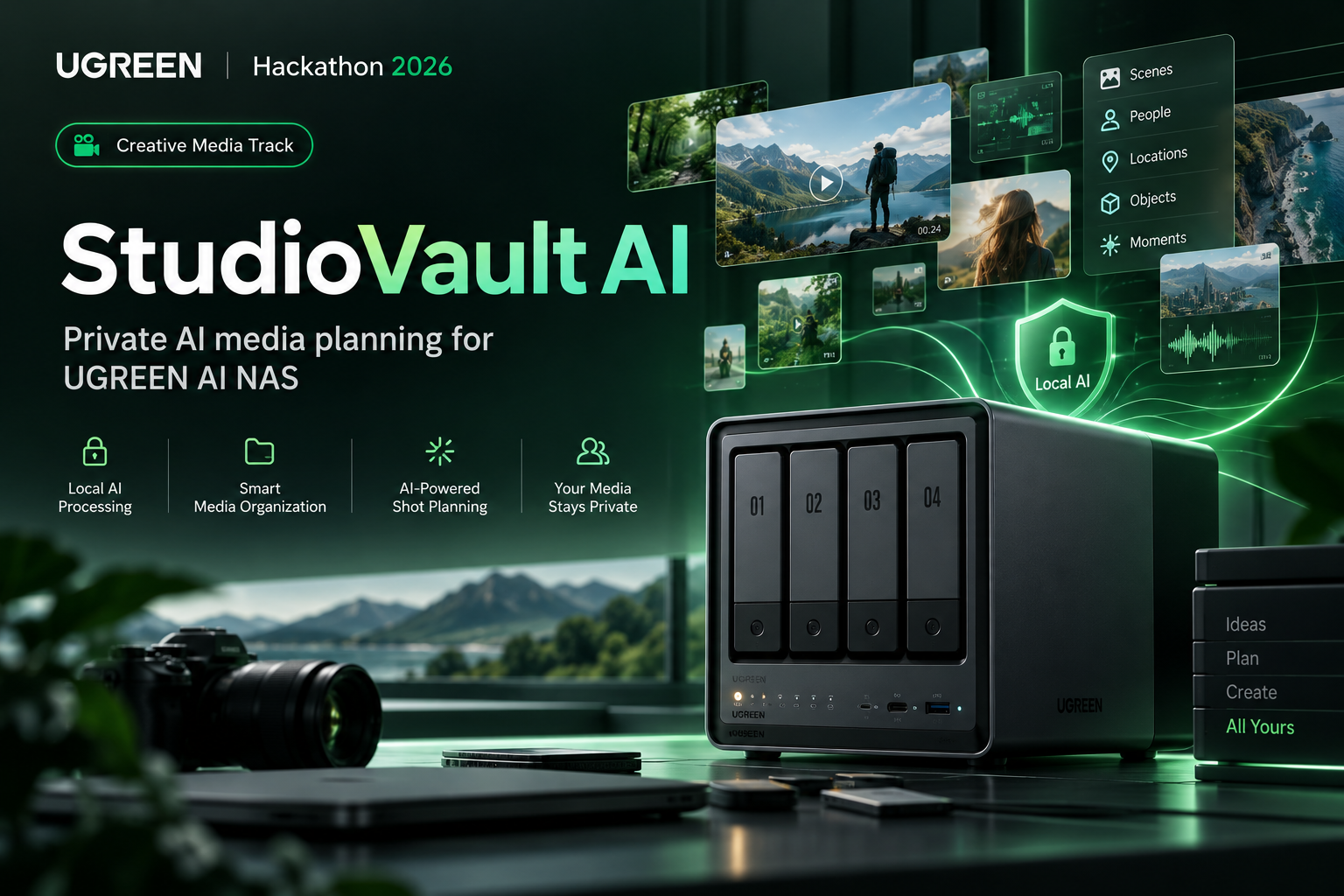
I envisioned StudioVault AI as a privacy-first creative assistant that transforms a UGREEN AI NAS from passive storage into an intelligent media-planning workspace.
The goal is simple: Spend less time searching for footage and more time creating.
What it does
StudioVault AI is an AI Skill designed to help creators organize their production workflow using media already stored on their UGREEN AI NAS.
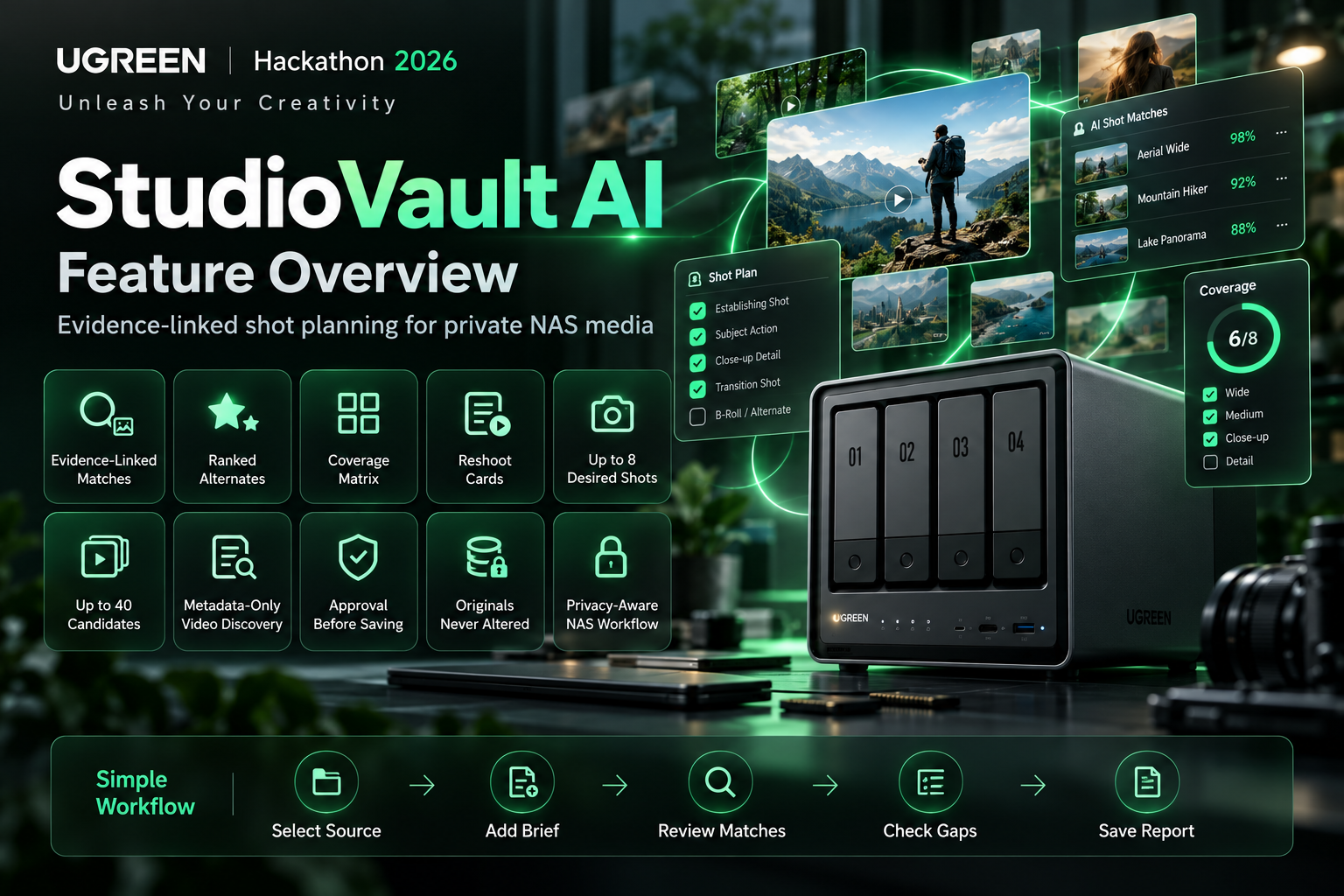
Given a creative brief and an authorized media folder or album, StudioVault AI is designed to:
- Discover relevant media within explicitly approved storage locations.
- Match available images to planned shots using supported search and visual evidence.
- Generate a shot-coverage matrix identifying covered, partial, unverified, and missing scenes.
- Create an actionable shot list highlighting what creators already have and what they still need to capture.
- Protect original files through non-destructive, approval-controlled workflows.
- Preserve privacy by enforcing the creator's processing requirements and refusing unsupported operations.
The initial Skill treats video content as metadata-only because the verified capability catalog does not establish arbitrary video scene analysis.
Rather than automatically editing videos, StudioVault AI focuses on the critical planning stage before editing begins.
How we built it
StudioVault AI was developed using the UGREEN Uliya Skill Development Standard, the official Skill Developer Kit, and AI-assisted development tools.
Technology and architecture:
- Uliya Skill Kit 0.7.3 — official development framework.
- Capability Catalog 2.0.0 — verified expert-agent mappings.
- Markdown-based SKILL.md — orchestration instructions and workflow definitions.
- Registered expert agents — filesystem, photo, document, and knowledge capabilities.
- Standard
delegateorchestration — coordinating supported expert workflows. - Evidence-linked reporting — grounding suggested media matches in returned results.
- Privacy and approval gates — restricting access, protecting originals, and requiring authorization for report saving.
Google Gemini contributed to early concept development, ChatGPT assisted with specification and documentation, and Codex supported implementation and static validation.
The submission contains a lightweight, Markdown-only Skill package without custom executables, external APIs, or bundled AI models.
Challenges we ran into
The biggest challenge was designing a useful creative AI workflow within the UGREEN platform's supported capabilities.
Our original concept included automated video transcription, frame extraction, and rough-cut timeline generation. However, these operations could not be assumed available under the competition's supported expert-agent architecture.
Instead of promising functionality that wasn't verified, we refined StudioVault AI into a focused, evidence-driven shot-planning assistant.
Other challenges included enforcing exact folder permissions, preventing speculative AI matches, distinguishing incomplete searches from missing footage, and ensuring that private media isn't processed through an unapproved route.
Accomplishments that we're proud of
- Built a complete, standards-aligned AI Skill package for the UGREEN Hackathon.
- Passed the official static checker with 0 errors, 0 warnings, and 0 informational diagnostics.
- Implemented a structured orchestration design using registered Uliya expert mappings.
- Defined evidence-based shot matching with explicit uncertainty reporting.
- Established non-destructive workflows and approval-controlled report saving.
- Produced a compact, three-file Markdown submission package.
The Skill has passed static validation; actual NAS runtime behavior remains to be tested.
What we learned
This project reinforced an important principle of AI engineering: reliable AI is not just about generating answers, but knowing what can actually be verified.
We learned how Uliya's expert-agent orchestration works, why catalog availability is different from runtime capability, and how to design workflows that fail safely when permissions, evidence, or processing guarantees are uncertain.
Most importantly, we learned that a smaller, trustworthy AI capability can provide more practical value than an ambitious workflow built on unsupported assumptions.
What's next for StudioVault AI
If selected as a finalist, the next milestone is deploying and testing StudioVault AI on the actual UGREEN AI NAS iDX6011 Pro environment.
Our priorities include:
- Validate registered expert-agent availability, permission boundaries, and processing routes.
- Run synthetic photo-library tests to measure shot-coverage accuracy and evidence quality.
- Verify behavior for missing scenes, incomplete searches, inaccessible folders, and unsupported video analysis.
- Test approval-controlled report saving and recovery from interrupted operations.
- Record a real NAS demonstration showing the complete supported workflow.
Beyond the hackathon, we envision StudioVault AI evolving into a broader privacy-first creative production assistant, with richer media intelligence and editing integrations where supported.
StudioVault AI — Your media. Your story. Your NAS.