Inspiration
Film production starts with a creative idea, but converting that idea into an executable plan requires hundreds of decisions. Small production teams often manually manage scenes, locations, actors, props, equipment, schedules, and production risks. A change in one element can affect multiple parts of the production plan. We wanted to build an AI system that could understand the complete production context, rather than simply generate a screenplay. This inspired StudioPilot AI — an intelligent virtual production coordinator powered by Gemini.
Our core question was:
“Can an AI agent turn creative intent into an adaptive, production-ready plan?”
What it does
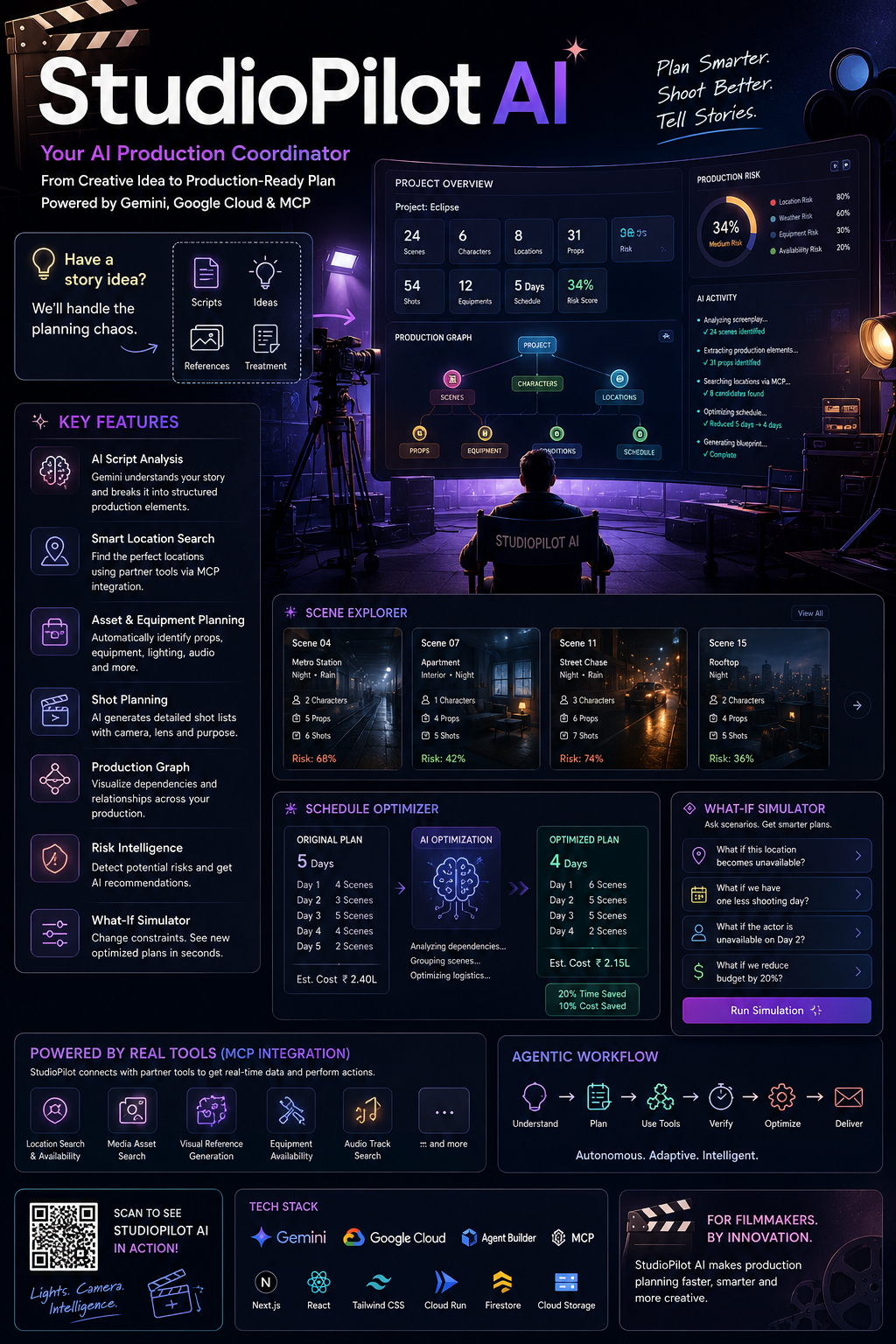
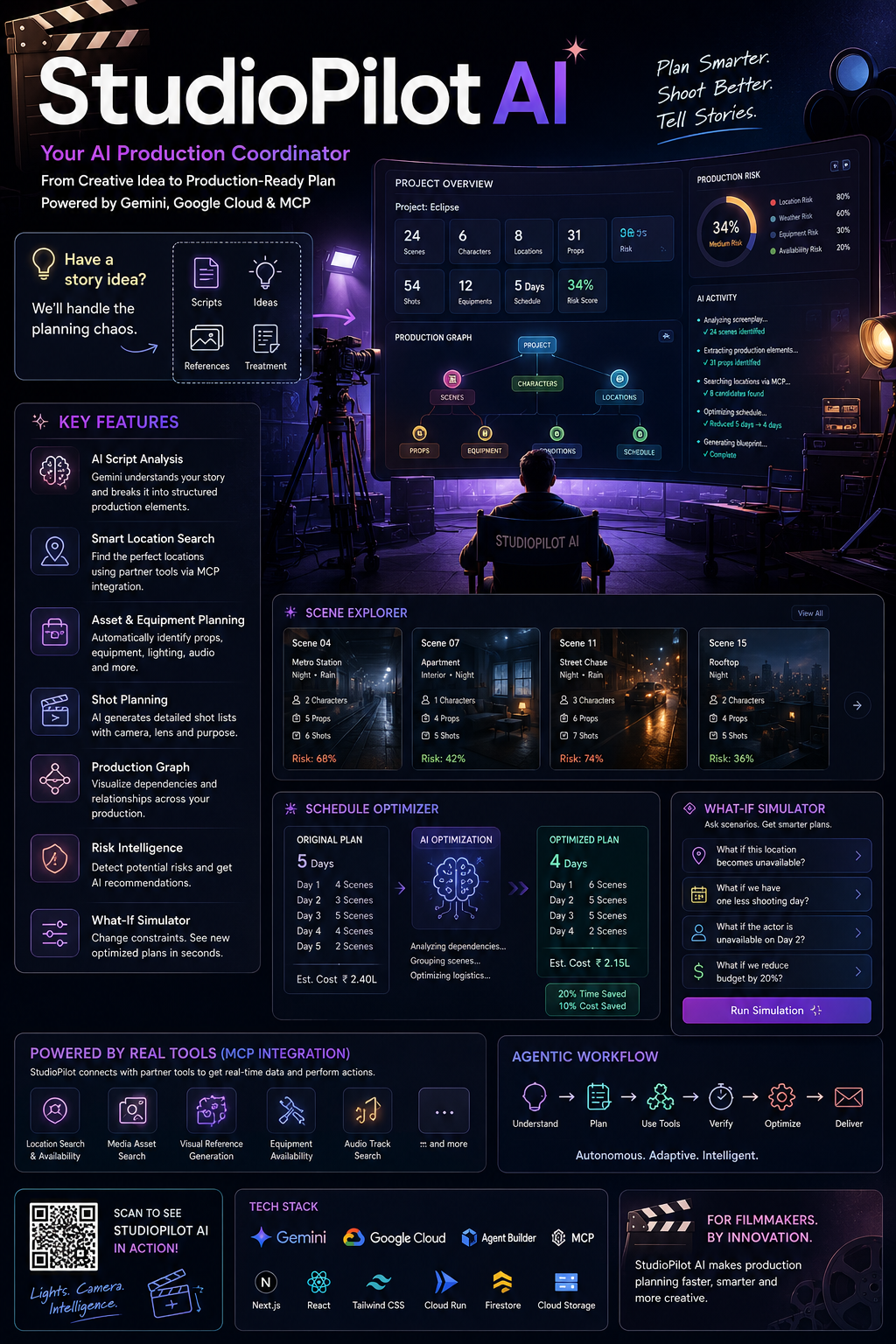
Accepts a screenplay, story idea, or creative brief as input. Uses Gemini to understand the story and extract production requirements. Automatically identifies: 🎬 Scenes 👥 Characters 📍 Locations 🎒 Props 🎥 Equipment 💡 Lighting requirements 🎙️ Audio requirements 🌦️ Environmental conditions Creates a visual production dependency graph connecting these elements. Uses MCP-connected partner tools to retrieve relevant external information or perform supported media-production actions.
How we built it
Gemini → Story understanding, reasoning, scene extraction, planning and decision-making. Google Cloud Agent Builder / Agent Platform → Agent orchestration and tool-based workflow. MCP → Connection between the AI agent and external partner capabilities. Next.js + React → Interactive production dashboard. Tailwind CSS → Responsive and modern UI. React Flow → Interactive production dependency graph. Node.js → Backend services and API layer. Cloud Run → Application deployment. Cloud Storage → Production assets and project files.
Challenges we ran into
Making the AI genuinely agentic We had to move beyond simple prompt → response interactions. The agent needed to decide when and why to use external tools. Managing production dependencies Changing one location can affect multiple scenes and schedules. We needed a structured dependency model to track these relationships. MCP integration Designing reliable tool inputs and outputs required careful validation. We had to handle tool failures and unavailable information gracefully.
Accomplishments that we're proud of
Built a functional AI production coordination workflow instead of a conventional chatbot. Successfully designed the project around Gemini + Google Cloud Agent Builder + MCP. Converted unstructured creative input into a structured production blueprint. Created an interactive Scene → Location → Character → Asset → Equipment dependency graph. Implemented production risk analysis for individual scenes. Developed the What-If Production Simulator for dynamic replanning.
What we learned
AI agents are more than LLMs — they require reasoning, tools, state, orchestration and validation. MCP showed us how AI agents can interact with external capabilities in a structured way. Complex problems become easier when divided into specialized agents or workflows. Structured information is essential when dealing with interconnected production requirements. A good AI system should explain why it made an important decision, not just provide the result. We learned that tool failures must be treated as part of the workflow rather than unexpected exceptions
What's next for StudioPilot AI
Built With
- agentbuilder
- agenticai
- aiorchestration
- artificialintelligence
- cloudrun
- cloudstorage
- firestore
- gemini
- generativeai
- google-cloud
- javascript
- mcp
- mediaentertainment
- multiagentai
- nextjs
- node.js
- productionintelligence
- productionplanning
- react
- reactflow
- tailwindcss
- virtualproduction
- whatifsimulation
- workflowautomation

Log in or sign up for Devpost to join the conversation.