-
-
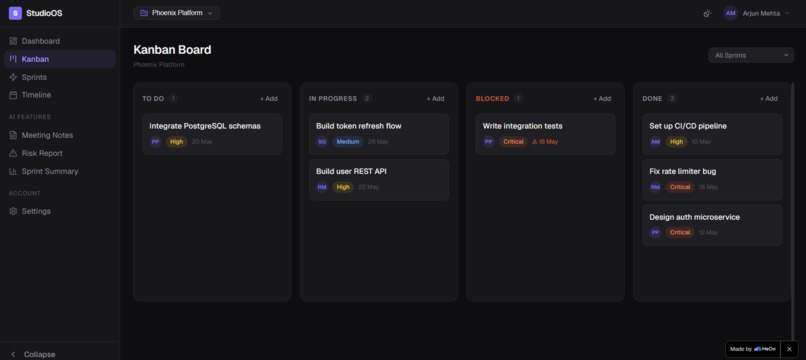
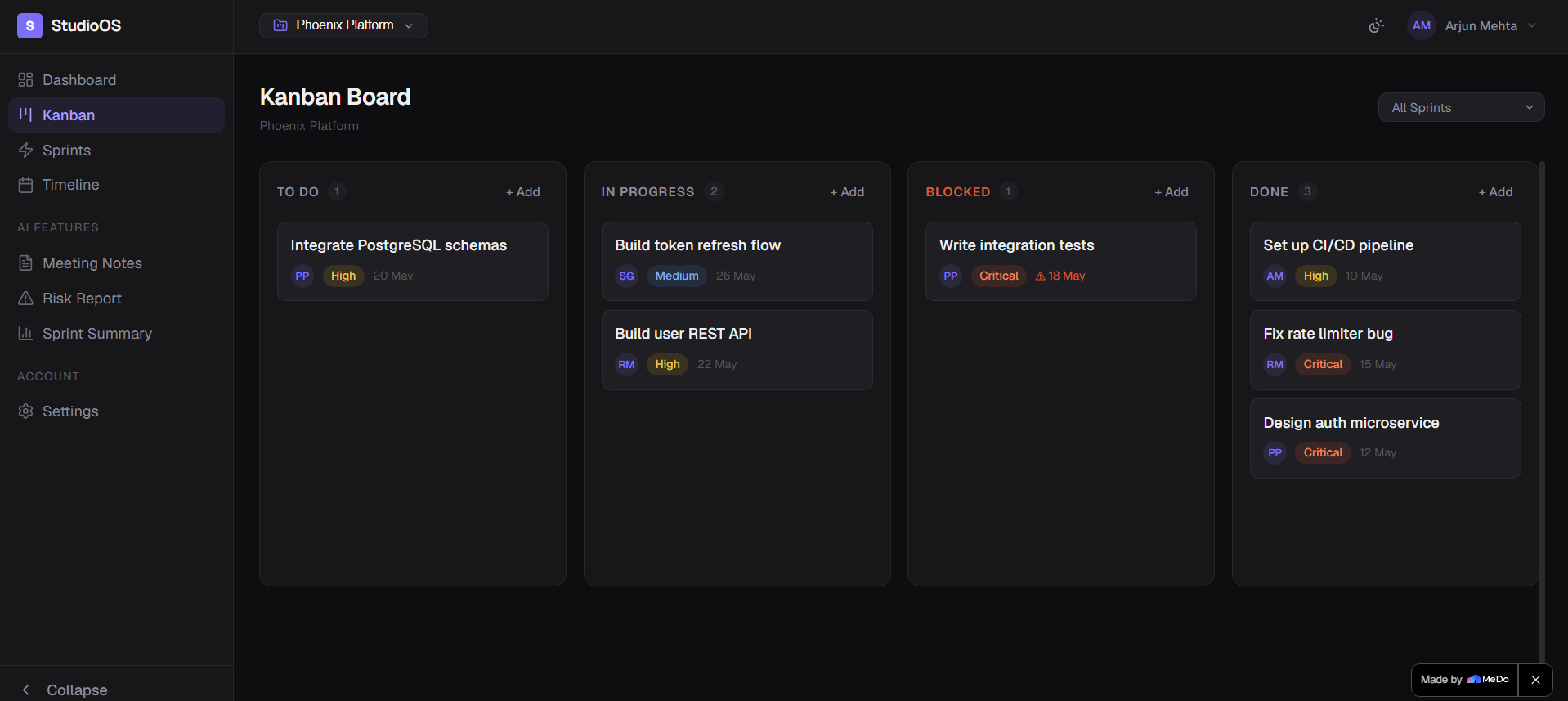
Kanban Board
-
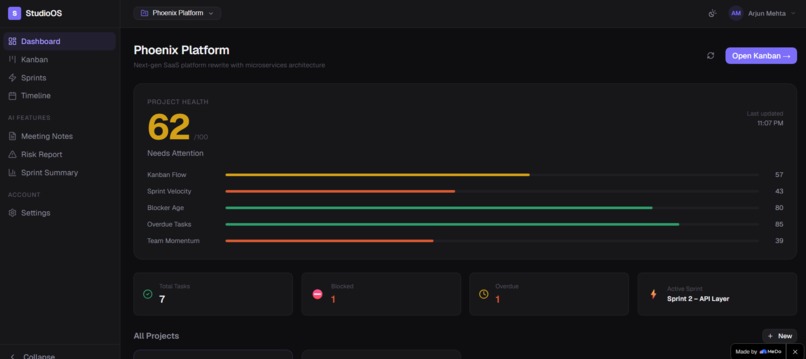
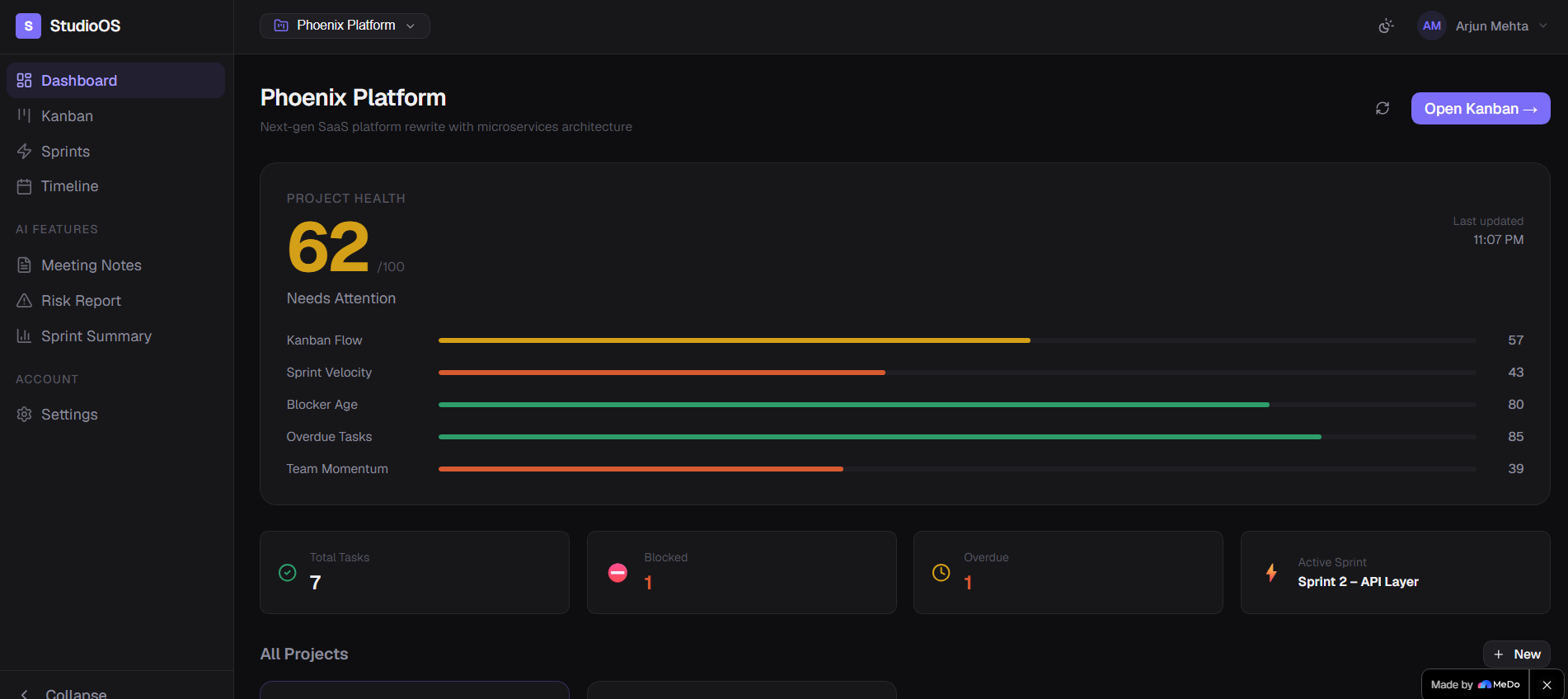
Home Dashboard
-
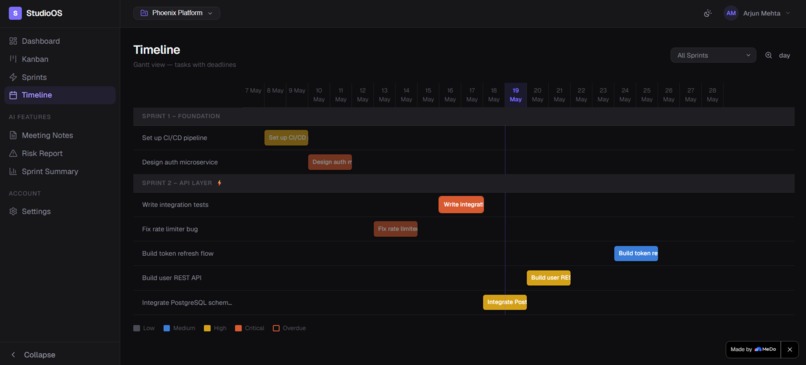
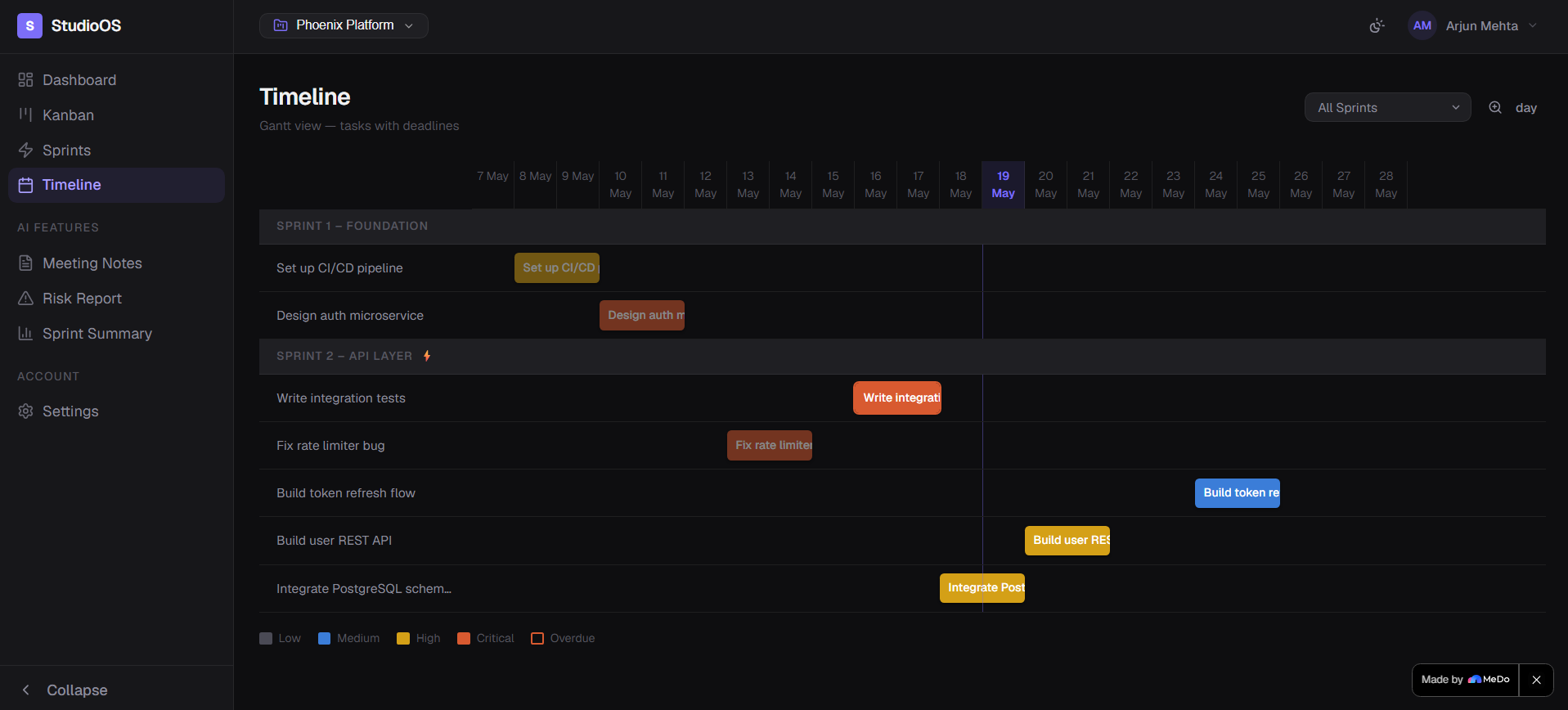
Timeline Viewer
-
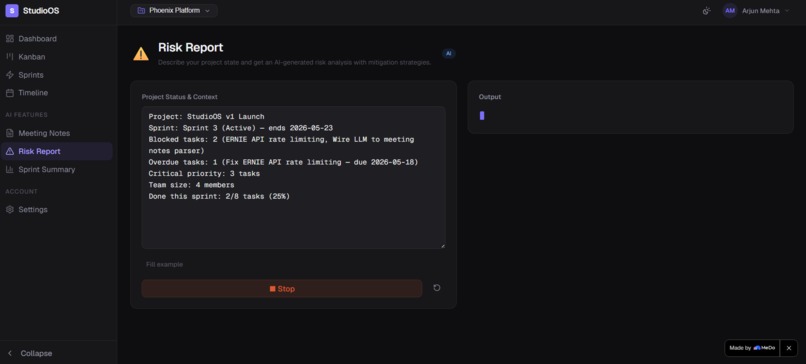
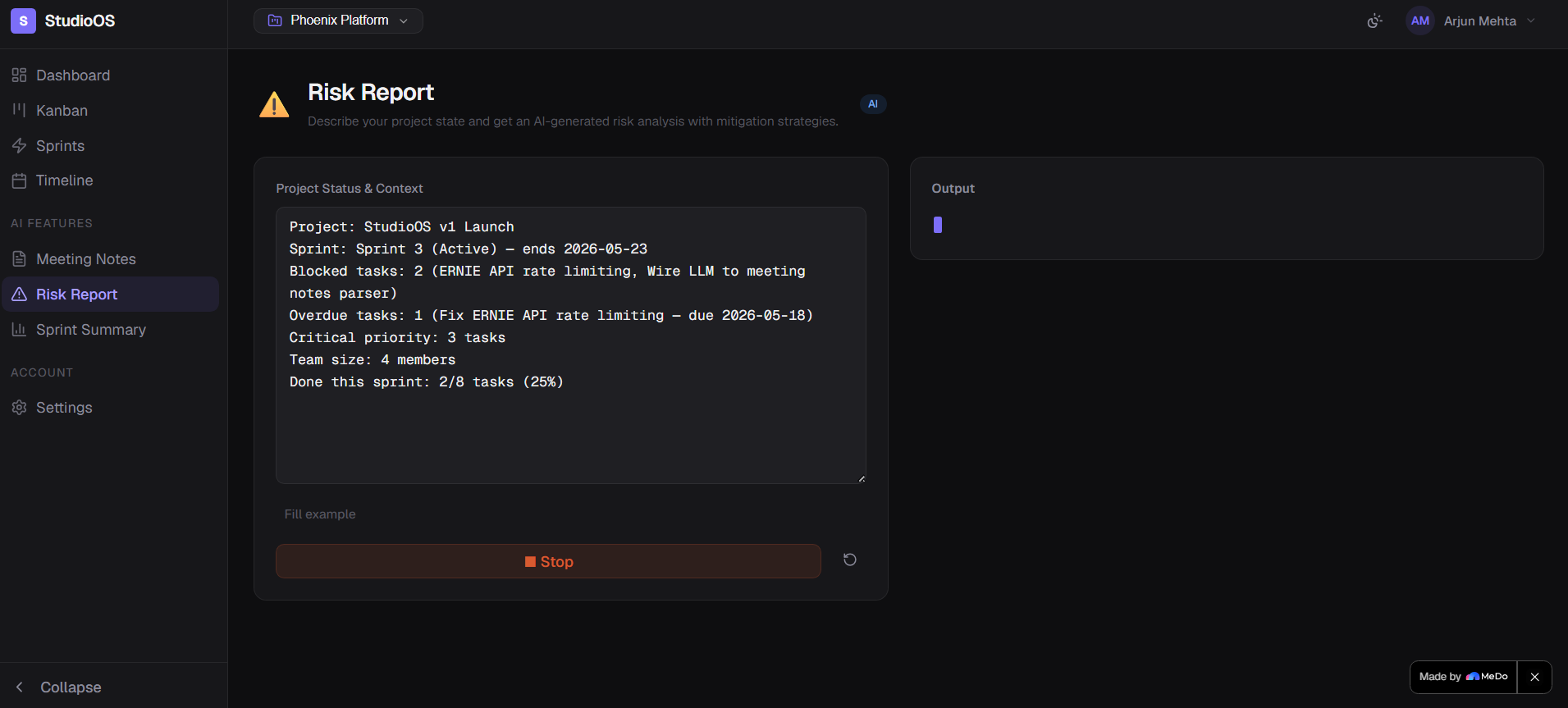
Risk Calculation using AI
-
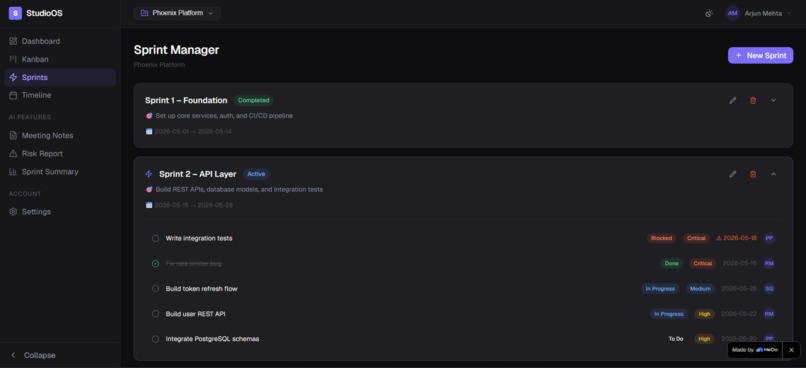
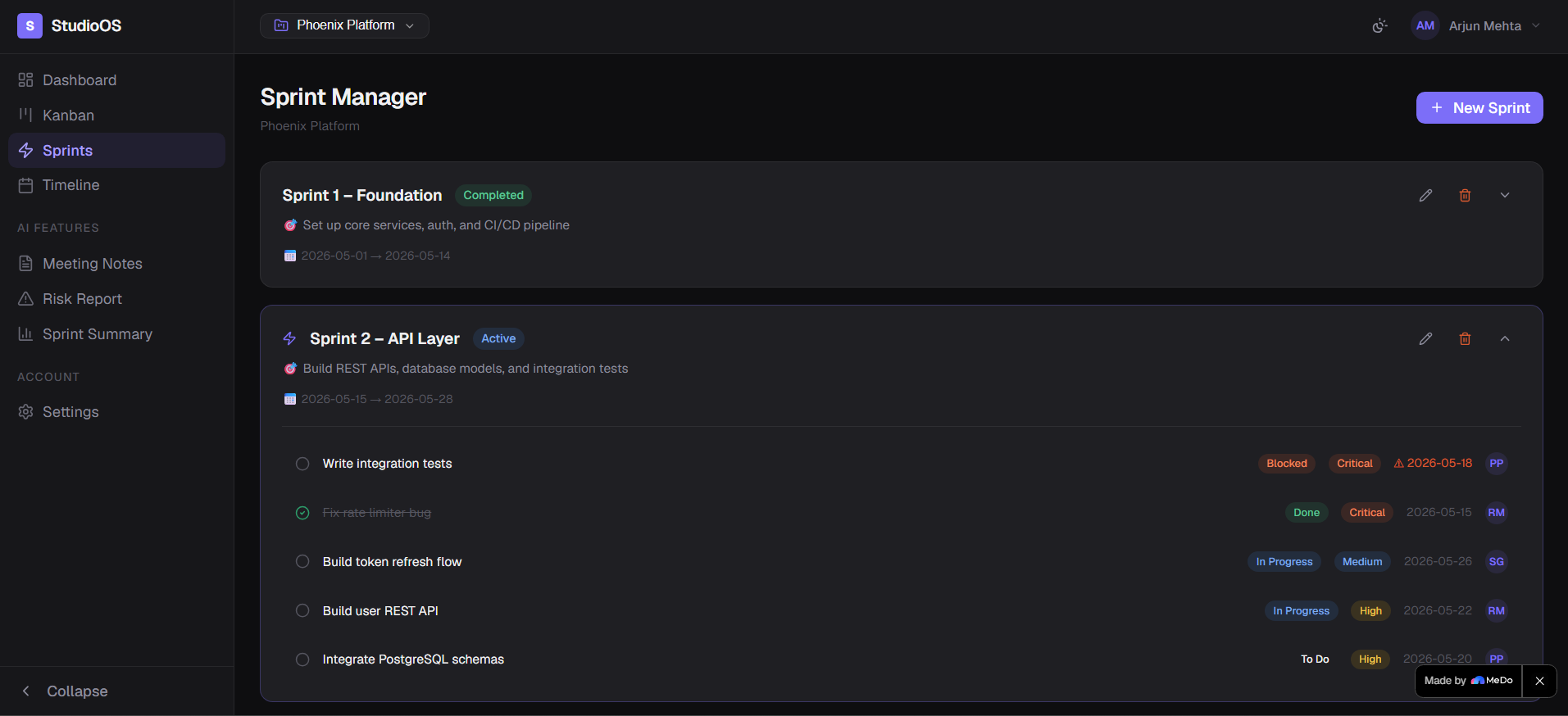
Sprint Mapper
-
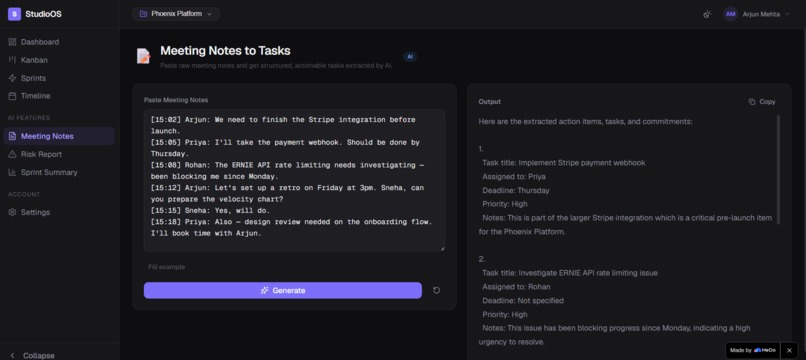
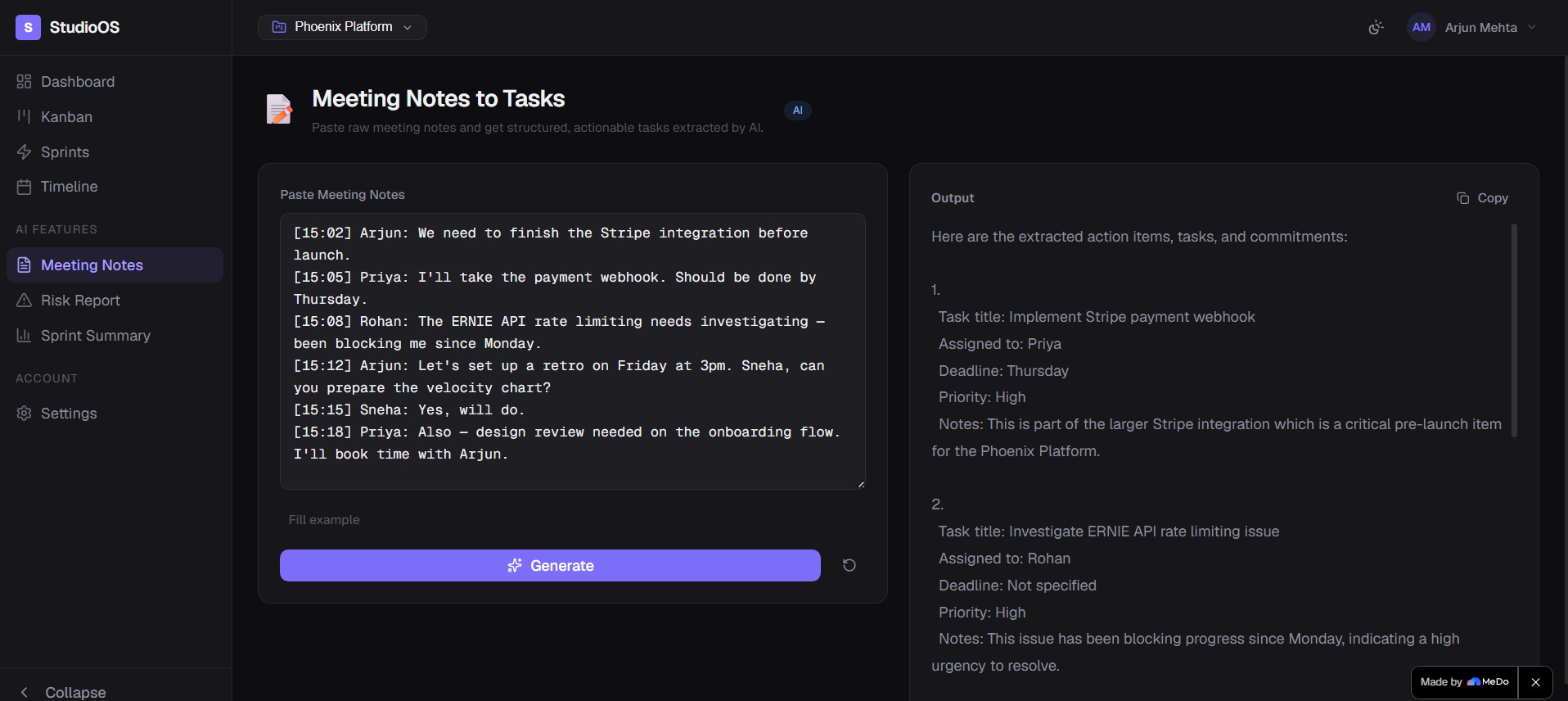
AI Meeting Summary and Task Assignment
-
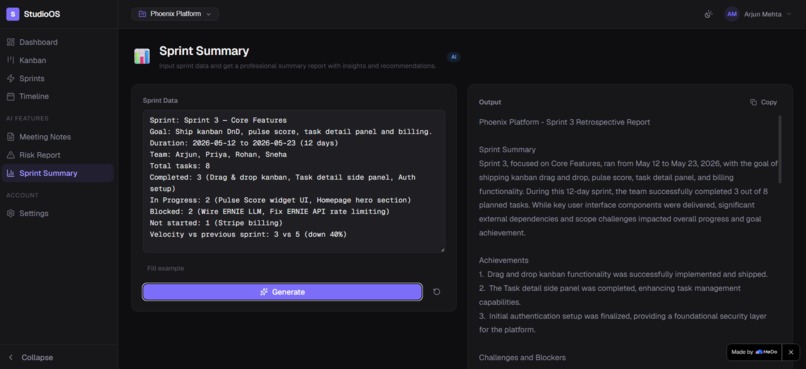
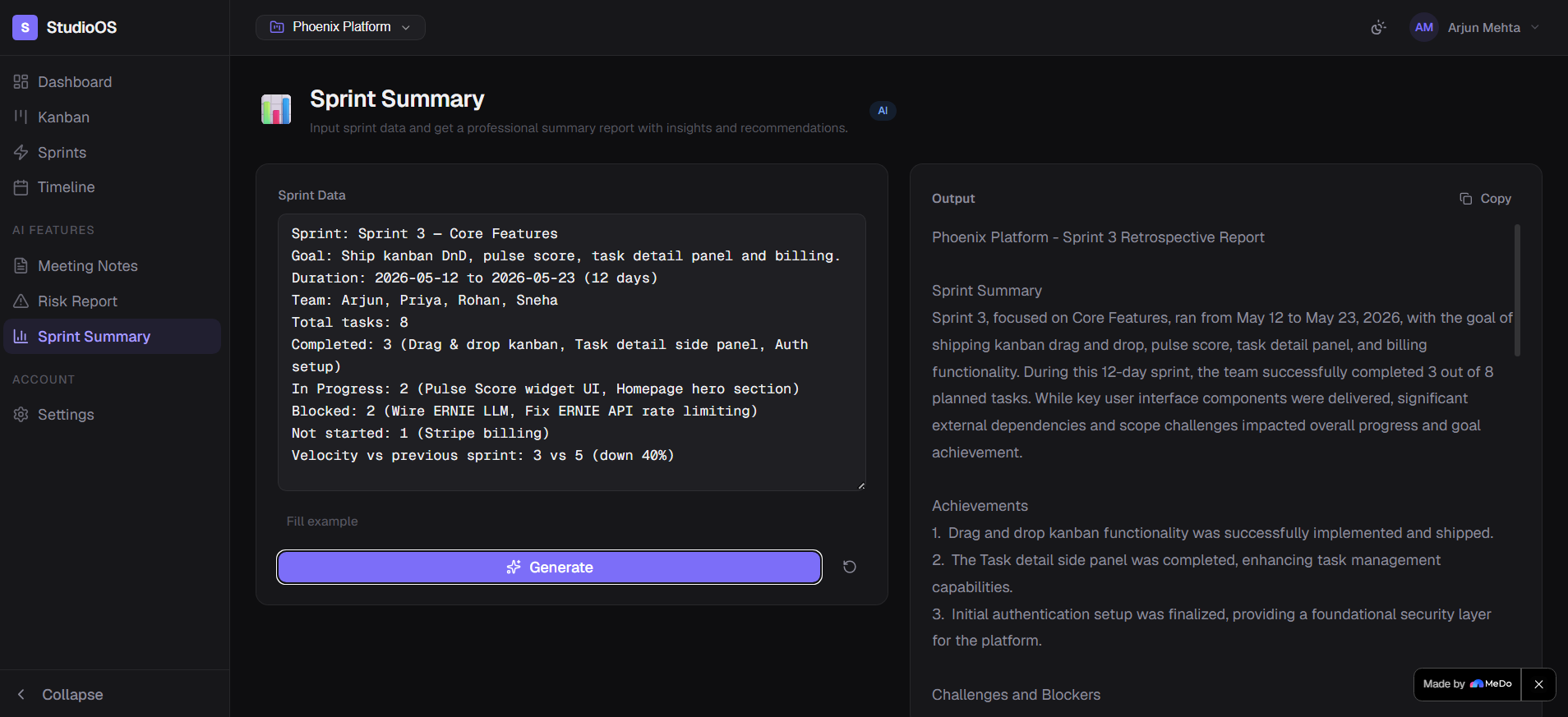
AI Sprint Summary
Inspiration
Every serious team runs on at least three tools. Jira for sprints. Notion for documentation. Linear for issue tracking. And after all of that, nobody actually knows if the project is healthy until a deadline gets missed or a manager asks a question nobody can answer.
The data to answer that question already exists inside these tools. Tasks are moving or stuck. Blockers are aging. Deadlines are passing. Sprint velocity is dropping. But no tool reads all of this continuously and translates it into a single honest signal. Teams are flying blind with expensive instruments.
That gap is what inspired StudioOS. Not another feature-heavy project tool, but a workspace that observes your project and tells you the truth about it without being asked.
What it does
StudioOS is a full-stack project management workspace that replaces the three-tool stack with one clean interface. It gives teams a kanban board, sprint manager, timeline view, task collaboration, and AI-powered features, all connected to the same live database.
The centrepiece is the Project Pulse Score: a 0 to 100 health indicator that sits at the top of every project dashboard and updates automatically every time a task moves, a blocker is added, or a deadline passes. No button. No prompt. No asking. It reads five signals simultaneously: kanban flow, sprint velocity, blocker age, overdue task count, and team momentum. It weights them and produces a score with a plain-English verdict like "2 blockers unresolved, the oldest has been stuck for 4 days."
Beyond the Pulse Score, StudioOS includes three AI features powered by Gemini 2.5 Flash. Meeting Notes to Tasks converts raw meeting notes into structured tasks with owners, deadlines, and risk levels. Risk Report analyses the current project state and surfaces what is likely to slip and why. Sprint Summary generates a stakeholder-ready summary of the completed sprint in seconds.
How we built it
StudioOS is built on a React and TypeScript frontend with a Supabase PostgreSQL backend. Authentication, row-level security, and real-time database operations all run through Supabase. The AI features stream live responses from Gemini 2.5 Flash via MeDo's Gemini gateway using a custom SSE parser built with eventsource-parser v3 that handles incomplete frames, non-JSON chunks, and mid-stream cancellation gracefully.
The Pulse Score runs entirely client-side. It fetches live task and sprint data from Supabase and recalculates on every mutation so the score is always current without requiring a dedicated AI call or server computation.
MeDo's platform generated the full application structure. We brought pre-engineered logic files for the Pulse Score engine, API routes, database schema with triggers, design system, and drag-and-drop behaviour, giving MeDo a precise foundation to build on rather than starting from zero. The result is a production-quality application delivered in under 48 hours.
Challenges we ran into
The hardest design challenge was making the Pulse Score feel ambient rather than interactive. Most project tools make you ask for information. Getting the signal weighting right, so the score drops meaningfully when something is genuinely wrong and does not overreact to minor issues, took significant iteration across five independent scoring functions.
On the technical side, integrating SSE streaming from Gemini through MeDo's gateway with proper AbortSignal support was non-trivial. The stream needed to handle partial Gemini response frames, silently skip malformed chunks, and cancel mid-stream without breaking the UI or leaving the component in a broken state.
Staying within MeDo's credit budget while building a full production application required careful prompt engineering. We pre-built the complex logic as uploadable files so MeDo only had to focus on UI generation, reducing credit consumption significantly.
Accomplishments that we're proud of
The Pulse Score is the accomplishment we are most proud of. It is the first ambient project health indicator we have seen in any no-code-generated application. It does not require a prompt, a button, or a question. It just watches and tells the truth.
We are also proud of the end-to-end AI streaming implementation. Seeing meeting notes transform into structured tasks in real time, streamed token by token from Gemini, inside an application built in under 48 hours, is something we did not expect to achieve this cleanly.
Zero TypeScript errors. Zero ESLint warnings. A fully seeded database with working demo credentials. For a hackathon build, that level of completeness is something we are genuinely proud of.
What we learned
Building StudioOS made clear that the gap in the project management market is not features. Every tool has enough features. The gap is ambient intelligence: tools that observe and report without being asked.
We also learned that the most effective way to work with a no-code AI platform like MeDo is to bring your own logic. Pre-engineering the hard parts as uploadable files, including database schema, score calculation, API routes, and drag-and-drop, and letting MeDo focus purely on UI generation produces dramatically better results than asking it to figure everything out from scratch.
What's next for StudioOS
The Pulse Score is just the beginning of what ambient project intelligence can look like. The next phase of StudioOS includes real-time collaboration so the score updates live across all team members simultaneously, a 30-day health trend graph so teams can see whether their project is improving or declining over time, and Slack integration that pushes a Pulse Score alert the moment a project drops below 50.
On the AI side, we want to move from reactive features to proactive ones. Rather than waiting for a user to request a risk report, StudioOS will detect when the Pulse Score is dropping and surface an unprompted risk analysis automatically. The project tells you what is wrong before you think to ask.
Built With
- css
- gemini
- javascript
- react
- sonner
- supabase
- typescript
- vite

Log in or sign up for Devpost to join the conversation.